
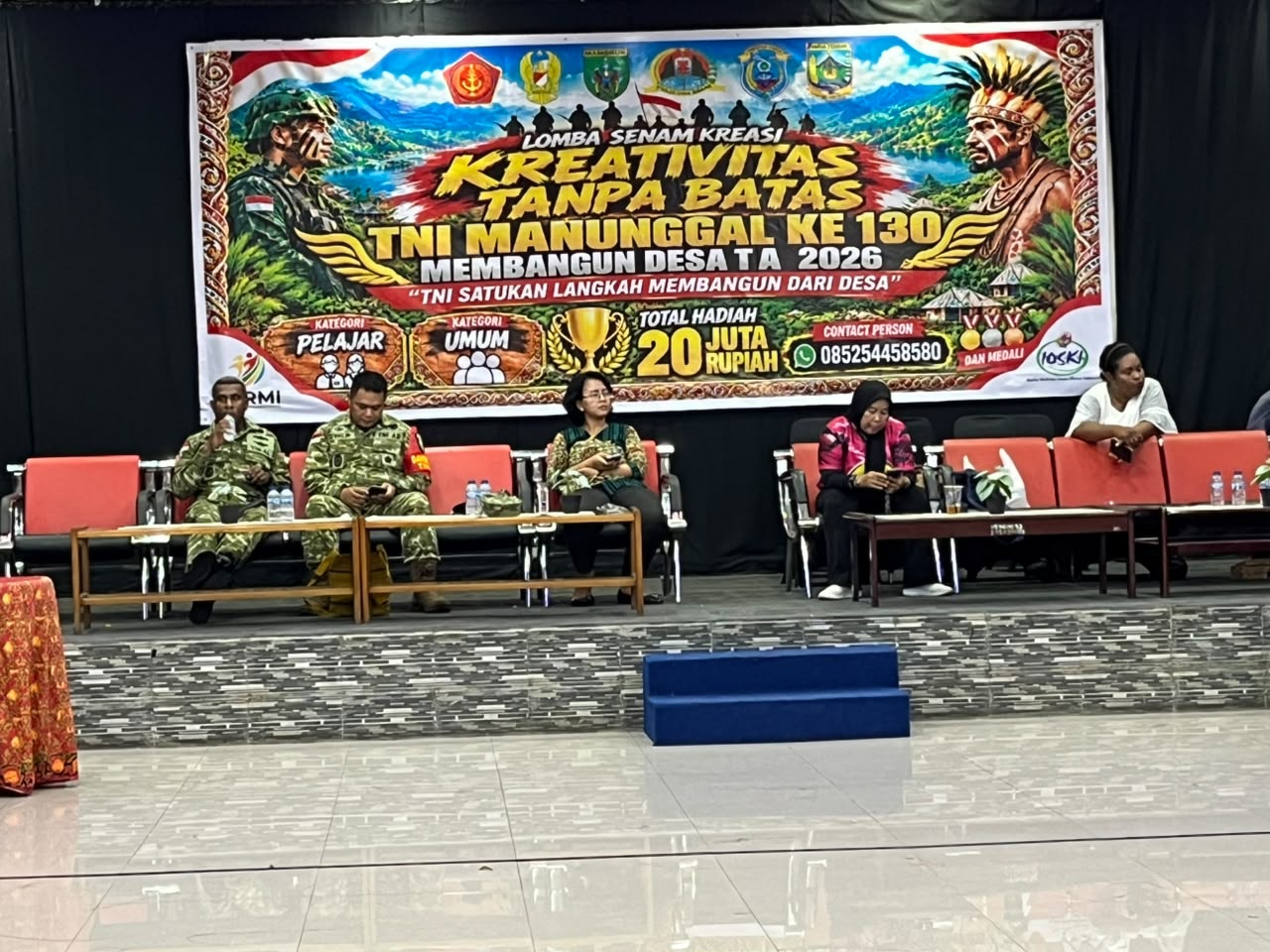
Twenty four teams took to the stage in Nabire for a creative movement competition organised by the Indonesian National Armed Forces (TNI), turning an event associated with rural development into an opportunity to celebrate local culture, encourage young talent and strengthen ties between the military and the community.
Organised by the Nabire Military District Command (Kodim 1705/Nabire), the competition took place at the Radio Republik Indonesia (RRI) auditorium on November 7, 2026. It attracted participants from schools and the wider public, with 20 teams competing in the student category and four in the general category.
The event formed part of the 130th edition of the TNI Manunggal Membangun Desa (TMMD) programme for the 2026 fiscal year, which carries the theme TNI Satukan Langkah Membangun dari Desa, or “TNI Unites Its Steps to Build from Villages”.
Although the competition was structured as a creative gymnastics event, its performances also provided a platform for artistic expression inspired by local culture, including Papua’s dance traditions. The organisers sought to encourage young people to appreciate their cultural identity while developing confidence, creativity and a spirit of cooperation.
For the organisers, the message extended beyond the competition itself. Papua’s cultural heritage, they argued, needs active participation from younger generations if traditional arts and local identity are to remain part of everyday community life.
The event also demonstrated how the TNI’s community engagement can extend beyond physical infrastructure projects to include education, sports, cultural activities and the development of human resources.
Twenty Four Teams Gather at the RRI Auditorium
The competition was held at the RRI auditorium on Jalan Merdeka, Karang Mulia, Nabire District, Central Papua.
The programme officially opened at approximately 9.32 a.m. local time, with Nabire Deputy Regent Burhanuddin Pawennari opening the event alongside Lieutenant Colonel Arh Dwi Palwanto Tirta Mentari, commander of Kodim 1705/Nabire and the person responsible for the activity.
Around 120 people attended, including military personnel, representatives of the local government, officials from related institutions, organisers and members of the public.
The 24 participating teams represented two categories. Twenty teams entered the student division, while four competed in the general division.
The scale of participation demonstrated the appeal of an activity that brought together students and members of the wider community through sport and creative performance.
The event adopted the theme Kreativitas Tanpa Batas, or “Creativity Without Limits”, alongside the broader TMMD message of building from villages through cooperation between the TNI and the public.
Rather than focusing exclusively on winning, the organisers presented the competition as an opportunity for participants to develop their abilities, work together and express themselves through movement and artistic performance.
The programme also offered a public setting in which young people could engage with cultural themes while taking part in a healthy and constructive activity.
TNI Commander Calls for Stronger Cultural Awareness
Lieutenant Colonel Dwi Palwanto said the competition was intended to support the development of young people’s creativity while strengthening their appreciation of Papua’s cultural heritage.
He stressed that local traditions needed to be maintained collectively so that younger generations would continue to recognise and value them.
“Our culture is very rich and unique. Let us work together to care for and preserve our culture so that it is not eroded by outside influences,” Dwi said, as quoted by Nabire.Net on November 7, 2026.
He also highlighted the challenges posed by changing social conditions and the growing influence of external cultural trends.
In his view, introducing local arts and traditions to children and young people from an early age was important for maintaining cultural continuity.
The creative movement competition provided one way to achieve that objective. By combining artistic expression with physical activity, it gave participants a chance to explore different movements while recognising the cultural influences behind them.
Dwi hoped that activities of this kind would encourage a stronger sense of pride in local traditions and motivate residents to contribute to the development of their villages and communities.
His message was consistent with the broader philosophy of the TMMD programme, which seeks to strengthen cooperation between the military, local government and communities in support of regional development.
The commander also emphasised that cultural preservation should not be left to formal institutions alone. Community participation, particularly from younger generations, remains important in ensuring that local traditions continue to be practised and appreciated.
Building Young People’s Confidence Through Creative Expression
For many participants, the competition was more than an opportunity to perform in front of an audience. It was also a chance to test their abilities, work as a team and gain experience in a public event.
One participant, Ivana Rumayomi, said she was enthusiastic about taking part because the competition offered a new experience and an opportunity to develop her skills alongside other team members.
She explained that her team had prepared for approximately one week before the event.
Despite the relatively short preparation period, the group managed to deliver a performance that competed successfully in both categories.
According to Nabire.Net, the team she represented secured first place in the student category and third place in the general category.
Ivana said the experience had encouraged her and her teammates to continue developing their creativity.
Her account illustrates one of the practical benefits of community competitions. Young participants gain opportunities to prepare collectively, manage performance pressure and learn from other teams.
Such experiences can also help develop communication, discipline and confidence, qualities that are valuable beyond artistic activities.
The participation of students was particularly important to the organisers because they represent the generation expected to carry local traditions into the future.
By giving them a public platform, the competition helped connect cultural awareness with activities that appeal to younger audiences.
Students and Community Teams Share the Stage
The division between student and general participants allowed the event to involve people from different age groups and backgrounds.
The 20 student teams formed the largest part of the competition, while the four general teams provided an opportunity for wider community participation.
This format helped create an atmosphere in which schools, families, community groups and local organisations could interact through a shared activity.
It also reflected the organisers’ intention to make cultural appreciation a collective responsibility rather than an issue confined to specific schools or cultural institutions.
The final results recognised achievements in both categories.
In the student division, Bocil Sakti AS took first place with 281.5 points. SMA 2 Power Pulse Team 2 finished second with 273 points, followed by Wishdom Crew in third place with 271 points.
In the general category, AWDC Squad secured first place with 279.6 points. Sans Studio came second with 275.1 points, while Besti Kece finished third with 274.3 points.
The results showed how the competition provided an opportunity for both younger participants and community groups to demonstrate their abilities.
A total prise allocation of Rp20 million was also reported by MataPapua, adding an incentive for teams to prepare seriously and deliver their best performances.
However, the event’s wider purpose remained centred on participation, creativity, healthy competition and the promotion of local culture.
Nabire Deputy Regent Highlights the Human Side of Development
Nabire Deputy Regent Burhanuddin Pawennari praised Kodim 1705/Nabire for organising the competition and emphasised that regional development should not be measured only through physical infrastructure.
Roads, bridges, public buildings and other facilities remain important, but he said development must also address human capabilities through health, creativity, social interaction and a spirit of cooperation.
His remarks reflected a broader understanding of development in which investment in people complements improvements to physical infrastructure.
The deputy regent also encouraged participants to maintain healthy lifestyles through regular exercise.
He reminded them that age should not prevent people from remaining active and productive.
Drawing on his experience attending the National Recreational Sports Festival (FORNAS) in Lombok, he shared a message about the value of participation:
“Whether winning or losing, everyone is pleased. Whether winning or losing, everyone celebrates. Whether winning or losing, everyone stays healthy,” he said.
The message placed the emphasis on the social and health benefits of the activity rather than the final rankings.
Burhanuddin also reminded the judging panel to assess performances professionally, fairly and objectively so that every participant would have an equal opportunity to demonstrate their abilities.
The local government expressed appreciation to Kodim 1705/Nabire and the TMMD personnel for their contribution to development activities in the regency.
This included their involvement in the 130th TMMD programme in Wanggarsari Village, Wanggar District.
The deputy regent’s comments reinforced the idea that development requires cooperation across different sectors, including education, public health, sports and cultural activities.
Cultural Preservation as Part of Rural Development
The Nabire competition was held within the wider framework of TMMD, a programme designed to strengthen cooperation between the TNI, regional administrations and local communities.
While TMMD is often associated with village infrastructure and public facilities, the Nabire event demonstrated how its activities can also address social and human development.
Cultural preservation is particularly relevant in Papua, where local traditions, artistic expressions and customary knowledge form an important part of community identity.
Dance and movement provide ways for people to express those traditions, pass knowledge between generations and maintain a connection with their cultural background.
The competition’s creative format offered participants an opportunity to interpret artistic movements in a contemporary setting. This approach can make cultural activities more accessible to young people who are also exposed to a wide range of influences through digital media and modern entertainment.
Dwi Palwanto’s appeal to protect local traditions from being overshadowed by outside influences reflected this concern.
However, cultural preservation does not require communities to reject new forms of expression. The challenge is to ensure that modern creativity remains connected to an understanding of local identity and heritage.
When young people are encouraged to learn about their traditions while exploring new ways to express themselves, cultural continuity can become an active and evolving process.
The competition therefore offered a practical example of how traditional cultural values and contemporary activities can share the same public platform.
TNI and Local Government Strengthen Community Cooperation
The involvement of the TNI and local government was another defining feature of the programme.
The event was opened by the deputy regent and organised by Kodim 1705/Nabire, demonstrating cooperation between military and civilian institutions in supporting community activities.
The TMMD programme’s emphasis on building from villages also provides a framework for involving residents directly in local development.
In this case, the involvement of students and community teams gave the public an active role rather than limiting participation to attending as spectators.
Such engagement can help strengthen communication between institutions and residents while creating opportunities for communities to contribute their ideas and talents.
The event also showed how public institutions can support cultural awareness through accessible activities that attract participants across different age groups.
The wider TMMD programme in Nabire was scheduled to conclude officially on November 12, 2026, with the closing ceremony to be led by the commander of Kodam XXIX/Mambruk, according to the event report.
The creative movement competition formed one part of that wider programme, complementing other activities intended to support development and community welfare.
A Platform for Future Cultural Activities
The participation of 24 teams provides a foundation for further cultural and recreational activities in Nabire.
For organisers, the next challenge is to maintain the interest generated by the competition and create more opportunities for students and community groups to develop their skills.
Regular cultural and sports events could help schools, community organisations and local institutions work together to promote healthy lifestyles and cultural awareness.
They could also provide a platform for local performers and creative groups to gain public recognition.
Future programmes may benefit from closer collaboration with schools, cultural practitioners and community leaders, ensuring that the artistic elements reflect the diversity of Papua’s traditions.
The available reports do not provide a formal schedule for future editions of the competition. Nevertheless, the participation of 24 teams offers an indication of the community interest that such activities can attract.
The event’s organisers have expressed hope that the spirit of cooperation, creativity and cultural appreciation will continue to grow among residents of Nabire.
Conclusion
The creative movement competition organised by Kodim 1705/Nabire brought 24 teams together in a programme that combined sport, artistic expression and cultural awareness. With 20 student teams and four general teams participating, the event provided a public platform for young people and community members to demonstrate their creativity while strengthening their appreciation of local traditions.
The statements from Lieutenant Colonel Dwi Palwanto and Deputy Regent Burhanuddin Pawennari reflected a shared understanding that development must include both physical improvements and investment in people. Ivana Rumayomi’s experience also showed how such activities can encourage confidence, teamwork and continued creative development among young participants.
As part of the TMMD 130 programme, the competition demonstrated how cooperation between the TNI, local government and communities can extend beyond infrastructure projects to include education, sports and cultural engagement.
Ultimately, preserving Papua’s cultural heritage requires more than celebrating it on special occasions. It depends on creating regular opportunities for young people to learn, perform and pass local traditions to the next generation. By bringing communities together through creative activities, the Nabire initiative offers a positive example of how public institutions and residents can work together to keep cultural identity alive while strengthening the foundations of local development.
Read Also
Noken: The Living Philosophy of Papua’s Heritage
Festival Kali Maro IV Celebrates Papua’s Heritage

