
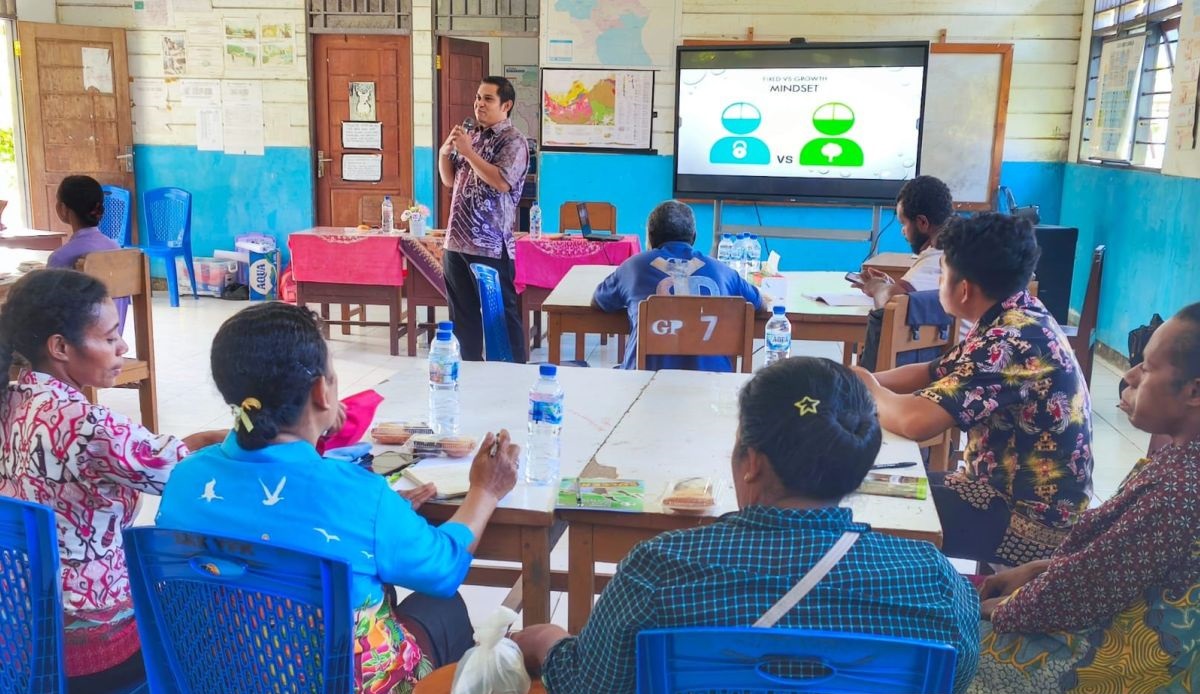
The Papua Tengah (Central Papua) Provincial Government is developing an integrated vocational education model that brings secondary schools and job-training services together, aiming to give young people and working-age residents better access to practical skills and employment opportunities. Known as SMK Terintegrasi (the Integrated Vocational Senior High School), the program connects vocational high schools with job training centers, community learning centers, and skills-training institutions in a single service system.
The initiative responds to several challenges facing the province, including unemployment, poverty, and the number of children who are not attending school. Rather than building an entirely new network of educational institutions, the provincial government plans to make better use of existing vocational schools, their teachers, workshops, and facilities, while opening access to people who have traditionally been outside the formal school system.
The model has developed through a series of policy and implementation steps during 2026. In July, the Education and Culture Agency outlined the program’s design and identified four church-affiliated private vocational schools as pilot locations. In September, the Papua Special Autonomy Development Acceleration Steering Agency (BP3OKP) described the initiative as part of the Papua Cerdas program and highlighted its potential to address school exclusion and unemployment. By November 7, the provincial government had outlined a broader structure integrating vocational high schools, Job Training Centres (BLK), Course and Training Institutions (LKP), and Community Learning Centres (PKBM).
The ambition is to make education more accessible and closely connected to the economic needs of local communities. Its success, however, will depend on the quality of training, the readiness of teachers and facilities, and the ability of graduates to turn their skills into employment or sustainable businesses.
A Response to Education and Employment Challenges
The program was developed following an assessment of social and economic challenges in Papua Tengah. According to the provincial Education and Culture Agency, unemployment, poverty, school dropout, and other social problems were among the issues considered when designing the integrated vocational model.
Yulianus Kuayo, Head of the Data Division at the Papua Tengah Education and Culture Agency, explained that conventional vocational education had not always reached people who needed a second opportunity to study or acquire work-related skills.
Under the existing arrangement, access to regular vocational high schools was generally intended for students completing formal junior secondary education. This meant that people who had left school, lacked formal qualifications, or were already of working age could face barriers to entering vocational education.
The new model seeks to widen that access. It is designed not only for school-age students but also for adults who want to complete basic education, obtain vocational skills, or develop small businesses.
The central idea is to bring different learning pathways under one coordinated management structure. Instead of treating formal schooling, non-formal education, and job training as separate services, the program seeks to connect them and make their resources more accessible.
Yulianus described the concept as a comprehensive education service combining academic learning with practical skills.
“The school becomes a complete package because its curriculum combines academic education and work skills, allowing it to serve people of all ages,” he said, as quoted by ANTARA on November 7.
From the July Plan to the November Model
The program’s development during 2026 shows how the provincial government has moved from planning to institutional preparation.
July: Four schools selected as pilot projects
On July 28, ANTARA reported that the Papua Tengah Education and Culture Agency was preparing the integrated vocational school program as a way to reduce unemployment, poverty, and school dropout.
At that stage, the agency explained that the program would not require the construction of entirely new educational institutions. Instead, existing vocational schools with productive-subject teachers, practical facilities, curricula, and supporting infrastructure would be strengthened and used more effectively.
The initial design combined three educational pathways under one management structure.
The first was the regular vocational high school pathway for school-age students. The second was the Community Learning Centre pathway, which would enable residents without formal educational certificates to pursue equivalency programmes known as Paket A, Paket B, and Paket C. The third was the Course and Training Institution pathway, intended for school or university graduates and other residents seeking additional work-related skills.
Teachers could serve across the different pathways, while learning activities for PKBM and LKP participants would place greater emphasis on practical training.
The provincial government selected four private vocational schools affiliated with church foundations in Nabire, Dogiyai, and Deiyai as the first pilot locations.
September: BP3OKP backs the program as part of Papua Cerdas.
On September 8, BP3OKP member Petrus Waine described the integrated vocational school initiative as part of the Papua Cerdas program, intended to make education more responsive to social challenges and local economic needs.
BP3OKP had worked with the Papua Tengah Education and Culture Agency to agree on developing the program. Waine said regional needs would first be mapped to ensure that the schools and their training activities were relevant to their communities.
He also emphasized the importance of preparing teachers before expanding vocational instruction.
“Teachers must first be equipped, and the programs must be properly designed, with subjects adapted to the needs of the community,” Waine said, according to ANTARA.
The emphasis on teacher capacity is significant. Vocational education requires instructors who can teach practical competencies, supervise workshop activities, and connect classroom learning with real working conditions. A school may have equipment, but its value depends on whether teachers can use it effectively and whether students receive sufficient hands-on instruction.
Waine also outlined a longer-term ambition for the program. He said the government wanted graduates to be capable of entering employment or establishing businesses independently.
“Within the next five years, we want graduates of the Integrated Vocational School program to be able to establish their own businesses. Students must be equipped to do that,” he said.
The September report also included an important indicator of the province’s education challenge. Based on data from the Ministry of Primary and Secondary Education, the number of children not attending school in Papua Tengah declined from 205,764 in 2024 to 131,118 as of April 2026.
The figures indicate a substantial reduction in the recorded number of out-of-school children. However, the available report does not explain how much of that decline resulted from the integrated vocational school program, which was still being prepared. The initiative should therefore be understood as part of the province’s broader response to the problem, rather than the direct cause of the reported reduction.
November: The model expands to include BLK
The latest update, published by ANTARA on November 7, provides a clearer picture of the institutional structure.
The provincial Education and Culture Agency said the program would integrate four types of services: vocational high schools, Job Training Centres (BLK), Course and Training Institutions (LKP), and Community Learning Centres (PKBM).
This wider structure is intended to bring formal education and employment-oriented training into one system. Participants could pursue academic qualifications while also developing practical competencies relevant to employment and entrepreneurship.
The model also reflects cooperation between two national government portfolios: the Ministry of Manpower and the Ministry of Primary and Secondary Education.
Yulianus said the program was designed to allow residents to access academic education as well as skills needed to enter the labor market or develop their own businesses.
This model is an important distinction from a conventional vocational school. The integrated approach seeks to serve people at different stages of life, including young students, adults who have left formal education, and graduates who need additional practical training.
The programme includes four pilot schools, each aligned with specific local economic priorities.
The program’s pilot schools have been assigned different areas of focus based on the potential and needs of their respective locations.
In Nabire Regency, SMKS YPPK St. Joseph Calasanz Wanggar is being developed as a center for animal feed production. The focus is intended to build practical capabilities in producing feed for livestock, an activity that could support local animal husbandry and related businesses.
Another Nabire school, SMKS YPK Dr. Nomansen Kalibobo, has been assigned a focus on clean-water processing and renewable energy. These fields are relevant to basic infrastructure and energy needs while offering opportunities for students to develop technical skills.
In Dogiyai Regency, SMKS YPPGI Jehezkiel Dumapa Idakebo is being directed towards horticultural agriculture and egg-laying poultry farming. The combination connects vocational learning with food production and potential small-scale agricultural enterprises.
Meanwhile, SMKS YPPK Santo Yohanes Pembabtis Gaiyabi in Deiyai Regency is being developed for pig farming, covering both breeding and meat production.
The selection of these four areas reflects an effort to link vocational education with local economic activities rather than relying on a uniform curriculum across all schools.
For students, such an approach could mean learning through activities that have practical relevance to their surroundings. For communities, it could create opportunities to strengthen production, develop small enterprises, and build local expertise.
The provincial government has also explained why it selected schools under church foundations. According to Yulianus, these institutions have established relationships with local communities through their congregations and networks, which may help them reach residents who need access to education and training.
The four pilot schools received support to strengthen school governance and management during 2026. This preparatory work is intended to establish the institutional capacity needed before the program moves into its next stage.
Preparing for Teaching Factories in 2027
The next phase is scheduled for 2027, when the provincial government plans to prepare supporting documents, recruit students, and establish standard operating procedures for the management of teaching factories, known as Teaching Factory or TEFA.
A teaching factory is intended to connect learning activities with production processes. In the Papua Tengah program, this approach could allow students to develop practical skills through activities related to their schools’ designated economic fields.
The animal-feed production school in Nabire, for instance, could implement a teaching-factory model to link classroom instruction with production tasks. The horticulture and poultry school in Dogiyai could similarly develop practical learning around agricultural production.
The Education and Culture Agency is also lobbying the Ministry of Primary and Secondary Education to provide funding in 2027 for business units or TEFA spaces, including machinery and equipment.
These facilities will be important to the program’s practical ambitions. Without suitable equipment and properly maintained workshops, vocational learning risks becoming too theoretical to prepare students for actual work.
The provincial government has also announced plans to add one more school in 2027: SMKS Bakidi Nabire, which operates under the GIDI Church foundation. The expansion is intended to widen the program’s reach.
The November report also said that supporting documents, student recruitment, and TEFA management procedures would be part of the next implementation stage. These preparations indicate that the program is still being developed and that full implementation will require further administrative and technical work.
From Education Access to Employment Opportunities
The integrated model addresses two connected challenges: the need to bring more people into education and the need to equip them with skills that can support their livelihoods.
For children and young people who have left school, the PKBM pathway offers an opportunity to pursue recognized educational equivalency programs. For adults, LKP and BLK-based training can provide a route towards practical competencies without requiring them to return to a conventional full-time school environment.
For regular vocational students, the program aims to make academic subjects more closely connected with practical work and entrepreneurship.
Petrus Waine said the long-term goal was to produce graduates who could enter employment or establish businesses independently. This ambition is especially relevant in communities where local economic activities such as agriculture, livestock production, clean-water services, and renewable energy could provide opportunities for small enterprises.
However, training alone cannot guarantee employment. Graduates will also need access to markets, business mentoring, equipment, finance, and links with employers. The proposed teaching factories could provide a starting point by connecting education with production, but their effectiveness will depend on sound management and sustained support.
The same applies to the program’s role in addressing unemployment. Its impact will need to be measured through outcomes such as course completion, recognized qualifications, job placement, business creation, and the ability of graduates to maintain their livelihoods.
Conclusion
Papua Tengah’s Integrated Vocational School program represents an effort to rethink how education and job training can work together. By connecting SMK, BLK, LKP, and PKBM services, the provincial government is seeking to create a more flexible system that reaches school-age students, out-of-school children, and working-age residents.
The four pilot schools in Nabire, Dogiyai, and Deiyai provide the program with a practical starting point. Their focus on animal feed, clean water, renewable energy, horticulture, and livestock farming reflects an effort to align vocational learning with local economic opportunities.
The next stage will be decisive. Teacher development, suitable equipment, student recruitment, clear management procedures, and the establishment of teaching factories will determine whether the concept can move from planning into effective operation.
If the program is implemented consistently, it could help more residents gain access to education while building skills that are relevant to the local economy. Its success should ultimately be judged not by the number of schools included, but by whether students complete their training, out-of-school residents discover a route back into learning, and graduates are able to secure work or establish sustainable businesses.
For Papua Tengah, connecting education with practical skills offers a way to make human-resource development more closely linked to the needs and potential of its communities.
Read Also
Papua Tengah Invests Rp6.3 Billion in Indigenous Papuan Job Training
Vocational Training Empowers Indigenous Papuan Women

