
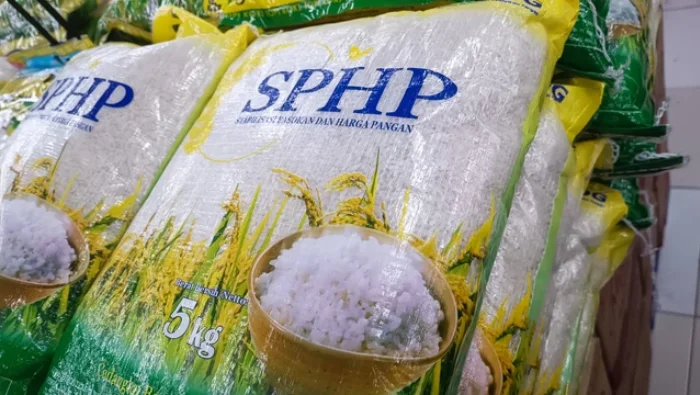
Indonesia is approaching the final stretch of its 2026 rice stabilization program, with 1,700 tonnes of SPHP rice already distributed in Mimika, equivalent to 68 percent of the 2,400-tonne annual target.
The figure, reported by the Indonesia Logistics Affairs Agency, or Bulog Mimika, on October 8, comes as the government continues to use the Stabilization of Food Supply and Prices program, known as SPHP, to keep affordable rice available to households and help prevent excessive price pressures in the market. Bulog Mimika says the remaining allocation will be adjusted to actual community demand rather than distributed simply to meet a numerical target.
For consumers in Timika and surrounding areas, the program has become an important additional source of rice alongside commercial products. The availability of SPHP rice gives households another option, particularly those looking for a lower-priced product than premium rice.
The current distribution also reflects a continuing government effort to maintain food price stability in Papua Tengah, where logistics and geographic conditions can make the cost of bringing staple food to consumers more challenging than in many other parts of Indonesia.
A New Distribution Cycle Began in March
The 2026 SPHP program did not begin at the start of the calendar year.
Bulog Timika was still completing the previous year’s allocation during the first two months of 2026. A March report confirmed that Timika fully achieved the 2025 SPHP distribution target of 2,400 tonnes. Because a new assignment for 2026 had not yet been issued at the beginning of the year, the 2025 program was extended until February 28, 2026.
The transition to the new program followed on March 1, when Bulog Mimika received instructions from the central government to begin distributing SPHP rice for the 2026 cycle.
That sequence is important because the 1,700 tonnes reported in October should be understood as progress under the 2026 allocation, rather than as part of the previous year’s target.
The program has therefore moved from a completed 2025 cycle into a new period in which Bulog is again responsible for maintaining an adequate supply of affordable rice across Mimika.
From 300 Tonnes to 1,700 Tonnes
The pace of distribution increased substantially during the year.
In March, Bulog Timika reported that it had already distributed 300 tonnes of SPHP rice through 50 Rumah Pangan Kita, or RPK, partners located across Timika, including outlets inside and outside traditional markets. These outlets were recorded in the government’s Market and Basic Needs Monitoring System, known as SP2KP.
By October, total distribution had reached approximately 1,700 tonnes.
The increase means that around 700 tonnes remain from the 2,400-tonne target, assuming the allocation remains unchanged.
That remaining volume gives Bulog room to continue supplying the market through the final months of the program.
Dedy Wahyudi, head of the Bulog Mimika branch, said the organization would continue working toward the target. But he stressed that the more important objective was to ensure that rice remained available to consumers.
“We are trying to reach the target, but beyond the target, the most important point is that we maintain availability,” Dedy said.
His statement reflects the practical nature of food stabilization.
A distribution target is useful for planning, but actual consumption determines how much rice needs to be released into the market. If demand has already been met, Bulog does not necessarily need to force additional supplies into the distribution chain simply to reach a predetermined number.
Why Availability Matters
Rice is one of Indonesia’s most important staple foods, making its price particularly sensitive for household budgets.
In Mimika, the role of SPHP is therefore not simply to sell cheaper rice. Its presence creates an additional supply option that can help prevent consumers from being entirely dependent on higher-priced commercial varieties.
Dedy said public interest in SPHP rice had remained strong.
“The presence of SPHP rice in the Mimika market gives people more choices in buying rice according to their economic ability,” he said.
The distinction between availability and affordability is important.
A stable supply does not automatically mean every household will experience the same purchasing power. However, maintaining an affordable government-supported option can help reduce the pressure faced by consumers when market prices rise.
That is one reason SPHP remains part of the government’s wider strategy for stabilizing food prices.
Retail Price Set at Rp13,500 per Kilogram
The 2026 SPHP program also comes with a regulated retail ceiling.
In Mimika, Bulog said partner retailers are permitted to sell SPHP rice at a maximum retail price, or HET, of Rp13,500 per kilogram, equivalent to Rp67,500 for a five-kilogram package.
The price at the Bulog warehouse is lower.
Dedy said Bulog sells the rice at Rp11,600 per kilogram, or Rp58,000 per five-kilogram package, in accordance with the HET applicable to Zone III covering Maluku and Papua. Retail partners then sell the rice to consumers at the prescribed maximum price.
This price structure creates room for distribution costs while establishing a ceiling intended to protect consumers from excessive mark-ups.
For a government-run food stabilization program, monitoring is as crucial as the volume of rice distributed.
Rice can be physically available in the market but still fail to achieve its stabilization purpose if consumers cannot purchase it at the regulated price.
Bulog Monitors Retailers
To address that risk, Bulog Mimika continues to coordinate with the local government and conduct inspections in markets.
The monitoring focuses on the price charged by SPHP retail partners and whether the program’s rice reaches consumers according to the applicable rules.
As of the latest report, Bulog Mimika had not received complaints from consumers concerning excessive retail prices for SPHP rice.
That does not mean monitoring can stop.
Dedy said Bulog and the local government would continue coordinating inspections, including unannounced checks of markets, to observe how SPHP rice is being sold.
The approach is significant because food price stability depends on the entire distribution chain.
The government may provide the supply and establish a price ceiling, but retailers and distribution partners remain important links between the warehouse and households.
Regular monitoring helps ensure that the intended benefit reaches the final consumer.
A Program Designed Around Demand
One of the more important points in Dedy’s latest statement is that Bulog does not intend to treat the 2,400-ton target as an objective that must be reached regardless of market conditions.
Instead, the agency is looking at actual community demand.
“If the target has not been achieved but the community’s needs have already been fulfilled, we automatically consider the project complete,” Dedy said.
That approach makes the program more flexible.
Food distribution works differently from an ordinary infrastructure project. A road has a fixed construction target, while food demand can change depending on household consumption, market prices, competing products, and seasonal conditions.
Bulog, therefore, needs to balance two risks.
Too little supply could contribute to higher prices or shortages. Too much supply relative to demand could create unnecessary pressure on the distribution system.
The objective is to keep the market supplied at a level that supports price stability.
Lessons from the 2025 Program
The experience of the previous year provides an important benchmark.
In 2025, Bulog Timika was given a target of 2,400 tonnes of SPHP rice and ultimately distributed the entire allocation. The program was extended into February 2026 because the new year’s assignment had not yet been issued at the beginning of January.
Dedy said the 2025 target was achieved at 100 percent.
At the time, the average monthly distribution was reported at between 200 and 300 tonnes.
That history helps explain the scale of the 2026 program.
The government has maintained a similar annual target while continuing to rely on the same broad distribution architecture involving RPK partners and market outlets.
The difference is that the 2026 program is now being monitored through the current year’s demand conditions rather than simply replicating the previous year’s distribution pattern.
The Role of Rumah Pangan Kita
The Rumah Pangan Kita network is central to the final stage of distribution.
These partner outlets provide a channel through which Bulog can move government rice beyond its warehouses and into neighborhood-level markets.
In March, 50 RPK partners were already distributing SPHP rice across Timika, both within and outside traditional market areas. Their activities were included in SP2KP, providing a mechanism for market monitoring.
For consumers, the importance of such outlets is straightforward: rice needs to be available where people shop.
A warehouse in Timika cannot stabilize prices by itself. The commodity must travel through a functioning distribution network before it can influence retail supply.
That makes local traders and partner outlets an important part of the government’s food security infrastructure.
Supporting Inflation Control Through Food Stability
The 2026 SPHP distribution also has a broader economic significance.
Rice is a basic household necessity, so changes in its price can influence the cost of living and contribute to broader food price pressures. Maintaining a reliable supply of affordable rice can therefore support efforts to contain inflation, particularly when staple food prices come under pressure.
The available reports describe SPHP primarily as a program to maintain rice supply and price stability. Dedy specifically said the program helps keep rice prices stable by providing consumers with a lower-priced alternative to premium rice.
For regional policymakers, the program is important.
Inflation is not determined by rice alone, and SPHP should not be portrayed as a single solution to all inflationary pressures. But stabilizing the price of a major staple can help reduce one source of pressure on household expenditure.
In a region where logistics can influence food prices, ensuring that affordable rice remains in the market can be particularly valuable.
Mimika’s Geographic and Economic Context
Mimika occupies an important position in Papua Tengah’s economy.
Timika serves as a major urban and commercial center, while the wider regency includes communities with different levels of access to markets and transportation.
That geographic reality makes food distribution a continuing logistical task.
Government-supported rice programs need to consider not only how much rice is available but also how it reaches different parts of the market.
The use of established RPK partners and market monitoring provides a mechanism for extending distribution beyond Bulog’s own facilities.
At the same time, the government’s oversight role helps ensure that the program remains focused on consumers rather than becoming simply another commercial supply channel.
What the Remaining 700 Tonnes Mean
With 1,700 tonnes already distributed, the 2026 program has reached 68 percent of its 2,400-tonne target.
The remaining 700 tonnes provide enough room for Bulog to continue responding to market needs until the end of the current allocation period.
But Dedy’s comments suggest that the final figure should not be interpreted in isolation.
If demand remains strong, further distribution can help maintain supply and support price stability. If demand is weaker because household needs have already been met through existing supply, forcing the full allocation into the market would not necessarily produce a better outcome.
The key indicator is therefore not simply whether the final number reaches 2,400 tonnes.
The more meaningful question is whether households can continue to obtain SPHP rice at the regulated price when they need it.
Government Coordination Remains Central
The program also demonstrates the importance of coordination between Bulog, the national food agency, and local government.
Bapanas determines the allocation and pricing framework, while Bulog manages procurement and distribution. Local authorities participate in market monitoring and inspections.
This layered system reflects the nature of food price management in Indonesia.
National policy establishes the framework, but implementation ultimately takes place in local markets.
In Mimika, that implementation includes checking retailers, observing prices, and responding to consumer needs.
Dedy said there had been no complaints about the retail price of SPHP rice in Mimika at the time of his latest statement.
Maintaining that situation through the remaining months will be the next practical test.
Conclusion
The distribution of SPHP rice in Mimika has reached approximately 1,700 tonnes in 2026, representing 68 percent of the 2,400-tonne target set by the National Food Agency.
The progress follows a successful 2025 program in which Bulog Timika eventually distributed the full 2,400-tonne allocation after the previous year’s program was extended until February 28, 2026. The 2026 cycle officially began on March 1.
The current program is designed not merely to move rice but to maintain a reliable and affordable supply for consumers.
At Rp13,500 per kilogram at the retail level, or Rp67,500 per five-kilogram package, SPHP rice provides an alternative to more expensive premium products. Bulog sells the commodity to its partners at Rp11,600 per kilogram before retail distribution.
The government’s monitoring of retail prices is equally important. Local authorities and market inspections regularly coordinate to ensure that households benefit from the program.
With approximately 700 tonnes remaining under the current allocation, Bulog Mimika is approaching the final stage of the 2026 program. Yet the agency has made clear that its priority is not simply to complete a numerical target.
Its central task is to keep rice available when people need it and to prevent unnecessary price pressure.
For Mimika, that balance between supply, affordability, and demand is an important part of maintaining food security. In a region where distribution costs and geography can affect consumer prices, keeping a government-supported rice option available can help strengthen household resilience.
The market will determine whether it absorbs the remaining allocation in the coming months. Whatever the final volume, the broader objective remains the same: ensuring that a staple food stays within reach of consumers while supporting the government’s wider effort to maintain food price stability and contain inflationary pressure in Papua Tengah.
Read Also
Bulog Papua Strengthens Farmers Through Corn Purchases
Bulog Papua Targets Food Aid for 845,425 Families
Bulog Papua Purchases 398 Tons of Corn From Keerom

