
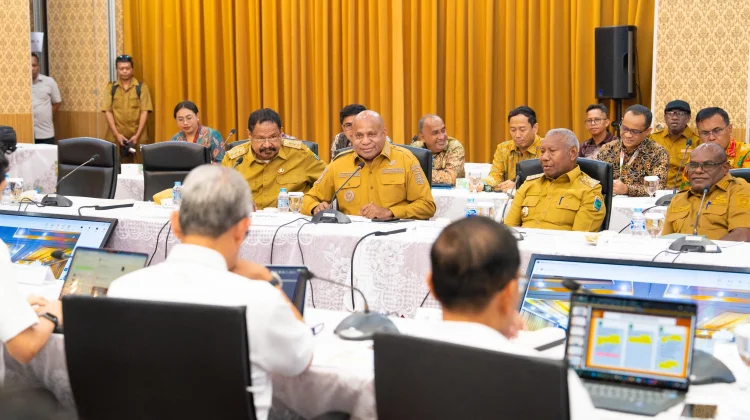
In Jakarta, meetings between regional leaders and central government officials are often routine. This one was not.
On April 13, 2026, six governors from Papua’s provinces came with a shared concern and a clear message. Development in their regions needs to move faster. By the end of the discussion with Indonesia’s finance authorities, they left with something concrete. The Papua Special Autonomy funds were confirmed at Rp12.69 trillion.
For leaders from Papua, Papua Barat (West Papua), Papua Barat Daya (Southwest Papua), Papua Tengah (Central Papua), Papua Pegunungan (Highland Papua), and Papua Selatan (South Papua), the figure matters not only because of its size but also because of what it represents.
A sense that their concerns were heard.
A Different Kind of Meeting
Those familiar with the process say the tone of the discussion stood out.
Rather than focusing on technical details alone, the governors spoke about conditions on the ground. In some districts, roads are improving and access is getting easier. It takes longer to bring about change in others.
That gap was central to the conversation.
Officials from the Directorate General of Fiscal Balance listened and eventually confirmed the allocation. Rp12.69 trillion would be disbursed through the Special Autonomy mechanism, which is a system that allows certain regions to receive additional funding and governance autonomy from the central government.
It was not framed as a breakthrough.
It is more of a continuation, but with renewed emphasis.
Development During Budget Tightening
The decision comes at a moment when Indonesia is reviewing its spending.
Efficiency has become a priority. Programs are being reassessed. Budgets are being adjusted.
In that context, maintaining strong support for Papua carries weight.
It signals that, despite broader fiscal pressures, development in the region remains part of the national agenda.
For the governors, this issue was one of the key concerns going into the meeting.
The governors were primarily concerned about preventing Papua from lagging behind as priorities change.
A Region That Moves at Its Own Pace
Development in Papua has never been straightforward.
Distance between communities can be significant. Terrain makes construction more difficult. Delivering basic services often requires more time and resources than in other parts of Indonesia, particularly in remote areas where access is hindered by challenging terrain and long distances between communities.
Because of that, progress tends to be gradual.
Visible, but uneven.
Some areas change quickly.
Others take longer.
The special autonomy fund has been one of the main tools used to address this.
Increasing or maintaining its scale is seen as a way to keep that process moving, as it provides essential resources for local development projects and community initiatives that directly benefit the people in Papua.
What the Funding Means on the Ground
For many people in Papua, figures discussed in Jakarta can feel distant.
But the effects are not abstract.
A road that shortens travel time.
A clinic that provides consistent care.
A school that remains open and staffed.
These are the points where funding becomes visible.
Regional leaders have emphasized that the additional resources should translate into improvements that people can see and feel.
Not just in cities.
But in smaller, more remote communities.
Turning Plans Into Results
There is also an awareness that funding alone does not guarantee outcomes.
How it is used matters.
Coordination between central and regional governments plays a role in ensuring that funding is effectively utilized to achieve desired outcomes in public programs. So does oversight.
In recent years, there has been more attention on these aspects, particularly regarding how improved coordination and oversight can lead to better resource allocation and governance outcomes.
The broader conversation now includes ensuring the effective use of funds.
Working Together, Rather Than Separately
One detail that stood out from the meeting was the presence of all six governors.
They did not come individually.
They came together.
This reflects a shift.
A more coordinated approach.
Instead of presenting separate concerns, they spoke collectively about shared challenges, such as resource allocation and policy implementation, which demonstrates a more coordinated approach to addressing these issues.
From the central government’s perspective, this kind of alignment makes it easier to respond to issues such as resource allocation and policy implementation.
From the regional side, it strengthens their position.
Expectations and Some Caution
There is cautious optimism around the funding.
With Rp12.69 trillion confirmed, there is room to accelerate ongoing programs. Projects that were moving slowly can gain momentum, allowing for improved outcomes and increased efficiency in the implementation of these programs. New initiatives can be introduced.
The expectation is not sudden transformation.
But steady progress.
The Work That Still Needs to Be Done is ongoing.
At the same time, challenges remain.
Geography does not change.
Implementation capacity varies.
Ensuring that development reaches remote areas continues to require effort.
Funding helps.
But it is not the only factor.
Connecting to a Bigger Picture
The meeting in Jakarta is part of a broader story.
Papua’s development has been moving forward, but not evenly. Earlier reporting has shown gradual improvements in some indicators, alongside persistent gaps.
The special autonomy fund sits at the center of that process.
It is both a tool and a test.
A tool for addressing disparities.
A test of how effectively policy can translate into results.
What Comes Next
With the funding confirmed, attention shifts to implementation.
How quickly the funds are distributed.
How effectively they are used.
And how clearly the impact can be seen.
For the six provinces, the priorities are already clear.
Infrastructure.
Public services.
Economic opportunities.
The challenge is to connect these priorities with consistent execution.
Conclusion: A Step That Feels Measured
As the governors left Jakarta, there was no sense of celebration.
More a sense of movement.
The confirmation of Rp12.69 trillion in Papua Special Autonomy funds is not a final result.
It is part of a longer process.
For Papua, progress rarely comes in sudden leaps.
It comes in steps.
Sometimes small.
Sometimes more visible.
This is one of those steps.
And like the ones before it, its impact will depend on what happens next.

