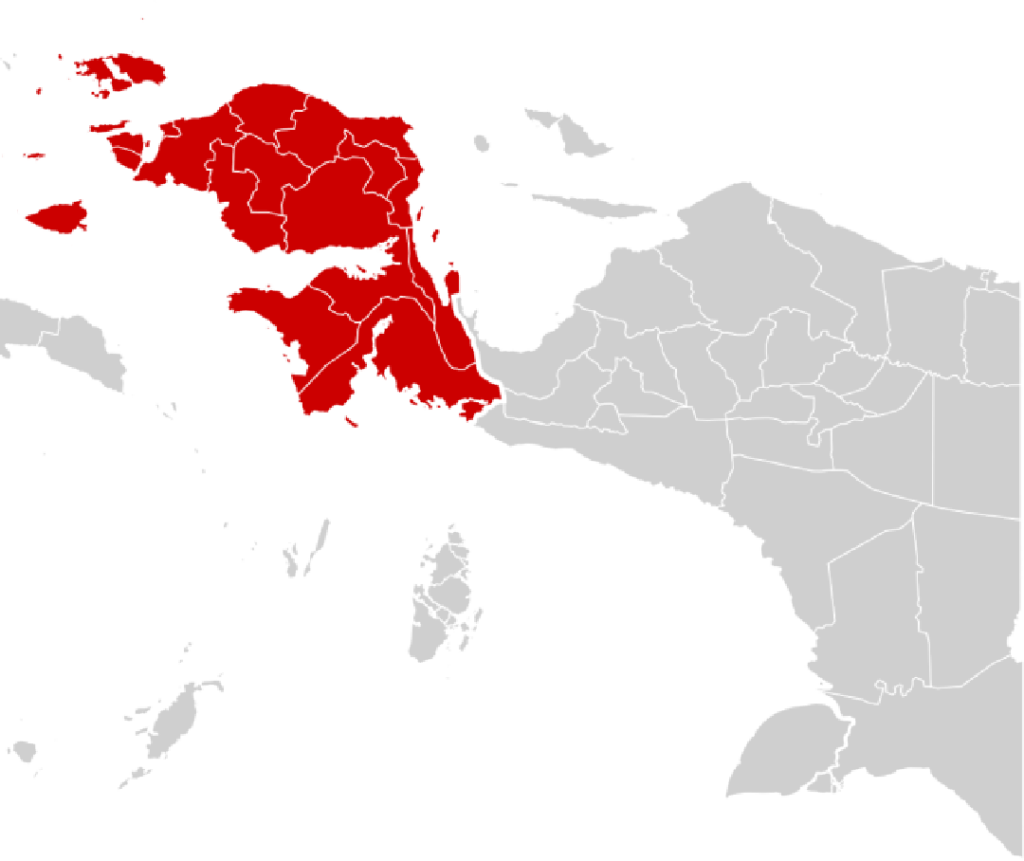
A fresh wave of violence in Papua has put civilian safety back at the centre of the conflict, after several people were killed or taken hostage in incidents attributed in media reports to armed groups linked to the West Papua National Liberation Army of the Free Papua Movement (TPNPB OPM).
The Amnesty International Indonesia responded on September 16 by condemning the reported killings and hostage-taking, describing attacks against civilians as serious violations of international humanitarian law. The organisation called for those responsible to be investigated and prosecuted, while also urging the Indonesian government and the House of Representatives to open peace negotiations or humanitarian dialogue involving stakeholders across Papua.
The statement came after a series of incidents reported in Papua during August and September, including the deaths of three civil servants in Jayawijaya on September 9, the killing of a travel driver on the Wamena-Nduga route on September 15 and the reported abduction and hostage-taking of nine women in Mimika on August 17.
Amnesty’s position contains two parallel demands: civilians must be protected, and alleged perpetrators must face due process, while the wider armed conflict should be addressed through dialogue and conflict resolution.
For Papua, where security concerns, political grievances and development challenges overlap, the latest debate again raises the question of how civilian protection and longer-term conflict resolution can proceed at the same time.
A Week of Violence Draws International Attention
The immediate trigger for Amnesty’s statement was a series of violent incidents involving civilians.
According to Amnesty International Indonesia, three civil servants were killed in Jayawijaya on September 9. The organisation said the victims had been returning to Wamena after carrying out duties involving livestock assistance and agricultural extension services for local communities.
Amnesty’s account said the victims were accused by TPNPB OPM of being agents of Indonesian military intelligence.
That allegation is important to distinguish from an established fact. The source reports it as the justification attributed to the armed group and does not establish that the three civilians were intelligence personnel.
Six days later, another civilian was killed in Jayawijaya.
Amnesty said media reports indicated that the TPNPB OPM Kodap III Ndugama Derakma had taken a civilian hostage and shot him dead on September 15 in Wamena. The victim was identified in media reporting as a travel driver.
According to Amnesty, the armed group again accused the victim of being an Indonesian military intelligence agent.
The killing was also confirmed by Lieutenant Colonel M. Wirya Arthadiguna, head of information for the TNI’s Habema Joint Defence Operation Command, who said the travel driver was found inside a burnt vehicle.
Jubi similarly reported that the driver was killed on the Trans Wamena-Nduga road and attributed responsibility to the TPNPB based on reporting surrounding the incident.
The available reports therefore establish that the death occurred and that Indonesian military authorities confirmed the discovery of the victim, while the precise circumstances and legal responsibility remain matters for investigation.
The Mimika Hostage Case
The latest Amnesty statement also referred to an earlier case involving nine women in Mimika, Central Papua.
According to Amnesty, media reports linked the hostage-taking to TPN OPM Kodap X Keneyam.
The organisation said the incident was connected, according to the armed group’s account, to an operation against Indonesian military personnel in Jila District, Mimika, between August 12 and 17.
Two of the nine women reportedly managed to escape while being taken by members of the armed group. Amnesty said one of those two women was later found dead by members of the local community.
The incident illustrates one of the central difficulties in reporting the Papua conflict: information from remote areas can be fragmented, while claims from armed groups, security authorities, residents and human rights organisations may differ.
For that reason, independent investigation and verification remain essential when determining what happened, who was responsible and whether particular allegations can be substantiated.
Usman Hamid Calls for Accountability
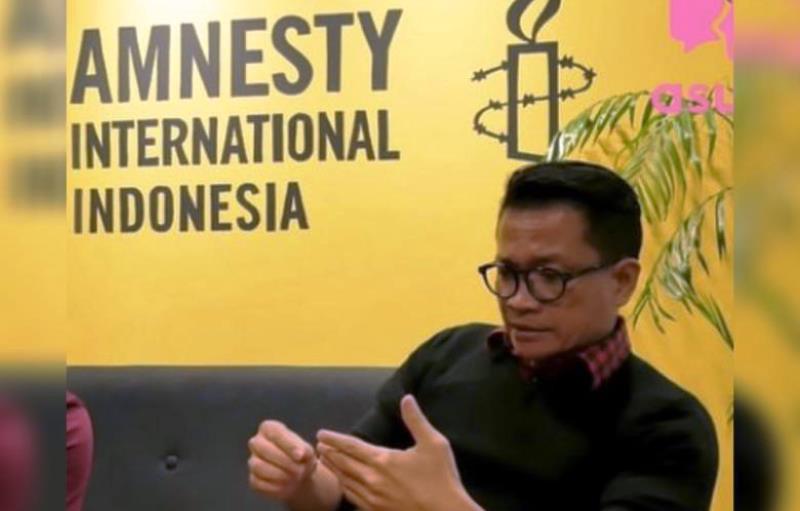
Amnesty International Indonesia Executive Director Usman Hamid said the organisation condemned what he described as a series of killings of civilians in Papua during the preceding week.
“We mourn for the victims’ families,” Hamid said, while calling on the state to investigate and prosecute those responsible.
His central argument was that international humanitarian law imposes minimum standards on parties involved in armed conflict.
According to Amnesty, those standards prohibit torture, hostage-taking and politically motivated killings.
Hamid stressed that the protection of civilian life should apply regardless of the political motivation claimed by an armed actor.
The organisation also said that all parties involved in the armed conflict, including Indonesian military personnel and armed pro-independence groups, are required to respect international humanitarian law.
That distinction is significant.
Amnesty’s statement was not limited to criticism of one side. While the organisation specifically condemned the recent incidents attributed in reports to TPNPB OPM, it also said that all parties to the conflict have obligations under international humanitarian law.
For civilians living in affected areas, however, the immediate concern is more basic: the ability to travel, work and provide services without becoming targets in an armed confrontation.
Amnesty Warns Against Wider Escalation
Hamid also warned against the possibility of Papua’s armed conflict producing a much larger civilian toll.
He referred to Sudan as a warning of what can happen when armed conflict escalates and civilian protection deteriorates.
The comparison was presented by Amnesty as a warning rather than a prediction that Papua would follow the same trajectory.
Papua’s conflict has a different historical, geographical and political context from Sudan. Nevertheless, Amnesty’s broader argument is that the protection of civilians should remain a priority even when political disputes remain unresolved.
The organisation said there can be no justification for killing civilians and argued that the right to life must be protected.
That position places civilian protection at the centre of the current debate rather than treating civilian casualties as an unavoidable consequence of the conflict.
Calls for Investigation and Fair Trials
Amnesty’s second major demand concerns accountability.
The organisation said survivors’ and victims’ families have the right to know what happened, who was responsible and what concrete measures Indonesian authorities will take to deliver justice.
It called for proper investigations and fair trials.
Amnesty also argued that anyone found responsible for civilian killings should be processed through the legal system and that authorities should take measures to prevent similar incidents from happening again.
This approach places the emphasis on evidence and legal proceedings rather than collective blame.
In a conflict environment where accusations can quickly circulate through social media and competing information networks, establishing individual responsibility through a credible investigative process is particularly important.
The killing of civilians cannot be resolved simply by exchanging accusations.
Evidence, witnesses, forensic findings and a transparent legal process are needed to establish responsibility.
The Wider Political Question: Dialogue
Alongside its call for prosecution, Amnesty urged a political response to the longer conflict.
The organisation called on the Indonesian government and DPR RI to open peace negotiations or humanitarian dialogue involving stakeholders from across Papua.
Amnesty argued that dialogue should seek a dignified solution to a conflict that has continued for decades.
The call for dialogue represents a different track from criminal accountability.
Investigations concern responsibility for specific acts of violence. Dialogue concerns the broader political and social conditions that allow conflict to persist.
In practical terms, these approaches do not necessarily have to exclude each other.
Civilian protection can require immediate security and law enforcement measures, while dialogue can address longer-term grievances and pathways toward reducing violence.
The challenge is ensuring that dialogue does not become a substitute for accountability when serious crimes are alleged, while security measures do not become a substitute for addressing legitimate civilian concerns.
Why Civilian Protection Matters to Papua’s Development
The recent violence also has consequences beyond the immediate loss of life.
Many parts of Papua depend on access to roads, transportation, schools, health services and agricultural assistance. When insecurity affects civilian movement, development programmes can become harder to implement.
The three civil servants killed in Jayawijaya, according to Amnesty’s account, were returning from activities involving livestock assistance and agricultural extension.
That detail illustrates how violence can affect ordinary development work.
A security incident does not only affect the people directly involved. It can also influence whether government workers, teachers, health personnel, agricultural officers and private-sector employees are willing or able to travel into remote communities.
The consequences can therefore extend into the economy and social services.
This is one reason why civilian protection has significance beyond human rights discussions. It is also connected to the practical functioning of public services and regional development.
For Indonesia, maintaining security while ensuring access to services remains an important challenge in geographically difficult areas.
A Conflict Seen Through Competing Narratives
The Papua conflict is also an information challenge.
Armed groups may present civilians as intelligence personnel or security collaborators. Indonesian authorities may characterise armed groups through security and law enforcement terminology. Human rights organisations often focus on civilian protection and international humanitarian law.
These different frameworks can produce sharply different interpretations of the same incident.
The September 15 killing demonstrates the problem.
TPNPB OPM reportedly accused the victim of being a military intelligence agent. Indonesian military authorities confirmed that the driver was found dead inside a burnt vehicle. Amnesty condemned the killing and called for an investigation.
But the accusation against the victim should not automatically be treated as evidence of intelligence activity.
Likewise, an attribution of responsibility should be subjected to evidence and legal investigation.
For international audiences, this distinction is essential. Reporting on Papua requires separating confirmed events from allegations and separating the statements of interested parties from independently established facts.
Dialogue Does Not Remove the Need for Security
Amnesty’s call for dialogue comes at a time when Indonesian authorities continue to face armed attacks and security threats in parts of Papua.
Any future dialogue would therefore have to operate within a complicated security environment.
The protection of civilians, public servants, transport workers and local communities would remain an immediate concern.
At the same time, a purely security-focused response would not necessarily resolve the political and social dimensions of a conflict that has persisted for many years.
This creates a difficult policy balance for Indonesia.
Authorities have a responsibility to protect citizens and maintain public order. They also face pressure from human rights organisations to ensure that security operations comply with human rights and humanitarian standards.
Amnesty’s latest statement adds another dimension by calling for dialogue involving a broad range of stakeholders.
Whether such a process could gain sufficient trust among the parties would depend on its design, participation, security conditions and ability to produce concrete outcomes.
The International Humanitarian Law Question
Amnesty’s central legal argument is that civilians remain protected even during armed conflict.
International humanitarian law establishes minimum standards for the treatment of people affected by conflict. Amnesty specifically highlighted prohibitions on torture, hostage-taking and the deliberate killing of civilians.
The organisation therefore argues that political objectives cannot justify attacks against civilians.
This principle is broader than the Papua conflict.
It is a basic feature of the international legal framework governing armed conflict and is intended to limit the human cost of violence.
For Papua, applying such standards consistently would mean that allegations against armed groups and security personnel alike should be assessed through credible evidence and appropriate legal mechanisms.
That principle also gives families and survivors a clear expectation: civilian status should provide protection, regardless of political affiliation or alleged association.
What Happens Next?
The immediate question is whether the recent killings and hostage-taking will lead to formal investigations that establish responsibility.
For the families of the victims, that process matters because they want answers about what happened.
For the government, investigations provide an opportunity to demonstrate that serious crimes can be addressed through the legal system.
For communities in conflict-affected areas, credible accountability could help reduce fear and uncertainty.
The longer-term question is whether the violence will generate renewed political efforts to reduce the conflict.
Amnesty has explicitly placed dialogue on the agenda, calling for the government and DPR RI to pursue peace negotiations or humanitarian dialogue involving stakeholders in Papua.
Any such process would face substantial obstacles.
The parties do not share the same political objectives, and trust has been weakened by years of violence. Remote geography and limited access to some conflict-affected areas add further complications.
Yet the latest debate highlights an important point: civilian protection and conflict resolution are interconnected.
A community cannot experience meaningful security if civilians continue to fear being targeted, while a political dialogue is difficult to sustain if violence continues unchecked.
Conclusion
The latest Amnesty International statement has brought renewed attention to the human cost of the Papua conflict.
The organisation condemned the recent killings and hostage-taking, called for investigations and fair trials, and urged all parties to respect international humanitarian law. It also called for the Indonesian government and DPR RI to pursue peace negotiations or humanitarian dialogue involving stakeholders across Papua.
The incidents that triggered the statement remain subject to investigation, and allegations made by armed groups about the identities or affiliations of victims should not be treated as established facts without evidence.
What is clear from the available reporting is that civilians have again become central to the consequences of armed violence in Papua.
The deaths of public servants and a transport worker, together with the reported hostage-taking of women in Mimika, demonstrate how insecurity can reach beyond the immediate confrontation between armed actors.
For Indonesia, the path forward involves several challenges at once: protecting civilians, maintaining security, ensuring due process and addressing the longer political dimensions of the conflict.
Amnesty’s call for dialogue is one proposed avenue. Its demand for accountability is another.
The two can exist together.
A credible response to the latest violence would ultimately depend on establishing the facts, prosecuting those responsible through fair legal procedures, protecting communities from further attacks and creating space for a political process capable of reducing violence.
For Papua’s civilians, the objective is less abstract than the political arguments surrounding the conflict.
It is the ability to travel safely, work, receive public services and live without fear.
That remains the most immediate measure of whether efforts to reduce violence are succeeding.
Read Also
Nine Women Reported Abducted in Papua Violence
Three Jayawijaya Civil Servants Killed by TPNPB OPM in Muliama
Aris Sanda: A Migrant Driver Killed by TPNPB OPM in Papua