
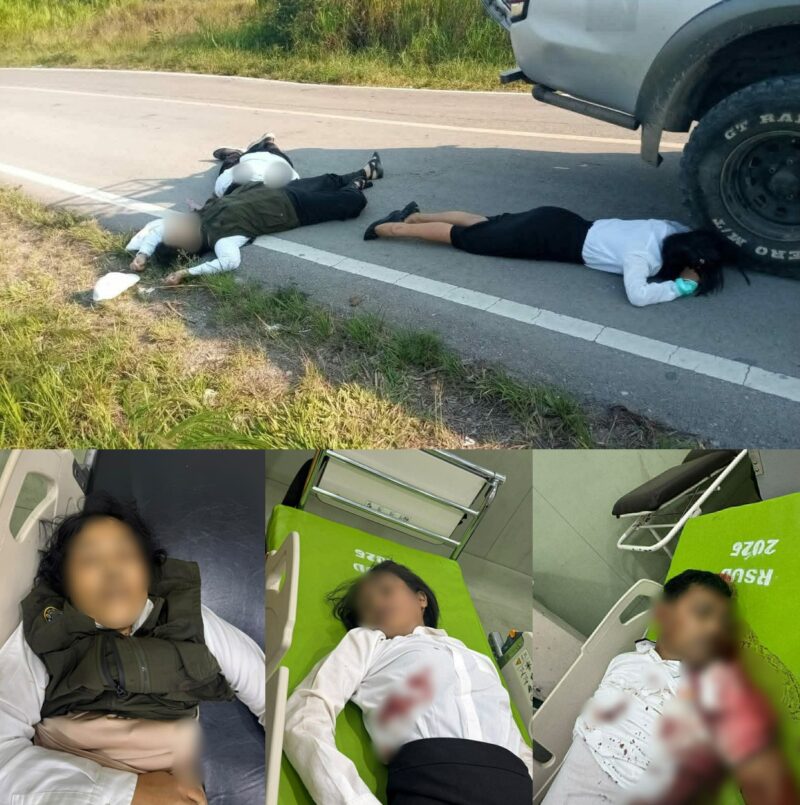
The Muliama shooting in Jayawijaya has left three government agricultural officers dead after their eight-person convoy came under fire while returning to Wamena following a government food assistance mission in Papua Pegunungan (Highland Papua) Province. Indonesian authorities have identified the victims as Aprida Rapi, Alfonsius Albinus Mehan, and Wili Mbuik. Police are investigating the incident, while preliminary findings cited by the Damai Cartenz Operation point to suspected involvement by an armed group associated with the West Papua National Liberation Army from the Free Papua Movement (TPNPB OPM) of War Region Command (Kodap) III Ndugama.
The attack occurred on Wednesday, September 9, 2026, at around 3:45 p.m. local time in Muliama District, Jayawijaya Regency. The victims were members of the Jayawijaya Agriculture Office who had been carrying out government assistance activities for local communities.
Their deaths have brought renewed attention to one of Papua’s most difficult security questions: how can government services reach remote communities when civilian workers themselves remain exposed to armed violence?
The incident also carries a broader political dimension. It comes shortly after Pacific leaders meeting in Palau reaffirmed Indonesia’s sovereignty over Papua while calling on all parties to protect human rights and agreeing to facilitate further regional engagement.
A Government Mission Turns into a Deadly Attack
According to the reports, the eight agricultural officials were travelling as a group while delivering government assistance to communities.
The mission involved food assistance and pig livestock intended for local residents. Earlier in the day, the team had completed distribution activities in Kampung Kimbim, Asologaima District, before beginning the journey toward Wamena.
The convoy later passed through Muliama District.
At approximately 3:45 p.m., attackers ambushed the group.
The initial information reported by the Jayawijaya military commander said the attackers stopped the group and separated members who were not Indigenous Papuans from those identified as Orang Asli Papua, or OAP. The three victims were subsequently shot.
The other five members of the group managed to escape.
According to iNews, the five survivors fled from the scene and sought protection at the Muliama Community Health Center. The three other members of the group were found on the road and subsequently evacuated by security personnel to Wamena Regional General Hospital.
The sequence illustrates how quickly an ordinary government field mission turned into a deadly security incident.
The Three Victims
The three deceased officials were identified as Aprida Rapi (woman, 49), Alfonsius Albinus Mehan (man, 35), and Wili Mbuik (woman, 25).
All three were associated with the Jayawijaya Agriculture Office. Media Indonesia reported that they were civil servants or civil service candidates carrying out official duties when the attack occurred.
Their work placed them in direct contact with rural communities.
That is significant because agriculture remains central to household livelihoods in the highlands of Papua. Government agricultural programs frequently involve the movement of personnel, livestock, seeds, food assistance, and technical support into communities that may be difficult to reach.
The three men were therefore not travelling for a private activity. They were returning from a government assistance mission.
Their deaths consequently raise concerns not only about civilian safety but also about the ability of public institutions to deliver development programs in remote areas.
What Happened to the Five Survivors?
Five members of the eight-person group survived the attack.
When gunfire erupted, the group scattered in an attempt to escape. The five survivors reached the Muliama health center and sought protection there.
The survivors were later expected to provide information to investigators concerning what happened during the attack.
The testimony of those who survived could become important in reconstructing the sequence of events, identifying the attackers and establishing whether the group had been specifically targeted.
At the same time, authorities must carefully distinguish confirmed information from preliminary accounts.
That distinction was visible in the first hours following the incident.
Early Reports Contained Conflicting Information
The initial reporting contained different accounts of the victims’ condition.
ANTARA reported that the military commander initially said all three victims had died and had been evacuated to Wamena Regional Hospital. However, the police spokesman for the Damai Cartenz Operation initially said that two people had died while another remained in critical condition.
Later reporting identified all three as deceased.
The changing information illustrates the difficulty of confirming casualty figures during a rapidly developing incident in a remote area.
For international readers, this is an important point when assessing early reports from conflict-affected regions. Initial casualty figures can change as victims are evacuated, hospitals confirm their condition, and authorities complete identification.
Police Investigate the Suspected Attackers
Indonesian authorities have since narrowed their preliminary assessment.
Chief of the Damai Cartenz Operation, Inspector General Faizal Ramadhani, said investigators suspected that members of KKB Kodap III Ndugama were responsible for the shooting. However, he stressed that the specific perpetrators had not yet been identified.
This distinction matters.
The suspected affiliation with Kodap III Ndugama is based on the preliminary investigation and remains subject to further law enforcement work. Media Indonesia similarly reported that the military had identified the incident as an attack by KKB but said the specific group responsible was still being investigated.
The investigation is therefore expected to focus on reconstructing the attack, examining witness accounts, and establishing the identity of the perpetrators.
The five surviving officials could be particularly important to that process.
Claims About the Victims as Alleged Intelligence Agents
Reports circulating around armed conflict in Papua can also involve competing narratives about the identity and motives of victims.
There have been claims associated with the TPNPB OPM narrative that civilians targeted in such incidents were suspected of having links to security or intelligence institutions.
However, the sources supplied for this article do not independently substantiate such a claim concerning Aprida Rapi, Alfonsius Albinus Mehan, or Wili Mbuik.
What the available reporting establishes is different: the three were agricultural officials carrying out a government assistance mission when they were attacked.
That distinction should not be overlooked.
Calling government agricultural workers intelligence personnel without evidence risks transforming an unverified allegation into an apparent justification for violence.
For any credible investigation, responsibility should be established through evidence rather than through accusations made after the fact.
Why the Attack Matters Beyond Muliama
The consequences extend beyond the three families who lost relatives.
Government personnel working in agriculture, health, education, and other public services are among the people who connect state programs with communities in remote parts of Papua.
When these workers face serious security threats, the impact can reach far beyond one government office.
Agricultural assistance can be delayed. Field visits can be cancelled. Communities may receive fewer services. Officials may become reluctant to travel to isolated areas.
The result can be a cycle in which insecurity limits development, while weaker access to development services makes communities more vulnerable to economic and social pressures.
This is why civilian security is closely connected to development in Papua.
Food Assistance and Agricultural Development
The mission preceding the shooting is also significant.
The officials were involved in distributing food assistance and livestock to communities. These programs aim to enhance household food security and agricultural livelihoods.
In Papua Pegunungan, livestock and agriculture are particularly important components of rural economic activity.
Government support can include livestock distribution, agricultural inputs, technical assistance, and programs intended to improve local production.
These activities require government workers to physically reach communities.
The Muliama attack demonstrates the vulnerability created when development personnel have to travel through areas affected by armed violence.
A government can build infrastructure and allocate development funds, but those investments cannot reach their full potential if workers cannot safely access the communities they are assigned to serve.
Security and Development Are Closely Linked
The incident therefore presents a challenge that cannot be addressed through security measures alone.
Law enforcement has a responsibility to identify the perpetrators and protect civilians. At the same time, government institutions need to maintain essential services.
This requires coordination among local authorities, security agencies, community leaders, and public service providers.
The objective should be to ensure that communities do not become isolated because of violence.
That is particularly important in Papua Pegunungan, where geographical conditions already make transportation and public-service delivery difficult.
A road between villages may represent much more than a transportation route. It can determine whether farmers can reach markets, whether government workers can reach communities, and whether residents can access hospitals or schools.
Security along these routes therefore has direct economic and social consequences.
The Broader Human Rights Debate
The Muliama attack also arrives at a sensitive moment in the international discussion surrounding Papua.
At the 55th Pacific Islands Forum (PIF) Leaders Meeting in Koror, Palau, leaders explicitly recognized Indonesia’s sovereignty over West Papua while also calling on all parties to protect and uphold the human rights of residents. They agreed to facilitate dialogue with Indonesia and a mission involving interested leaders in consultation with the Melanesian Spearhead Group Secretariat, with a report to Forum leaders in 2027.
The decision is important because it places two principles together: respect for Indonesia’s sovereignty and concern for human rights.
It also means that violence against civilians by any actor should be viewed seriously.
Human rights protection cannot logically apply only to one side of a conflict.
Civilians, government employees, indigenous communities, migrants, security personnel, and other residents all have a right to safety.
The Question of Consistency
The Muliama incident also raises a difficult question about consistency in international human rights discourse.
If the international community calls for scrutiny of alleged abuses in Papua, the same standard should logically be applied to violence committed by armed non-state groups against civilians.
That does not diminish legitimate concerns about civilian protection or alleged abuses by state actors. Rather, it reinforces a universal principle: civilians should not be targeted regardless of who carries out the attack.
PIF’s latest communiqué provides a useful framework because it calls on all parties to protect and uphold human rights while maintaining recognition of Indonesia’s sovereignty.
The implication is straightforward.
Any future regional or international assessment of Papua should examine the security and human rights environment comprehensively, including violence against civilians by armed groups.
Why the PIF Decision Matters for Indonesia
The Palau communiqué does not endorse Papua’s separation from Indonesia.
Instead, it recognizes Indonesian sovereignty while establishing a mechanism for dialogue and regional engagement.
For Jakarta, the communiqué presents both a diplomatic responsibility and an opportunity.
Indonesia can use future engagement to demonstrate developments in Papua, explain security challenges, and provide evidence concerning the protection of civilians.
The Muliama attack makes that engagement more complicated but also more relevant.
If a regional mission eventually examines conditions on the ground, incidents involving civilian victims should form part of the factual record.
That means the deaths of the three agricultural officials should not be treated as a secondary issue.
They are part of the broader reality of how insecurity affects ordinary people and government services.
A Challenge to Papua’s Development Agenda
The incident also highlights the connection between security and the Indonesian government’s wider development agenda in Papua.
Programs designed to improve food security, agriculture, and community welfare depend on people being able to deliver them.
The three victims were actively involved in this type of work.
Their deaths serve as a reminder that we cannot measure development solely by budgets, infrastructure projects, or program targets.
It must also be measured by whether government personnel and communities can safely interact.
This is where local community engagement becomes essential.
Traditional leaders, churches, village authorities, and community organizations can help create communication channels that allow public services to continue even when security conditions deteriorate.
Such engagement should complement, not replace, professional law enforcement.
A Human Cost Behind the Security Debate
Behind the language of KKB, TPNPB OPM, Kodap, and security operations are three individuals whose lives ended while performing public duties.
Aprida Rapi was 49.
Alfonsius Albinus Mehan was 35.
Wili Mbuik was 25.
Their ages span different stages of working life, but the circumstances of their deaths were similar: they were travelling as part of a government agricultural mission when their journey was violently interrupted.
Five colleagues survived.
They now carry not only the trauma of the attack but also the responsibility of helping investigators understand what happened.
For the families of the three victims, the investigation will ultimately matter because accountability begins with establishing facts.
Conclusion
The killing of three Jayawijaya Agriculture Office employees in Muliama is a clear example of the human cost of armed violence in Papua Pegunungan.
Aprida Rapi, Alfonsius Albinus Mehan, and Wili Mbuik were killed while returning from a government mission involving food assistance and livestock support for local communities. Five colleagues survived after the eight-person group scattered during the attack and sought protection at the Muliama health center.
Indonesian authorities have provisionally attributed the attack to an armed group associated with TPNPB OPM Kodap III Ndugama, although investigators are still working to establish the identities of the individual perpetrators.
The unverified claim that the victims were intelligence agents should not be treated as fact. The available reporting identifies them as agricultural officials conducting government assistance work. Any allegation concerning their alleged affiliation with security agencies requires independent evidence.
The broader significance of Muliama extends beyond one shooting.
For Papua, security is inseparable from development. Food assistance, agriculture, healthcare, education, and other public programs depend on officials being able to reach communities safely.
The incident also comes as Pacific diplomacy continues to scrutinize the human rights situation in Papua. Yet the latest PIF position is more nuanced than competing political narratives sometimes suggest. The Forum recognized Indonesia’s sovereignty while calling on all parties to uphold human rights and agreeing to facilitate further regional engagement.
This framework provides a crucial principle for the future.
Human rights should protect everyone.
Civilian lives should not become bargaining chips in a political conflict.
And development should not be held hostage by violence.
For Indonesia, the task is to strengthen security, ensure accountability, and keep development programs moving. For Papua’s communities, the ultimate measure will be whether they can live, work, travel, and receive public services without fear.
The three lives lost in Muliama should reinforce that priority.
Read Also
PIF Communiqué Affirms Indonesia’s Sovereignty in Papua
Paniai Market Fire Leaves 11 Dead Amid TPNPB OPM Probe
Police Officer Wounded in TPNPB’s Attack in Tolikara, Papua Pegunungan
TPNPB OPM’s Terror in Papua Leaves One Dead, Three Injured

