
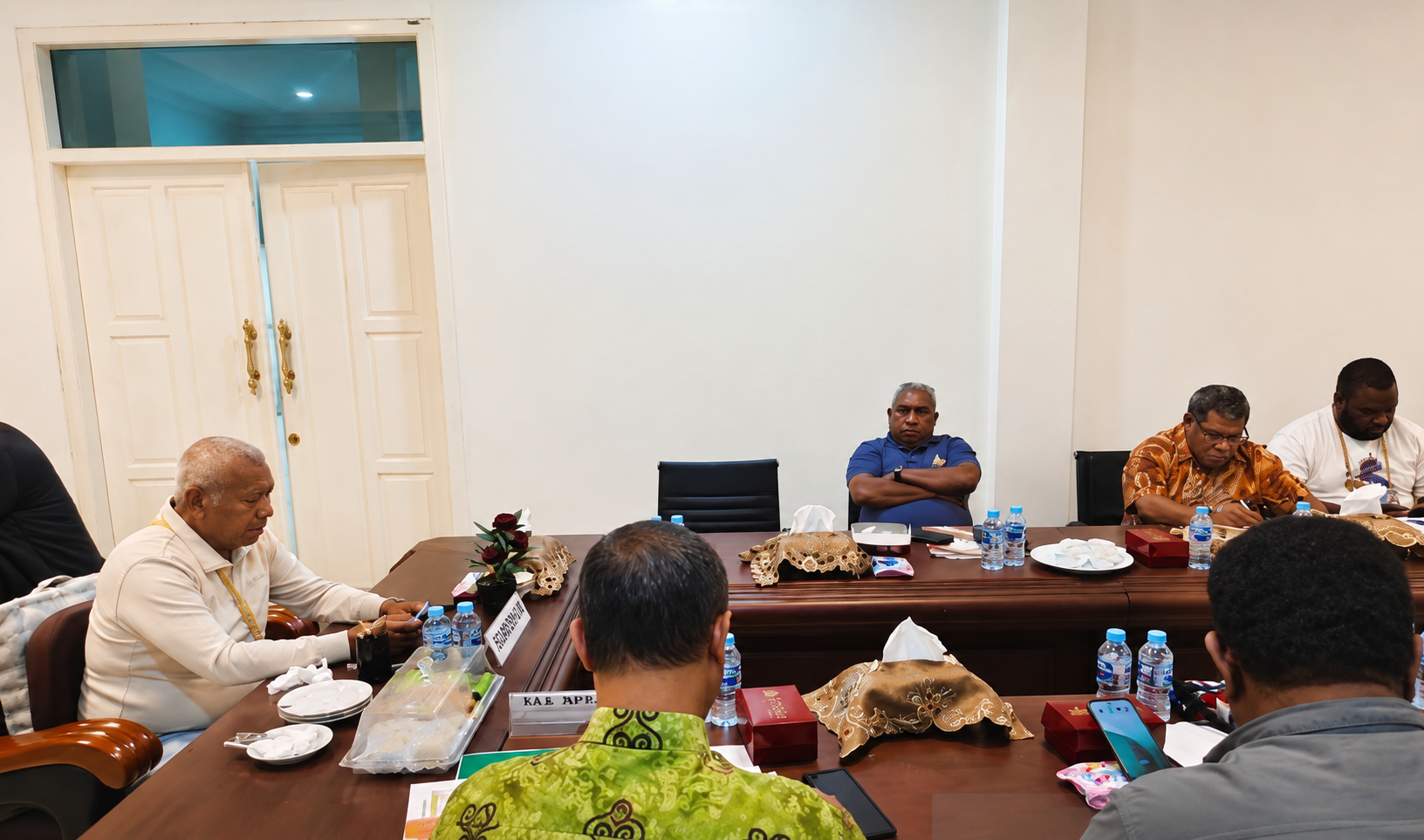
Despite ongoing budget constraints, the Papua Barat (West Papua) Provincial Government led by Governor Dominggus Mandacan has announced 167 public infrastructure work packages worth Rp30.7 billion to create additional opportunities for Indigenous Papuan (OAP) contractors to participate more actively in regional development.
The initiative is one of the province’s latest efforts to stimulate local economic involvement and to make sure infrastructure investment translates into business opportunities for Indigenous entrepreneurs.
Provincial officials described the allocation as a pragmatic compromise that addresses aspirations expressed by Indigenous contractor associations while being consistent with the fiscal capacity of the regional budget.
Several contractor groups proposed a significantly larger allocation, but provincial officials emphasised that current fiscal realities necessitate a cautious approach to spending priorities in order to maintain stable public finances while supporting essential development initiatives.
The policy is an example of the wider dilemma that many developing regions face in balancing expectations of the community with inclusive economic participation and responsible fiscal management.
Government Allocates 167 Infrastructure Work Packages
Provincial officials said the government has prepared 167 infrastructure work packages worth a total of about Rp30.7 billion.
The projects are expected to include a range of public works activities that support infrastructure improvements across West Papua.
The distribution signals the government’s commitment to expanding opportunities for Indigenous Papuan businesses while maintaining the implementation of regional development priorities, officials said.
The work packages will generate employment opportunities for local contractors, stimulate economic activity and increase the participation of Indigenous entrepreneurs in the construction industry.
The provincial authorities stressed the multiplier effects of infrastructure development besides physical construction.
Infrastructure projects such as road improvements, public facilities, drainage systems, government buildings and other infrastructure projects often create jobs, increase demand for local suppliers and improve access to markets and public services.
Policymakers hope these economic benefits will be more broadly shared in local communities by working more closely with Indigenous contractors.
Balancing Aspirations With Fiscal Reality
The distribution comes after talks between the provincial government and organisations of indigenous Papuan contractors.
During the discussions, several contractor associations proposed to allocate about Rp100 billion for projects involving Indigenous contractors.
The provincial leaders admitted the aspirations but explained that the amount requested could not be fully accommodated in the 2026 Regional Budget (APBD).
Papua Barat, like other units of regional government across Indonesia, is still operating with limited fiscal resources while funding education, healthcare, transportation, public administration, social programmes and infrastructure development, officials said.
That means government leaders said they need to spread the available money among several priorities.
The administration decided to move ahead with the current package of 167 projects as a first step towards increasing Indigenous contractor participation within the existing budget constraints, rather than postponing support indefinitely.
Future allocations, officials said, would continue to depend on fiscal capacity, development priorities and overall regional economic conditions.
Encouraging Greater Participation by Indigenous Papuan Businesses
A key goal of the broader development strategy for Papua Barat is increasing the participation of Indigenous Papuan entrepreneurs.
Government officials say that when local businesses are more engaged, economic growth is more inclusive and development dollars are spent to create opportunities for communities within the province.
Infrastructure projects may provide valuable experience to local construction companies and contribute to enhanced technical capacity, financial management and project implementation skills.
This experience can make firms more competitive over time and allow local firms to bid on larger and larger projects.
Officials also emphasised that increasing participation must be accompanied by continuous efforts to enhance contractor professionalism, transparency, technical competence, and adherence to procurement regulations.
A competitive local construction industry requires not only opportunities for projects but also sustained investment in human resources, business management and institutional capacity.
The provincial government, therefore, sees contractor empowerment as a long-term development process and not as a single budgetary allocation.
Infrastructure Investment Drives Regional Growth
Economists generally agree that public infrastructure is one of the strongest drivers of regional economic development.
Investment in roads, bridges, water systems, public buildings and transportation networks reduces logistical costs while improving connectivity between communities.
Better infrastructure also helps education, healthcare, tourism, agriculture, fisheries and private investment.
In Papua Barat, where geographic conditions often create significant logistical challenges, infrastructure is essential to strengthening regional integration and improving access to government services.
Officials say involving Indigenous contractors in these projects allows local communities to have a more direct role in the province’s economic transformation.
In addition to immediate employment, infrastructure spending creates secondary economic benefits by generating demand for construction materials, transportation services, equipment suppliers, food providers, and other local businesses.
These multiplier effects contribute to broader economic activity and reinforce household incomes.
Inclusive Procurement Supports Community Empowerment
Provincial authorities say the current initiative is part of a broader effort to ensure that public procurement is not only about delivery of infrastructure but also about community empowerment.
Inclusive procurement policies aim to grow opportunities for businesses that have historically had less access to government projects.
Greater involvement of Indigenous contractors in Papua also supports development goals around local economic inclusion and strengthening of capacity.
Officials stressed the need for the project allocation to go on in compliance with applicable procurement regulations and with transparency, accountability and value for public spending.
Policymakers view inclusive participation and responsible governance as a combination that can help harness the economic and social benefits of infrastructure investment for communities across Papua Barat.
Strengthening Indigenous Economic Capacity
The provincial leadership stressed that providing opportunities for Indigenous Papuan (OAP) contractors is part of an overall effort to build up local economic resilience and ensure regional development delivers tangible benefits to communities across Papua Barat.
Officials say that wider participation in government procurement is more than simply awarding work packages. Long-term success also depends on building technical skills, improving financial management, strengthening project planning, and guaranteeing compliance with national procurement standards.
Many local contractors gain practical experience in public infrastructure projects that helps businesses develop managerial capacity, establish stronger financial records and build professional credibility. These capabilities are essential for companies to compete for ever more complex projects in the future.
Economic analysts say successful local contractor development often has wider benefits for surrounding communities. Construction companies tend to hire local labour, source building materials from local suppliers, use local transportation services and generate demand for small businesses that support project implementation.
As these economic linkages become more powerful, public investment can help to spur wider local economic activity even while household incomes and business opportunities are strengthened.
Provincial officials therefore see contractor empowerment as an important part of inclusive development alongside investment in education, infrastructure, healthcare and entrepreneurship.
Infrastructure Development Supports Wider Community Welfare
The 167 work packages are expected to enhance physical infrastructure and advance broader regional development goals.
Public infrastructure is still central to improving connectivity across Papua Barat, where geographic conditions often pose logistical challenges for transportation, education, healthcare and economic activity.
Road improvements reduce the time of travel between communities.
Public facilities make government services accessible.
Drainage systems promote a healthier living environment.
Transportation infrastructure supports distribution of agriculture and commerce.
Improved infrastructure also encourages private investment through increased accessibility and lower costs of doing business.
Such improvements can increase access to schools, health centres, markets and administrative services for communities living in remote districts, while supporting long-term regional integration.
Government officials have always stressed that infrastructure should be a catalyst for sustainable economic development, not just physical construction projects.
Policymakers hope that by increasing participation among Indigenous contractors, infrastructure investment will generate broader socioeconomic benefits and reinforce local ownership of development initiatives.
Transparency and Good Governance Remain Essential
Provincial authorities also stressed that the expansion of participation should continue to be within the existing procurement framework of Indonesia.
Officials said all project allocations are still subject to the rules on transparency, accountability, competition and responsible financial management.
These principles are thought to be important to ensure that the use of public resources brings the maximum benefit while maintaining public confidence in government institutions.
Infrastructure experts broadly agree that inclusive procurement policies are most effective when coupled with good governance, robust oversight, transparent tendering processes and ongoing monitoring of projects.
Such actions help to ensure that the projects are completed in accordance with quality standards and at minimum implementation risks.
Officials also said building the institutional capacity of local contractors will help them compete in future procurements beyond provincial government projects.
Contractor empowerment is thus an economic initiative and a governance objective.
International Perspectives on Inclusive Procurement
Governments worldwide increasingly use public procurement as a tool to promote inclusive economic development.
Australia, Canada, New Zealand and several African countries have procurement policies that promote greater participation of Indigenous, local, small and medium-sized businesses in government-funded projects.
Similarly, international development organisations such as the World Bank and the Asian Development Bank have emphasised that well-designed procurement systems can generate broader socioeconomic benefits by expanding opportunities for local businesses while maintaining transparency and competition.
These approaches acknowledge that infrastructure investment can achieve multiple objectives at the same time.
Procurement policies can also foster entrepreneurship, create employment, develop local industries and enhance community participation in economic growth, beyond building roads or public buildings.
Papua Barat’s initiative is a reflection of this broader trend of utilising public investment to foster greater inclusive participation in regional development while balancing fiscal responsibility and sound governance for the international readers.
Looking Ahead
Officials from the province said that support for Papuan indigenous contractors will continue to evolve in line with improvements in regional fiscal capacity and development priorities. Because of current budget constraints, resources need to be allocated carefully, but the government has indicated its intention to continue to expand opportunities for local businesses as financial conditions allow.
Future efforts are also expected to focus on improving contractor training, strengthening institutional capacity, enhancing procurement transparency and encouraging greater collaboration between government agencies and local business organisations.
Officials say these measures will help build a stronger local construction industry that can contribute more significantly to the long-term infrastructure development of Papua Barat.
As regional development continues, there is an expectation that greater participation by Indigenous entrepreneurs will strengthen the broader government efforts to improve connectivity, expand public services and create inclusive economic growth across the province.
Conclusion
The Papua Barat Provincial Government’s decision to assign 167 work packages for public infrastructures worth Rp30.7 billion is an attempt to broaden the opportunities for Indigenous Papuan contractors while showing responsible fiscal management in the face of budget limitations. Provincial leaders assert that the allocation, despite being lower than the proposals submitted by contractor associations, is a positive step towards enhancing local participation in infrastructure development within the framework of the 2026 regional budget. The initiative is expected to create jobs, build local construction capacity and support wider regional economic activity, as well as business prospects. The policy, together with continuous improvements on governance, transparency and professional development, speaks to Papua Barat’s wider commitment to promote inclusive development where local communities are more engaged in the province’s economic transformation.

