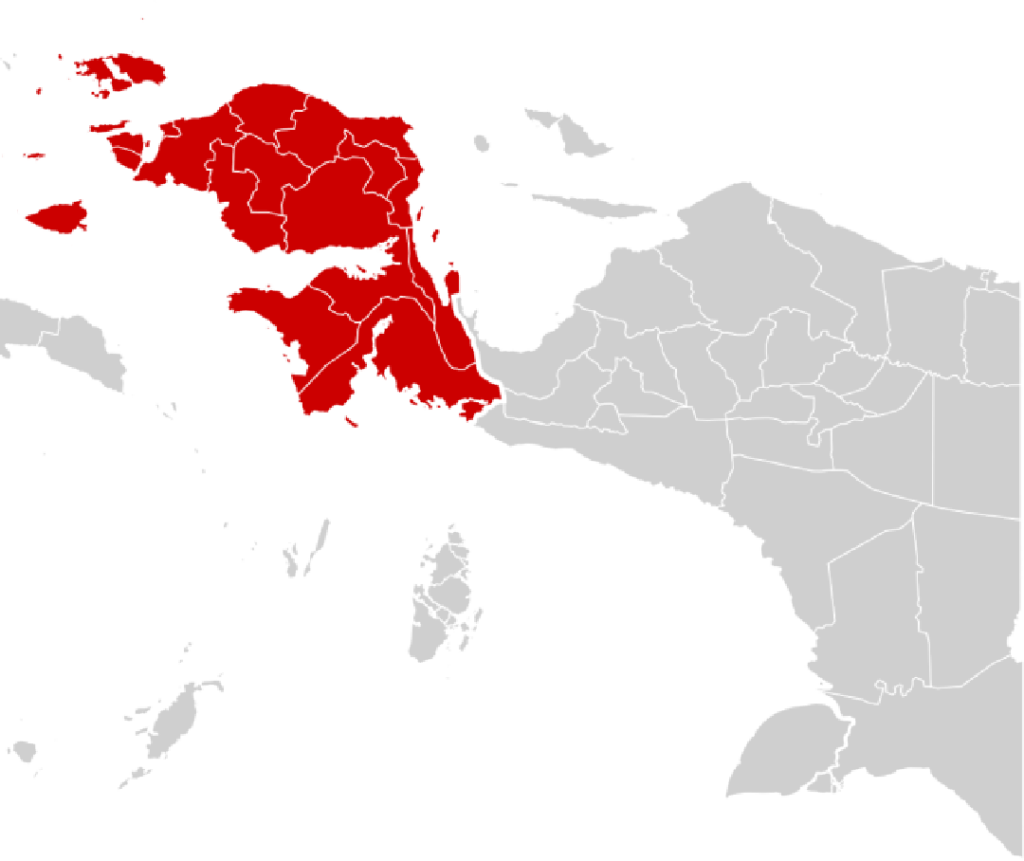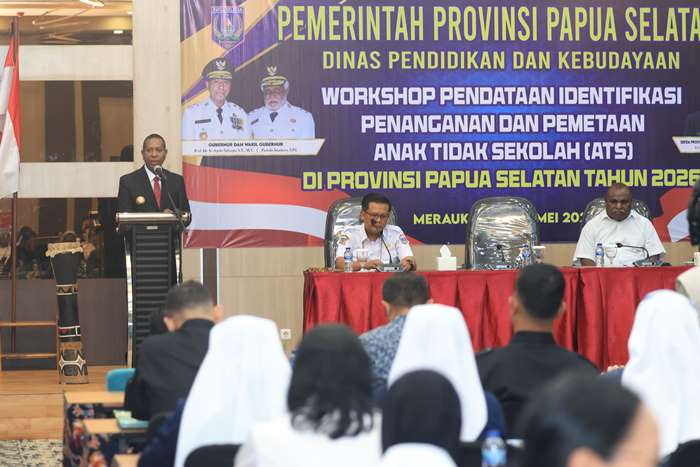
The numbers came out in a government meeting, but they did not feel abstract.
38,732 children in Papua Selatan are currently out of school. Some stopped attending years ago. Others never really started.
In Asmat alone, officials recorded 14,623 children outside the education system. In Mappi, the figure reached 12,445. Another 7,511 were identified in Merauke, while Boven Digoel accounted for 4,153.
The scale of the issue has pushed the Papua Selatan (South Papua) school crisis of 2026 into public discussion in a way that has rarely happened before.
For many people in the region, though, the reality itself is not new.
In Some Villages, School Is Still Far Away
In parts of Papua Selatan Province, getting to school can take hours.
Some children travel by boat along narrow rivers. Others walk through muddy paths that become difficult after heavy rain. In isolated settlements, transportation is unpredictable enough that missing class can slowly become routine.
Teachers face similar problems.
There are schools where attendance changes depending on weather conditions or fuel availability for river transport. In some places, educators rotate between villages because staffing remains limited, which can lead to inconsistent educational experiences for students and contribute to higher dropout rates.
Local officials assert that these factors contribute to the high rate of school dropouts among children.
The Government Is Now Speaking More Openly About It
Governor Apolo Safanpo recently addressed the issue publicly, acknowledging that the numbers were serious and could not simply be treated as an administrative matter.
His remarks were unusually direct.
He spoke about the need for coordination between districts, schools, communities, and provincial agencies. More importantly, he admitted that solving the problem would take more than building classrooms.
Officials have begun discussing targeted approaches district by district because the reasons children leave school are not always the same, with factors such as poverty, family circumstances, and local community support varying significantly across different areas.
Poverty Is Part of the Story
Families Often Face Difficult Choices
For some households, education competes with daily survival.
Children may help parents fish, gather forest products, or support small family businesses. When income is uncertain, school attendance becomes fragile.
A local education worker in Merauke described how some students disappear gradually.
“They stop coming for a week, then a month,” he said during a recent workshop discussion. “After that, it becomes difficult to bring them back.”
The situation is particularly challenging in areas where schools are located far from residential settlements.
School Expenses Are Not Always Simple
Although public education is formally available, indirect costs still matter.
Transport.
Uniforms.
Food during travel.
Families with multiple children often struggle to cover everything consistently.
Officials say these pressures are one reason dropout rates increase in remote districts, as families may prioritize immediate needs such as food during travel over educational commitments.
Geography Continues to Shape Education in Papua
Papua Selatan’s geography is unlike most parts of Indonesia.
Wetlands, rivers, and forest areas dominate large sections of the region, limiting infrastructure. Even relatively short distances can require long travel times.
In districts such as Asmat and Mappi, river transport remains essential for many communities.
That affects everything, including education.
Building schools is one challenge.
Keeping them connected is another.
Officials Want Better Data Before Expanding Programs
Some Children Are Missing From Records
Education authorities now say they are trying to improve data collection because tracking school participation in remote areas remains difficult, particularly due to the challenges posed by seasonal population movement between villages and the transient nature of some families.
Population movement between villages can change quickly. Some families relocate seasonally. Others move for work or family reasons.
As a result, local officials admit that records are sometimes incomplete, which can hinder efforts to ensure that all children are enrolled in and connected to schools.
The provincial education office has heavily focused its workshops on verifying the actual location of children and their continued connection to schools.
The Goal Is Not Only Enrollment
Officials also stress that returning children to classrooms is only part of the solution.
Keeping them there matters more.
In previous years, some students enrolled initially but stopped attending after a short period. The provincial government now says it wants programs that focus on continuity rather than short-term statistics.
Education Is Becoming a Bigger Political Issue
For years, discussions about Papua often centered on infrastructure and security.
Now education is starting to receive similar attention.
Local policymakers increasingly describe schooling as central to Papua’s long-term development, especially as the region’s young population continues growing.
Without stronger educational access, officials worry economic inequality could deepen further between urban centers and remote districts, leading to a situation where children in remote areas may lack the skills and opportunities needed to compete in the job market.
Community Leaders Are Being Asked to Help
In many villages, churches and customary leaders still hold strong influence.
Provincial authorities say involving them is essential because formal institutions alone cannot solve the problem.
Some local pastors have already begun encouraging families to return children to school, especially those who stopped attending after the pandemic years.
In certain communities, these conversations happen informally after church gatherings or village meetings rather than through official campaigns.
Progress Exists, But It Moves Slowly
The government points to ongoing improvements in roads, school facilities, and scholarships for Indigenous Papuan students.
In urban areas such as Merauke, access to education has expanded significantly compared to previous decades.
But officials also acknowledge that development remains uneven.
What works in one district may not work in another.
That reality makes education policy in Papua more complicated than simply increasing budgets.
Collaboration between Local and Central Governments
Provincial officials also linked the education recovery effort with several national programs promoted by President Prabowo Subianto, particularly the proposed Sekolah Rakyat initiative and the Free Nutritious Meals program, widely known as MBG.
In remote parts of Papua Selatan, authorities believe these programs could help address one of the deeper reasons many children stop attending school: daily economic pressure inside households. For some families, sending children to class is not always the immediate priority when transportation expenses, food access, and basic living needs remain uncertain.
Local education observers say the promise of free meals at school could gradually change that pattern. In communities where children often leave home without breakfast or spend long hours traveling by river and footpaths, nutrition support may become an important incentive for attendance. The central government has repeatedly described the MBG program as part of a broader strategy to improve child welfare and reduce long-term inequality across Indonesia.
Officials in Papua Selatan are also paying attention to the Sekolah Rakyat concept, which is designed to expand access for children from vulnerable and low-income families through more inclusive education support. Some local administrators believe the combination of free education access, nutrition assistance, and targeted outreach could be more effective than infrastructure development alone.
In districts such as Asmat and Mappi, where geography still limits access to schools, the government hopes these programs can help rebuild trust between communities and formal education institutions. Officials admit the challenge will not disappear quickly, but they increasingly see nutrition and social welfare policies as directly connected to whether children remain in classrooms.
Conclusion
The growing attention around the Papua school crisis of 2026 is not only about numbers.
It is about distance.
Isolation.
Economic pressure.
And the difficulty of keeping children connected to education in some of Indonesia’s most remote areas.
In Papua Selatan, the provincial government is now under pressure to turn concern into measurable action.
Whether those efforts succeed will likely depend not only on policy announcements but also on how deeply they reach villages where classrooms are still far away and school attendance can disappear quietly, one child at a time.