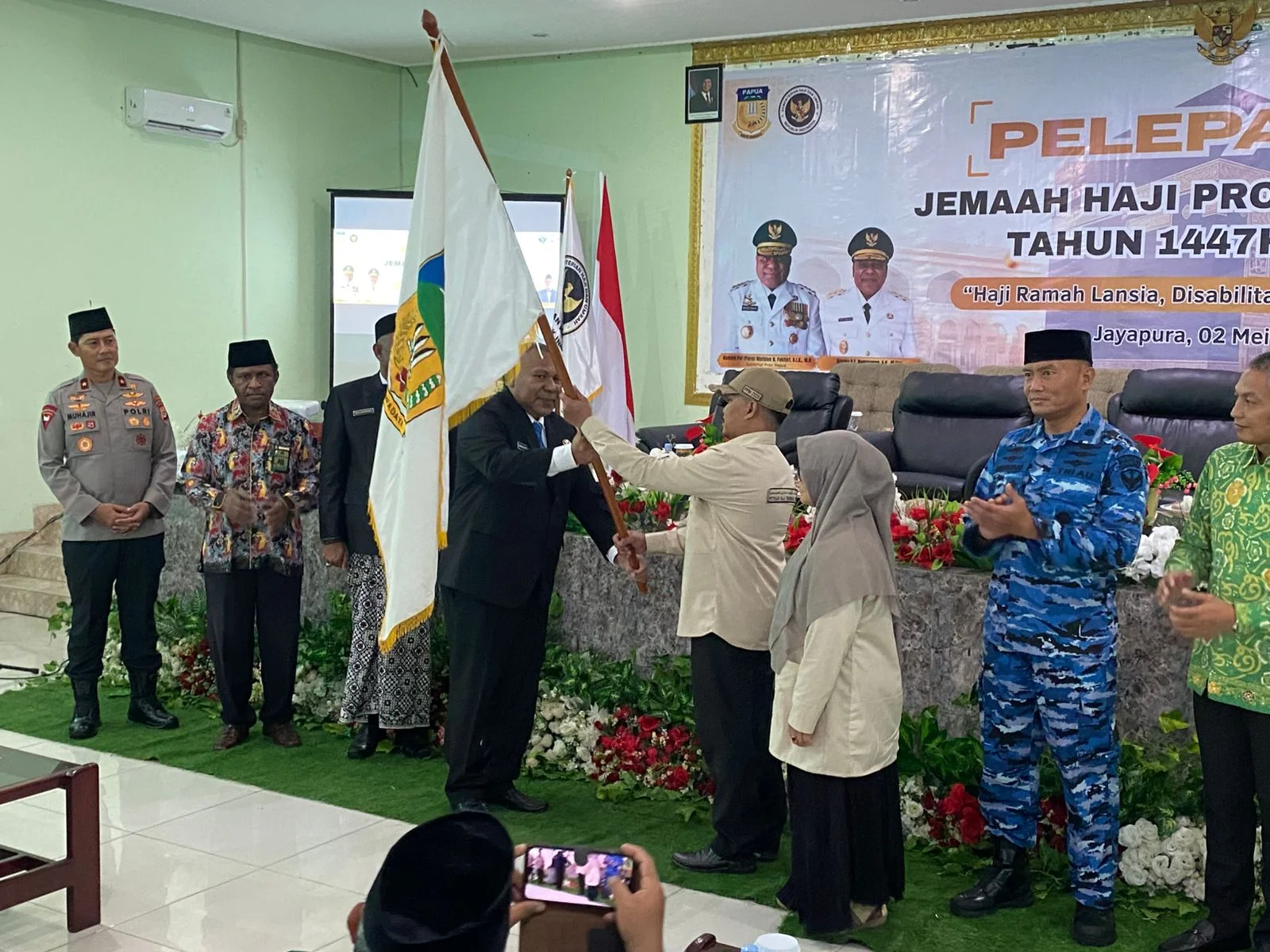
On May 2, 2026, in Jayapura, families stood close, not saying much. Some pilgrims looked calm, others a little anxious. Bags were checked again; small conversations faded in and out. The Papua Hajj pilgrims of 2026 did not leave in a rush. It felt slower, almost as if people wanted to hold on to the moment just a bit longer.
For many of them, this journey had taken years of waiting.
A Departure That Moves in Stages
This year, around 840 Hajj pilgrims from Papua are scheduled to depart for Mecca, divided into three departure (kloter) groups.
They are not leaving together.
Instead, the departure is arranged in several flight groups, known locally as “kloter.” Some will depart directly, while others will join larger groups through Makassar alongside pilgrims from other regions.
On paper, the process looks orderly.
On the ground, it is more complicated.
Papua’s geography means that reaching Jayapura itself can already feel like a long journey. Some pilgrims have traveled across districts, combining flights and land transport before even reaching the departure point.
By the time they gather here, they are already partway through the journey.
The Moment Feels Personal, Not Formal
Small Gestures That Matter
There were official speeches, but they were not what people seemed to remember.
The smaller things stood out.
A mother adjusting her child’s scarf.
A quiet handshake between friends.
Someone is reminding others to stay healthy.
These moments do not appear in official notes, but they shape the feeling of the day.
Aryoko Rumaropen’s Message
During the send-off, Papua’s Deputy Governor, Aryoko Rumaropen, spoke in a tone that felt less ceremonial and more personal.
He reminded the pilgrims that not everyone is given the chance to perform Hajj, describing it as a “noble calling” that should be carried out sincerely.
More than that, he asked them to remember Papua in their prayers.
He urged them to pray not only for themselves or their families, but also for the entire region.
He spoke about hope in simple terms.
Papua could potentially experience greater peace.
That development could continue.
That people could live with more stability.
He also reminded them to stay disciplined, respect one another, and “show exemplary character” during the pilgrimage, adding that they carry the name of Papua wherever they go.
The message was repeated quietly in different ways, and it stayed.
A Spiritual Journey With Local Meaning
For Muslims in Papua, the Hajj holds the same meaning as anywhere else.
But the path to reach it is often longer.
Access can be limited.
Travel takes time.
Preparation requires patience.
That is why the departure becomes more than a routine event.
It becomes something shared.
Even those who are not traveling pay attention.
Preparation Beyond Travel
Health and Readiness
Before leaving, pilgrims go through medical checks and orientation.
Officials emphasize that conditions in Mecca will be very different from Papua. The weather, the crowd, the pace.
Physical readiness matters.
So does mental preparation.
Carrying More Than Personal Intentions
This year, the emphasis on collective prayer was particularly noteworthy.
Pilgrims are not only preparing for their own spiritual journey.
They are also being asked to carry something else.
They are also being asked to carry a shared intention for Papua.
It is not something written down.
But it is understood.
A Moment That Reflects Stability
Papua is often discussed in terms of its challenges.
But moments like these show a different side.
A calm gathering.
An orderly departure.
People coming together without tension.
It may seem simple, but context matters.
And in this context, it carries meaning.
Between Faith and Everyday Reality
The request for prayers connects directly to daily life.
People speak about peace.
About opportunity.
The discussions also encompass the expansion of development to more regions.
These are ongoing conversations in Papua.
At the departure ceremony, they were expressed in a quieter way.
Not as demands.
But as hopes do.
What Comes After the Journey
The pilgrims will complete the Hajj and return home.
When they do, the experience does not end.
It continues through stories, conversations, and the way they share what they have seen.
In many communities, that matters.
It becomes part of how people understand the world beyond Papua, influencing their perspectives and interactions with other cultures and societies.
Conclusion
The Papua Hajj pilgrims’ 2026 departure was not dramatic.
It did not need to be.
In Papua, it unfolded quietly, shaped by small moments and simple messages.
People left.
Others stayed behind.
And somewhere between them, there was a shared sense of hope.
Not something loud or immediate.
But something steady.
Carried along with the journey.