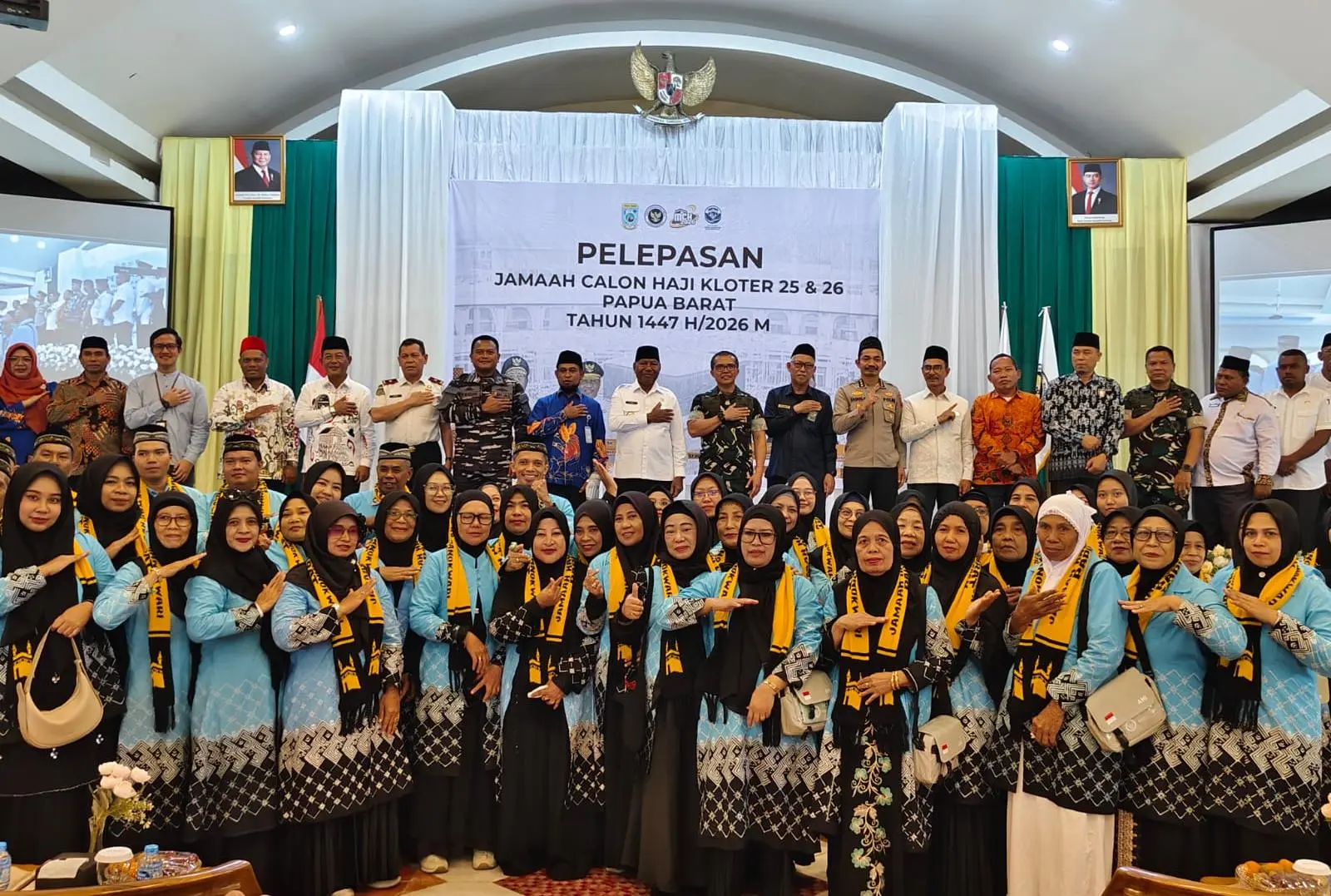
The final prayer recited briefly silenced the departure hall in Manokwari on May 6, 2026. Elderly pilgrims wiped away tears. Families stood close together, some holding phones to capture the moment before saying goodbye. A few children clung tightly to their parents, reluctant to let go as buses prepared to leave for the airport.
For the 143 Hajj pilgrims departing from Papua Barat (West Papua) Province this year, the journey to Mecca was more than a long-awaited religious obligation. For many of them, it marked the fulfillment of a dream built slowly over decades through savings, sacrifice, and patience.
As he officially released the pilgrims this week, Governor Dominggus Mandacan delivered a message that resonated throughout the ceremony hall. He reminded the pilgrims that once they arrived in Saudi Arabia, they would not only represent themselves or their families but also the people of Papua and Indonesia.
“Protect the good name of the region and the nation,” the governor told the congregation, urging the pilgrims to maintain discipline, humility, and respect throughout the pilgrimage.
The ceremony itself was simple, but emotionally powerful. It reflected a side of Papua rarely seen in international headlines, one shaped not by conflict or political tension, but by faith, community, and quiet personal devotion.
Years of Waiting for a Sacred Journey
For Muslims across Indonesia, the Hajj pilgrimage often requires extraordinary patience. In certain provinces, prospective pilgrims endure a wait of over a decade before receiving confirmation of their departure schedule.
In Papua, the challenge can be even greater.
The vast geography of the region, expensive transportation costs, and limited infrastructure mean many families must work for years just to prepare for the journey financially. Some pilgrims in this year’s group are elderly residents who spent most of their adult lives saving money little by little in the hope of one day reaching Mecca.
One family member waiting outside the departure venue described the pilgrimage as “the biggest prayer of our parents’ lives.”
That feeling was visible throughout the ceremony.
Several pilgrims carried small bags filled with medicines, prayer books, and gifts from relatives. Others sat quietly listening to religious guidance before departure. Some smiled constantly. Others looked nervous as they prepared to leave home for several weeks.
In Indonesian Muslim communities, performing the Hajj is deeply personal, but it is also communal. When someone departs for Mecca, entire neighborhoods often feel connected to the journey.
That atmosphere was especially visible in Manokwari this week.
Governor Calls for Discipline and Unity
During his remarks, Governor Mandacan reminded the pilgrims that spiritual preparation matters as much as physical readiness.
He asked them to avoid attitudes and behavior that could diminish the value of worship during the pilgrimage, such as negativity, distractions, or conflicts among fellow pilgrims. The message reflected a common concern among Indonesian religious leaders, particularly because the Hajj is physically exhausting and emotionally demanding, especially for elderly participants.
But the governor also spoke about responsibility beyond religion alone.
Indonesian pilgrims are among the largest groups attending the annual pilgrimage in Saudi Arabia each year. Because of that, officials regularly encourage participants to demonstrate discipline, cooperation, and respect for regulations while abroad.
For Papua’s provincial leadership, the message carries additional meaning.
Internationally, people often view Papua through the lens of security problems and political disputes. Events such as the Hajj departure ceremony provide a very different picture of daily life in the region, one centered on ordinary families, religious values, and community solidarity.
Local observers say that image matters.
In recent years, regional governments across Papua have tried to strengthen narratives focused on education, social harmony, cultural identity, and development rather than allowing the region to be defined entirely by conflict-related issues.
The departure of the Hajj pilgrims became one of those moments.
Faith Remains Central in Community Life
Although Papua is known for its ethnic and religious diversity, faith continues to play an important role in public life throughout the region.
In Papua Barat, Muslim communities coexist with Christian, Catholic, and indigenous traditions. Many towns collectively support religious celebrations across community lines, especially during major holidays.
That spirit of coexistence remains one of the strongest social foundations in Papua, according to local religious leaders.
The Hajj departure ceremony reflected that atmosphere clearly. Religious officials, provincial authorities, and family members gathered together not simply for an administrative event but for what many viewed as a deeply meaningful community occasion.
For some families, this year marked the first time a relative had ever performed the pilgrimage.
Others spoke quietly about relatives who had hoped to complete the Hajj but passed away before their names reached the departure list.
Those stories gave the ceremony a deeply human feeling that extended beyond speeches and official protocol.
The Long Road From Papua to Saudi Arabia
Unlike pilgrims from major Indonesian cities, participants from Papua face a far longer and more complicated route before reaching Saudi Arabia.
Many travelers must first fly to larger embarkation points in other provinces before continuing their international journey. For elderly pilgrims, the journey itself can become physically exhausting, even before the pilgrimage begins.
Health preparation has therefore become a major focus for local authorities.
Officials said medical examinations and travel guidance had been conducted before departure to help pilgrims prepare for the climate and conditions in Saudi Arabia. Temperatures in Mecca can differ drastically from Papua’s tropical environment, especially for older participants unaccustomed to extreme heat.
Indonesian authorities have spent years improving the Hajj management system, including accommodation, transportation, and health monitoring for pilgrims. Those efforts are particularly important for provinces in eastern Indonesia where travel access remains more limited.
Still, challenges remain.
Transportation costs for Papuan pilgrims are significantly higher compared to western Indonesian provinces, and logistical coordination often requires additional government support, which can strain local resources and complicate the planning process for the pilgrimage.
Despite those difficulties, enthusiasm for the pilgrimage continues to grow throughout Papua each year.
Papua Beyond the Headlines
For many residents, the departure ceremony carried symbolic importance beyond religion.
International attention toward Papua has frequently focused on violence, separatist tensions, and security operations in remote areas. While those issues remain part of the region’s reality, local communities often feel that everyday life in Papua is largely unseen by the outside world.
The gathering in Manokwari offered a different perspective.
It showed elderly couples preparing for prayer in Mecca. Families embracing loved ones before departure. Local officials discussed the importance of dignity, morality, and social responsibility.
In other words, it reflected ordinary human experiences shared by communities across much of the world.
That quieter side of Papua often receives less attention internationally, despite being central to daily life for millions of residents, and it plays a crucial role in fostering community bonds and resilience among the population.
Several community figures attending the ceremony said they hoped the departure of the pilgrims would inspire younger generations to strengthen values of tolerance, patience, and mutual respect.