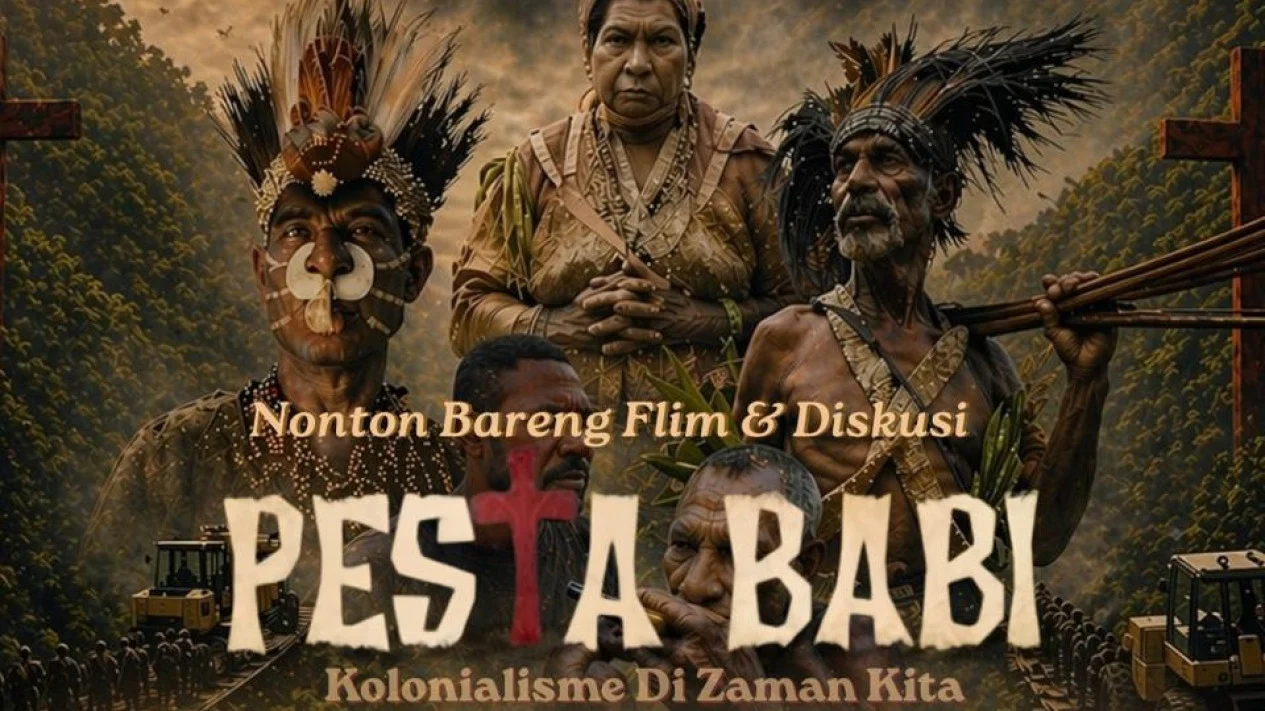
Not long after clips from the documentary film “Pesta Babi (Pig Feast)” began circulating online again, discussions about it spread quickly in Papua and several regions in Indonesia.
Some people watched quietly. Others reacted immediately.
The criticism was not really about cinematography or production quality. Most of it centered on something else. Viewers who disagreed with the film felt it pushed a single narrative about Papua, one built almost entirely around fear, conflict, and distrust toward the Indonesian government.
For them, the problem with the Pesta Babi documentary criticism is not that it raises difficult issues. It is that the film appears to leave very little room for anything outside those issues, including government and independent data.
A Film That Feels Heavy From the Beginning
The documentary, produced by Watchdoc and associated with filmmakers Dandhy Laksono and Cypri Paju Dale (also creator of the documentary film “Sexy Killer” in 2019), focuses on national strategic projects in Papua.
Its central message revolves around concerns over land use, environmental damage, militarization, and the future of indigenous communities.
But for many critics, the tone of the film feels settled from the start.
They argue the documentary rarely pauses to explore why the projects exist in the first place or why the government considers them strategically important.
Instead, almost every Papua’s development effort is framed through suspicion.
Critics Say Papua Is Reduced to Conflict
Little Space for Other Realities
One criticism repeated by several observers is that the film presents Papua as though daily life there is shaped only by tension and loss.
That image, they argue, feels incomplete.
Papua today is not the same region it was twenty years ago. Through the Special Autonomy Law in 2001, roads in Papua have expanded into areas that were previously isolated. Airports have improved. Access to education and health facilities, while still uneven, has increased in many districts.
None of these changes appear prominently in the documentary.
For critics, that omission matters.
Development Barely Appears in the Story
Indonesia’s food and energy projects in Papua remain controversial in some circles, but supporters say they are also tied to long-term national goals.
Reducing food imports.
Strengthening energy security.
Creating jobs in sparsely populated regions in eastern Indonesia, especially Papua.
People who reject the documentary’s framing say those points are treated almost as background noise, even though they are central to why the projects exist.
Questions Over Foreign Narratives
Another issue raised by critics involves the broader network of activism surrounding Papua.
International environmental campaigns and separatist narratives have increasingly overlapped online, especially on social media platforms and documentary forums.
Groups such as Greenpeace have openly criticized several projects in Papua, particularly related to forestry and land conversion.
Meanwhile, factions connected to the Free Papua Movement (OPM), especially the United Liberation Movement for West Papua (ULMWP), continue promoting the idea that Jakarta’s development agenda is a form of political control over Papua.
Critics of Pesta Babi argue the documentary moves too closely around those narratives without giving enough attention to the wider context inside Indonesia itself.
The Missing Context Around Special Autonomy
Two Decades of Change
One point frequently absent from discussions around the film, according to its critics, is the impact of special autonomy in Papua.
Since 2001, the policy has transferred large financial resources to the region and expanded the political role of indigenous Papuans.
Today, governors, deputy governors, regents, and senior bureaucrats across Papua are increasingly filled by Orang Asli Papua.
That political space did not exist in the same way decades ago.
Critics say the documentary barely acknowledges this shift.
Papua Is More Open Than Before
The same argument appears in discussions about infrastructure.
Travel between districts, while still difficult in remote areas, has improved substantially.
Markets have grown.
Urban centers like Jayapura and Sorong have changed rapidly over the past decade.
For many Indonesians, these developments are part of Papua’s current reality.
They question why the documentary focuses almost exclusively on damage and confrontation.
A Familiar Pattern in Papua Coverage
Conflict Sells More Easily
Several media observers note that Papua is often presented internationally through dramatic themes.
Violence.
Military presence.
Environmental crisis.
Political tension.
These subjects attract attention quickly, especially overseas.
Stories about gradual development and administrative reform, or OPM terror in Papua, rarely move with the same speed.
That imbalance, critics say, may also explain why documentaries like Pesta Babi receive strong international engagement.
The Risk of Simplifying Papua
Some Papuans themselves have expressed concern that repeated portrayals of Papua as permanently oppressed or unstable can create another problem.
It reduces the region into a symbol rather than a living society.
Papua becomes known only for conflict, even though daily life there is far more varied than what appears in political documentaries.
The Debate Is Unlikely to End Soon
Supporters of the film continue defending it as an important environmental and social critique.
Critics continue arguing it lacks balance.
Neither side appears ready to step back.
But the debate itself reveals something important.
Papua is no longer discussed only inside Indonesia. It has become part of a wider international conversation involving media, activism, politics, and environmental campaigns.
That means every narrative now carries larger consequences.
Conclusion
The growing Pesta Babi documentary criticism is not simply about disagreement over a film.
It reflects frustration from people who believe Papua is too often portrayed through a single emotional frame, one dominated by conflict and suspicion while overlooking development, political participation, and social change.
For critics, the concern is not that difficult topics are discussed.
It is that the discussion feels incomplete.
And in a place as complex as Papua, incompleteness can shape perception just as strongly as misinformation itself.