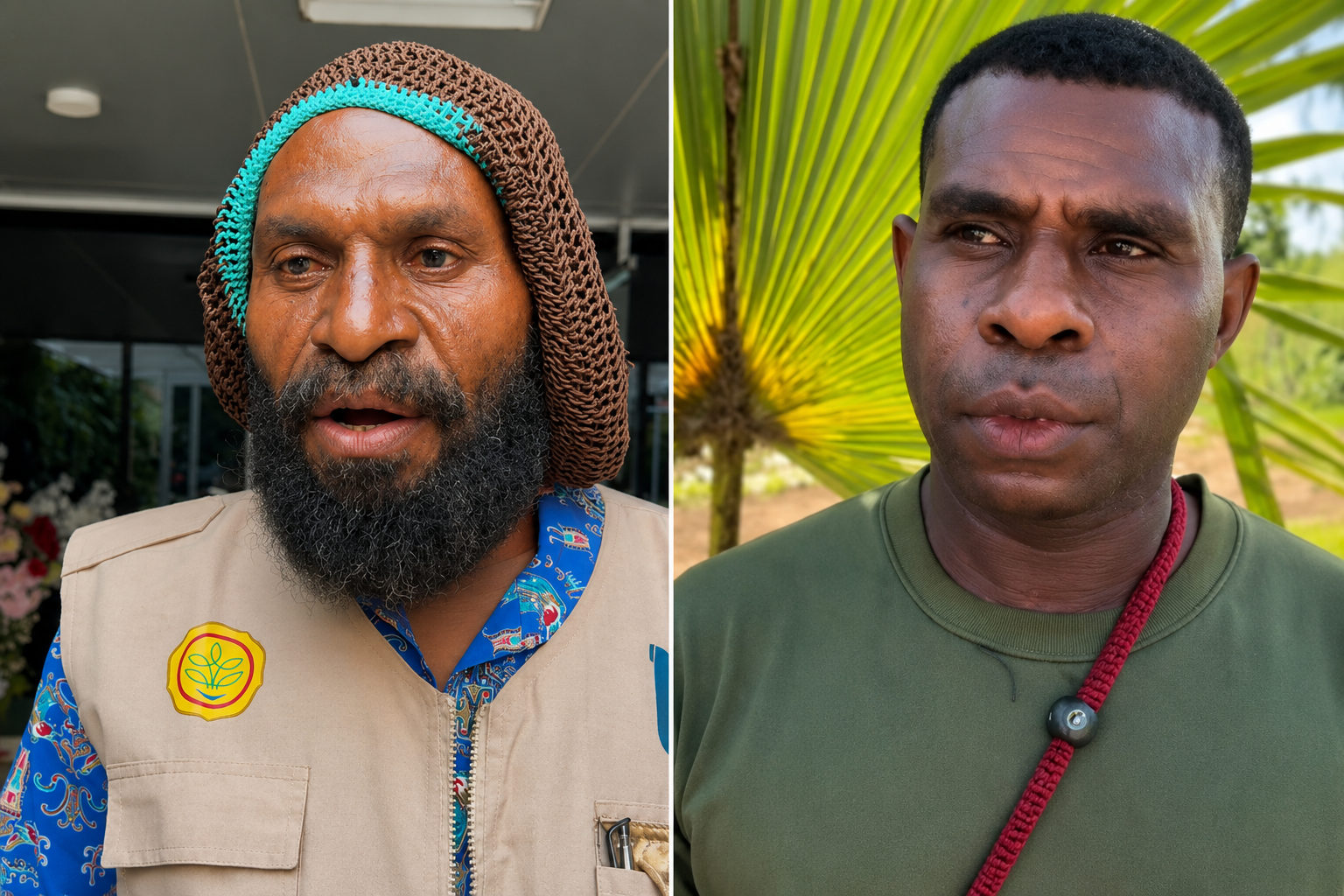
Chritoforus A. Mahuse could hardly contain his excitement when the first rice harvest came to the long idle land.
The Indigenous Papuan customary landowner stood in the newly harvested fields and thought about how much the landscape had changed in just a few seasons. The open land is now growing rice, creating income opportunities for local communities and motivating farmers to prepare for another planting cycle. “We’ve harvested the rice already; now we want to plant again,” Mahuse said recently, describing the changes happening on customary land in Papua.
His statement may sound simple, but for many communities across Papua it is a big shift. For years, talks about food security projects, agricultural expansion, and new rice field development have often been projections and planning documents. Instead, local residents are now starting to discuss the upcoming harvest, yields, and planting seasons.
The experience of Mahuse, alongside testimony from farmer groups in the Sarmi Regency, has become one of the most compelling local examples used by supporters of Indonesia’s National Strategic Projects in Papua, particularly the rice field expansion and food estate programs to build food security while also creating economic opportunities for Indigenous Papuans.
Their stories arrive at a time when food security has become an increasingly important issue not only for Indonesia but also for countries across the Asia-Pacific region grappling with climate uncertainty, population growth, and disruptions to global food supply chains.
From Skepticism to Harvest
Many residents were initially skeptical about the idea of establishing large-scale rice fields in Papua.
In many Papuan communities agriculture has always been part of life, but rice cultivation on newly developed land was relatively new in several areas.
Would the dirt be suitable?
Would the crops survive?
Would the local communities actually benefit?
The questions remained during the initial implementation stage.
Mahuse said many people preferred to wait and see before jumping to conclusions.
When the first harvest came in, he said, the answer was clear. The land has paid. You see it yourself,” he said.
“The harvest altered the perceptions of local residents who were unsure of the potential of the program,” he said.
“Farmers are discussing real issues like when to plant, seed availability, irrigation management, and future production instead of what might be.
That shift is an indication of increased confidence among participants.
A Harvest That Changed Local Perceptions
It is often observed that development programs gain legitimacy when the local community starts talking about concrete results.
Successful harvests have become an important measure in Papua, where many residents have understandably come to judge projects on the basis of actual results rather than promises.
The most convincing argument for the program, Mahuse said, is not in government presentations but in the fields themselves.
It has provided local people with a concrete example that agricultural development can be beneficial, with rice harvested from land that was once barren.
The experience has inspired greater participation among farmers and increased hope for next harvests.
Farmers in Sarmi Share Similar Experiences
The positive assessment is not only for customary landowners.
Michael M. Kubuan, Chairman of the Farmers Group Association (Gapoktan) in Ketom Jaya Village, Bonggo District, Sarmi Regency, shared the same view.
Kubuan has been active in agriculture in the area and has witnessed firsthand the response of local farmers to the first successful harvests.
“Many farmers, who were tentative in coming to the project, now want to go on planting,” he said.
The success of the harvest showed that rice growing could be a sustainable economic activity for the communities in the area.
Kubuan said the harvest season has provided a big boost to farmers’ enthusiasm.
Now, those who have watched developments from a distance are beginning to look for ways to become more closely involved.
Looking Toward the Next Planting Season
Perhaps the best sign of confidence is what happens after harvest.
Many farmers are already preparing for the next planting cycle, rather than finishing their participation.
“Community discussions are increasingly turning to productivity improvement and the expansion of cultivation,” Kubuan said.
The encouraging thing is that they are happy to continue planting, so farmers are not doing a one-off experiment but see the potential for the long term.
Agricultural experts often consider repeated planting cycles a better indicator of success than a single harvest, because they demonstrate confidence in sustainability.
That confidence appears to be rising in Sarmi.
Food Security Becomes a Strategic Priority
The developments in Papua are consistent with national efforts to bolster Indonesia’s food resilience.
Like many countries, Indonesia is not immune to the impact of climate variability, changing weather patterns, and volatility in the global agricultural markets.
Such factors have prompted policymakers to hasten the pace of domestic food production and lessen reliance on foreign supply chains.
Papua plays an increasingly important role in that strategy.
Papua has large land resources, a favorable climate in certain areas, and an expanding network of infrastructure, all of which have attracted the attention of agricultural planners aiming to increase food production capacity.
That’s part of that larger effort, including the program for developing rice fields.
Agriculture and Economic Development
Supporters claim that the benefits go beyond food production itself.
Agricultural development often has ripple effects throughout the local economy.
Workers are employed in the land preparation and planting seasons.
Transportation services activity picks up.
Local businesses provide equipment, seeds, and ag inputs.
Markets receive additional products for sale.
Such activities create economic opportunities that may also extend to communities beyond individual farmers.
A particularly important feature of the program, according to many local leaders, is that it gives Indigenous Papuans a say in agricultural production while still retaining control of customary land.
Indigenous Participation at the Center
Local testimonies consistently point to the important role played by Indigenous Papuans.
Supporters of the program say it’ll need real buy-in from local communities if it’s to succeed in the long term.
So the experience of Mahuse.
He is a customary landowner, a member of a group of people whose involvement is critical to garner local support for development projects.
Therefore, his positive opinion is valuable, particularly regarding the harvest.
This implies that some Indigenous stakeholders are deriving tangible benefits from agricultural expansion.
Development Through Partnership
Agricultural officials have repeatedly said working with local communities is still a priority.
The programs are designed not only to boost production but also to develop local capacity through training, technical assistance, and infrastructure support.
The goal is to make sure communities can benefit long after the first phases of development are finished.
Participants say that approach has helped build trust and allowed for broader engagement.
The Broader Impact on Papua’s Future
The success stories from Sarmi are indicative of broader conversations occurring across Papua about economic diversification and sustainable development.
For many years, the narrative on Papua’s economy was often about extractive industries and government spending.
Another way is through agriculture.
Higher food production has the potential to enhance food availability and create local income for communities.
This is in line with efforts to promote more inclusive economic growth that reaches rural areas and Indigenous peoples.
Agricultural development will not solve all of Papua’s problems.
But successful harvests show that it can have an important role to play in a wider development strategy.
Building Confidence Through Results
Development programs are frequently evaluated on results, not intentions.
In this sense, the testimony of Mahuse and Kubuan is important because it is directly from the people involved in implementation.
Their comments offer a window into how local communities view the changes happening on the ground.
While challenges remain to be certain, the transition from idle land to productive rice fields is a tangible accomplishment that many residents can see for themselves.
A New Narrative Emerging From Papua
Policy debates have dominated much of the national discourse surrounding food estate projects.
However, in areas such as Sarmi, the discussion has increasingly turned to more practical matters.
Farmers are talking about harvests.
Communities are getting ready for the next planting seasons.
Local leaders look into economic opportunities with agricultural activity.
Proponents say these developments suggest Papua may be playing a bigger role in Indonesia’s food future.
But if we look at the stories from new rice fields through the prism of food security, rural development, or Indigenous empowerment, it is obvious that agriculture is more and more part of Papua’s economic landscape.
Conclusion
For a rare glimpse into the community level of agricultural initiatives in Papua, read the experiences of Chritoforus A. Mahuse and Michael M. Kubuan. Their excitement after successful rice harvests reflects increasing confidence that newly developed rice fields can contribute to food security, economic opportunity, and rural development. Continued investment, technical support, and community engagement remain essential, but the evidence from Sarmi shows that the benefits are beginning to move out of planning documents and into everyday life. But for many Indigenous Papuans, the greatest success is not the size of the project but the sight of productive fields, successful harvests, and the opportunity to plant again for the next season.