
A knife attack against a government employee in Ilaga, Papua Tengah (Central Papua), has taken on a wider security dimension after the spokesperson of the TPNPB-OPM, Sebby Sambom, publicly claimed responsibility for the assault and repeated threats against civil servants working across Papua.
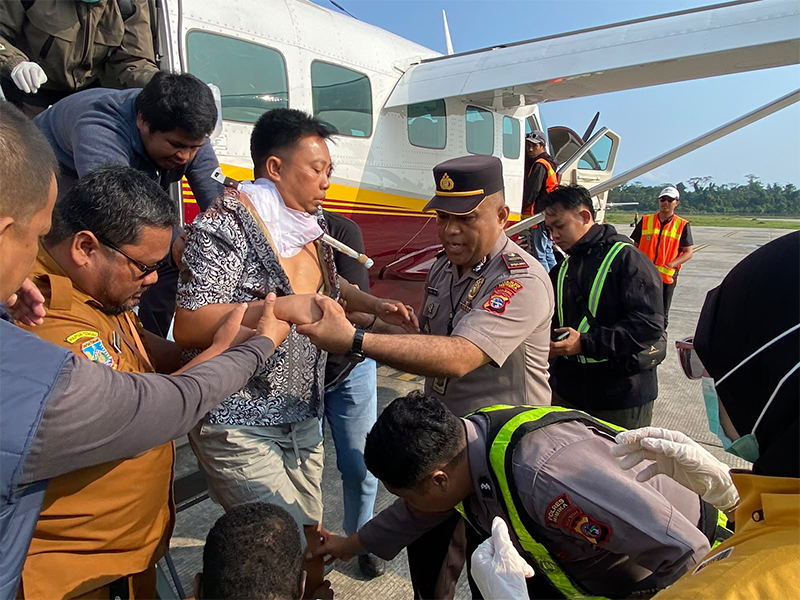
The victim, identified as Muchsin Muchtar (MM), an employee of the Public Works and Spatial Planning Office (PUPR) of Puncak Regency, was stabbed in the neck on November 1, 2026, in the Kago Market area of Ilaga. The attack left him seriously injured and required emergency medical treatment and subsequent referral to a larger hospital.
Three days later, on November 4, Sebby Sambom issued a statement on behalf of the TPNPB-OPM central headquarters management, claiming that members of the armed group had carried out the attack. He said the information had been received from TPNPB forces led by Titus Murib and Jeki Murib in Ilaga.
The same statement reiterated an ultimatum directed at civil servants and other people involved in Indonesian government activities in Papua. The group threatened to shoot or execute government employees who continued working in areas it claimed as its operational territory.
The declaration has intensified concerns about the safety of public servants, particularly those responsible for delivering essential services in remote districts. Teachers, health workers, infrastructure personnel and administrative officials are among those whose work directly affects the daily lives of local communities.
However, an important distinction remains: although TPNPB-OPM has claimed responsibility, the perpetrators’ identities and the full circumstances of the attack still require verification through the police investigation. The group’s statement is a claim of responsibility, not a judicial determination of individual criminal liability.
The November 1 Attack in Ilaga
According to reporting by Galeri Papua, the attack took place at approximately 4 p.m. local time on November 1, in front of the Mandiri Utama workshop near Kago Market, Kampung Ulumuni, Ilaga District, Puncak Regency.
Muchsin was reportedly sitting on his motorcycle when an assailant approached him from behind and stabbed him in the neck with a knife. The weapon penetrated deeply, leaving a serious wound.
After the attack, the perpetrators fled towards Kampung Ulumuni. Muchsin reportedly called for help, prompting nearby residents to approach and assist him.
The initial police investigation suggested that as many as five individuals might have been involved. According to the preliminary account, three allegedly monitored the surrounding area while two others carried out the stabbing.
These details remain part of the investigation. Police have not publicly established the identities of all the individuals involved or confirmed their respective roles.
Residents helped transport the injured civil servant to the Ilaga Regional General Hospital (RSUD Ilaga), where medical personnel provided emergency treatment.
The circumstances of the attack highlighted the vulnerability of public employees operating in areas where security conditions remain challenging. A routine moment outside a workshop became a serious medical emergency, requiring an immediate response from residents and local health personnel.
Medical Evacuation After a Serious Neck Injury
The victim arrived at RSUD Ilaga in a conscious condition despite the severity of his injury, according to information provided by the Damai Cartenz 2026 Public Relations Task Force.
Police spokesperson and Public Relations Task Force Commander Commissioner Yusuf Sutejo explained that the knife remained embedded in Muchsin’s body when he received initial medical attention.
Because of the limitations of medical facilities in Ilaga, the victim was referred to RSUD Timika on Monday morning, November 2. The evacuation was conducted by aircraft under police escort.
Medical personnel used a splint to minimise movement during transportation and reduce the risk of worsening the injury. Reports also indicated that further referral to Makassar was planned so that Muchsin could receive more comprehensive medical treatment.
The medical evacuation demonstrated the importance of reliable emergency transport in remote areas of Papua. When a patient suffers a serious injury, access to specialist facilities may depend on aircraft availability, coordination between medical teams and security arrangements.
For the victim and his family, the immediate priority was medical recovery. For authorities, the incident also reinforced the need to protect public employees and ensure that emergency response services can operate safely.
Police Begin Investigation and Examine Possible Motives
Following the incident, the Damai Cartenz 2026 Task Force and Puncak Police launched an investigation.
Officers visited the crime scene, collected witness statements and conducted searches in the surrounding area. Investigators also documented several items belonging to the victim, including a navy-blue jacket, navy-blue jeans and a black shirt.
A wooden-handled knife measuring approximately 40 centimetres was reportedly still lodged in the victim’s body during the initial reporting. It could not immediately be secured as physical evidence because medical treatment had to take priority.
Police therefore continued gathering other available evidence while waiting for the appropriate medical procedures to allow the weapon to be examined.
Yusuf Sutejo said the victim had suffered a stab wound to the neck and remained conscious when he arrived at the hospital.
He also explained that investigators were examining a possible connection with an armed criminal group, commonly referred to by Indonesian authorities as KKB.
One line of enquiry concerned the possibility that the stabbing was an act of retaliation following the arrest of a suspected armed-group member identified as Pepi Waker by personnel from the Damai Cartenz 2026 Task Force.
According to the statement attributed to Puncak Police Chief Adjunct Senior Commissioner Domingos De Fatima Ximenes, preliminary witness information had raised this possibility. However, he emphasised that the suspected motive still required further investigation and verification.
The police have not publicly established that the individuals responsible for the stabbing belonged to a specific organisation. Nor had they confirmed, in the initial reporting, that the attack had been ordered by TPNPB-OPM.
This distinction is particularly important following Sebby’s subsequent declaration. His statement provides investigators with an additional claim to examine, but the identities of the attackers, their operational roles and the possible chain of command must still be established through evidence.
Sebby Sambom Claims Responsibility on November 4
The case entered a new phase when Sebby Sambom issued a statement on November 4 on behalf of the TPNPB-OPM central headquarters management.
According to Papuanews Online, Sebby said the group had received information about the incident from TPNPB forces led by Titus Murib and Jeki Murib in Ilaga.
The statement claimed that the stabbing had been carried out by members of the group at approximately 12.57 p.m. local time on November 1.
There is a discrepancy between this claimed time and the approximately 4 p.m. incident time reported by Galeri Papua and the Damai Cartenz 2026 Task Force. The available reports do not explain the difference.
The discrepancy is relevant because it illustrates why investigators must examine the statement alongside witness testimony, medical records, physical evidence and other information from the scene.
Nevertheless, the public claim is significant because it changes the context in which the incident is being discussed. What was initially reported as an attack by unidentified individuals has now been publicly claimed by an armed organisation.
The claim should therefore be examined seriously by law enforcement authorities while avoiding premature conclusions about the identities and individual responsibilities of those involved.
Threats Against Civil Servants Across Papua
More concerning than the claim of responsibility was the accompanying threat against government employees.
In its November 4 statement, TPNPB-OPM reiterated an ultimatum that it said had previously been issued on September 14, 2026.
The group threatened to shoot or execute civil servants who continued carrying out government activities in areas it considered part of its operational territory.
The threat was directed not only at ordinary civil servants but also at government officials, members of legislative bodies, representatives of the Papuan People’s Assembly (MRP), and migrants working within the government system.
Sebby’s statement called on civil servants, including Indigenous Papuans and people from other parts of Indonesia, to stop government activities and leave areas claimed by the group.
The group described the Indonesian government bureaucracy as part of what it characterized as a colonial system. It also called on President Prabowo Subianto and his administration to address what it described as the underlying causes of the Papua conflict.
TPNPB-OPM further stated that its armed struggle would continue if the government did not respond to its demands. It proposed international negotiations under United Nations supervision and referred to its claim concerning Papua’s independence on December 1, 1961.
These statements represent the group’s political position and demands. They do not change the legal status of Indonesian government employees or justify threats and violence against civilians.
A threat to kill public servants is especially serious because their responsibilities extend far beyond administrative matters. In remote districts, government employees often provide services that communities rely on every day.
Why Threats Against ASN Matter to Local Communities
Civil servants working in Papua are part of the infrastructure that keeps local government functioning.
Their responsibilities include managing administrative records, supporting village governance, coordinating public assistance, maintaining infrastructure programmes and facilitating access to education and healthcare.
In districts such as Puncak, where geographical conditions can make service delivery difficult, the presence of government personnel is particularly important.
Threats against these workers can have consequences that extend well beyond the individuals directly targeted. If employees become afraid to travel or carry out their duties, public services may be disrupted and communities may face additional difficulties accessing essential assistance.
For example, interruptions to education administration can affect school operations, while threats against health personnel may complicate access to medical services. Restrictions on infrastructure workers can also delay projects intended to improve transportation and connectivity.
The impact may be especially severe for residents in remote villages who already face limited access to public facilities.
The threat described in the TPNPB-OPM statement therefore raises a broader issue of civilian protection and the right of communities to receive government services without intimidation.
Public employees should be able to carry out their responsibilities safely, regardless of their ethnic background or place of origin. At the same time, security operations must protect civilians and comply with applicable laws and procedures.
Police Urge Public Calm as Investigation Continues
Following the stabbing, authorities also expressed concern about the circulation of violent videos on social media.
According to Galeri Papua, the Damai Cartenz 2026 Task Force had monitored and profiled several videos shared by accounts associated with Sebby Sambom. Investigators said the footage being circulated included recordings from earlier incidents in April 2026 and September 2025, rather than evidence of the November 1 attack.
Yusuf Sutejo urged the public not to be misled or provoked by old recordings presented without proper context.
His warning reflects a wider challenge facing security authorities in Papua: the circulation of unverified information can intensify public anxiety, create confusion about the chronology of events and potentially undermine efforts to establish the facts.
Separately, Inspector General Faizal Ramadhani, Head of the Damai Cartenz 2026 Operation, stressed that the investigation would be conducted professionally and based on lawful evidence.
He said the authorities would seek to identify the perpetrators and determine the motive behind the stabbing. Any suspected connection with an armed group would also be examined through witness statements and other legally admissible evidence.
The operation and Puncak Police have continued increasing patrols and monitoring in Ilaga while coordinating with relevant stakeholders to maintain security.
This approach is important not only for identifying those responsible but also for reassuring residents that the case is being handled through an established legal process.
Protecting Public Services and Civilian Safety
The stabbing of Muchsin Muchtar and the subsequent threats against civil servants highlight the close relationship between security and development in Papua.
Government employees are not merely representatives of an administrative system. They are also teachers, engineers, healthcare workers, planners and local officials whose responsibilities directly affect community welfare.
Their ability to work safely is essential to maintaining public services and supporting regional development.
The Indonesian government therefore faces the dual responsibility of responding to violence and ensuring that the rights and safety of civilians are protected. Law enforcement must establish accountability through evidence, while public institutions need to maintain essential services and provide appropriate support to affected communities.
For residents of Puncak, the immediate concerns are practical: the recovery of the injured civil servant, the identification of those responsible, and the assurance that daily activities can continue without fear.
The November 4 statement from Sebby Sambom makes those concerns more urgent. Threats directed at a broad category of public employees risk creating an atmosphere of intimidation that affects not only government offices but also the communities they serve.
Conclusion
The stabbing of PUPR civil servant Muchsin Muchtar in Ilaga on November 1, followed by Sebby Sambom’s November 4 claim of responsibility and renewed threats against civil servants, underscores the continuing security challenges facing Puncak Regency and Papua Tengah. While the TPNPB-OPM statement is a significant development, the identities and individual responsibility of the perpetrators must still be established through a professional police investigation. Threats against public servants cannot be allowed to disrupt essential services or undermine the safety of local communities. Indonesia’s response must combine effective law enforcement, protection of civilians, reliable public services and firm adherence to the rule of law. Ultimately, lasting stability in Papua depends on ensuring that every resident, including government employees and their families, can live and work without intimidation, while communities continue to receive the education, healthcare and development services they need.
Read Also
Ilaga Stabbing: Police Probe Suspected KKB Link
Civil Servants from Toraja Seek Transfer After the TPNPB OPM’s Killings in Papua
The TPNPB OPM’s Terror Message Prompts Transfer Requests from 21 Civil Servants

