
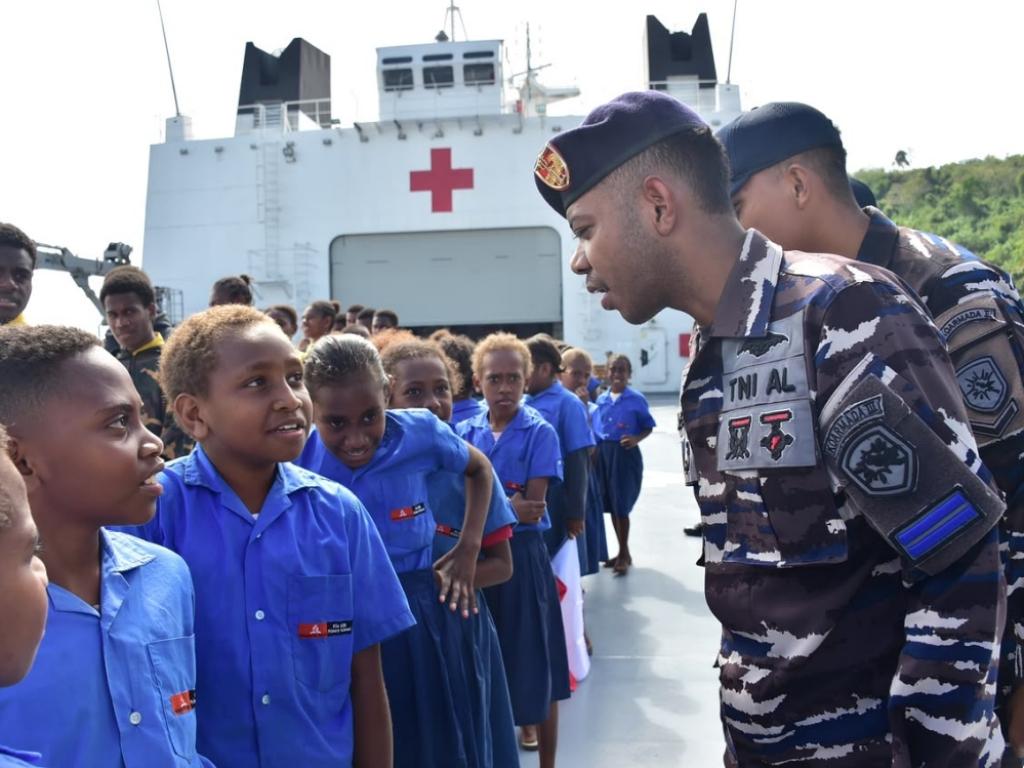
Indonesia’s maritime diplomacy took a distinctly humanitarian form when the Indonesian Navy’s hospital ship, KRI Dr Wahidin Sudirohusodo-991, arrived in Vanuatu carrying a medical team and supplies intended to support local communities. During the visit, the Indonesian task force treated 656 patients over two days, performed surgical procedures, provided social assistance and supported a local health clinic, demonstrating how practical cooperation can complement traditional diplomatic engagement. The mission formed part of Indonesia’s 2026 Port Visit programme, which connects the country’s naval presence with humanitarian service, cultural exchange and closer relations with Pacific island nations.
The deployment was more than a ceremonial port call. For residents seeking medical attention, the ship offered access to doctors and facilities aboard a floating hospital. For Indonesian officials, the visit provided an opportunity to build relationships through direct contact with local communities, government representatives and public institutions.
The operation also carried significance for Indonesia’s eastern maritime region. The mission began in Sorong, Southwest Papua, before the vessel crossed the Pacific towards Vanuatu. Its departure from an important Indonesian naval hub in Papua and its subsequent engagement with Pacific communities illustrated the geographical connections that make the region relevant to Indonesia’s maritime diplomacy.
From Sorong to Port Vila: A Mission Across the Pacific
Ten Days at Sea Before the Vanuatu Visit
KRI dr Wahidin Sudirohusodo-991, commonly known as KRI WSH-991, arrived at Main Wharf in Port Vila on Friday, October 2, 2026, after a ten-day voyage from Sorong. The ship was carrying personnel assigned to the Integrated Port Visit 2026 Task Force, a joint mission intended to combine maritime engagement with medical assistance and humanitarian activities.
The arrival marked the second stage of a planned tour involving four South Pacific countries: Vanuatu, Fiji, the Solomon Islands and Papua New Guinea. The programme was designed to extend Indonesia’s engagement with neighbouring Pacific nations through a combination of naval diplomacy, public service and people-to-people interaction.
The Indonesian contingent received a welcome from Indonesian defence representatives, diplomatic officials and members of the local community. Among those present were Rear Admiral Novera Budi, Indonesia’s defence attaché for Australia and Vanuatu, Rear Admiral Yusliandi Ginting, Ambassador Jimmy Nipo of Vanuatu in Canberra, and other representatives involved in the visit.
The programme began with diplomatic engagements intended to strengthen communication between the two countries. The task force scheduled courtesy calls involving Vanuatu’s Prime Minister Jotham Napat, Indonesia’s Ambassador to Australia and Vanuatu, Dr Siswo Pramono, and Commissioner of the Vanuatu Police Force Kalshem Bongran.
These meetings provided an official framework for the visit, allowing Indonesian representatives to discuss bilateral relations and cooperation with their Vanuatu counterparts. The mission’s activities aimed to enhance public engagement, particularly through healthcare and community assistance.
The combination was deliberate. Diplomatic meetings can establish channels of communication between governments, but community engagement allows people to experience the practical results of international cooperation. In Port Vila, the medical ship became the centre of that second form of engagement.
Free Medical Services Reach 656 Patients
Two Days of Treatment Aboard the Naval Hospital Ship
The principal humanitarian activity took place on Saturday and Sunday, October 3 and 4. During those two days, the task force opened free medical services aboard KRI WSH-991 for residents of Vanuatu.
The response was substantial. According to a report by Harian Disway published on October 6, the medical team treated 656 patients over the two-day programme. The number reflected strong demand for the service and required the medical personnel to manage patient registration, waiting areas, examinations and treatment in an organised manner.
Metro TV reported on October 4 that more than 250 residents had already sought treatment during the early phase of the programme. The report described queues forming as residents arrived to receive medical attention aboard the vessel. The figure was an early count, while the later total of 656 covered the full two-day service.
The ship’s medical facilities allowed the team to offer more than basic health checks. The services included general consultations and access to specialist medical personnel, with facilities supporting eye care, dental treatment, emergency services and surgical procedures.
For patients requiring more specialised intervention, the ship’s operating facilities provided an opportunity for treatment during their visit. Harian Disway reported that the medical team carried out 14 major and minor operations during the two-day programme. One documented procedure involved the removal of a lipoma, a benign fatty lump, from a patient’s back.
Major and minor operations require careful clinical assessment, appropriate equipment and postoperative observation. The reported procedures therefore illustrated the role of the ship’s medical facilities in supporting treatment beyond routine consultations. However, the published reports offer an incomplete breakdown of diagnoses and procedures, necessitating a careful statement of the precise range of conditions treated.

Benedictus Hery Murwanto Highlights the Medical Response
The task force was commanded by Navy Colonel Benedictus Hery Murwanto, who described the response from local residents as strong.
In remarks carried by Metro TV on October 4, Benedictus said that more than 250 people had attended the medical service by that stage. He also reported that approximately six patients had undergone minor surgical procedures involving areas including the eyes and legs, with the procedures completed successfully.
His comments offered an early snapshot of the operation as the team worked through the demand for treatment. The final patient count reported by Harian Disway later provided a fuller picture of the scale of the two-day programme.
For residents, the value of the service was immediate: they could consult medical personnel without paying for the treatment provided through the mission. For the Indonesian Navy, the operation demonstrated the capacity of its hospital ship to support humanitarian activities beyond Indonesian territorial waters.
The experience also showed how important planning and logistics are. A ship-based medical operation must coordinate patient access, equipment, supplies and clinical workloads within a limited period at port. Its effectiveness depends not only on the availability of specialist facilities but also on the medical team’s ability to assess patients and prioritise care appropriately.
Beyond Treatment: Social Assistance for Vanuatu Communities
Healthcare was the central feature of the visit, but the task force also carried out a series of activities intended to support local community needs.
According to the Indonesian Navy’s official report, Ambassador Siswo Pramono, Rear Admiral Novera Budi, Rear Admiral Yusliandi Ginting and Colonel Benedictus visited the medical and social assistance activities on October 3. The programme included the distribution of material assistance and basic food supplies to local residents.
Metro TV reported that the task force distributed 400 food packages supplied by Indonesian Navy Headquarters. The assistance also included cement supplied by Indonesia’s Ministry of Industry. The commander also announced the handover of 20 water storage tanks to three local chiefs. The water tanks were particularly relevant because Vanuatu was experiencing a prolonged dry period associated in the report with El Niño conditions.
Access to water is an essential concern for households and communities, particularly when dry weather places pressure on available supplies. The provision of storage tanks can help communities manage water resources, although the long-term benefit depends on access to a dependable water source, maintenance and suitable arrangements for distribution.
The task force also supported a local medical facility. At Saint Camile de Lellis Clinic in the Anambou area along Lini Highway, personnel carried out limited renovation work and provided medical equipment intended to support services for local residents.
The clinic initiative extended the visit’s potential benefits beyond the period when the ship was in port. While the vessel could offer temporary treatment during its stay, assistance to an existing local clinic could help strengthen a facility that remains part of the community’s healthcare network.
The published reports did not quantify the scale and long-term impact of the clinic improvements. Even so, the approach reflected an important principle of humanitarian engagement: assistance can be delivered both directly to patients and through support for local institutions.
Cultural Exchange and Educational Opportunities
The Indonesian mission also featured cultural and educational activities, acknowledging that relations between countries extend beyond official meetings and security cooperation.
The task force presented Indonesian cultural performances at the George Pompidou area, opposite the Public Works Department in Port Vila. The programme offered local audiences an opportunity to encounter elements of Indonesia’s diverse cultural traditions in a public setting.
The team also introduced educational scholarship opportunities for Vanuatu residents interested in pursuing studies in Indonesia. Such initiatives can create pathways for future academic and professional connections, allowing participants to develop relationships that continue after the port visit has ended.
The task force also handed over copies of the Qur’an to members of Vanuatu’s Muslim community. The Indonesian Navy described the gesture as an expression of care and respect for religious diversity.
Taken together, these activities added a social dimension to the maritime mission. Medical assistance addressed immediate health needs, while cultural performances and scholarship outreach offered ways for people in the two countries to become more familiar with each other’s society and traditions.
Such exchanges do not automatically translate into deeper political alignment or long-term bilateral commitments. Their value lies in creating opportunities for mutual understanding, personal contact and future cooperation. Sustained educational partnerships, cultural engagement and follow-up programmes are what can turn a brief visit into a lasting relationship.
A Diplomatic Relationship Built Through Practical Cooperation
The Vanuatu visit demonstrated how humanitarian services can complement formal diplomacy. During the mission, Indonesian representatives met senior officials, including the country’s police commissioner, while the medical and social programmes brought the task force into direct contact with residents.
On October 2, Colonel Benedictus met Commissioner Kalshem Bongran at the Vanuatu Police Force headquarters in Port Vila. RRI reported that Benedictus described the meeting as an effort to strengthen the good relationship between the two countries. Bongran welcomed the Indonesian contingent and engaged with the visiting personnel about their experience in Port Vila.
The engagement with the police force represented one strand of the visit’s institutional diplomacy. The medical programme and community activities formed another, demonstrating how a single deployment can create multiple points of contact between governments and societies.
For Indonesia, this form of engagement is particularly relevant in the South Pacific, where geography connects island states through maritime routes and shared regional concerns. Health cooperation, disaster preparedness, education and maritime engagement can all provide practical areas for bilateral collaboration.
For Vanuatu, the visit brought a temporary medical service and material assistance while creating opportunities for further communication with Indonesian institutions. The value of such cooperation should be judged by the usefulness of the assistance delivered and the quality of relationships maintained after the ship departs, rather than by diplomatic symbolism alone.
Indonesia’s Chief of Naval Staff, Admiral Muhammad Ali, has emphasised that naval diplomacy should strengthen friendship, deliver tangible benefits and build cooperation with partner countries in support of regional peace and stability. The Vanuatu activities reflected that stated direction by combining the ship’s naval presence with medical care, community support and cultural engagement.
Papua’s Maritime Role in Indonesia’s Pacific Engagement
The voyage’s departure from Sorong provides an important connection to Indonesia’s eastern maritime region. Sorong is a significant hub in Southwest Papua, with a strategic position for naval activities and maritime links to the Pacific.
By sailing from Sorong to Vanuatu, KRI WSH-991 connected Indonesia’s eastern waters with a wider regional programme involving several Pacific island nations. The voyage showed how naval assets based in the east can support diplomatic and humanitarian activities beyond national waters.
This does not mean that one port visit can resolve the complex issues affecting relations across the Pacific. Regional engagement involves many factors, including trade, development, education, maritime security and historical relationships. Nevertheless, practical programmes can provide a useful foundation for ongoing contact.
The ship’s medical role was central to that contribution. It demonstrated a form of maritime capability that can be used not only for military support but also for medical assistance and humanitarian service when the mission, resources and host-country arrangements permit.
The wider Port Visit 2026 programme was planned to continue from Vanuatu to Fiji, the Solomon Islands and Papua New Guinea. Following the completion of the Vanuatu activities, the task force departed for Fiji on October 6, with the next phase expected to include similar medical, social and community engagement. The Indonesian Navy subsequently reported that KRI WSH-991 arrived at Walu Bay Wharf in Suva on October 9.
The sequence illustrates that the Vanuatu visit was one stage in a broader regional effort, rather than an isolated event.
Conclusion
The visit of KRI doctor Wahidin Sudirohusodo-991 to Vanuatu showed how Indonesia can use its maritime capabilities to support humanitarian needs while strengthening relations with its Pacific neighbours. The treatment of 656 patients over two days, the reported 14 surgical procedures, assistance to a local clinic, the distribution of food packages and water tanks, and cultural and educational outreach gave the mission a practical dimension beyond formal diplomacy.
The deployment also highlighted the strategic role of Indonesia’s eastern maritime region, with the voyage beginning in Sorong before continuing across the Pacific. For South Pacific engagement to produce lasting benefits, however, one-off visits need to be complemented by continued dialogue, reliable follow-up and cooperation that responds to the priorities identified by partner communities.
As the Port Visit 2026 task force continues its regional journey, the Vanuatu experience offers a clear lesson: diplomacy can become more meaningful when official relationships are supported by services that people can directly experience. By combining medical assistance, respect for local communities and sustained maritime engagement, Indonesia has an opportunity to deepen cooperation across the Pacific through practical contributions to shared welfare and regional friendship.
Read Also
Biak Cultural Festival Opens Papua to the Pacific
Indonesian Navy Rescues 11 PNG Fishermen in Pacific

