
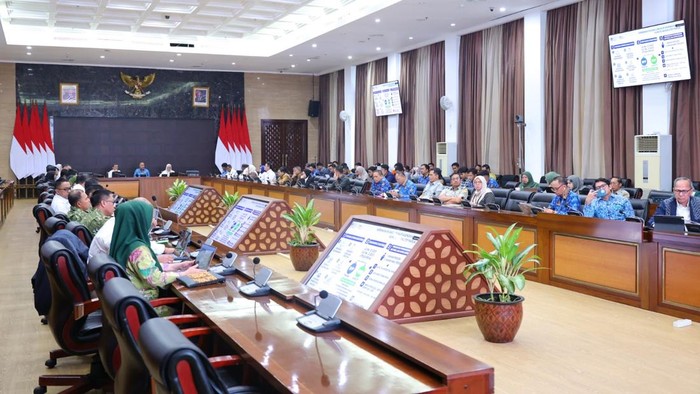
The Papua border development programme is entering a more integrated phase as the National Border Management Agency of Indonesia, known as BNPP, works with central institutions and regional stakeholders to accelerate development along the country’s frontier with Papua New Guinea.
The effort is no longer being framed simply around border posts, immigration controls or the movement of people and goods. Instead, BNPP is seeking to connect border infrastructure with economic activity, rural development, sustainable agriculture, community empowerment and improved living conditions in some of Papua’s more remote areas.
The latest coordination took place through the Forum for Synchronisation of Planning and Implementation of the 2025 to 2029 Action Plan for Accelerating Papua Development, or RAPPP. The forum brought together BNPP, the Executive Committee for the Acceleration of Special Autonomy Development in Papua, the Papua Special Autonomy Development Acceleration Steering Agency, ministries and agencies, as well as representatives of the Indonesian National Armed Force (TNI), the Indonesian Police (Polri) and the State Intelligence Agency (BIN).
For the government, the objective is straightforward but strategically important: development at Indonesia’s eastern frontier should help bring economic opportunities closer to communities that have historically faced difficult access to infrastructure, markets and public services.
From Border Control to Regional Transformation
A Wider Understanding of the Border
The latest BNPP initiative reflects a broader interpretation of what a national border represents.
Papua shares a land border with Papua New Guinea, and the two countries have long maintained official crossing points that serve communities on both sides. Yet the economic potential of these areas extends well beyond the immediate border gates.
Nurdin, Deputy for Management of State Border Areas at BNPP, said border development should be placed within a wider regional development framework.
“Border development should not merely be viewed as the development of exit-entry points,” Nurdin said, stressing that the frontier should also become part of efforts to establish economic connectivity with the interior of Papua and, in particular, with Papua New Guinea.
That approach represents an important shift in emphasis.
A border post can regulate legal movement. But roads connecting a border post with villages, markets and production centres can create an economic network. Agricultural areas can supply local markets. Small businesses can gain access to consumers. Better settlements can improve quality of life.
The development strategy therefore seeks to link these different components rather than treating each as an isolated government project.
Three PLBN Gates Anchor the Strategy
Skouw, Yetetkun and Sota
According to BNPP, Papua currently has three operating State Border Crossing Posts, or PLBN, which serve as official state gateways.
They are PLBN Skouw in Jayapura, PLBN Yetetkun in Boven Digoel and PLBN Sota in Merauke.
Each location has its own geographical and socioeconomic characteristics. Together, however, they provide the institutional and physical foundation for Indonesia’s border management along the Papua New Guinea frontier.
The government’s objective is to ensure that these facilities are not isolated points on the map.
Instead, we expect the areas surrounding the PLBNs to connect with broader development programmes, including transportation infrastructure, economic empowerment, and community-based initiatives.
Nurdin said connectivity from PLBN areas into the interior needs to continue developing and be integrated with physical infrastructure programmes and community empowerment.
The reasoning is particularly relevant in Papua, where long distances and challenging geography can make the cost of moving people and goods significantly higher than in more densely connected parts of Indonesia.
Better connectivity can therefore have an economic effect beyond transportation itself.
Yetetkun Provides an Example of Community-Driven Development
Agriculture and Environmental Priorities
One of the examples highlighted by BNPP is the Yetetkun border area.
According to Nurdin, communities in Yetetkun have expressed aspirations to improve their environment and develop sustainable agriculture. BNPP sees these priorities as useful references for designing development programmes based on the actual needs of local communities.
This is significant because development in remote border regions cannot rely entirely on infrastructure construction.
A new road or border facility can improve access, but its long-term impact depends on whether local residents can use that access to improve their livelihoods.
Agriculture is one potential pathway.
Where suitable land, water resources and local knowledge exist, improved connectivity can help farmers reach markets and obtain agricultural inputs. At the same time, sustainable production can reduce pressure on the local environment.
The Yetetkun example therefore illustrates the type of integrated approach BNPP is advocating: infrastructure should support communities, while community needs should influence how infrastructure and economic programmes are designed.
The Border as an Economic Gateway
The government’s broader objective is to create a stronger relationship between border infrastructure and local economic growth.
Nurdin said the presence of PLBN facilities provides legal access for cross-border movement while also beginning to create opportunities for economic activity in surrounding communities.
For local producers, formal border infrastructure can potentially provide a more predictable environment for legitimate trade and movement.
These matters because informal economic relationships have historically existed across the Indonesia-Papua New Guinea border, particularly among communities with cultural and family ties that predate the modern state boundary.
A well managed border can accommodate those realities while maintaining national regulations and sovereignty.
The development agenda is therefore not simply about increasing the volume of cross-border activity. It is about creating conditions in which legitimate economic and social interaction can take place within an orderly legal framework.
That distinction is important for both economic development and border governance.
Reintegrating Communities and Strengthening Social Cohesion
Development Goes Beyond Physical Infrastructure
The BNPP strategy also addresses social issues in border communities.
Nurdin pointed to Papuan residents currently living in Papua New Guinea who may wish to return to Indonesia. He said their relationship with family networks, customary communities and customary land in their areas of origin can represent an important form of social capital in voluntary return processes.
The government therefore sees infrastructure and community relations as interconnected.
Nurdin argued that a family-based approach and engagement with customary communities should accompany the development of physical infrastructure. In his view, such an approach can help reduce potential friction at the community level while supporting the reintegration of returning residents.
This is particularly relevant in Papua, where customary communities remain an important part of the social structure.
Development programmes that recognise local institutions and community relationships can potentially improve acceptance and effectiveness.
Rather than imposing a single model across all border areas, the approach described by BNPP places greater emphasis on understanding local circumstances.
Housing, Environment and Livelihoods Become Part of the Agenda
Border communities are not defined solely by their proximity to an international boundary.
They also need adequate housing, environmental protection, productive economic activities and access to public services.
Nurdin said the needs of border residents are increasingly extending into these areas. The desire for adequate settlements and better integration with neighbouring areas across the border demonstrates, he argued, the need for integrated planning.
This provides another reason for synchronising programmes among government institutions.
Planning road construction, housing, agriculture, border management, and economic empowerment independently can yield limited results.
A road may be completed without sufficient production to generate economic traffic. A market may be built without reliable transport. Agricultural programmes may struggle if farmers cannot reach their buyers.
The BNPP approach seeks to reduce such fragmentation by bringing different government programmes into a common development framework.
National Coordination is Central to the Strategy
RAPPP 2025 to 2029
The Papua border initiative forms part of the wider RAPPP 2025 to 2029 framework.
The recent forum included representatives from ministries and government agencies, BP3OKP, the Executive Committee for the Acceleration of Papua Development, TNI, Polri and BIN.
The broad composition reflects the complexity of development in Papua.
Economic development requires infrastructure and investment. Border management requires security and law enforcement. Community development requires social and administrative programmes. Indigenous communities require engagement with customary structures.
No single institution can manage all of these areas independently.
That is why synchronisation has become an important part of the government’s approach.
Earlier in 2026, BNPP also emphasised the importance of cross sector coordination in implementing its national border management action plan. The agency said the complexity of border areas requires collaboration among ministries, agencies and regional governments rather than isolated programmes.
Indonesia Wants Its Border Areas to Become Growth Centres
The latest Papua discussions are consistent with a wider national policy direction for Indonesia’s border regions.
In September, Interior Minister and BNPP Head Tito Karnavian said border areas should no longer be viewed as Indonesia’s “backyard” but developed as the country’s “front yard” and potential centres of economic growth and equitable development.
The statement provides a broader context for the Papua initiative.
A frontier community should not be defined by its distance from Indonesia’s major urban centres. Instead, government policy aims to ensure that border communities can participate in national economic development while maintaining effective state administration and security.
In Papua, that vision has a particular geographical significance.
The border with Papua New Guinea stretches across areas where settlements can be separated by substantial distances. Strengthening connectivity can therefore serve both economic and social objectives.
At the same time, infrastructure development remains linked to national sovereignty because formal border facilities help ensure that cross border movement takes place through recognised and regulated channels.
Infrastructure, Security and Economic Opportunity
The economic dimension of border development does not replace the security function of the state.
Instead, the two are being presented as complementary.
BNPP’s role includes coordinating border management involving multiple institutions. Recent government discussions have also emphasised the importance of maintaining security and sovereignty while developing economic opportunities in frontier areas.
For Papua, this means that economic connectivity must operate alongside immigration, customs, quarantine, policing and defence arrangements.
A functioning border economy depends on predictable rules.
Businesses need to know where goods can legally cross. Residents need legal channels for movement. Government agencies need reliable information. Security institutions need the capacity to respond to threats.
The PLBNs provide a physical platform for this system.
The next stage is to ensure that the communities beyond the gates can also benefit from the connectivity they create.
Why the Strategy Matters For Papua’s Interior
For international observers, the most important aspect of the current policy may be the attempt to connect border development with the interior rather than concentrating investment only at official crossing points.
Nurdin specifically said that connectivity from PLBN areas to inland Papua needs to continue expanding.
The potential economic logic is clear.
If producers in remote communities can reach larger markets more efficiently, the value of agricultural and other local products can increase. If roads and other infrastructure improve access to education, health services and public administration, development benefits can extend beyond the immediate border zone.
This does not mean that infrastructure automatically produces economic growth. Accompanying investment with productive activities, skills, market access, and appropriate maintenance is essential.
But without connectivity, many of those opportunities remain difficult to realise.
That is why the government’s current emphasis on synchronisation is significant.
Conclusion
Indonesia’s latest effort to accelerate Papua border development reflects a broader understanding of what a national frontier can become.
The three operating PLBNs at Skouw, Yetetkun and Sota remain important gateways for legal cross border movement. But BNPP is increasingly positioning them as starting points for wider development, linking border infrastructure with inland connectivity, local economic activity, sustainable agriculture, settlement improvement and community empowerment.
The challenge now is implementation.
The success of the strategy hinges on the ability to deliver various government programmes as a unified development effort instead of treating them as separate projects. It will also depend on meaningful engagement with communities, including customary institutions, and on ensuring that economic development proceeds alongside environmental protection and effective border governance.
For Papua, the potential significance is substantial. Better connectivity can bring remote producers closer to markets, create new opportunities for local businesses and improve access to services. For Indonesia, stronger border regions can simultaneously reinforce national integration, legal cross-border interaction and territorial governance.
The government’s message is increasingly clear: Indonesia’s eastern frontier is not simply a line to be guarded. It is also a place where communities live, work and trade, and where infrastructure can create new economic possibilities.
The task for BNPP and its partners is to turn that vision into durable results on the ground. If coordination succeeds, Papua’s border areas can become more than entry and exit points. They can develop into connected economic corridors that bring the benefits of national development closer to communities at Indonesia’s frontier.
Read Also
Papua Moves to Regulate Traditional RI-PNG Border Routes
RRI Expands Information Access Across Papua Border

