
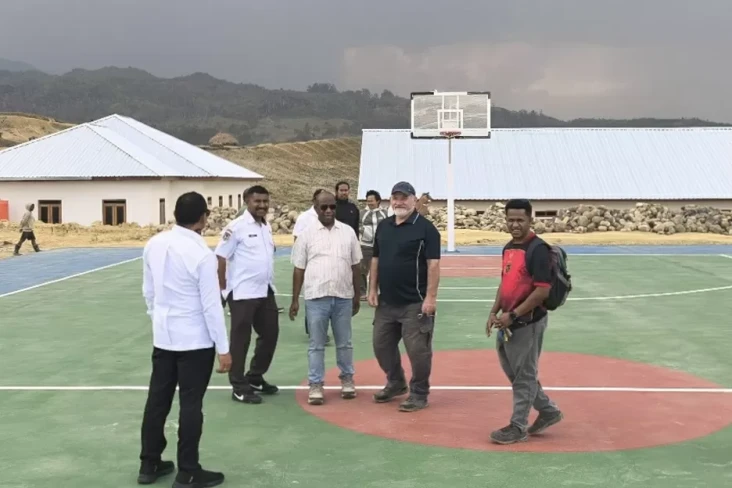
For many young people in Papua Pegunungan (Highland Papua), obtaining a university scholarship can provide access to opportunities that extend well beyond their hometowns. But securing a place at a university, particularly overseas, requires more than academic ambition. Students must also be prepared for demanding entrance requirements, unfamiliar learning environments, language expectations, and the responsibilities of studying away from home.
The provincial government is seeking to address that challenge through the Baliem Global Training Center, a boarding education and training facility being developed in Kampung Elekma, Napua District, Jayawijaya Regency. Built entirely with Indonesia’s Special Autonomy Fund, known as Dana Otonomi Khusus or Otsus, the center is designed to prepare high school graduates from Papua Pegunungan before they pursue higher education through scholarship programs at universities in Indonesia and abroad.
The project has received a total allocation of Rp27 billion, equivalent to approximately US$1.6 million, across two years of construction and development. The provincial government allocated Rp19 billion in 2025 for classrooms, dormitories, and office buildings, followed by another Rp8 billion in 2026 for supporting facilities.
The main school and dormitory buildings have been completed, while work on additional facilities is nearing completion. The government is targeting 2027 for the center to begin operating.
Beyond its physical infrastructure, the initiative is intended to connect two generations of Papuan students: young people preparing to enter university and graduates who have already received Otsus-funded scholarships and completed undergraduate, master’s, or doctoral studies. The latter are expected to contribute as instructors, sharing their knowledge and experience with the next group of scholarship candidates.
A New Approach to Preparing Scholarship Candidates
From high school graduation to higher education
The Baliem Global Training Center is designed to address a stage of education that can determine whether students are ready to make the most of scholarship opportunities.
Completing secondary school is an important achievement, but the transition to university can involve a different set of academic and personal demands. Students seeking admission to competitive institutions may need stronger preparation in core subjects, language proficiency, study skills, and independent learning.
Those planning to study outside Papua, particularly in international universities, may also need to adjust to different academic cultures and living arrangements.
The provincial government intends to use the center as a place where high school graduates can receive structured preparation before entering higher education.
Papua Pegunungan Regional Secretary Elai Giban explained that the institution would serve as an educational center for young Papuans who had completed secondary school and were preparing to continue their studies through scholarship programs.
“Baliem Global Training Center will become an educational center for children in Papua who have graduated from secondary school before they undertake scholarship programs at various universities, both domestically and overseas,” Giban said in a statement issued on November 10, as reported by RMOL.
The concept places preparation before scholarship placement at the center of the institution’s work. Rather than treating scholarships as a process that begins only when students apply to universities, the provincial government wants to build an environment where prospective candidates can strengthen their readiness in advance.
The center is therefore intended to function as more than a conventional boarding school. Its planned role combines academic preparation, personal development, and skills training.
How the Rp27 Billion Project Took Shape
2025: Construction begins with Rp19 billion
Development of the Baliem Global Training Center began in 2025, when the provincial government allocated Rp19 billion from the education sector’s Special Autonomy funding.
The initial allocation was used to construct the principal facilities: classrooms, dormitories, and office buildings.
The location in Kampung Elekma, Napua District, places the institution in Jayawijaya, one of the regencies in Papua Pegunungan. Its setting in the Baliem Valley region also gives the center a geographical connection to the communities it is intended to serve.
The boarding concept is particularly relevant to a province where students may come from different regencies and communities, with varying access to educational facilities. A residential arrangement can provide a shared learning environment for participants who need to undertake intensive preparation away from their home schools.
The government has not yet publicly detailed the final admission criteria, the number of students to be accepted in the first intake, or the selection calendar. Those details will be important as the institution moves towards operation.
2026: An additional Rp8 billion for supporting facilities
In 2026, the provincial government allocated another Rp8 billion to complete supporting infrastructure.
Simon Sembor, Acting Head of the Papua Pegunungan Education Office, confirmed that the entire construction budget came from the Special Autonomy Fund.
“The source of funding for the construction of this educational institution is entirely the Special Autonomy Fund,” Sembor said, according to RMOL.
The additional allocation is intended to make the facility operationally ready, rather than simply complete its main buildings.
Sembor said that in 2027 the government would provide computers, internet connectivity, and clean water while also preparing teachers and other instructors and completing facilities needed for teaching and learning.
These elements are essential to the center’s intended role. Students preparing for university scholarships need access to learning materials, digital resources, and reliable instruction. Internet access will be particularly important for research, university applications, and preparation for overseas study opportunities.
Clean water and appropriate residential facilities are equally important in a boarding environment, where students and staff will spend extended periods on the campus.
2027: The planned start of operations
The provincial government is targeting 2027 for the Baliem Global Training Center to begin operating.
Regional Secretary Giban said the main school and dormitory buildings had already been completed, with supporting facilities still being finalized.
“The school and dormitory buildings have been completed. Other supporting facilities are now being constructed and are almost finished,” he said, as reported by local media.
The next phase will involve equipping the institution, recruiting and preparing instructors, and establishing the academic arrangements needed for its first students.
The transition from construction to operation will be an important test of the program. A functioning training center requires not only buildings and equipment but also a clear curriculum, qualified instructors, student support, and a transparent admissions process.
The provincial government has indicated its intention to make the facility a long-term part of its education development strategy.
Scholarship Graduates Expected to Return as Instructors
One of the most distinctive aspects of the Baliem Global Training Center is its plan to involve graduates who have received higher education through Otsus-funded scholarships.
According to Sembor, many young people from Papua Pegunungan have pursued undergraduate, master’s, and doctoral degrees at universities in Indonesia and overseas through scholarship support worth more than Rp80 billion.
The government plans to use these graduates’ knowledge and experience by hiring them as instructors at the new center when they return to the province.
“Many children from Papua Pegunungan have pursued bachelor’s, master’s, and doctoral education at universities at home and abroad with support from Otsus scholarships worth more than Rp80 billion. When they return to Papua Pegunungan, they will be utilized as part of the teaching team at this school,” Sembor said.
The proposal creates a potential link between scholarship investment and local education development.
Graduates who have studied at universities outside Papua may bring back academic experience, language skills, research knowledge, and familiarity with different learning systems. Their involvement could provide prospective scholarship candidates access to guidance from people who have already experienced the challenges of higher education.
It may also create professional opportunities for returning graduates, allowing them to contribute to the province while continuing to develop their careers.
The arrangement reflects an approach in which scholarships are not viewed solely as individual opportunities. They can also form part of a wider effort to build local human resources, provided graduates are able to return and contribute through appropriate professional roles.
The government has not yet disclosed the final number of returning graduates who will be recruited or the specific teaching positions they will fill. Those arrangements are expected to be part of the centre’s operational preparation.
An Integrated Curriculum Beyond Academic Preparation
Academic ability, character, and practical skills
The Baliem Global Training Center is also being designed to provide a broader educational experience.
Paul Wetipo, Head of the Governor’s Expert Team and Chair of the Papua Cerdas Working Group, said the institution would apply an integrated curriculum covering academic ability, character development, sports, and practical skills.
This approach reflects the view that preparation for higher education should extend beyond examination results.
Students need the ability to manage their time, work with others, communicate effectively, and adapt to new situations. These qualities become particularly important when they enter universities far from their families and familiar communities.
Sports and physical activities can also provide opportunities to develop discipline, teamwork, and confidence. Practical skills, meanwhile, can help students become more adaptable as they move between academic and professional environments.
The center’s curriculum is therefore intended to combine intellectual development with personal and social preparation.
Preserving Papuan identity while preparing for global opportunities
Another priority identified by Wetipo is the development of students’ sense of identity.
He said the center would seek to ensure that young people could pursue academic opportunities at national and international levels without losing their connection to their cultural background.
“We do not want the young generation who will become future leaders to lose respect for their identity. They must be proud to be Papuan and proud to be Indonesian,” Wetipo said, according to ERA.id.
The statement reflects the center’s intended balance between global exposure and local identity.
For students who may eventually study in major Indonesian cities or overseas, maintaining a strong understanding of their cultural background can be an important part of personal development.
The aim is not to limit students to opportunities within their home region but to prepare them to participate in wider academic and professional environments while remaining connected to their communities.
In this sense, the Baliem Global Training Center is expected to combine educational preparation with an understanding of cultural identity and national citizenship.
Special Autonomy Funding and the Development of Human Resources
The project also illustrates how Special Autonomy funding is being directed towards education infrastructure and human resource development in Papua Pegunungan.
Special Autonomy is a policy framework that provides additional fiscal support for Papua’s development, including sectors such as education, health, and community welfare.
In the case of the Baliem Global Training Center, the provincial government has allocated Rp27 billion specifically for the construction and supporting facilities of the institution.
This construction allocation should be distinguished from the more than Rp80 billion in Otsus scholarship funding cited by Sembor. The two figures refer to separate education investments: one for developing the training center and the other for supporting students pursuing higher education.
The distinction is important when assessing the scale and purpose of public expenditure.
The training center is intended to help future scholarship recipients become better prepared, while the scholarship program supports their subsequent university studies.
If implemented effectively, the two initiatives could form part of a continuous education pathway: secondary school graduates receive preparation, successful candidates pursue higher education, and returning graduates contribute to the next generation’s development.
However, the long-term value of the investment will depend on the center’s ability to deliver measurable educational outcomes.
These could include the number of students completing its preparation program, scholarship application and admission results, university graduation rates, and the number of returning graduates who contribute to local institutions.
Transparent selection procedures and regular public reporting would also help demonstrate that the facility is serving students from across Papua Pegunungan.
The Road Ahead: From Infrastructure to Educational Results
The construction of the Baliem Global Training Center represents an important stage in the provincial government’s plan to strengthen the preparation of young people for higher education.
Yet the real test will begin once the facility opens.
The government will need to ensure that computers, internet services, clean water, and residential facilities are fully functional. It will also need to establish a qualified teaching team and a curriculum that responds to the admission requirements of universities in Indonesia and overseas.
Equally important will be the selection of students. A clear and accessible process could help ensure that young people from all eight regencies have a fair opportunity to benefit from the program.
The involvement of returning scholarship graduates could become one of the center’s most valuable assets. Their experiences may provide practical guidance that cannot be gained from textbooks alone.
At the same time, the institution will need to maintain a strong focus on academic standards. Character development and cultural identity are important, but students must also receive the subject knowledge and language preparation required to succeed in competitive university environments.
These priorities will determine whether the center becomes a sustainable educational institution rather than simply a completed construction project.
Conclusion
The Baliem Global Training Center represents an effort by the Papua Pegunungan provincial government to connect special autonomy investment with long-term human resource development.
Through Rp27 billion in Otsus funding, the government has financed the construction of classrooms, dormitories, offices, and supporting facilities in Kampung Elekma, Jayawijaya. The center is expected to begin operating in 2027 as a boarding education and training institution for high school graduates preparing to pursue scholarships at universities in Indonesia and abroad.
Its proposed involvement of returning Otsus scholarship graduates as instructors adds another dimension to the program. It offers a potential way to bring academic experience back into the region and allow former scholarship recipients to support younger students.
The next phase will require careful attention to teaching quality, admissions, student welfare, curriculum delivery, and the management of public funds.
Ultimately, the success of the Baliem Global Training Center will not be measured by the size of its buildings or the amount of funding allocated. It will be measured by the opportunities it helps create: young Papuans who are academically prepared, confident in their abilities, equipped with practical skills, and able to contribute to their communities.
From the Baliem Valley, the provincial government is seeking to build a pathway that connects local aspirations with national and international education opportunities. Its lasting impact will depend on how effectively that pathway is put into practice.
Read Also
Puncak Regency Sends 15 Papuan Students Abroad to Build Human Capital
Bhayangkari Scholarships Support 32 Papuan Students in Papua Tengah

