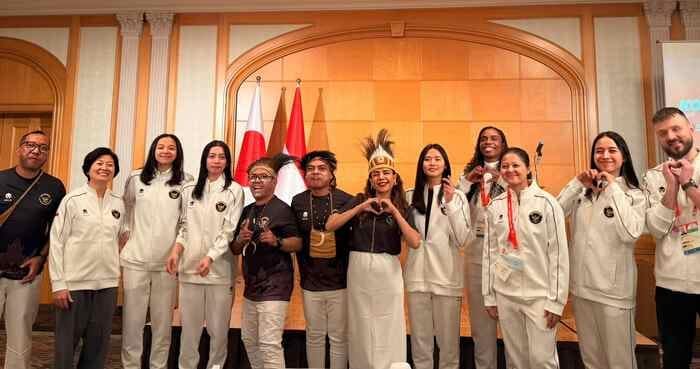
When Indonesia’s Asian Games contingent arrived in Nagoya on September 18, the welcome carried a distinctly Papuan voice. Papua musicians Nowela Mikhelia, Bona Pascal, Nobo Idol, and Boii Soa Soa stood alongside the Indonesian delegation and led the singing of Indonesia Raya, turning a sporting welcome into a moment of music, culture, and national encouragement.
Their presence at the Aichi Nagoya 2026 Asian Games was more than a performance appearance. The four musicians were invited to take part in activities supporting Indonesia’s athletes and officials, bringing songs from Papua and Indonesia to an international sporting environment in Japan.
For Nowela, the experience carried a personal meaning. She described the opportunity to perform Indonesia Raya while representing Papua as a way of sending prayers and encouragement from home to Indonesian athletes competing thousands of kilometers away.
“From Papua, we came carrying the spirit for Indonesia,” Nowela said.
The appearance also reflected a broader cultural message. Papua’s presence in Nagoya extended beyond sports. Music became another way for Indonesian audiences and international visitors to encounter the province’s cultural identity.
From Papua to Nagoya
The journey of the four musicians unfolded alongside Indonesia’s participation in the 2026 Asian Games.
On Friday, September 18, they welcomed the Indonesian contingent as it arrived in Nagoya. Nowela, Bona Pascal, Nobo Idol, and Boii Soa Soa led the singing of Indonesia Raya, providing an emotional soundtrack to the arrival of athletes and officials preparing for competition.
The following day, September 19, their role continued at the inauguration of Rumah Indonesia in Nagoya.
The four musicians performed a selection of national songs as well as songs from Papua. The event brought together Indonesian officials, athletes, and members of the delegation in a setting designed to support the country’s contingent during the Asian Games.
Among those attending were Youth and Sports Minister Erick Thohir, Indonesian Team Chef de Mission Todotua Pasaribu, and Indonesian Ambassador to Japan Nurmala Kartini P. Sjahrir, along with Indonesian athletes and officials.
The setting gave the musicians an opportunity to perform before an audience connected directly with Indonesia’s largest sporting delegation in Japan.
It also placed Papua’s musical expression within an event representing Indonesia on an international stage.
Music Meets Sport in Nagoya
Sporting events often create their own language of national identity.
Athletes compete individually or as teams, but they also carry the colors, symbols, and hopes of their countries. Music can reinforce that atmosphere in ways that statistics and competition results cannot.
The four Papua musicians in Nagoya played that role.
Their performances were not part of the sporting competition itself. Instead, they contributed to the atmosphere surrounding Indonesia’s participation, offering encouragement to athletes and providing a cultural element to events involving the Indonesian delegation.
For Papua, the significance lies in the visibility of its artists.
Nowela Mikhelia, Bona Pascal, Nobo Idol, and Boii Soa Soa were able to appear in Japan not simply as individual performers, but as musicians from Papua participating in an international event associated with Indonesia.
That distinction is relevant for an international audience.
Discussions about Papua often revolve around political, security, and development issues. The Nagoya appearance presented another dimension: Papuan artists participating in a major international sporting event and expressing support for Indonesian athletes through music.
Nowela: Bringing Papua’s Voice to Japan
For Nowela, the opportunity was closely connected with both her artistic journey and her identity as a Papuan musician.
She said that being present at the Asian Games allowed her to bring Papua to an international stage while directly supporting Indonesian athletes.
“Being here, bringing Papua and singing Indonesia Raya to encourage Indonesian athletes is a very meaningful experience for me. We came from Papua carrying prayers and encouragement for Indonesia,” Nowela said in a written statement.
Her words capture the dual character of the trip.
There was the professional side of performing overseas, an experience that can broaden an artist’s exposure. But there was also a personal and cultural dimension, with Nowela describing the journey as an opportunity to carry Papua’s identity beyond Indonesia.
The two elements came together in Nagoya.
A Papuan musician could perform Indonesian national songs while also presenting songs associated with Papua, showing that regional cultural identity and national representation could coexist on the same stage.
A Chance for Papuan Talent to Reach a Wider Audience
Nowela also expressed appreciation to PT Freeport Indonesia, which supported the participation of the musicians in Japan.
According to the reports, the company provided an opportunity for Papuan talents to gain experience and perform on an international stage.
Nowela said she was proud to bring the colors of Papua to Japan while supporting Team Indonesia.
She also expressed hope that more Papuan talents would receive opportunities to demonstrate their work and abilities to wider audiences.
That point extends the significance of the Asian Games appearance beyond the four musicians.
For emerging artists, international exposure can provide experience that is difficult to obtain without access to major events, professional networks, and overseas audiences.
The Nagoya experience therefore became a small example of how sporting events can create cultural opportunities beyond the competition arena.
Todotua Pasaribu Welcomes the Papuan Musicians
Indonesia’s Asian Games Chef de Mission, Todotua Pasaribu, also highlighted the significance of the musicians’ presence.
He said he was proud to see Papuan musicians in Nagoya bringing both Papua’s cultural richness and the spirit of Indonesia to the event.
According to Todotua, their presence gave a distinctive color to the Indonesian delegation and added encouragement to the athletes competing at the Asian Games.
His statement reflects an important feature of large international sporting events.
A national delegation is made up of more than athletes. Coaches, officials, medical personnel, support staff, and cultural representatives can all contribute to the environment surrounding a country’s participation.
In Nagoya, music became part of that support structure.
The presence of Papuan artists also allowed the Indonesian delegation to showcase a regional culture with a strong musical identity.
Freeport Indonesia and the Search for Papuan Talent
PT Freeport Indonesia President Director Tony Wenas said the appearance of the musicians represented a spirit of togetherness in supporting Indonesian athletes.
He said the company was proud to see Papuan musicians in Nagoya carrying the spirit of Papua while supporting Team Indonesia.
Tony also emphasized the wider potential of Papua’s creative talent.
“Papua has so many talents with works and potential to be proud of,” he said, adding that the company wanted to help create opportunities for them to gain new experiences, demonstrate their abilities, and bring Papuan identity to broader stages.
The statement puts the Nagoya trip within a broader conversation about talent development.
Papua’s young people and creative professionals are increasingly participating in areas that extend beyond traditional sectors. Sport, music, culture, education, and entrepreneurship all provide avenues through which Papuan talent can gain national and international exposure.
The challenge is to ensure that these opportunities become sustainable instead of remaining isolated events.
Papua’s Cultural Identity on an International Stage
Viewing Papua’s cultural diversity reveals the significance of the four musicians’ appearance.
Papua has a large number of distinct communities, traditions, and musical expressions. Presenting Papuan music at an international event provides an opportunity to introduce part of that cultural richness to audiences who may know the region primarily through news about politics, geography, or security.
The Rumah Indonesia event offered a natural setting for this.
The musicians performed national songs alongside songs from Papua, allowing the two cultural layers to exist together rather than being presented as competing identities.
That combination became one of the strongest messages from their participation.
The musicians simultaneously supported Indonesia’s national sporting delegation while representing Papua through its own cultural expression.
For an international audience, that provides a more complete picture of Papua as a place of culture and talent, rather than a region understood only through difficult political and security narratives.
A Different Kind of Support for Indonesian Athletes
Athletes preparing for international competition face pressure that extends beyond training.
They spend months preparing physically and mentally, often far from their families. The atmosphere surrounding a major event can therefore influence morale.
The arrival of familiar cultural expressions can provide a sense of connection.
For Indonesian athletes in Nagoya, hearing Indonesia Raya led by musicians from Papua created one such moment.
The message was simple: support had travelled with them from across Indonesia.
Nowela’s statement that the musicians came from Papua carrying prayers and encouragement for Indonesia captured that sentiment.
Their contribution was not measured in medals or competition results.
It was measured in atmosphere, cultural representation, and the sense of collective support surrounding the Indonesian team.
The Asian Games as a Cultural Meeting Point
The Aichi Nagoya Asian Games provides a particularly broad international platform.
Athletes and officials from across Asia gather in Japan, bringing different languages, traditions, and cultural backgrounds with them.
Within that environment, every national delegation has an opportunity to show something about the society it represents.
Indonesia’s participation therefore extends beyond sporting performance.
The presence of Papuan musicians adds another layer to that representation.
The musicians’ appearance also demonstrates how culture can travel alongside sport.
An athlete may introduce Indonesia through competition, while a musician can introduce Indonesia through sound and performance. Both can contribute to how international audiences experience a country.
For Papua, that opportunity is especially meaningful because it allows regional identity to become part of an international cultural conversation.
More Than a Performance
It would be easy to describe the Nagoya appearance simply as a musical performance.
But the story is broader.
Four Papuan musicians travelled to Japan, welcomed Indonesian athletes, led the national anthem, performed national and Papuan songs, and participated in an event attended by senior Indonesian officials and the national sporting delegation.
Their presence connected three elements: Papua, Indonesian national identity, and international sport.
That combination provides an example of cultural participation that does not require abandoning regional identity.
Instead, the musicians brought their regional identity with them.
For Nowela, this was precisely what made the experience meaningful.
She said she was proud to bring Papua’s colors to Japan while encouraging Team Indonesia and hoped more Papuan talents would have opportunities to show their work to the world.
A Broader Opportunity for Papua’s Creative Economy
The appearance also points toward the potential of the creative economy in Papua.
Music can create employment, professional networks, and opportunities for cultural promotion. International appearances can expose artists to new audiences and collaborators.
The sources do not provide economic figures or evidence that the Nagoya appearance has already generated measurable commercial benefits for Papua.
Nevertheless, the opportunity itself is significant.
International exposure can become part of a longer process of talent development if followed by training, professional management, access to recording and performance infrastructure, and continued opportunities to appear before wider audiences.
Tony Wenas’s remarks about creating opportunities for Papuan talents point toward precisely this broader ambition.
The challenge will be to ensure that talented artists from Papua can continue building careers after the international spotlight moves elsewhere.
From the Asian Games Back to Papua
When the Asian Games eventually ends, the most lasting part of the musicians’ participation may not be the photographs from Nagoya.
It may be the example they provide to younger Papuan artists.
A young musician watching Nowela, Bona Pascal, Nobo Idol, and Boii Soa Soa perform in Japan can see a possible path from local talent to national recognition and international exposure.
That journey requires work, discipline, and opportunity.
The same principle applies in sport.
Papua has produced athletes who have represented Indonesia at major competitions, while its musicians have also built audiences across the country.
Bringing these forms of achievement into the same international setting creates a powerful picture of Papua’s contribution to Indonesia.
Conclusion
Nowela Mikhelia, Bona Pascal, Nobo Idol, and Boii Soa Soa brought a unique perspective to the Aichi Nagoya 2026 Asian Games, differing from the typical sporting narrative.
They did not enter the competition as athletes. Instead, they stood alongside Indonesia’s contingent as musicians, cultural representatives, and supporters.
On September 18, they led Indonesia Raya as the Indonesian delegation arrived in Nagoya. The next day, they performed national and Papuan songs at the inauguration of Rumah Indonesia, attended by Indonesian officials, athletes, and members of the delegation.
For Nowela, the trip was an opportunity to bring Papua to an international stage while sending encouragement to Indonesian athletes.
For Todotua Pasaribu, the musicians brought cultural richness and additional energy to the Indonesian team.
For Tony Wenas, their appearance demonstrated the potential of Papuan talent and the importance of creating opportunities for artists to gain experience and reach wider audiences.
Perhaps the most memorable message came from Nowela herself: “From Papua, we came carrying the spirit for Indonesia.”
In Nagoya, that spirit was expressed through music.
And for Papua, the journey offered a reminder that its contribution to Indonesia can be heard not only in the songs themselves but also in the talent, culture, and people who carry those songs beyond the country’s borders.
Read Also
Mikhayla Shanum Caya from Papua Pegunungan Represents Indonesia in the Asian Games
Why Papua and Maluku Back the Dutch’ Football Team