
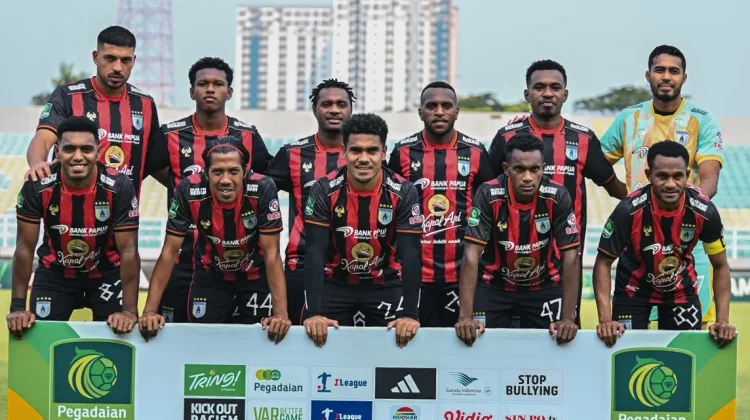
The history of Persipura Jayapura and the Indonesia national football team has been shaped by a recurring story: players emerging from Papua, developing their abilities in local football, and eventually earning the opportunity to wear the Garuda emblem on the international stage. For decades, Persipura has stood at the center of that journey, providing a platform for generations of footballers whose skills have enriched the national game.
Known affectionately as Mutiara Hitam, or the Black Pearls, Persipura is more than a football club in Jayapura. Its history reflects the contribution of Papua to Indonesian sport, from the early achievements of Rully Nere and the long service of Eduard Ivakdalam to the remarkable career of Boaz Solossa and the emergence of younger players such as Ramai Rumakiek.
Their careers span different eras of Indonesian football, but they share a common thread. Papua has continued to produce players capable of competing at the highest domestic level and representing Indonesia. Persipura’s record offers a compelling example of how regional clubs can become important pathways to national sporting achievement.
The club has experienced difficult periods, including relegation from the top division and the challenge of rebuilding its competitive strength. Yet those setbacks should not obscure its historic contribution. The more pressing question is how Persipura and Papua’s wider football community can strengthen youth development so that the next generation follows the path established by its predecessors.
From Early Pioneers to the National Stage
Long before Persipura became one of Indonesia’s most successful clubs, Papuan footballers were already making their mark beyond the region.
Rully Nere stands among the pioneers of this tradition. Emerging during a period when travel and access to football opportunities across Indonesia were more difficult, he helped demonstrate that players from Papua could compete alongside footballers from the country’s established sporting centres. His career became part of a broader story of Papuan representation in Indonesian football.
Rully’s significance lies not only in his performances but also in what his career represented for younger players. At a time when geographical distance could make national recognition more difficult, his progress helped establish a route for talent from eastern Indonesia to gain wider attention.
Earlier Persipura generations also included figures such as Yohanes Auri, Timo Kapisa, Hengky Heipon, and other players who helped build the club’s reputation. Their achievements formed part of the foundation on which later generations would build.
A major milestone came in 1976, when Persipura defeated Persija Jakarta 4-3 in the third Soeharto Cup final at the Gelora Bung Karno stadium. The victory helped raise the club’s national profile and became an important episode in its history.
Persipura had also represented Indonesia in an invitational tournament in Saigon, present-day Ho Chi Minh City, in 1974, finishing as runner-up. The club subsequently participated in international competitions in Bangkok and Kuala Lumpur, gaining experience against teams from outside Indonesia.
These achievements helped establish a reputation that would endure long after the players of that era retired. Persipura was becoming a club capable of carrying the ambitions of Papuan football beyond its home region.
Eduard Ivakdalam: A Link Between Generations
By the 1990s, Eduard Ivakdalam had become one of the most recognizable figures in Persipura’s history. Born in Merauke, the midfielder spent 16 years with the Jayapura club, from 1994 until 2010. Known for his left foot and ability to influence play from midfield, he became a central figure during a period of sustained development for the team.
Ivakdalam was not simply a club player. He also represented Indonesia internationally between 1996 and 2004 and was part of the national team that won the silver medal in men’s football at the 1997 Southeast Asian Games. His career demonstrated how a player could build a long-term identity with Persipura while contributing to Indonesia’s wider sporting ambitions.
His club career coincided with Persipura’s emergence as a more consistent force in national competition. The team combined experienced players with younger footballers, creating an environment in which emerging talent could learn from established professionals.
Persipura’s league titles in 2005 and 2008-09 helped consolidate that progress. The success was not simply a story of individual brilliance. It reflected the value of assembling a team with a strong local foundation, experienced leadership, and the ability to compete over an entire season.
Ivakdalam later continued to contribute to Papuan football through coaching. In 2021, he led Papua’s men’s football team to a gold medal at the National Sports Week, known as PON, held in Papua. This achievement illustrates how players can leverage their on-pitch experience to develop future talent.
His transition from player to coach also highlights a key requirement for the future of Papuan football. A strong talent pipeline needs more than gifted young athletes. It also requires coaches, mentors, and local competitions capable of developing players over time.
Persipura’s Golden Era and the Rise of Boaz Solossa
The early 2000s brought a major transformation in Persipura’s standing. The club developed into one of Indonesia’s leading sides, combining experienced players with emerging talent from Papua.
Among the generation that helped shape this era were Ian Louis Kabes, Ricardo Salampessy, Yustinus Pae, Gerald Pangkali, Christian Warobay, and Boaz Solossa. Their rise showed how a strong club structure could bring local talent into national prominence.
Boaz, born in Sorong, became the most prominent symbol of that generation. He established himself as a prolific forward, known for his pace, movement, and ability to score in decisive moments. He made his professional debut at a young age and spent much of his career with Persipura, becoming closely associated with the club’s identity.
His record with Persipura was exceptional. The club won major domestic league titles in 2005, 2008-09, 2010-11, and 2013, while also lifting the Indonesia Soccer Championship A trophy in 2016. Boaz contributed significantly to that period of success and collected multiple top-scorer and individual-player awards.
At the international level, Boaz became one of Indonesia’s notable forwards. Radio Republik Indonesia’s October 2026 feature reported that he recorded 48 appearances and 14 goals for the national team. His career demonstrated how a player developed in Papua could become an important figure in Indonesian football.
His path, however, was not without setbacks. In 2007, as Indonesia prepared for the Asian Cup, Boaz suffered a serious fibula fracture and ankle injury that prevented him from playing in the tournament. Teammates Jendry Pitoy and Ricardo Salampessy made it to Indonesia’s final squad, but Boaz missed the chance due to his injury.
This episode serves as a reminder that circumstances beyond their control can shape even the most talented players’ careers. Yet Boaz continued to leave a substantial mark on Indonesian football, and his name remains inseparable from Persipura’s most successful years.
A Legacy Beyond One Star
While Boaz became the face of Persipura’s golden generation, the club’s contribution extends beyond a single player.
Ian Louis Kabes became an important figure in the team’s midfield, while Ricardo Salampessy and Yustinus Pae helped provide defensive stability. Other players from Papua developed careers at Persipura and elsewhere in Indonesia, demonstrating the depth of talent emerging from the region.
The broader story also includes Papuan footballers who established themselves at other Indonesian clubs. Ronny Wabia, who played for Persipura from 1995 to 2003, was named the best player in the 1995-96 Indonesian league season. Erol Iba developed a reputation as a strong left-sided defender, while Elie Aiboy enjoyed a long professional career in Indonesia and Malaysia.
These careers highlight the fact that Papuan football talent extends beyond a single club or generation. Persipura has served as a prominent platform, but the wider development of players also depends on opportunities at other clubs, youth competitions, and access to professional coaching.
For the national team, that diversity matters. A healthy football system draws from different regions, playing styles, and development environments. Papua’s contribution gives Indonesia a wider pool of players to evaluate and helps make the national game more representative of the country’s geographic and cultural diversity.
Ramai Rumakiek and the Next Generation
The tradition continued with Ramai Rumakiek, a Jayapura-born player developed through Persipura’s football environment.
Ramai attracted attention for his pace, willingness to take on defenders, and ability to operate in tight spaces. In January 2022, he marked his Indonesia senior-team debut against Timor-Leste in a friendly match in Bali by scoring a goal. The performance provided a clear example of a younger Papuan player making the transition from domestic football to the national stage.
His emergence matters because it demonstrated that Persipura’s contribution extended beyond the era of Boaz Solossa. Even as the club faced growing competitive challenges, it continued to provide opportunities for players who could attract national attention.
Other younger players have also shown potential. Todd Rivaldo Ferre, for example, was named the best young player in Liga 1 in 2019 while playing for Persipura. Gunansar Mandowen also drew attention for his movement and attacking qualities. Their careers illustrate both the promise of the talent pool and the need for consistent development, professional discipline, and suitable opportunities.
Not every promising player will immediately earn a place in the senior national team. Selection depends on many factors, including form, fitness, tactical requirements, and competition for positions. But the existence of talented players is only the beginning. Clubs and football authorities must ensure that potential is supported by regular competition, quality coaching, and a clear progression from youth football to the senior game.
Relegation Is a Setback, Not the End of the Story
Persipura’s achievements have not shielded it from difficult periods. In 2022, the club was relegated from Indonesia’s top division after finishing level on points with Barito Putera but losing the head-to-head comparison. The outcome marked the end of a lengthy tenure in the top division and surprised numerous fans who had become accustomed to witnessing the Black Pearls among the nation’s elite teams.
The reaction reflected the club’s wider significance. Former Persipura star Boaz Solossa expressed his disappointment on social media, thanking the players for their efforts on behalf of their families and the Papuan community. “You have fought for your families and the people of Papua,” he wrote in a message reported by Indonesian media.
The response from outside the club was also telling. I Putu Gede, then coach of PSS Sleman, said Persipura’s relegation meant that the top division had lost one of its best teams, citing its history, quality, and distinctive playing style.
The club’s difficulties continued to shape its more recent seasons. In May 2026, Persipura lost 1-0 to Adhyaksa FC in a promotion play-off and remained in the second tier for the 2026-27 season. The result underlined the scale of the rebuilding task, even for a club with a decorated history.
Yet league position and talent production are not the same thing. Relegation affects a club’s visibility, finances, recruitment, and ability to attract high-level competition. It does not mean that the region has run out of footballers.
The challenge is to ensure that young players continue to receive opportunities, whether through Persipura, other professional clubs, school competitions, regional academies, or national development programs.
Building the Next Pathway From Papua to Garuda
Persipura’s historical contribution offers useful lessons for the next stage of football development in Papua. The first is the importance of continuity. Generations of players developed in a football environment where local talent could progress to senior competition and, in some cases, the national team.
The second is the need for stronger grassroots development. Young players require access to safe playing facilities, qualified coaches, regular competitions, and pathways that allow them to progress without having to leave their communities too early. Family support and local competition also play important roles in helping promising players remain involved in the sport.
The third is institutional sustainability. A club’s ability to develop talent depends on more than its playing squad. Financial management, recruitment, coaching standards, youth programs, and long-term planning all influence whether promising players receive the support needed to fulfill their potential.
Persipura’s history shows what can happen when these elements come together. Its domestic titles helped create a competitive environment, while its players brought recognition to Papua and Indonesia. Maintaining that tradition will require sustained effort from the club, regional football organizations, schools, coaches, and national football authorities.
Papua’s talent pool should also be understood in national terms. Players from Jayapura, Merauke, Sorong, and other parts of the region are part of Indonesia’s broader football community. Their success benefits the clubs that develop them, but it also strengthens the national team and creates role models for young athletes across the country.
Conclusion
Persipura Jayapura’s place in Indonesian football rests on more than its trophies. It lies in the generations of players who moved from local pitches to professional competition and then to the national team, carrying the hopes of their communities while contributing to Indonesia’s sporting identity.
Rully Nere helped establish an early path. Eduard Ivakdalam linked club success with international representation and later returned to coaching. Boaz Solossa became one of the defining figures of Persipura’s golden era, while Ramai Rumakiek showed that younger players from the same football environment could still reach the national stage.
The club’s recent difficulties are real and should not be dismissed. Rebuilding its competitive position will require sound management and sustained investment in youth development and opportunities for emerging players to gain experience. But the history of Papuan football provides strong reasons not to confuse a club’s setbacks with an absence of talent.
Persipura serves as a reminder for Indonesia that recognizing and developing regional potential fosters national sporting strength. The next generation may follow a different route from its predecessors, but the fundamental opportunity remains: to provide young Papuan footballers the training, competition and support they need to represent their clubs and, when selected, the Garuda.
As long as that pathway remains open, Papua’s contribution to Indonesian football will continue to be measured not only by past champions but also by the players still waiting for their opportunity.
Read Also
Persipura Targets Liga 1 Return with New Era
Persipura Jayapura at 63: New Faces This Season That Could Define Its Future
Persipura Jayapura: A Legacy of Excellence in Indonesian Football

