
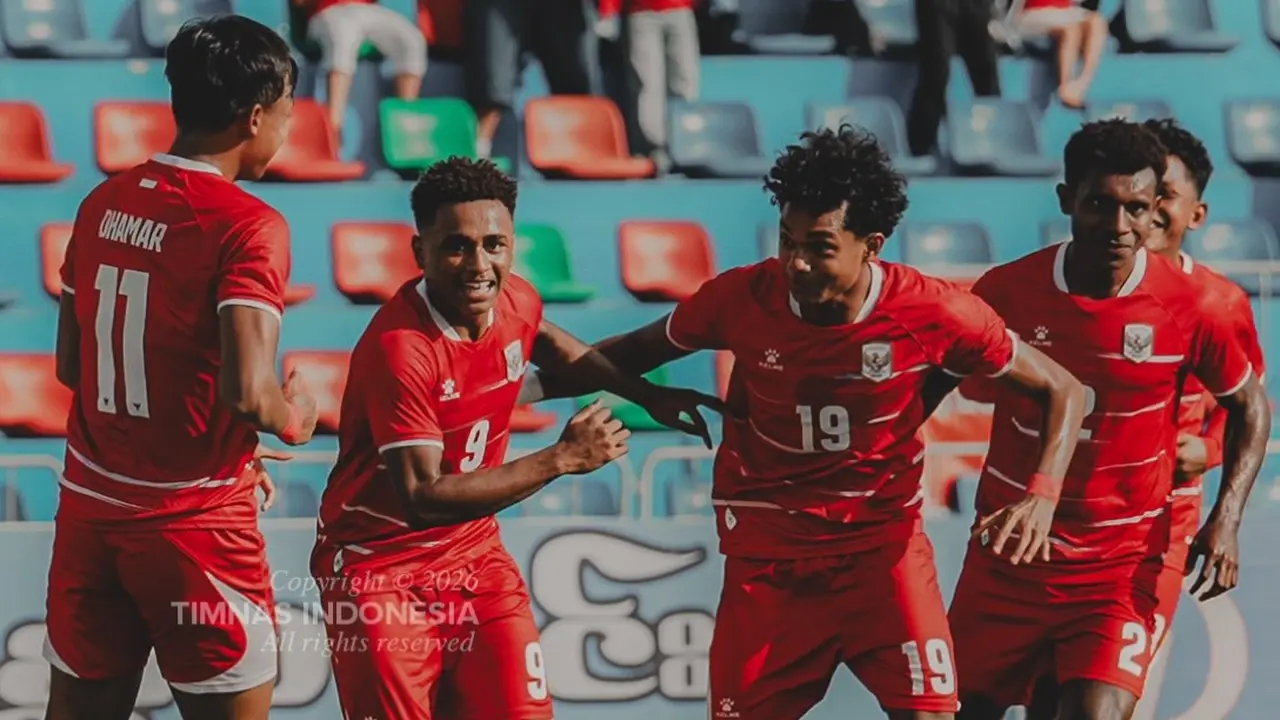
Papua’s contribution to Indonesian football is gaining fresh attention as two young players, Chico Jericho Yarangga and Dolvi Theofilus Solossa, emerge as important figures in the Indonesia Under-17 national team. Their performances in the 2027 AFC U-17 Asian Cup qualifiers have offered a compelling reminder that Papua continues to produce footballers capable of competing at the highest levels of youth football in the country.
Both players were born in Jayapura and have grown through different stages of football development before earning places in the national squad. Chico, a left-footed attacking player with experience in youth development competitions, has impressed with his movement, crossing, and ability to create chances. Dolvi, meanwhile, has attracted attention for his pace, confidence in one-on-one situations, and attacking instincts.
Their stories became even more prominent during Indonesia’s opening matches in Group A of the Asian Cup qualifiers in Myanmar. Indonesia defeated the Philippines 3-0 on November 11, before beating Cambodia 2-0 on November 14, 2026. Both Papuan players contributed to the team’s attacking performance, with Chico providing assists in the two matches and Dolvi scoring against Cambodia.
Their progress is about more than individual achievement. It reflects the depth of football talent in Papua, a region with a long association with the sport and a history of producing players who have represented Indonesia with distinction.
Two Papuan Players Making Their Mark
The presence of Chico and Dolvi in the national squad has attracted attention because they represent two different generations of football heritage and development pathways in Papua.
Both are sons of former Indonesian national team players. Born in Jayapura March 28, 2010, Chico is the son of Chris Yarangga, a former Persipura Jayapura midfielder who represented Indonesia during the 1990s. Dolvi is the son of Ortizan Solossa, a former national team defender, and the nephew of Boaz Solossa, one of the most recognizable forwards in Indonesian football.
Yet their selection is not based on family names alone. Their performances, technical abilities, and development through organized youth football have helped them earn opportunities at the national level.
The two players also demonstrate how Papua’s football tradition continues to evolve. Established family legacies remain influential, but modern academies, youth competitions, and structured coaching are increasingly important in preparing young players for national and international football.
Chico Jericho Yarangga: A Left-Footed Attacking Prospect
Chico Jericho Yarangga, 16, has developed into one of the attacking options trusted by Indonesia U-17 coach David Nascimento.
His football journey began in Jayapura, where he trained at Sekolah Sepak Bola (SSB) Nafri, a football school established by his father, Chris Yarangga, and his mother. The early environment gave Chico an opportunity to develop his technical ability while learning the discipline required in organized football.
He later continued his development at ASIOP, one of Indonesia’s established football development institutions, and was also involved with Garuda United U-18 in the Elite Pro Academy competition.
Chico is known as a left-footed player with good ball control, an ability to deliver set pieces, and an understanding of attacking movement. These qualities have made him useful in wide attacking positions, where he can challenge defenders, create space, and deliver crosses into the penalty area.
His national-team debut came on February 8, 2026, when Indonesia’s U-17 side was coached by Nova Arianto. According to CNN Indonesia’s profile published on November 13, Chico had recorded 12 appearances for the youth national team, with one goal and three assists at that point.
His first international goal came from a free kick in a friendly match against China on February 11, 2026. Indonesia lost that match 3-2, but the goal provided an early indication of Chico’s ability to contribute from set-piece situations.
The statistics and his growing role in the team suggest that he is becoming more than a promising prospect. He is increasingly involved in the attacking structure of a national side competing for a place in the continental finals.
Dolvi Theofilus Solossa: Carrying a Famous Football Name
Dolvinus Theofilus Bochrit Solossa, widely known as Dolvi Solossa, is another emerging talent from Jayapura. Born on November 15, 2010, he turned 16 on 15 November 2026, one day after Indonesia’s victory over Cambodia.
Dolvi comes from a family with a significant place in Indonesian football history. His father, Ortizan Solossa, was a respected left-back who played for several Indonesian clubs, including Persipura Jayapura, PSM Makassar, Persija Jakarta, Arema Malang, and Persiram Raja Ampat.
His uncle, Boaz Solossa, is widely regarded as one of Indonesia’s outstanding forwards of his generation. Boaz became a major figure in Persipura’s successful years and also represented the national team, scoring 13 goals in 50 international appearances, according to figures reported by Tirto.
For Dolvi, this family background provides a strong connection to Papua’s football history. It also brings expectations. However, his early performances suggest that he is beginning to establish his own identity rather than simply following the achievements of his relatives.
Dolvi received his early football development through Papua Football Academy. He subsequently competed for Garuda United U-18 in the 2026/2027 Elite Pro Academy season. Data cited by CNN Indonesia showed that he scored four goals in seven appearances in the competition.
His primary position is as a winger, although he can also operate as a central striker. Wearing the number nine shirt for Indonesia U-17, he offers speed, direct running, and the willingness to take on defenders.
These attributes were evident in the match against the Philippines, when he repeatedly challenged opposing defenders and combined effectively with Chico and Dhamar Tri Kusuma in the attacking line.
The Qualifiers: From the Philippines to Cambodia
The two players’ growing influence became particularly visible during Indonesia’s opening fixtures in Group A of the 2027 AFC U-17 Asian Cup qualifiers.
The competition, held in Yangon, Myanmar, brought Indonesia together with the Philippines, Cambodia, Afghanistan, and hosts Myanmar. Under coach David Nascimento, the Indonesian squad entered the campaign seeking a place in the final tournament scheduled for 2027.
Indonesia defeats the Philippines 3-0
Indonesia began its campaign with a convincing 3-0 victory over the Philippines on November 11, 2026, at Thuwunna Stadium in Yangon.
Dolvi started on the left side of the attacking line in a 4-3-3 formation, with Chico also operating in the forward unit alongside Dhamar Tri Kusuma.
Although Dolvi did not score, his contribution was important. Tirto reported that he helped create Indonesia’s opening goal by providing the ball to Dhamar, who converted the opportunity despite pressure from the opposing defense.
Dolvi also showed confidence in individual duels, using his pace to challenge defenders and create attacking options. His movement helped stretch the Philippine defense and gave Indonesia additional ways to approach the game.
Chico also contributed to the attacking performance, recording an assist during the 3-0 win. The combination between the two Papuan players and Dhamar provided Indonesia with movement and attacking variety.
The result gave the young Indonesian side a positive start to the qualification campaign and increased attention on the players emerging from Papua.
Dolvi scores as Indonesia beats Cambodia
Three days later, Indonesia faced Cambodia at the Starcity Sports Club Stadium in Thanlyin.
The match ended in a 2-0 victory for Indonesia, with Dolvi opening the scoring in the 10th minute before Melki Alvando Caussy Yatipai added the second goal in the 35th minute.
Dolvi’s goal followed an early attacking move. He had already struck the crossbar in the second minute before finding the net with a powerful shot from outside the penalty area.
The goal was a decisive moment for the young forward. After contributing to the opening goal against the Philippines without scoring himself, he now converted an opportunity and gave Indonesia an early advantage.
Chico also played a decisive role in the second goal. Operating on the right side of the attack, he delivered a well-directed cross into the penalty area. Melki met the ball with a header to make it 2-0.
Bola.com highlighted Chico’s movement and delivery, noting that the assist was his second in the qualification campaign after setting up a goal against the Philippines.
The result gave Indonesia its second consecutive victory in Group A. It also underlined the importance of the attacking combination involving the two Papuan players, whose contributions came in different ways: Dolvi through direct finishing and Chico through chance creation.
More Than Family Heritage: The Importance of Football Development
The stories of Chico and Dolvi reveal two important aspects of Papua’s football development.
The first is the strength of football culture within families and communities. In both cases, their fathers played professional football and represented Indonesia. Their early exposure to the sport provided an environment in which football skills and discipline could be developed from a young age.
However, family background alone does not guarantee success. Both players have also benefited from structured development opportunities.
Chico’s progression from SSB Nafri to ASIOP and Garuda United illustrates the importance of a pathway connecting grassroots football with organized youth competitions. Dolvi’s development through Papua Football Academy and Garuda United demonstrates the role of specialized training environments in preparing young players for competitive football.
Papua Football Academy is particularly relevant in this context. Its development system has helped young players from Papua access more structured football education and competition. The presence of academy graduates in national youth teams also highlights the importance of sustained investment in talent identification and player development.
For young footballers in Papua, these pathways can provide a clearer route from local training grounds to national selection.
Papua’s Continuing Contribution to Indonesian Football
Papua has long been associated with Indonesian football, particularly through clubs such as Persipura Jayapura. The club’s achievements and its contribution to the national team have helped establish the region’s reputation as an important source of football talent.
Players such as Boaz Solossa and Ortizan Solossa became notable figures in different eras. Their careers helped demonstrate that footballers from Papua could compete at the highest levels of Indonesian football and represent the country internationally.
Chico and Dolvi are part of a younger generation carrying that tradition forward.
Their progress also challenges the idea that elite football talent can only emerge from major urban centers with extensive sporting infrastructure. Papua’s local football schools, family-based training environments, and regional academies continue to provide opportunities for young players to develop their abilities.
For the wider Indonesian football system, the challenge is to ensure that such talent receives consistent support. Access to qualified coaches, competitive matches, medical services, education, and professional development pathways will remain important as players move from youth football towards senior competition.
The success of two individuals should not be treated as proof that all development challenges have been resolved. Instead, their achievements offer a reason to strengthen the systems that allow more young Papuan players to progress.
The Road Ahead for Indonesia U-17 and Papua’s Young Players
Indonesia’s two victories against the Philippines and Cambodia provide an encouraging start to the qualification campaign, but the remaining matches will test the squad’s consistency.
The group also includes Afghanistan and Myanmar, meaning Indonesia will need to maintain its performance across the remaining fixtures to secure its objective of reaching the final tournament.
For Chico, the next stage will involve continuing to provide creativity, accurate delivery, and attacking movement while improving his consistency against stronger opponents.
For Dolvi, the challenge will be to build on his first goal in the campaign, maintain his effectiveness in wide attacking areas, and continue developing his decision-making in front of goal.
Both players are still young and have significant room to develop. Their performances should be viewed as the beginning of a longer journey rather than a guarantee of future professional success.
Nevertheless, their contributions have already provided a positive example for aspiring footballers in Papua. They show that talent developed in Jayapura and other parts of the region can find a place in Indonesia’s national football structure.
Conclusion
Chico Jericho Yarangga and Dolvi Theofilus Solossa represent the continuing contribution of Papua to Indonesian football. Their performances in the 2027 AFC U-17 Asian Cup qualifiers have brought attention to the region’s young talent, while their different development journeys demonstrate the value of grassroots football schools, academies, and organized youth competitions.
Chico’s creativity and two assists in Indonesia’s opening victories, together with Dolvi’s goal against Cambodia and his attacking contribution against the Philippines, show how both players are becoming important members of the national team.
Their family backgrounds connect them to the achievements of earlier generations, but their progress will ultimately depend on their own discipline, development, and performances.
For Papua, their emergence is a source of pride and a reminder of the region’s potential to produce more players for Indonesian football. For Indonesia, it reinforces the importance of investing in young talent across the archipelago.
With the right coaching, competitive opportunities, and long-term support, more young footballers from Papua could follow a similar path, carrying their local identity onto the national and international stage while contributing to the future of Indonesian football.
Read Also
Korneles Howay Shines in Barito Putera Debut
Daniel Hanasbey: Papua’s Football Pioneer in Europe

