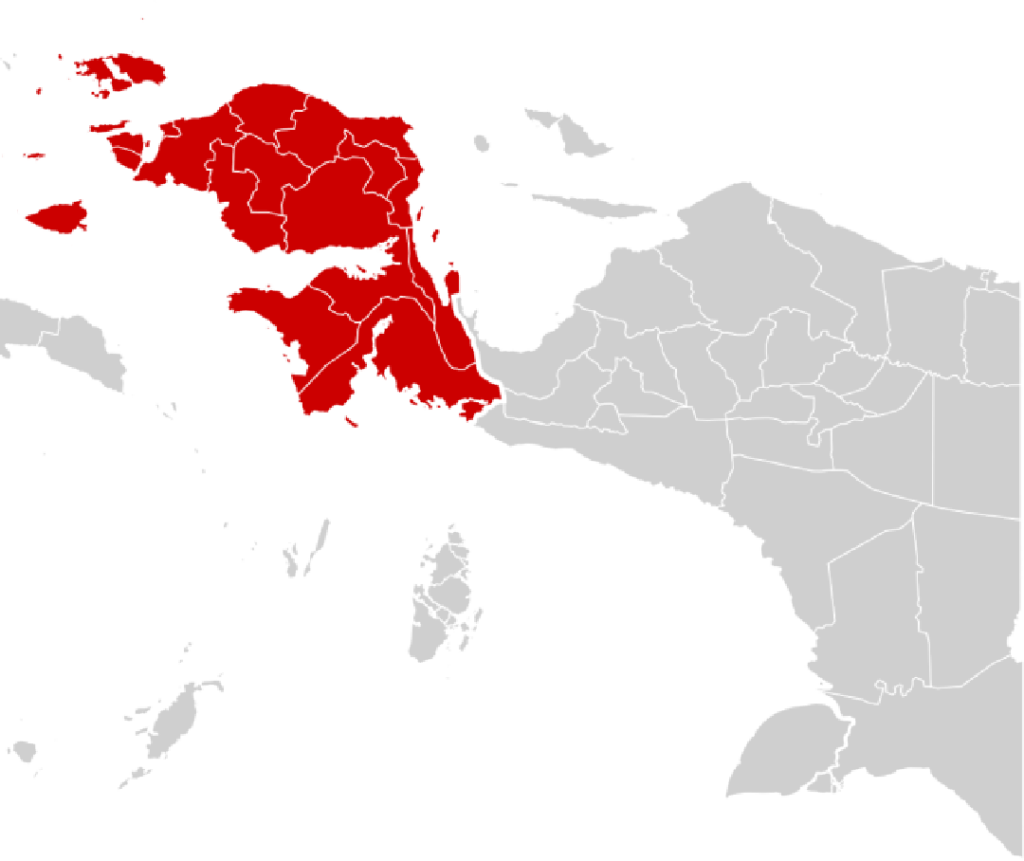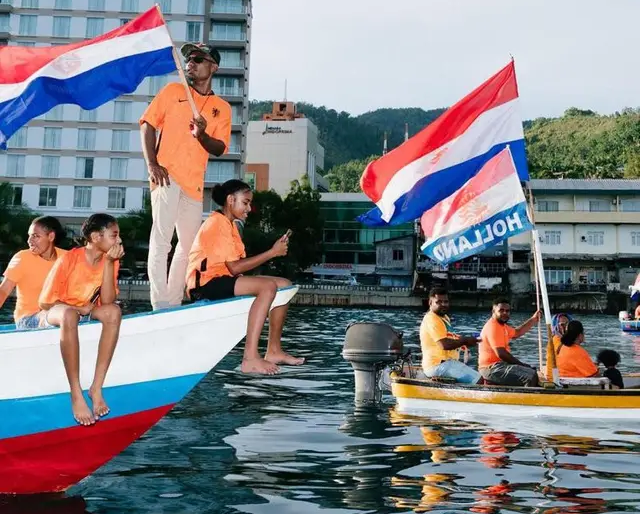
When the Netherlands plays at a World Cup or UEFA European Championship, the orange shirts do not appear only in Amsterdam, Rotterdam or The Hague. Thousands of kilometres away, in parts of Papua and Maluku (Moluccas), Dutch flags can also be seen outside homes, on roadside gatherings and during football watch parties.
The phenomenon is striking because the Netherlands is not Indonesia’s national team. Yet in parts of eastern Indonesia, particularly Papua and Maluku, supporting “De Oranje” has become a familiar football tradition passed from parents and grandparents to younger generations.
Reports by RRI, DetikTravel and Portal Papua point to a mixture of history, family connections, diaspora, football culture and admiration for the Dutch game. The tradition is not necessarily a political statement. Rather, it has developed into a distinctive part of football culture in communities where historical connections with the Netherlands remain visible in family stories and popular memory.
A Football Tradition That Predates Modern Indonesia
To understand the attraction of the Dutch national team in Papua and Maluku, the story has to begin long before the latest World Cup.
In Papua, researcher and archaeologist Hari Suroto told Portal Papua in 2022 that the territory was the last Dutch colonial possession in the Indonesian archipelago, with Dutch administration continuing until the early 1960s.
During that period, the Dutch administration developed schools, government institutions and health services. Suroto explained that Dutch officials serving as civil administrators in what was then known as Dutch New Guinea were trained not only in government administration but also in anthropology.
According to his account, the officials were expected to understand local communities and their cultures. Their detailed observations later became material for academic work after some returned to the Netherlands.
That historical experience left memories that survived among older generations.
Suroto pointed specifically to the influence of Dutch teachers and medical personnel. He said Dutch teachers were remembered by some older Papuans as disciplined and committed, while Dutch medical workers were remembered for providing services, including travelling to remote communities.
Those memories became part of family narratives.
When football became involved, the Netherlands had already established a familiar presence in the memories of certain communities.
From Family Stories to Football Shirts
According to the RRI report published in June 2026, older generations in parts of Papua retained stories and memories associated with the Dutch period.
The report notes that support for the Netherlands can sometimes function as a local cultural identity or family tradition rather than an expression of political preference.
Parents watch the Netherlands. Their children grow up watching the same team. Eventually, the orange shirt becomes part of family football culture.
The result is a tradition that can survive even as the original historical experience becomes increasingly distant.
The symbolism is easy to recognise.
During major international tournaments, supporters wear orange, display Dutch flags and gather to watch matches. RRI reported that celebrations and convoys can appear in parts of Papua and Maluku, accompanied by the familiar Dutch football chant, “Hup Holland Hup.”
For younger supporters, the attraction may have little connection with colonial history at all.
They may simply have inherited the team from their parents.
Maluku and the Netherlands: A Different Historical Connection
The story is particularly strong in Maluku.
DetikTravel reported in June 2026 that support for the Netherlands among some Maluku communities has been passed down through generations, from grandparents to grandchildren.
During World Cup periods, Ambon displays Dutch red, white, and blue flags on poles and in front of houses.
The report described the phenomenon as rooted in historical, cultural and family relationships.
The relationship between Maluku and the Netherlands has a much longer history, extending back to the colonial period and the era of the Dutch East India Company.
DetikTravel also highlighted the historical connection of many Maluku families with the former Royal Netherlands East Indies Army, or KNIL.
After Indonesian independence, thousands of people connected to the KNIL were relocated to the Netherlands. Over subsequent generations, a substantial Maluku diaspora developed there.
That diaspora created another bridge between Maluku and Dutch society.
Football became one of the most visible expressions of that connection.
Maluku Heritage in Dutch Football
The presence of players of Maluku descent in Dutch football has strengthened the emotional connection.
DetikTravel listed several prominent Dutch footballers with Maluku heritage, including Ruud Gullit, Giovanni van Bronckhorst, Simon Tahamata, Sonny Silooy, Tijjani Reijnders, Jenson Seelt, Denny Landzaat and Virgil van Dijk.
For supporters in Maluku, seeing players with family roots connected to the islands can make the Dutch national team feel less distant.
The relationship is not simply about nationality.
It is about ancestry.
A young supporter in Ambon may see a Dutch player with Maluku heritage and recognise a family story that has been repeated at home for decades.
That emotional connection helps explain why support can survive from one generation to another.
The Diaspora Keeps the Connection Alive
The relationship also operates in the opposite direction.
DetikTravel noted that members of the Maluku diaspora in the Netherlands often return to Maluku during European summer holidays, visiting relatives and reconnecting with family roots.
The report linked these journeys to a broader phenomenon known as “Tracing Your Roots,” in which younger generations of Dutch people with Maluku ancestry explore their family histories in Indonesia.
Football becomes part of that transnational connection.
The same family network can span two countries when the Netherlands plays. Relatives in the Netherlands follow the match while families in Maluku watch from home or gather in public spaces.
The orange shirt becomes a cultural link between communities separated by geography.
Football Itself Became Part of Indonesia’s History
There is another reason the Netherlands occupies a special position in Indonesian football history.
RRI noted that football developed in Indonesia during the colonial period, with early organisational structures, clubs and football culture influenced by the Dutch period.
That historical connection means the Netherlands is not an entirely foreign football reference point for Indonesia.
For generations, football has been embedded in Indonesian popular culture.
In Papua and Maluku, the historical connections with the Netherlands have uniquely shaped the legacy of local football traditions.
The result is a phenomenon that combines global sport with local history.
The Attraction of Dutch Football
History alone does not explain everything.
The Netherlands has also built a powerful international football identity.
RRI highlighted the country’s reputation for attractive football and the influence of Total Football, particularly through the generation associated with Johan Cruyff.
The Dutch approach became famous for fluid movement, positional interchange and attacking football.
For neutral supporters, that footballing identity has helped make the Netherlands an attractive team to follow.
This means that a supporter in Papua or Maluku can have several reasons for wearing orange.
For an older generation, it may be connected to family history.
For another supporter, it may be because a parent or grandparent supported the team.
For a younger fan, the reason may simply be admiration for Dutch players and the style of football associated with the national team.
The explanations can overlap.
World Cup Nights Become Community Events
The tradition becomes most visible during major tournaments.
DetikTravel reported that supporters in Maluku regularly organise communal viewing events when the Netherlands plays in the World Cup.
These gatherings transform a football match into a social event.
Families meet. Friends gather. Flags are displayed. Food is shared. The result is an atmosphere that goes beyond watching 90 minutes of football.
Similar scenes have been reported in Papua.
The RRI report described Dutch supporters using orange attributes and gathering in large numbers during major international competitions.
The sight of Dutch colours in eastern Indonesia can therefore appear unusual to outsiders, but within these communities it has become familiar.
The tradition is particularly intriguing because it demonstrates how global sport can absorb local history.
A European football team becomes part of the social life of an Indonesian community thousands of kilometres away.
Not Simply About Politics
One of the most important points raised by the sources is that support for the Dutch national team should not automatically be interpreted as a political position.
RRI explicitly described the phenomenon as being driven by historical and cultural factors rather than simply the current quality of Dutch football.
The report also stressed that being a supporter of the Netherlands does not mean that people in eastern Indonesia are “more Dutch.” Instead, it reflects a combination of colonial history, Maluku diaspora connections, family heritage, football history and inherited sporting traditions.
That distinction matters.
Sport often carries memories that are different from political attitudes.
A football supporter can admire a national team while identifying strongly with their country.
For many supporters, football loyalty operates in a cultural space of its own.
The orange shirt is therefore better understood as part of a football tradition than as a direct statement about political identity.
A Changing Tradition in a Modern Papua
Papua itself is changing rapidly.
Young people today consume football through television, streaming platforms and social media. They follow European leagues, Indonesian competitions and international tournaments simultaneously.
The emergence of strong local football communities also means that international football does not replace local sporting identity.
Instead, it becomes part of a much wider football culture.
Papuan footballers have repeatedly contributed to Indonesian football at national level, while local clubs and competitions continue to provide opportunities for young athletes.
In that environment, supporting the Netherlands can coexist with supporting Indonesian football.
A supporter may celebrate Oranje during the World Cup on one weekend and cheer for a local Papua club or the Indonesian national team at another time.
That is one of the strengths of sport: identities do not always have to compete.
The Orange Legacy in Papua and Maluku
The enduring popularity of the Netherlands in Papua and Maluku is ultimately a story about memory.
It began with historical relationships that shaped families and communities. In Maluku, migration to the Netherlands created a diaspora whose descendants remained connected to both sides. In Papua, memories of Dutch education, government and healthcare became part of stories passed through older generations.
Football then gave those memories a new language.
The World Cup and UEFA European Championship provided moments when the connection could become visible. Orange shirts, Dutch flags, family gatherings and communal viewing turned historical memory into a contemporary sporting ritual.
And as each generation inherits the tradition, the reason for supporting the Netherlands can change.
A grandparent may remember teachers or healthcare workers.
A parent may remember Dutch players of Maluku descent.
A young fan may simply love the team’s football.
All three can wear orange for the same match.
Conclusion
The enduring support for the Dutch national football team in parts of Papua and Maluku cannot be explained by a single factor.
It is the product of several layers of history and culture.
In Papua, the legacy of the former Dutch administration, including memories of education, government and healthcare, helped shape perceptions among older generations, according to researcher Hari Suroto.
In Maluku, historical family connections and the development of a large Maluku diaspora in the Netherlands created an additional bridge. The emergence of prominent Dutch footballers with Maluku ancestry strengthened that emotional connection.
Football itself provided the common language.
Every four years, the World Cup revives the tradition. The UEFA European Championship does the same between World Cups. Orange flags appear, families gather and the familiar “Hup Holland Hup” returns to streets and homes.
For Indonesia, the phenomenon is an interesting example of how the country’s diverse regions preserve historical memories while participating fully in modern global culture.
The supporters remain Indonesian, while their football affection crosses borders.
That is perhaps the most fascinating part of the story.
In Papua and Maluku, Dutch football has survived not simply because of history, but because history was transformed into family tradition, community celebration and love of the game.
Read Also
Daniel Hanasbey: Papua’s Football Pioneer in Europe
Jayapura Uses Mobile Legends Tournament to Develop Young Papua Talent