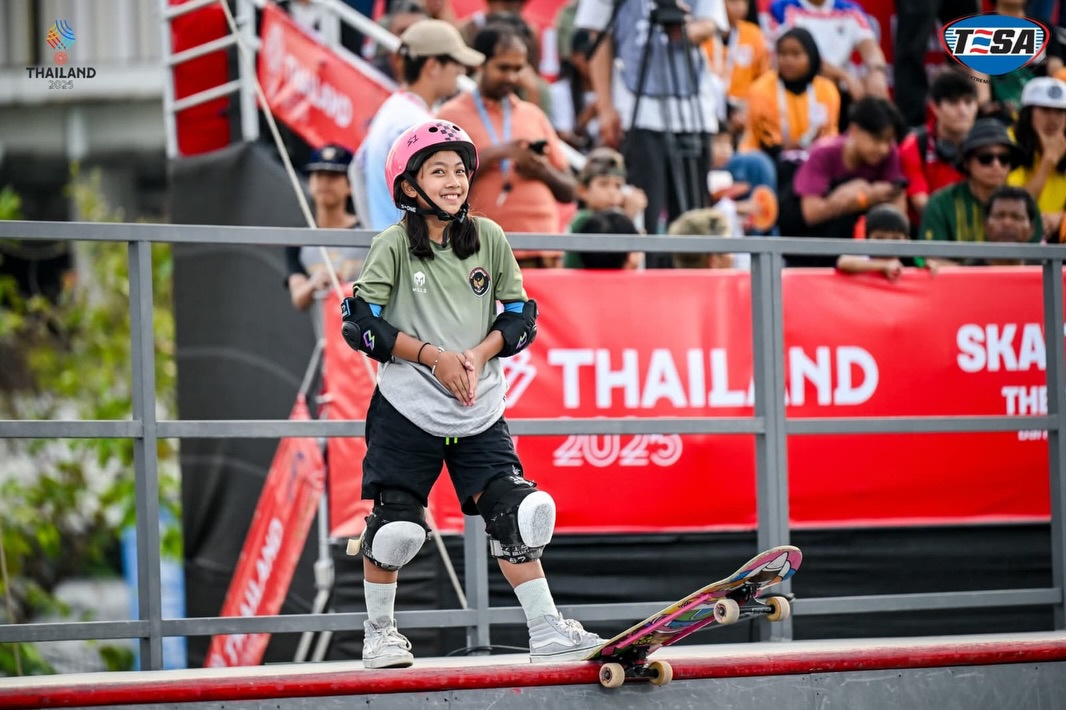
At 11 years old, Mikhayla Shanum Caya is preparing to step onto one of Asia’s biggest sporting stages. The young skateboarder from Papua Pegunungan (Highland Papua) has experienced a remarkably quick journey from a regional exhibition in Indonesia to the Asian Games Aichi-Nagoya 2026.
Mikhayla is set to represent Indonesia in the women’s park skateboard event at the Asian Games, which will be held in Japan from September 19 to October 4. She is the youngest member of Indonesia’s delegation and has already experienced the pressure of an international multi-sport event after reaching the final of the women’s park competition at the 2025 SEA Games in Thailand.
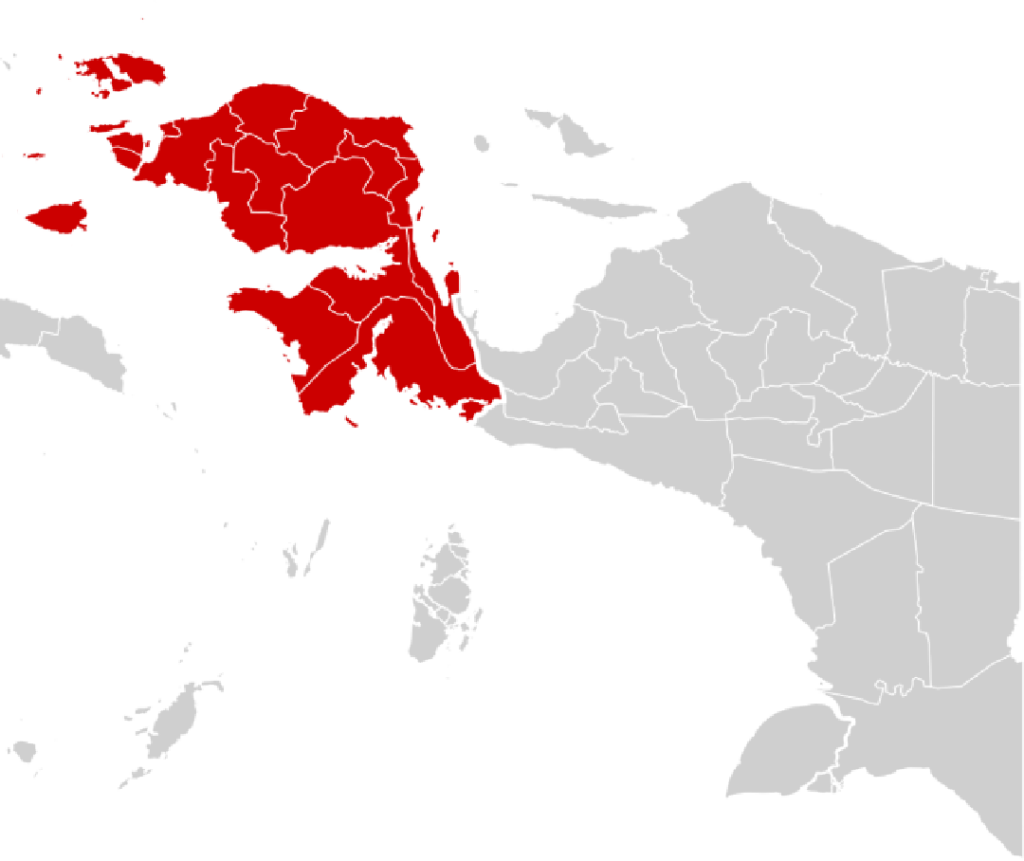
Mikhayla’s story closely connects to Papua Pegunungan, the Indonesian highland province she represents. Her appearance at the Asian Games gives the province another opportunity to place one of its young sporting talents in front of an international audience.
However, Mikhayla’s ascent has not been a sudden phenomenon.
It began with a skateboard, a supportive family, and a series of competitions that gradually exposed her to a much bigger world.
From Papua Pegunungan to the National Stage
Mikhayla’s early competitive experience included the skateboard exhibition at the 2024 National Sports Week (PON) XXI Aceh-Sumatra Utara.
On September 17, 2024, she competed in the women’s park exhibition representing Papua Pegunungan at the roller-skating venue in Sigli, Pidie, Aceh. The appearance gave the young athlete an important opportunity to experience a national sporting environment before she moved into larger international competitions.
Her family has also played a significant role in shaping her development.
Mikhayla’s father, Anthony Adam Caya, is a former national skateboard athlete and later became involved in coaching. His experience in the sport provided a natural environment for Mikhayla to develop her skills from an early age.
For a young athlete, that kind of support can matter as much as technical ability.
Skateboarding requires balance, coordination, timing, and the willingness to attempt difficult movements repeatedly. Falls are part of the learning process. So is learning how to recover from a failed trick and return to the board.
Mikhayla’s progress eventually brought her into the national development system, where she became part of Indonesia’s elite women’s park skateboarding group. The Ministry of Youth and Sports’ athlete database currently lists her as an 11-year-old national elite athlete in women’s park skateboarding.
That progression set the stage for her international debut.
The Breakthrough at SEA Games 2025
The next major step came in Thailand.
At the 2025 SEA Games, Mikhayla became the youngest athlete in the Indonesian delegation at 11 years old. She competed in women’s park skateboarding alongside Nyimas Bunga Cinta.
The qualification round immediately produced an important result.
Mikhayla finished seventh with a score of 45.93 points, placing her among the finalists. Nyimas Bunga finished second with 68.31 points, behind the Philippines’ Mazel Paris Alegado, who led the qualification with 78.70.
For Mikhayla, simply reaching the final was a major accomplishment.
She was competing against athletes with more experience and greater age, yet the 11-year-old secured her place in the decisive round.
The final took place on December 14, 2025.
This time, the young Indonesian did not finish on the podium. ANTARA reported that her medal hopes ended in the final after she was unable to match the points of the leading competitors.
Yet her reaction after the competition revealed something important about her experience.
Mikhayla acknowledged feeling both excited and nervous. She also spoke about the friendships and experiences that came with competing at the SEA Games.
“Happy, excited, and glad to be able to meet so many friends,” she said in comments cited by reports based on the Ministry of Youth and Sports.
The result meant no medal, but the competition gave Mikhayla something that cannot be measured only by a podium finish: experience against international opponents.
Why the SEA Games Final Mattered
For Indonesia’s skateboard program, Mikhayla’s SEA Games appearance was part of a broader effort to develop younger athletes.
The national skateboard program entered the 2025 SEA Games with a strong emphasis on regeneration. Before the Games, the Indonesian team had been preparing athletes through a national training camp that began in May.
The federation targeted medals across men’s and women’s street and park events.
Mikhayla’s presence demonstrated that Indonesia’s regeneration program was reaching athletes at a much younger age. Her participation also gave Papua Pegunungan visibility in a sport that has developed rapidly in Indonesia over the past decade.
The SEA Games were not the only event where she made progress.
Before Thailand, Mikhayla and Nyimas Bunga had also recorded a first-place finish at the Australia Bowl Competition, according to Indonesian skateboarding officials cited by ANTARA.
That result formed part of the competitive experience she carried into the SEA Games.
The pattern was becoming clear: domestic competition, international exposure, higher-level training, and increasingly difficult opponents.
The Road to Aichi-Nagoya
After Thailand, the next destination was Japan.
Mikhayla is now part of Indonesia’s eight-athlete skateboard contingent being prepared for the Asian Games Aichi-Nagoya 2026.
The Indonesian team is sending athletes across four events: men’s street, women’s street, men’s park, and women’s park. Mikhayla is the country’s representative in the women’s park category.
The Asian Games will provide a considerably different test.
The field includes athletes from countries with established skateboarding programs, particularly in East Asia. Indonesia’s national coach Anthony Adam Caya has identified Japan and South Korea among the major competitive challenges facing the team.
The Indonesian skateboard team has set a collective target of one gold, one silver, and one bronze medal in Aichi-Nagoya.
For Mikhayla, however, the immediate task is more specific.
She must compete in the women’s park event against athletes who are older and, often, have accumulated considerably more international experience.
Training in Bali Before Japan
The preparation for Aichi-Nagoya has included intensive training in Bali.
On July 16, 2026, Mikhayla was among the skateboard athletes training at Amplitude Skatepark in Badung. Indonesia’s Asian Games Chef de Mission, Todotua Pasaribu, also visited the session.
The visit was part of the Indonesian delegation’s monitoring of national training camps before the Asian Games.
Todotua said the purpose was to ensure that Indonesian athletes could compete at their maximum level.
The visit also brought together the leadership of the Indonesian delegation, the coaching team, and the athletes themselves.
Anthony Adam Caya outlined the skateboard team’s medal target during the visit: one gold, one silver, and one bronze from the eight athletes being prepared for the Games.
For Mikhayla, the training environment is particularly important because of the technical nature of park skateboarding.
The event takes place on a bowl-shaped course with curved transitions and other features that allow athletes to build sequences of tricks.
A successful run depends not simply on landing individual tricks but also on combining them into a coherent performance while maintaining speed, balance, and control.
The Arena Adds Another Challenge
The Asian Games organizers released the skateboard competition schedule and venue design in August.
Skateboarding will take place from September 24 to 27 at Aichi Sky Expo Hall B in Tokoname, Aichi Prefecture.
The women’s and men’s park qualification rounds are scheduled for September 24, followed by the park finals on September 25. Street events will follow on September 26 and 27.
The release of the venue design was significant for athletes and coaches.
Different skateparks have different transitions, heights, curves, and obstacles. These characteristics influence how athletes construct their runs and select the tricks they attempt.
Anthony Adam Caya had previously said that the team needed to study the competition course so athletes could adjust their technical preparation.
That preparation is especially relevant for a young athlete like Mikhayla, whose international experience is still developing.
The goal is not simply to perform the tricks she already knows.
It is also to adapt them to a new competitive environment.
Mikhayla’s View of the Challenge
Mikhayla has openly acknowledged the difference between herself and some of the athletes she will face.
Speaking about the Asian Games, she said she was excited but nervous because she wants to win a medal while knowing that some competitors are older and more experienced.
That combination of excitement and nerves is understandable.
The Asian Games is a major step up from the SEA Games, and Mikhayla will be competing against athletes with established international records.
Japan, in particular, has a deep pool of skateboard talent.
For Mikhayla, the challenge is therefore not only technical. It is also psychological.
She has to manage expectations, stay focused during each run, and make decisions quickly on the course.
At 11, those are lessons that many athletes spend years learning.
A Young Athlete with a Longer Road Ahead
Mikhayla’s Asian Games appearance should also be viewed within a longer development cycle.
Her career is only beginning.
The 2024 PON exhibition introduced her to a national sporting environment. The 2025 SEA Games gave her experience in an international multi-sport competition and a place in a final. The 2026 Asian Games now provides another opportunity to compete against some of Asia’s leading athletes.
Each stage adds a different lesson.
The PON experience provided exposure.
The SEA Games provided pressure.
The Asian Games will provide another test of how quickly she can adapt.
That progression is important for Indonesia’s broader skateboard program, which has identified the development of younger athletes as part of its longer-term strategy.
ANTARA reported in January that Anthony Adam Caya had discussed regeneration in Indonesian skateboarding, including the need to give young athletes space to develop. The program was also looking toward longer-term goals connected with future Asian Games and Olympic cycles.
Papua Pegunungan on an International Stage
Mikhayla’s story carries an additional significance because of where she comes from.
Papua Pegunungan is better known internationally for its mountains, distinctive cultures, and challenging geography than for producing athletes in modern urban sports.
Mikhayla’s presence at the Asian Games offers a different image of the province.
She is not entering the competition merely as an athlete from Indonesia. She is also one of the young representatives of Papua Pegunungan participating in an international sporting event.
Her journey demonstrates how sporting development can create connections between regions and national institutions.
The pathway from local and regional development to national selection is essential if Indonesia wants talented young athletes from geographically distant areas to receive opportunities at the highest level.
Mikhayla’s progression from the Papua Pegunungan delegation at the 2024 PON exhibition to the Indonesian national team illustrates that pathway in a concrete way.
It also shows why sustained coaching, competition experience, and access to appropriate facilities matter.
Talent may appear anywhere.
Building a pathway that allows that talent to develop is the harder task.
More Than a Medal
There is a temptation in elite sport to measure every athlete by medals.
For Mikhayla, that approach would overlook much of what has already happened.
She reached a SEA Games final at 11.
She has entered the Indonesian national elite system.
She has trained alongside established national athletes.
And now she is preparing for an Asian Games appearance while still at an age when many children are only beginning to discover the sports they enjoy.
None of this guarantees a particular result in Japan.
The competition will determine the final standings.
What can be established already is that Mikhayla has progressed rapidly through increasingly demanding levels of competition.
Her participation also gives Indonesia an opportunity to invest in a generation of skateboarders who may remain in the sport for many years.
For Papua Pegunungan, it provides a visible example of a young athlete reaching a national platform through sport.
A Different Kind of Papua Story
The international narrative around Papua often centers on politics, security, natural resources, or development.
Sport offers another window.
Through Mikhayla Shanum Caya, the story is about a child, a family, a coach, a skateboard, and the gradual movement from a local sporting environment to the international stage.
It is also a story about Indonesia’s effort to develop athletes beyond the country’s traditional sporting centers.
The significance of that process extends beyond a single competition.
If young athletes from regions such as Papua Pegunungan can enter national training systems and gain international experience, sport can become another channel for regional representation and social mobility.
Mikhayla’s journey is still at an early stage, but it already illustrates that possibility.
Conclusion
Mikhayla Shanum Caya arrives at the Asian Games Aichi-Nagoya 2026 with a story that began well before the Japanese competition.
She represented Papua Pegunungan at the skateboard exhibition of PON XXI in 2024. A year later, she became the youngest Indonesian athlete at the SEA Games in Thailand and reached the women’s park final after finishing seventh in qualification with 45.93 points. She did not win a medal in the final, but the experience gave her an important first taste of high-level international competition.
Now, at 11, she is preparing for another and larger challenge.
She will compete for Indonesia in women’s park skateboarding at the Asian Games Aichi-Nagoya 2026, where the park competition is scheduled for September 24 and 25.
The result will depend on what happens on the day.
For Mikhayla, the challenge is to turn months of preparation into a clean, confident performance against some of Asia’s strongest young skateboarders.
For Indonesia, her appearance is also part of a broader story of regeneration.
And for Papua Pegunungan, the young skateboarder offers an increasingly visible connection between the province and the international sporting community.
At 11, Mikhayla still has many competitions ahead of her.
The Asian Games may become another milestone.
The more important story, however, may be what comes after Japan.
Read Also
Papua Football Academy Builds a Path to Indonesia’s National Team
Two Papuan Students Join Indonesia Rugby Team in Japan
Gauri Rumbiak, Young Papuan Silat Champion Inspires Indonesia