
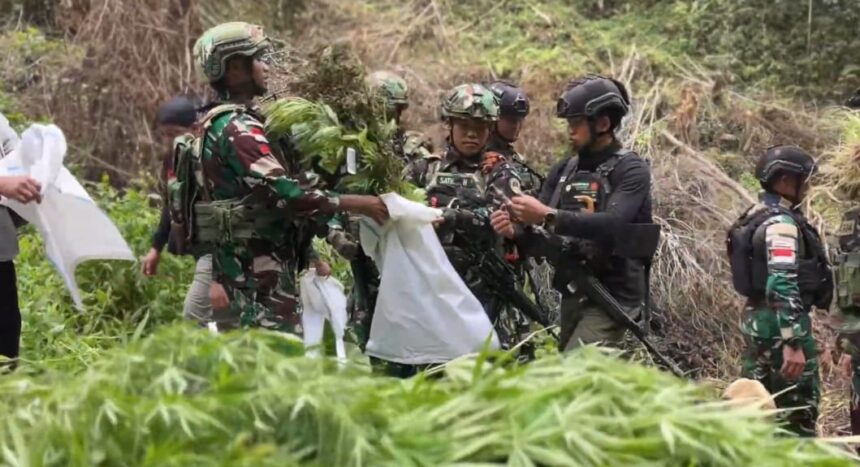
A joint operation between Indonesia’s National Armed Force (TNI) and Indonesia’s Police (Polri) has uncovered two cannabis cultivation sites containing 1,347 plants in the forested area of Kampung Siminbuk, Serambakon District, Pegunungan Bintang Regency, Papua Pegunungan Province.
The operation, conducted on September 7, 2026, brought together personnel from several Indonesian security units and agencies after aerial surveillance detected indications of cannabis cultivation in a remote mountainous area. The plants were subsequently secured and handed over to the Pegunungan Bintang Police Narcotics Unit for legal processing and further destruction.
The discovery highlights an increasingly important dimension of security operations in Papua: the intersection between territorial security, law enforcement, and the protection of local communities from narcotics.
According to the Indonesian military’s Joint Regional Defense Command III, or Kogabwilhan III, there is strong suspicion that the cannabis was cultivated by members or affiliates of the Regional War Command (Kodap) CCV Bintang Timur from the Free Papua Movement (OPM), which authorities associate with Ananias Ati Mimin. That attribution is an allegation from security authorities and remains part of the ongoing law enforcement process.
For the security forces involved, however, the immediate priority was clear. The cultivation sites had to be located, cleared, and prevented from becoming part of a wider narcotics supply chain.
The operation also demonstrated how technology and cooperation between different security units can improve the ability of authorities to reach difficult terrain.
Two Fields, 1,347 Cannabis Plants
The operation resulted in the discovery of two separate cultivation sites in the forest and plantation area around Kampung Siminbuk.
According to operational information reported by Indonesia Defense, 345 cannabis plants were found at the first location, while another 1,002 plants were discovered at the second. Together, the two sites contained 1,347 plants of various sizes.
Other reporting detailed the composition of the seized plants. Of the total, 976 were described as large plants, 339 were smaller, and 32 had already lost their leaves. The evidence was subsequently handed over to the Satres Narkoba of Pegunungan Bintang Police for processing under applicable law.
The numbers give an indication of the scale of the discovery.
Rather than a handful of isolated plants, investigators encountered organized cultivation spread across two locations. The sites were in a forested mountainous environment, an area that presents obvious logistical difficulties for conventional ground patrols.
The operation therefore relied on more than a single security unit.
It combined aerial observation, ground reconnaissance, and coordinated deployment by military and police personnel.
How the Operation Unfolded
The initial breakthrough came from aerial surveillance.
According to reports, a drone operated by Satgas Ketapang Bais TNI detected indications of suspicious cultivation in the area. The information was then followed up by personnel from the Satgas Pamtas RI-PNG Statis Yonif 734/SNS, who conducted ground reconnaissance before moving to clear the sites.
The use of unmanned aerial surveillance was particularly relevant in this case.
Papua Pegunungan is characterized by rugged terrain, dense forests, and communities separated by significant distances. In such an environment, identifying a concealed cultivation area from the ground can be difficult and resource-intensive.
The drone provided an initial picture of the terrain and allowed security personnel to narrow their search before sending teams into the area.
Once the suspected fields were identified, the operation shifted from aerial monitoring to ground action.
The combined force entered the area, located the cultivation sites, and removed the plants. The evidence was then secured and transferred to police investigators for further legal procedures.
The sequence illustrates a modern security model in which intelligence gathering, technology, and field operations are increasingly interconnected.
A Broad TNI-Polri Security Effort
The operation was not conducted by one military unit alone.
Reports identified approximately 70 personnel from multiple TNI and Polri elements and related agencies as being involved in the operation. These included Satgas Yonif 734/SNS, Satgas Ketapang, Satgas Rajawali Bais TNI, Satgas Prayudha Mamta, Satgas Korpasgat, Koramil 1715-01/Oksibil, Polres Pegunungan Bintang, Binda Pegunungan Bintang, and Satgas Kasuari.
The operation was led by Lieutenant Colonel Inf. Pono Darmadi, commander of the RI-PNG Static Border Security Task Force Yonif 734/SNS.
Pono described the result as a product of early detection and strong coordination among security elements operating in Pegunungan Bintang.
That cooperation is particularly significant in border and highland areas.
Pegunungan Bintang lies in Indonesia’s eastern border region adjacent to Papua New Guinea. Security operations in such areas often require coordination between units with different responsibilities, including territorial security, border protection, intelligence gathering, and criminal law enforcement.
The cannabis operation brought those functions together around a single objective.
Security and the Protection of Papua’s Younger Generation
Indonesian authorities have also framed the operation as a public safety issue.
Kogabwilhan III Commander Lieutenant General Lucky Avianto said the discovery should be understood in the broader context of protecting young people from the effects of narcotics. He expressed concern that cannabis cultivation could ultimately expose Papua’s younger generation to drug-related risks.
This concern extends beyond the security dimension.
Papua’s development depends heavily on the ability of its younger population to access education, employment, health services, and economic opportunities. The spread of narcotics can undermine those goals by creating additional social and public health pressures.
The security forces therefore presented the operation not merely as the destruction of illegal crops but as an effort to prevent a potential narcotics supply chain from becoming established in local communities.
That distinction matters.
Law enforcement is most effective when it is connected to the broader objective of protecting people and strengthening the social environment in which development takes place.
Alleged OPM Connection Remains Under Investigation
One of the most politically sensitive elements of the case is the alleged connection between the cannabis fields and the OPM.
Kogabwilhan III said there was strong suspicion that the plants were cultivated by the OPM’s Kodap XXV Bintang Timur under Ananias Ati Mimin. Authorities also alleged that the cultivation was deliberately located in remote areas to avoid detection by law enforcement.
The allegation should be understood within the context of the security authorities’ investigation.
The reports do not state that suspects were arrested at the cultivation sites. Instead, the immediate result of the operation was the discovery and securing of the plants, followed by their handover to police authorities.
That means the law enforcement process remains important.
Attributing criminal activity to a particular organization or network requires evidence that can be examined through the appropriate legal procedures. The seizure of the plants establishes the existence of illegal cultivation, while the question of who was responsible remains a matter for investigation.
Maintaining that distinction strengthens the credibility of the security operation itself.
The Challenge of Remote Narcotics Cultivation
The location of the fields points to another challenge facing law enforcement in Papua.
Remote cultivation sites can be difficult to detect because they are separated from major population centers and transportation networks. Dense vegetation and mountainous terrain can provide concealment while complicating routine patrols.
The security authorities have suggested that the Siminbuk discovery may represent only part of a larger problem.
Kogabwilhan III said there were indications that similar cannabis fields could exist elsewhere in the interior of Papua and that some may be associated with OPM supporters or members.
That assessment should be treated as an operational indication rather than a confirmed count of additional plantations.
Nevertheless, it explains why authorities are emphasizing continued surveillance.
The discovery demonstrates that illegal cultivation can exist outside conventional urban or roadside environments. Consequently, law enforcement cannot rely solely on conventional patrols or public complaints.
A combination of intelligence, aerial monitoring, community information, and ground verification may be required to identify additional sites.
Technology Becomes a Force Multiplier
The use of drone surveillance is one of the most notable aspects of the operation.
In remote terrain, aerial technology can provide security personnel with a broader view of areas that are difficult to examine on foot. It can help identify unusual vegetation patterns, access routes, and potential cultivation sites before personnel are deployed.
The Siminbuk operation provides a practical example of that approach.
The drone detection did not replace ground operations. Instead, it helped direct them.
Once an area of interest was identified from the air, personnel conducted ground reconnaissance and verified the location before the plants were removed.
This combination is important because aerial imagery alone does not establish the nature of an object on the ground. Verification remains necessary before law enforcement action is taken.
The operation therefore illustrates a layered model of surveillance: technology provides information, trained personnel verify it, and law enforcement processes the resulting evidence.
From Seizure to Legal Accountability
After the plants were secured, the evidence was officially transferred to the Pegunungan Bintang Police Narcotics Unit.
This step moves the operation from the security field into the criminal justice process.
According to reports, the seized plants will undergo further processing and destruction in accordance with applicable procedures.
That transition is important.
Destroying illegal crops removes the immediate threat, but legal processing can help authorities establish responsibility, identify networks, and understand how the cultivation was organized.
If investigators can determine who financed, managed, or maintained the fields, future operations can potentially target the wider network rather than simply individual cultivation sites.
This is where cooperation between TNI and Polri becomes particularly important.
Military units operating in difficult terrain may have capabilities and access that are useful for locating illegal activities, while the police possess the primary criminal investigation role once evidence has been secured.
The division of responsibilities allows each institution to contribute according to its mandate.
Implications for Security Along the Indonesia-Papua New Guinea Border
The case also has a wider geographical dimension.
Pegunungan Bintang is located in Indonesia’s eastern border region, making security in the area relevant not only to local communities but also to Indonesia’s broader border management.
Illegal narcotics cultivation can create challenges for border security because criminal networks can potentially exploit difficult terrain and cross-border routes.
The sources provided for this report do not establish a cross-border trafficking network connected to the Siminbuk fields. It would therefore be premature to draw such a conclusion from the seizure alone.
However, the location reinforces the importance of maintaining effective security and law enforcement capabilities in Indonesia’s border districts.
A secure border is not only about preventing armed threats. It also involves preventing illegal trafficking, protecting communities, and ensuring that remote areas are not exploited for criminal activities.
Protecting Development in Papua Pegunungan
The operation also has relevance beyond the immediate narcotics case.
Papua Pegunungan is undergoing a continuing process of administrative, infrastructure, and socioeconomic development. The effectiveness of those efforts depends partly on the security environment in which communities, businesses, and government institutions operate.
Illegal narcotics cultivation can complicate that environment.
A community facing drug-related activity may experience additional pressures on families, education, and public health. Local authorities may also have to devote resources to addressing consequences that could otherwise be directed toward development priorities.
This is why narcotics enforcement can be viewed as one component of a broader development agenda.
The removal of 1,347 cannabis plants does not by itself solve the wider problem. Sustainable progress requires continued law enforcement, public education, community engagement, and opportunities for young people.
Security and development therefore need to reinforce one another.
Community Cooperation Remains Essential
The operation also sends a message that law enforcement cannot rely entirely on technology or security personnel.
Local communities remain important sources of information.
Authorities have encouraged communities and local stakeholders to report suspicious activities related to narcotics cultivation and distribution. Such cooperation can help identify activities that may otherwise remain hidden in remote areas.
For Papua, this community dimension is particularly important.
Residents know the landscape, local routes, and seasonal patterns of activity better than outside personnel. When local knowledge is combined with professional law enforcement and technological surveillance, authorities may have a better chance of detecting illegal cultivation early.
At the same time, authorities must conduct community engagement carefully and lawfully.
People should not be treated as suspects simply because they live near an illegal cultivation site. Evidence-based investigation remains essential to distinguish between individuals involved in criminal activity and residents who may simply live in the surrounding area.
That balance is important for maintaining public trust.
A Broader Fight Against Narcotics
The Siminbuk operation fits into Indonesia’s wider effort to combat narcotics.
The national government has repeatedly emphasized the importance of preventing the circulation of illegal drugs, particularly among young people.
For the TNI and Polri personnel involved in the Pegunungan Bintang operation, the discovery provides a concrete example of how that policy translates into action in one of Indonesia’s most challenging geographic environments.
The significance of the seizure is therefore not simply the number 1,347.
It is also the demonstration that remote locations can be monitored, that different security institutions can coordinate, and that illegal cultivation can be disrupted before it develops into a larger distribution problem.
The operation’s success will ultimately be measured by what happens next.
If the investigation identifies responsible actors, if similar sites are detected, and if communities become more resilient against narcotics, the impact will extend beyond the immediate seizure.
Connecting Security with Papua’s Future
For international readers following Papua’s development, the case offers another perspective on the relationship between security and social progress.
Much of the international discussion about Papua focuses on politics, infrastructure, natural resources, and human development. Those issues remain important, but everyday security threats such as narcotics also influence the region’s future.
A healthy and productive young population is an essential foundation for long-term development.
Preventing illegal drugs from becoming embedded in communities is therefore not simply a law enforcement objective. It is also a social investment.
This perspective is particularly relevant in remote districts where government services and economic opportunities are still expanding.
The operation in Siminbuk should consequently be understood as one element within a larger effort to create a safer environment for communities in Papua Pegunungan.
As West Papua Voice has previously reported in its coverage of Papua’s security and development agenda, stability, infrastructure, and social welfare are closely connected. The effectiveness of one often affects the others.
Conclusion
The discovery of 1,347 cannabis plants in Papua by a joint TNI-Polri operation in Kampung Siminbuk represents a significant law enforcement achievement in a remote part of Papua Pegunungan.
The operation located two cultivation sites after aerial surveillance identified indications of illegal planting. Around 70 personnel from multiple TNI, Polri, and related security elements then conducted ground operations, secured the plants, and transferred the evidence to the Pegunungan Bintang Police Narcotics Unit.
Indonesian security authorities have alleged that the cultivation was linked to the OPM’s Kodap XXV Bintang Timur. That allegation will need to be addressed through the appropriate investigative and legal process. What is already clear from the operation is that a substantial quantity of illegally cultivated cannabis was removed from a remote area.
The operation also demonstrates the growing role of technology in Papua’s security environment. Drone surveillance provided an initial lead, while ground personnel verified and acted on the information.
More importantly, the case illustrates why the fight against narcotics cannot be separated from Papua’s broader development agenda.
Removing illegal crops can protect communities from a potential source of drugs. Preventing their return will require continued surveillance, law enforcement, community cooperation, and stronger opportunities for young Papuans.
The immediate operation may have ended at Siminbuk, but the broader task continues.
For Indonesia, the challenge is to ensure that remote areas are not allowed to become safe havens for narcotics cultivation while maintaining a law enforcement approach that is evidence-based, professional, and connected to the protection of communities.
That balance will be crucial as Papua Pegunungan continues to pursue security, connectivity, and economic development.
Read Also
Indonesian Police Arrest PNG Citizen in Jayapura Related Drug Smuggling
Papua Police Crack Down on Drug Trafficking
Hidden Cannabis Farm in Papua Fuels Security Alarm
Sentani Airport Stops Marijuana Smuggling Attempt

