
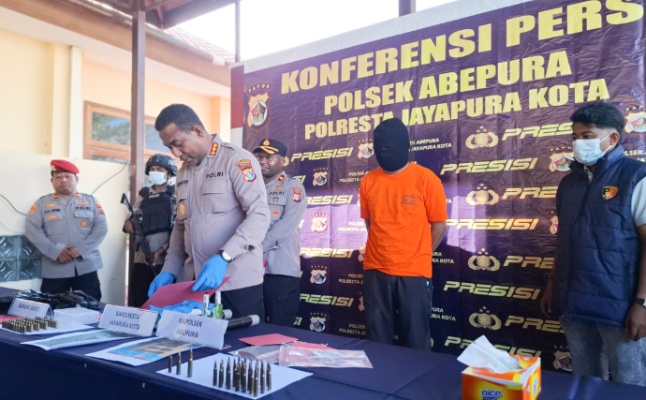
Indonesian security authorities have stepped up efforts to dismantle Papua’s illegal arms trafficking networks after the arrest of a fugitive suspected of supplying firearms and ammunition to the West Papua National Liberation Army (TPNPB) of the Free Papua Movement (OPM) in Yalimo and Yahukimo and the disruption of a separate attempt to smuggle ammunition across the border to Papua New Guinea (PNG).
The two operations, carried out days apart in Jayapura, underscore Indonesia’s persistent efforts to dismantle the illegal arms supply chains that authorities say fuel violence in Papua. Security officials say limiting access to guns and ammunition is key to protecting civilians and security personnel and to creating a safer environment for education, health, infrastructure development, and economic growth.
The Ops Damai Cartenz 2026 Task Force said the operations showed better teamwork among the Indonesian National Police, the Indonesian Armed Forces, intelligence agencies, and local law enforcement in fighting organized crime that supports armed violence.
Security analysts say hitting logistical networks is often as important as going directly against armed groups. Violent organizations can gradually lose their operational capabilities over time if they do not have reliable access to weapons, ammunition, and financial support.
Fugitive Arms Supplier Arrested in Jayapura
One of the most significant breakthroughs took place on 7 July 2026, when officers from the Ops Damai Cartenz 2026 Task Force arrested a fugitive with the initials AG, who had been listed as a wanted suspect (DPO) for about five months.
The arrest, made in front of the Indonesian Navy Hospital in Jayapura City, concludes a long investigation into an alleged illegal firearms and ammunition supply network to armed groups operating in the Yalimo and Yahukimo regencies, emphasizing the need to treat the illegal trade in guns as a transnational crime rather than viewing it solely as a local issue.
Police investigators suspect AG played an important logistical role in facilitating the movement of ammunition and other military supplies to armed networks active in Papua’s central highlands.
After months of surveillance, intelligence gathering, and coordination between several investigative units, officials said they were able to find the suspect.
The success of the operation is indicative of its growing importance. The operation’s success indicates a growing emphasis on dismantling logistical support structures rather than solely focusing on armed engagements. The operation’s success indicates a growing emphasis on dismantling logistical support structures rather than simply focusing on armed engagements.
Police said investigations are ongoing to identify more people possibly involved in the wider trafficking network.
Five Month Investigation Ends Successfully
The arrest of the AG was the culmination of a lengthy investigation involving intelligence gathering, evidence collection, and operational coordination across multiple jurisdictions, authorities said.
Investigators had been tracking the suspect’s movements for months, looking at communication patterns, transportation routes, and suspected links to illegal firearms distributors operating in and outside Papua, said Ops Damai Cartenz.
Instead of immediate enforcement action, investigators reportedly focused on gathering enough evidence to better understand the larger trafficking network.
Security experts frequently point out that dismantling organized criminal groups takes time and a lot of intelligence. Arresting one person without knowing the larger network often means that replacement actors will continue the illicit activity.
By tracing supply routes, financial transactions, communication channels, and logistical facilitators, authorities can more efficiently dismantle whole trafficking organizations instead of just breaking up isolated transactions.
Officials said the investigation will continue after the AG’s arrest, including efforts to identify other people who may have been involved in supplying weapons and ammunition to armed groups operating across Papua.
Illegal Firearms Networks Remain a Serious Security Challenge
The recent arrest underscores ongoing worries about illegal firearms circulating throughout Papua.
Weapons seized from armed groups have repeatedly been said by Indonesian authorities to come from various sources, including domestic criminal networks, stolen weapons, illicit commercial transactions, and cross-border smuggling operations.
Papua is close to international borders, and the geographical conditions are not simple to access: mountains, forests, rivers, and long coastlines. It is difficult for law enforcement agencies to prevent illegal trafficking.
Security analysts stress that the illegal trade in guns is a transnational crime rather than an internal security issue. Security analysts emphasize that we should view the illegal trade in guns as a transnational crime rather than an internal security problem.
International experience has shown that illicit weapons networks typically involve multiple actors involved in procurement, transportation, financing, storage, and distribution across jurisdictions.
As a result, effective counter-trafficking strategies are becoming increasingly reliant on cooperation between police, military forces, customs authorities, immigration officials, intelligence agencies, and neighboring countries.
Preventing illicit arms from reaching armed groups continues to be an important aspect of wider efforts to enhance public safety while supporting long-term stability across Papua for Indonesia.
Police Foil Attempt to Smuggle Ammunition to Papua New Guinea
Papua Police, in a separate operation on 6 July 2026, also announced the arrest of another suspect named GSP, who was allegedly trying to sell 82 rounds of ammunition to be delivered to a Papua New Guinea national.
The arrest was made on Manokwari Street, near GKI Harapan Church, in the Abepura District of Jayapura City.
During the operation, investigators said officers recovered dozens of live rounds before the transaction. Investigators reported that officers recovered dozens of live rounds before completing the transaction during the operation.
Police continue with forensic examinations and are tracking the origin of the ammunition and identifying further persons who may have been involved in the planned cross-border transaction.
The investigation is ongoing, authorities said, noting the importance of determining how the ammunition ended up in the illegal distribution chain to prevent similar attempts at trafficking in the future.
The operation also underscores increasing concerns about illegal cross-border movements of weapons and ammunition between Indonesia and Papua New Guinea.
Law enforcement officials say continuous surveillance, intelligence sharing, and close cooperation among agencies responsible for border management and public security are needed to prevent illicit trafficking.
Illegal Ammunition Trafficking Raises Regional Concerns
While the seizure was limited to 82 rounds of ammunition, security specialists point out that even relatively small quantities of ammunition can still pose significant security risks if diverted into illegal circulation.
Unlike the commercial goods, ammunition directly affects the operational capacity of the armed actors. Its distribution is thus a strategic priority for law enforcement agencies to disrupt.
Investigators are looking into whether the failed sale was an isolated piece of criminal activity or part of a broader trafficking network operating along the border between Indonesia and Papua New Guinea.
Security analysts say border areas around the world are often magnets for organized crime, as challenging terrain and poor infrastructure can create opportunities for smuggling.
Therefore, enhancing border security, intelligence cooperation, and customs enforcement remains an important element of Indonesia’s broader strategy to stop the illegal proliferation of weapons in Papua.
Disrupting Illegal Supply Chains Behind Armed Violence
Security officials said the recent arrests should be viewed as part of a wider law enforcement effort to dismantle the logistical infrastructure behind armed violence in Papua. While armed attacks attract public attention, investigators emphasize that the supply networks responsible for securing firearms, ammunition, transportation, funding, and communications are equally vital for sustaining illegal armed activities.
One of the task force’s main priorities is targeting these support networks, said Police Inspector General Faizal Ramadhani, Head of Ops Damai Cartenz 2026. The authorities intend to reduce the operational capacity of armed groups while preventing future attacks against civilians and security personnel by eliminating key intermediaries involved in the movement of weapons and ammunition.
“Disrupting supply chains is one of the most effective ways to weaken organized armed groups,” law enforcement experts often say, “because it can take significant time, resources, and coordination to find replacements for experienced logistical facilitators. So the successful investigations not only arrest individual criminals but also reveal larger criminal networks, financial transactions, transportation routes, and procurement channels.
Officials stressed investigations into both cases are continuing and that more suspects could be prosecuted if evidence shows they were involved in the illegal trafficking network.
Strengthening Border Security Along the Papua New Guinea Frontier
That has also renewed focus on the importance of securing one of Indonesia’s most challenging international borders, with an attempt to smuggle 82 rounds of ammunition to a Papua New Guinea (PNG) buyer.
The border between Indonesia and Papua New Guinea cuts through thick forest, mountains, and sparsely inhabited areas, posing special operational problems for the security services. While much of cross-border movement is legitimate economic and social interaction between neighboring communities, authorities acknowledge that criminal organizations may seek to exploit remote areas to facilitate illegal trafficking.
Hence, the Indonesian authorities continue to strengthen the coordination between the Indonesian National Police, the Indonesian Armed Forces (TNI), customs, immigration, intelligence, and border security agencies.
Security analysts say cross-border arms trafficking has become an increasingly transnational concern in many parts of the world. Therefore, effective prevention depends not only on domestic law enforcement but also on intelligence sharing and practical cooperation among neighboring countries to detect, investigate, and disrupt illegal trafficking networks before weapons fall into the hands of illegal recipients.
The operation, authorities said, strengthened Indonesia’s commitment to fighting transnational organized crime and eliminated future security risks by intercepting ammunition before it entered the country.
Ops Damai Cartenz Demonstrates Integrated Law Enforcement
The recent operations also highlight how the multiagency task force Ops Damai Cartenz 2026 is working together more closely to address armed criminal violence in Papua through coordinated law enforcement efforts.
Unlike traditional policing, the task force combines criminal investigation, intelligence gathering, forensic analysis, surveillance, cyber investigations, and operational coordination across a range of institutions.
Authorities said that the complex, far-flung networks of modern criminal organizations make collaboration among different agencies essential for effective investigations.
This integrated model allows investigators to concurrently track financial transactions, communication networks, digital evidence, and supply routes and coordinate arrests across jurisdictions.
Security specialists say such coordination can greatly increase the effectiveness of law enforcement, allowing authorities to take down entire criminal ecosystems instead of reacting to individual incidents after violence has occurred.
The successful arrests of AG and GSP reflect wider institutional efforts to improve preventive policing alongside traditional criminal investigations.
Security Supports Papua’s Long-Term Development
Government officials have repeatedly emphasized that improved security is intrinsically part of Papua’s broader development agenda.
Indonesia has increased investment in transportation infrastructure, health services, education opportunities, digital connectivity, agricultural modernization, and economic empowerment programs across Papua recently.
These development initiatives require a safe environment in which communities, businesses, schools, healthcare providers, and government institutions can operate in security.
Sustainable development and public security Security analysts frequently cite the mutual reinforcement of sustainable development and public security. by security analysts as mutually reinforcing. Stable conditions foster investment, boost public confidence, increase access to education and healthcare, and support economic activity. Better economic opportunities and improved public services can reduce the vulnerabilities that criminal organizations may try to exploit.
The disruption of illegal arms trafficking networks thus contributes to law enforcement objectives and to creating conditions that support inclusive regional development.
Papua is experiencing major infrastructure and economic transformations, but the safety of the public remains a vital requirement to ensure that development projects bring long-term benefits to local communities.
Looking Ahead
Indonesian authorities have indicated that probes into illicit arms and ammunition trafficking will persist throughout the latter half of 2026, emphasizing the need to uncover more members of criminal supply chains, enhance border monitoring, and strengthen collaboration between national and regional security agencies. Officials are also looking to expand intelligence-led operations targeting financial facilitators, transportation routes, and procurement channels traffickers use. These efforts are anticipated to support the wider government efforts to improve public security and promote sustainable economic and social development throughout Papua.
Conclusion
The arrest of AG, a fugitive suspected of supplying firearms and ammunition to armed groups in Yalimo and Yahukimo, along with the successful interception of 82 rounds of ammunition intended for illegal cross-border distribution, represents another significant step in Indonesia’s efforts to disrupt illegal weapons trafficking in Papua. Security officials are putting more effort into the logistical networks that allow armed groups to get weapons and ammunition, rather than just responding to violence after it happens. These measures, combined with increased border security, interagency cooperation, and intelligence-led investigations, form a comprehensive law enforcement strategy designed to improve public safety while supporting Papua’s development and long-term regional stability.

