
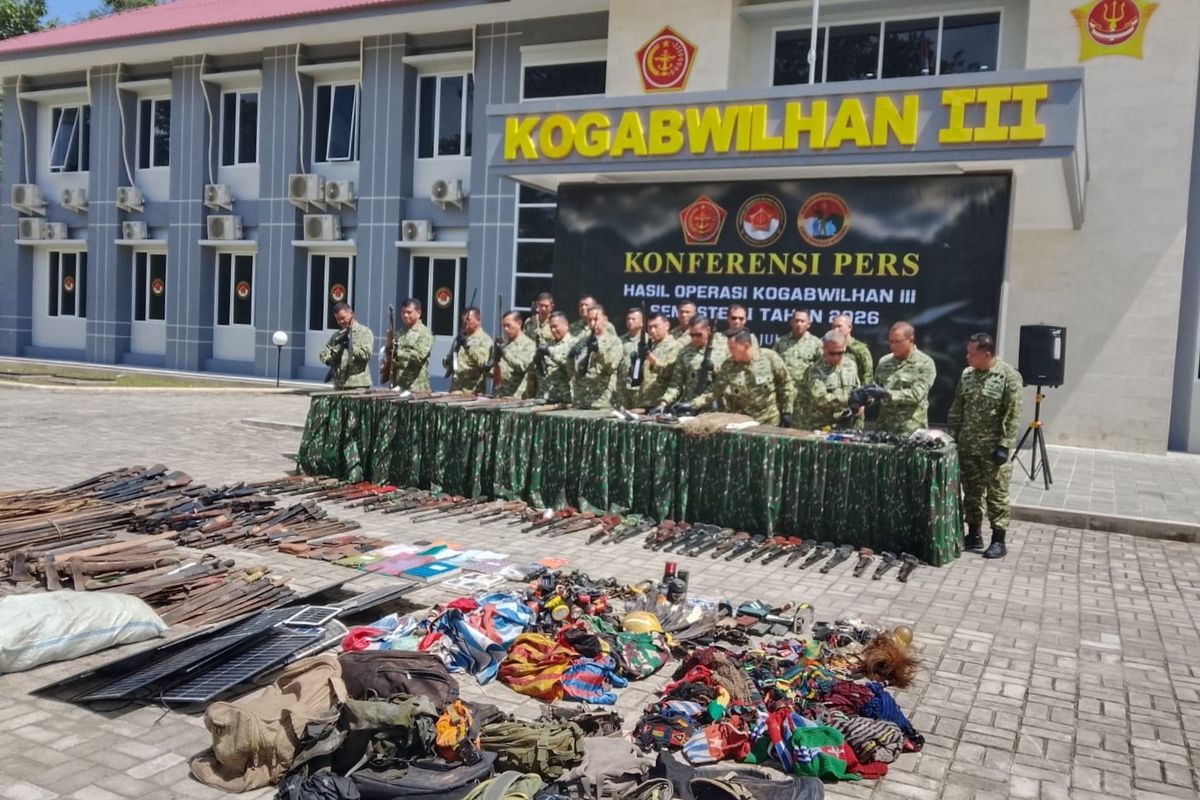
In the first half of 2026, Indonesia’s Joint Regional Defense Command III (Kogabwilhan III) has recorded impressive operational successes in Papua, demonstrating a security approach that combines law enforcement, border security, intelligence operations, and community engagement.
The command’s operational summary reads: “Security forces seized dozens of illegal firearms, disrupted narcotics trafficking, recovered ammunition and military equipment related to armed groups, and motivated 59 members of the TPNPB OPM to voluntarily surrender and reconfirm their allegiance to the Republic of Indonesia through nonmilitary engagement.
The military officials said the outcomes were part of a wider comprehensive security approach, saying that long-term stability in Papua depends not only on security enforcement but also on dialogue, humanitarian outreach, cooperation with local communities, and strengthening public confidence in state institutions.
Many security analysts view the report as an example of Indonesia’s attempt to combine operational readiness with community-focused policies to reduce violence and to support wider regional development.
Kogabwilhan III Reports Major Operational Achievements
The operational report was presented by the commander of Kogabwilhan III, Lieutenant General TNI Lucky Avianto, at a press briefing on security developments across Papua during the first semester of 2026.
The command said operations conducted from January to June resulted in the seizure of 47 illegal firearms, hundreds of rounds of ammunition, explosives-related equipment, communication devices, and various logistical supplies believed to have supported armed activities in several regions.
Additionally, security forces confiscated 1,479 marijuana plants and processed cannabis items, indicating ongoing efforts to curb narcotics production and trafficking as part of wider security operations.
Illegal narcotics cultivation and illicit weapons distribution often overlap in terms of security concerns, as both can feed criminal financing networks operating in remote areas, military officials said.
The operational achievements therefore outstrip the success of isolated law enforcement. They show continued efforts to break illegal supply chains and improve public safety in Papua’s various provinces.
Illegal Firearms Remain a Serious Security Concern
One of the most important findings in the report concerns the ongoing spread of illegal guns.
Lucky Avianto, the investigation shows that the guns used by armed groups come from various sources, including illegal domestic smuggling networks and cross-border smuggling routes beyond Indonesia.
“Restricting access to firearms directly affects the operational capability of armed groups, and stopping weapons trafficking has become one of the military’s key operational priorities,” the commander said.
For this reason, security authorities are still improving coordination with the National Police, customs authorities, intelligence agencies, and border security institutions to map trafficking routes and prevent the influx of more weapons into Papua.
Transnational crime analysts often cite illegal arms trafficking as a transnational problem that touches many countries, especially those where remote geography and porous borders create opportunities for smuggling.
For Indonesia, improving border surveillance and interagency cooperation remains an important aspect of broader efforts to maintain regional security.
Combating Narcotics Alongside Security Operations
The operational report also reported ongoing efforts to combat narcotics trafficking.
Security forces said they had seized 1,479 marijuana plants, processed cannabis products, and equipment used in illegal cultivation activities.
Officials stressed that narcotics enforcement is part of broader public security responsibilities because illegal drug production can pose serious social and public health risks and contribute to organized criminal activity.
The law enforcement agencies have also coordinated anti-narcotics operations with broader security missions, as the criminal networks often use remote areas for illegal cultivation and transportation.
Security experts say counter-narcotics operations combined with intelligence gathering help authorities identify larger criminal networks while protecting vulnerable communities from the long-term effects of drug trafficking.
The military said the operations were carried out in coordination with civilian law enforcement agencies under Indonesia’s legal system.
Security Through Community Engagement
While the operational successes in weapons and narcotics received much public attention, military officials stressed that Papua’s security strategy goes far beyond enforcement activities.
Kogabwilhan III said one of the command’s major priorities in 2026 has been improving cooperation with local communities through dialogue, humanitarian aid, and constant engagement with customary leaders, religious figures, youth representatives, and local governments.
“Many security challenges. ” Military officials stated that tactical operations alone cannot resolve many security challenges. by tactical operations alone,” military officials said.
Rather, sustainable stability requires nurturing public trust and fostering community well-being, enhancing communication, and promoting peaceful conflict resolution when possible.
The approach reflects what Indonesian security officials increasingly refer to as a comprehensive security strategy that blends military professionalism with social engagement, humanitarian outreach, and support for regional development.
As security scholars are wont to remind us, successful counterinsurgency efforts rely as much on public confidence as on operational capability. Where communities have good relationships with government institutions, they often become key partners in identifying security risks and backing peaceful solutions.
Humanitarian Operations Complement Security Measures
Kogabwilhan III also reported on humanitarian activities that continued throughout Papua during the reporting period in conjunction with security patrols.
They took part in medical outreach, infrastructure assistance, educational support programs, disaster response activities, and logistics distribution to isolated communities.
These activities are designed to support broader government development efforts by improving access to basic services and fostering cooperation between security institutions and local residents.
Humanitarian engagement, officials say, helps reduce misunderstandings and shows that security institutions play a supporting role in improving community welfare.
Development practitioners note that integrated approaches that combine security, public services, health, education, and infrastructure often contribute more effectively to long-term stability than isolated interventions.
In Papua, geographic conditions often limit access to government services, and civil-military cooperation is still a key element of broader regional development efforts.
Fifty-Nine Former TPNPB OPM Members Return Through Dialogue
In the first semester report of Kogabwilhan III, several significant developments were reported, including the voluntary surrender of 59 TPNPB OPM members who later swore allegiance to the Republic of Indonesia through a series of community-based engagement programs.
Lieutenant General TNI Lucky Avianto said these people decided to leave armed activities after long talks with members of the military, local governments, traditional leaders, religious figures, and families. Instead of relying exclusively on security operations, authorities emphasized persuasion, trust building, and community outreach as key elements in facilitating peaceful reintegration.
The military officials said that the circumstances of each surrender were different, but many had involved constant contact with local communities and assurances that those willing to give up violence would be treated in accordance with Indonesian law and given opportunities to rejoin society.
Security analysts note that voluntary disengagement from armed groups is often one of the most sustainable outcomes in conflict management because it reduces violence without the need for further confrontation. Reintegration initiatives can also help to rebuild the links between former combatants and their communities and decrease potential future recruitment into armed movements.
Officials stressed the process is voluntary and community-based, with local leaders playing an important role in facilitating dialogue and restoring public trust.
A Comprehensive Security Strategy Beyond Military Operations
Kogabwilhan III described its approach in Papua as a whole-of-security strategy that incorporates law enforcement, humanitarian assistance, community engagement, intelligence sharing, and support for regional development.
Military commanders said security cannot be judged by the number of operations carried out or weapons seized alone. Instead, long-term stability requires addressing the root causes that sustain violence while enhancing collaboration among state institutions and local communities.
In the first half of 2026, military personnel carried out medical outreach activities, educational assistance, infrastructure support, disaster response, food distribution, and community development programs in several regencies.
The activities form part of broader government investments in transport infrastructure, health services, telecommunications, education, and agricultural development implemented in the past few years throughout Papua.
Defense observers point out that integrated security models have been increasing globally as they acknowledge that sustainable peace often hinges on cooperation between military institutions, civilian agencies, local governments, and community organizations.
In Papua, where geographical remoteness and socio-economic conditions vary greatly from district to district, many believe that a coordinated policy is necessary to ensure sustainable stability.
Preventing Illegal Arms Trafficking
The operational report also reported ongoing concerns about illegal weapons entering Papua via domestic and international trafficking networks.
Lieutenant General Lucky Avianto said investigations have indicated that the firearms seized from the armed groups came from illegal markets in the country and from cross-border smuggling routes with foreign sources.
Breaking the flow of weapons is a strategic priority, the commander said, because limiting access to firearms has a direct impact on the operational capacity of armed groups.
To overcome this challenge, Indonesian authorities are constantly enhancing coordination among the military, the National Police, intelligence agencies, customs authorities, and border security institutions.
Security specialists say illicit arms trafficking has increasingly become a transnational issue needing cooperation among multiple government agencies. Remote terrain, maritime routes, and porous border areas frequently offer opportunities to criminal networks involved in smuggling activities.
Thus, enhancing surveillance and intelligence sharing remains an important part of Indonesia’s broader security strategy in eastern Indonesia.
Security Supports Broader Development
The military officials also emphasized the security operations within the broader context of Papua’s ongoing development. within the broader context of Papua’s ongoing development.
The government has launched projects to expand road infrastructure, improve healthcare facilities, enhance digital connectivity through fiber optic networks, increase agricultural production, improve educational opportunities, and promote economic growth in the provinces of Papua.
Officials say these development efforts need a stable security environment to benefit local communities for the long term.
Stronger public services and economic opportunities can enhance social resilience by addressing conditions that criminal or armed groups might exploit.
Development experts often point out that security and development are mutually reinforcing. Safe communities attract investment, have better access to education and health care, facilitate transportation, and boost local economies. Successful development can also help reduce social vulnerabilities that can lead to instability.
Therefore, in the first semester operational report, security is not an independent goal but part of Indonesia’s broader efforts to support sustainable regional development throughout Papua.
Looking Ahead
The Kogabwilhan III has indicated that its operational priorities for the second half of 2026 will remain focused on balanced security measures that include law enforcement, border protection, humanitarian assistance, intelligence cooperation, and community engagement. Authorities also plan to enhance cooperation with the provincial governments, customary institutions, religious figures, and local communities for peaceful solutions to conflicts and to curb illegal weapons trafficking, transnational crimes, and other activities. The military officials said that the comprehensive approach will continue to be taken because it will contribute to better security conditions along with the ongoing social and economic development of Papua.
Conclusion
The first semester achievements of Kogabwilhan III demonstrate a paradigm shift in Indonesia’s security approach in Papua, which balances operational effectiveness with humanitarian engagement and community-based dialogue. The confiscation of 47 illegal firearms; the disruption of narcotics activities, including 1,479 marijuana plants and processed cannabis products; and the voluntary surrender of 59 TPNPB OPM members are indicative of efforts to address both immediate security threats and their longer-term drivers. Together with ongoing cooperation among military institutions, civil agencies, traditional leaders, and local communities, these efforts represent a comprehensive approach that aims not only to secure public security but also to strengthen public confidence, support regional development, and foster an environment conducive to lasting peace throughout Papua.

