
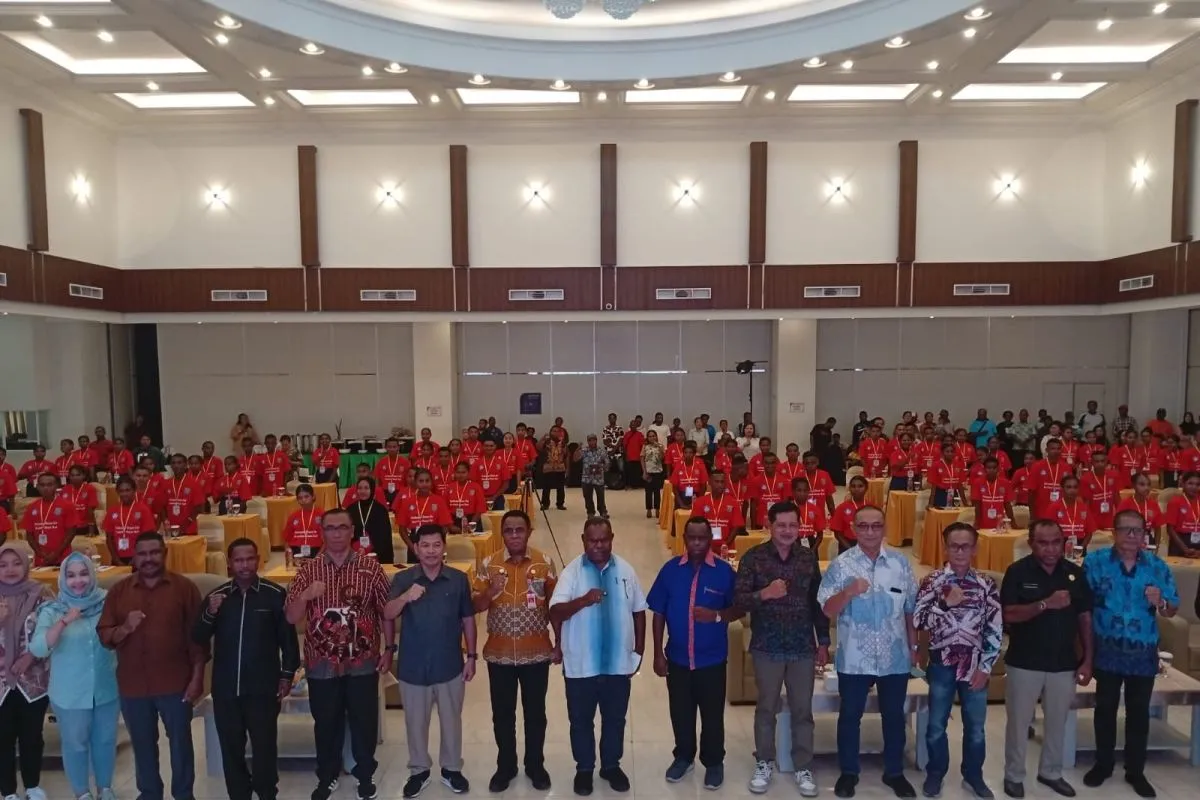
The Government of Papua Barat Daya (Southwest Papua) has dispatched 90 Indigenous Papuan (Orang Asli Papua/OAP) students to further their senior high school education in four provinces in Indonesia under the Affirmative Secondary Education Scholarship Program (ADEM) as part of the government’s long-term commitment to expanding educational opportunities and strengthening human capital in Indonesia’s easternmost region.
The students, selected on a merit basis, will continue their education in Central Java, East Java, West Java, and Banten, where they are expected to receive not only formal academic instruction but also broader exposure to leadership development, cultural diversity, and character building. The program is an important investment in preparing a new generation of educated Papuans who can contribute to regional development in the years to come, provincial officials said.
Held under the chairmanship of Governor Elisa Kambu and attended by education officials, families, and community representatives, the departure ceremony underscored a growing appreciation for education as one of the most potent ways of enhancing social mobility and expanding opportunities for Indigenous Papuan youth.
With rapid institutional and economic change in Papua, provincial authorities are increasingly seeing investments in education as essential to ensure local populations are prepared to actively participate in future development.
Education Becomes a Long-Term Investment in Papua’s Future
For many students in remote parts of Papua, access to quality secondary education remains one of the greatest challenges.
In some districts, geographic isolation, differences in educational facilities, and a shortage of specialized teachers still limit learning opportunities. Programs like ADEM seek to support existing efforts to improve education in Papua by giving selected students the chance to study in established senior high schools in other parts of Indonesia, while still maintaining strong ties with their home communities.
Officials said the scholarship program is meant to broaden students’ academic experience, foster independence and discipline, and expose them to different educational environments to make them more competitive.
Governor Elisa Kambu stressed that students are the future of Papua Barat Daya and encouraged them to study hard while respecting the values and cultural identity of their communities.
Most education specialists agree that investment in secondary education is a beneficial long-term investment, not just in terms of individual achievement. People with higher levels of education are more likely to participate in the labor force, enjoy better public services, have higher incomes, and live in more resilient communities.
For Papua Barat Daya, improving access to education is also part of a wider effort to develop local human resources who can support economic growth and public administration in the early years of the province.
ADEM Provides Opportunities Beyond the Classroom
One of Indonesia’s flagship programs to expand educational opportunities for Indigenous Papuan students is the Affirmative Secondary Education Scholarship Program (ADEM).
In addition to formal schooling, the program aims to create a supportive learning environment for participants, fostering academic excellence, leadership development, social adaptation, and personal growth.
Students participating in ADEM are usually housed in supervised dormitories at partner schools, giving them the chance to concentrate on their studies and meet other students from all over Indonesia.
Provincial education officials say the broader exposure helps students to build confidence, communication skills, and intercultural understanding that may prove valuable throughout their academic and professional careers.
Equally important, the experience allows participants to build networks that can foster future collaboration in higher education, entrepreneurship, public service, and community development.
Officials said the goal was not just to produce graduates but to develop young leaders who can help Papua’s long-term development after they finish their studies.
Merit-Based Selection Reinforces Fairness
Provincial authorities have highlighted one aspect of the program: its emphasis on academic achievement and merit-based selection.
Head of Provincial Education Office Adolof Kambuaya said the students were selected transparently on the basis of academic achievements and eligibility criteria, not nepotism or political interests.
That way, they can ensure equal opportunities for talented students in all districts and inspire the younger generation to aim for academic excellence, officials said.
Merit scholarship systems can motivate students to do better, education observers say, because selection depends upon measurable achievement and demonstrated commitment to learning.
For families across Papua Barat Daya, the program also signals an acceptance that educational opportunities should be available to qualified students, regardless of their location or social status.
The provincial government hopes that future scholarship recipients will continue to show the same commitment before and after they enter the program, serving as a positive example for younger students in their communities.
Character Building Alongside Academic Excellence
Government officials repeatedly emphasized that ADEM seeks to build more than academic capacity.
Students are encouraged to foster personal discipline, integrity, responsibility, and leadership qualities while studying outside Papua.
At the departure ceremony, the provincial leaders reminded the participants that they would be the ambassadors of Papua Barat Daya while studying in other parts of Indonesia.
Important values to be expected along with academic achievement identified in the study include respect for diversity, cooperation, adaptability, and mutual understanding.
Educational researchers often point to leadership development in adolescence as an important factor in future professional success. Students often develop broader perspectives while honing critical thinking and problem-solving skills by experiencing new cultures, educational systems, and social environments.
Thus, officials see ADEM as an investment in intellectual capacity and character formation.
Families Place Hope in the Next Generation
For many parents, their children leaving is both an emotional moment and a source of optimism.
Several families described the scholarship as an opportunity that might not have been available otherwise, especially for students coming from districts where educational facilities are still limited.
Community leaders also welcomed the initiative, expressing the hope that the students who would participate would return after their education with new knowledge and experience that could contribute to local development.
For many communities, successful students are not just those who have achieved a milestone but future teachers, healthcare professionals, entrepreneurs, engineers, and public servants who can build regional capacity.
This collective expectation mirrors a growing recognition that human resource development remains one of the most critical foundations for Papua’s long-term social and economic change.
Building Future Leaders for Papua Barat Daya
Provincial leaders say the ADEM scholarship program is more than an educational opportunity. It is part of a wider strategy to equip a new generation of Indigenous Papuan leaders who will be able to contribute to public administration, business, education, healthcare, and community development in Papua Barat Daya.
Papua Barat Daya, the youngest province of Indonesia, is in the process of developing its public institutions while pursuing long-term economic and social development. The process requires an increasing number of qualified professionals who possess the knowledge, technical skills, and leadership abilities to address increasingly complex development challenges.
Thus, officials view education as a strategic investment, not a short-term social program. It is hoped that enabling talented students to acquire quality secondary education outside of Papua will bolster the region’s future workforce while encouraging graduates to return and contribute to their home communities.
Experts in education often say that investing in human capital has long-term benefits for many areas, such as governance, healthcare, entrepreneurship, innovation, and economic productivity.
Improving access to quality education in Papua Barat Daya will support continuing investments in infrastructure, public services, and regional economic development.
Strengthening Human Capital Through Inclusive Education
The development of human resources has become one of the top priorities in the long-term development agenda of Papua.
In addition to improvements in transportation, health care, telecommunications, and economic infrastructure, provincial governments are increasingly recognizing that the quality of education will be the factor that determines the region’s competitiveness in the future.
Programs like ADEM help achieve this goal by giving students in other districts the opportunity to access learning environments they may not have access to at this time in their district.
The scholarship also promotes equal opportunity by guaranteeing academic achievement as the main criterion for selection, officials said. This merit-based approach rewards the best students and motivates the younger generations to pursue higher academic standards.
Education experts generally agree that access to quality secondary education increases the likelihood that students will pursue universities, vocational institutions, and professional careers.
For indigenous Papuan communities, the initiative may mean a gradual increase in local participation in strategic sectors and a reduction in disparities in educational attainment.
Learning Beyond Academic Achievement
The program’s main focus is classroom education, but ADEM also wants to expand the students’ personal experiences.
Participants will have a chance to study and live with fellow participants from other provinces and will gain the ability to communicate, adapt, work in a team, and understand other cultures, all of which are skills becoming more and more important in our increasingly connected world.
Officials in the province emphasized the importance of students seizing these opportunities while taking pride in their Papuan identity and cultural heritage.
They pointed out that the ability to confidently interact with diverse communities is an important leadership quality that can strengthen cooperation and social cohesion in the future.
Many education researchers also suggest that learning outside of one’s immediate environment often fosters greater independence, resilience, and critical thinking while preparing students for higher education and professional careers.
For the Papua Barat Daya participants, such experiences may be valuable assets in their eventual contributions to regional development.
Supporting Papua’s Long-Term Development Vision
The increase in scholarship opportunities is in line with Indonesia’s broader efforts to accelerate the development of Papua’s human resources.
Recently, national and provincial governments have launched numerous programs aimed at improving access to education, teacher quality, digital learning, vocational training, and scholarships for students in Papua.
These wider investments in roads, health facilities, internet connectivity, ports, and airports complement these efforts, aiming to raise living standards and support balanced regional growth. These efforts are complemented by wider investments in roads, health facilities, internet connectivity, ports, and airports, which aim to raise living standards and support balanced regional growth.
Development economists often cite education as one of the most potent engines of long-term economic transformation. A skilled workforce boosts productivity, innovation, institutional effectiveness, and investment attractiveness.
Improving educational achievement in Papua Barat Daya may benefit both individuals and the region’s competitiveness.
They hope today’s scholarship recipients will be tomorrow’s teachers, engineers, doctors, entrepreneurs, civil servants, researchers, and community leaders who will help shape the future of the province, officials said.
Investing in Young People Today
The departure ceremony was also symbolically important for many families.
Parents gave their children a chance that represents years of preparation, sacrifice, and aspiration. Provincial leaders urged students to stay disciplined, concentrate on their studies, and be resolute in maximizing the opportunities offered by the scholarship program.
Education officials reminded participants that academic success requires perseverance, responsibility, and continuous learning. At the same time, they encouraged students to maintain close connections with their families and communities, as their success is expected to have a positive impact not only on themselves but also on future generations.
The community leaders also expressed hope that the students’ experiences would inspire younger children throughout Papua Barat Daya to pursue higher education.
Looking Ahead
As Papua Barat Daya continues to strengthen its educational system, programs like the ADEM scholarship program are expected to play an increasingly important role in expanding opportunities for Indigenous Papuan youth. The program seeks to provide students with academic knowledge and skills, character development, leadership training, and intercultural experience to prepare them to meaningfully participate in the province’s long-term development. Continuing collaboration between the provincial government, Ministry of Education, schools, families, and local communities will remain critical to ensuring that these educational investments yield lasting benefits for the future of Papua.
Conclusion
Sending 90 indigenous Papuan students through the ADEM scholarship program is a manifestation of Papua Barat Daya’s seriousness in investing in human resources as a foundation for sustainable development. The initiative aims to prepare a new generation that can contribute to the development of the region by providing access to quality secondary education, promoting merit-based achievement, and enhancing leadership capacity. As these students continue their educational journey in other parts of Indonesia, they carry with them not only their aspirations but also the hope of returning with the knowledge, skills, and experience to support the long-term development of their communities and Papua Barat Daya as a whole.

