
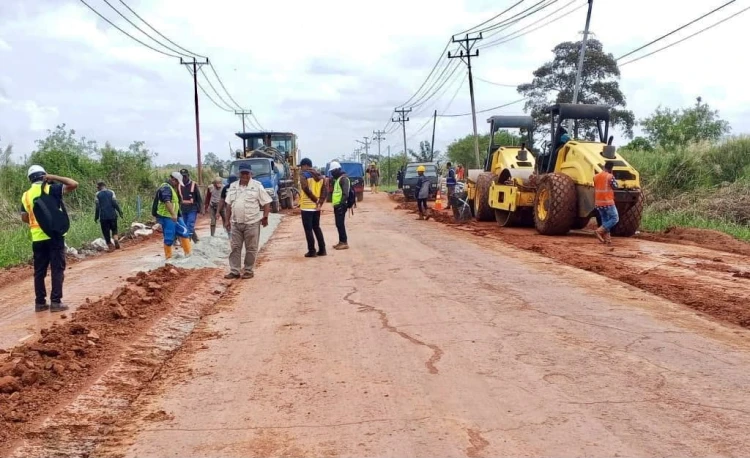
In several parts of Papua, distance is often measured in more than kilometers.
Occasionally it is measured by fuel costs.
Occasionally it depends on how many rivers need crossing.
Occasionally it is also measured by the duration that trucks remain stuck after rain.
For residents living in newly established autonomous provinces, infrastructure discussions therefore tend to feel less abstract than they sound in government presentations.
A bridge can shorten travel by hours.
A paved road can reduce prices inside local markets.
A missing connection can isolate entire communities.
That background partly explains why the Indonesian government’s latest infrastructure announcement received attention across several provinces after the Public Works Ministry confirmed funding worth Rp337.8 billion to accelerate roads and bridges in Papua’s new autonomous regions.
Officials say the objective is straightforward.
Improve connectivity.
Move goods faster.
Reduce logistical barriers.
Create stronger foundations for economic growth.
New Autonomous Regions Continue Facing Connectivity Gaps
The creation of new provinces in Papua created expectations that public services and development would move closer to communities.
Yet geography continues creating challenges.
Mountain ranges separate districts.
Heavy rainfall damages roads.
Transport costs remain high.
Because of these conditions, infrastructure remains among the first issues raised whenever regional governments discuss development priorities.
During announcements released in early June 2026, Public Works Ministry officials explained that much of the Rp337.8 billion allocation would focus primarily on roads and bridge construction intended to strengthen connections between economic centers and surrounding areas.
Several projects are expected to support mobility in newer administrative regions where transportation infrastructure remains limited.
Roads Still Matter More Than Many Realize
For businesses operating outside large urban areas, road conditions often determine whether products remain competitive.
Transport operators in Papua frequently describe logistics as one of the largest operational costs.
When roads deteriorate, transport times increase.
Fuel consumption rises.
Distribution becomes pricier.
That additional cost eventually reaches consumers.
This partly explains why government planners increasingly treat transportation infrastructure as economic policy rather than simply construction projects.
Papua Tengah (Central Papua) Receives Particular Attention
Several infrastructure projects in Papua Tengah are currently receiving attention.
Regional officials there have repeatedly argued that stronger connectivity remains necessary to support trade flows between districts and improve access to public services.
Local governments say infrastructure bottlenecks continue affecting agriculture, markets, and transportation networks.
In practical terms, this often means farmers struggle reaching larger markets.
Small businesses face higher distribution costs.
Travel times remain unpredictable.
Government officials involved in planning therefore argue that infrastructure spending should produce broader effects beyond construction itself.
Lower Logistics Costs Remain Major Goal
One word appears repeatedly during discussions surrounding Papua’s economy.
Logistics.
Because geography creates higher transportation costs, reducing logistical pressure has become one of the main justifications for road expansion.
Officials involved in the program argue that stronger road networks should eventually improve efficiency for both businesses and households.
Immediate changes may remain limited.
But policymakers increasingly view connectivity improvements as necessary groundwork for longer-term growth.
Infrastructure Also Shapes Access To Services
Road projects usually affect more than just economic activity.
In many parts of Papua, transportation networks also determine access to schools, hospitals, government offices, and public services.
Several communities remain separated by terrain that significantly increases travel time despite relatively short geographic distances.
Local officials therefore increasingly describe infrastructure development as something broader than transportation.
Better roads often influence healthcare access.
Education access.
Emergency services.
Market integration.
These connections partly explain why infrastructure spending remains politically important across Papua.
Construction Challenges Remain Significant
Building infrastructure in Papua continues to involve challenges rarely encountered elsewhere.
Weather conditions shift quickly.
Terrain remains difficult.
Construction materials often require expensive transportation.
Several government officials acknowledged that these factors increase both costs and project complexity.
Because of these conditions, officials repeatedly caution against expecting immediate transformation.
Infrastructure expansion in Papua usually happens gradually.
Sometimes slower than expected.
But policymakers argue that delaying projects further would create larger gaps later.
Economic Expectations Continue Growing
The government increasingly links infrastructure expansion with broader economic ambitions.
Officials argue stronger connectivity may encourage investment while supporting local businesses and regional markets.
Several economic observers also note that infrastructure frequently influences private investment decisions.
Businesses evaluate transport access.
Supply chains.
Distribution networks.
Without these factors, investment frequently becomes harder.
For newly established autonomous provinces, infrastructure therefore increasingly becomes part of larger discussions about competitiveness.
Conclusion
Construction budgets rarely generate excitement by themselves.
Road projects rarely make headlines.
Yet across many parts of Papua, infrastructure quietly shapes daily routines.
It influences market prices.
Travel times.
Access to services.
Economic opportunities.
The Rp337.8 billion allocation announced by Indonesia’s Public Works Ministry in early June 2026 represents more than just another construction program.
For many communities, it represents an attempt to make distance feel slightly shorter.

