For many travelers, a journey does not truly end when the plane leaves. It continues in the objects placed inside a suitcase, the flavors shared at home, and the stories attached to a gift.
That is particularly true in Papua, where Papua souvenirs offer more than simple reminders of a holiday. They provide a glimpse into the region’s diverse traditions, natural resources, and creative economy.
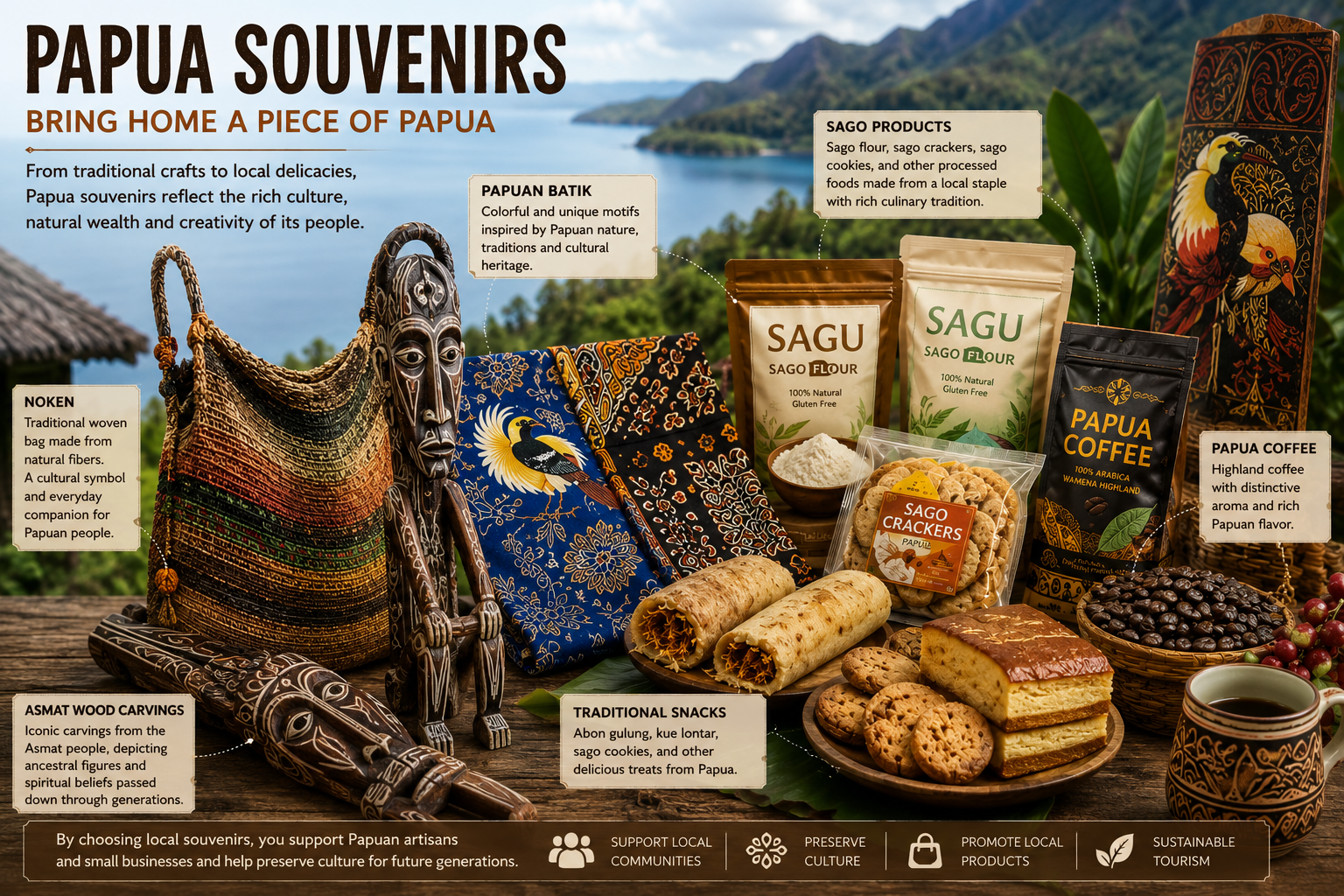
From woven noken bags and Papuan batik to sago-based snacks, coffee, and locally produced foods, Papua’s souvenir industry reflects a meeting point between culture and commerce. The products also provide opportunities for artisans, small businesses, and local producers to bring their work to visitors from Indonesia and abroad. Recent coverage of Papua’s distinctive souvenirs highlights the breadth of products available to travelers, ranging from handicrafts to food products.
For an international audience, the appeal is straightforward. A souvenir is small enough to carry home, but it can represent a much larger story about the place where it was made.
More Than a Gift From a Journey
Papua’s souvenir economy has grown around a simple idea: visitors want to take home something that feels connected to the destination.
That can be a traditional craft, a piece of local clothing, or a food product made from ingredients closely associated with Papua.
The diversity is one of the region’s strongest advantages.
In Jayapura, for example, travelers can encounter noken, sago products, Papuan batik, wooden crafts, and other locally inspired products. Tourism planning for Jayapura has also identified souvenir centers featuring products such as Port Numbay batik, traditional carvings, and local foods as part of the city’s tourism development strategy.
This matters because tourism is not only about hotels, restaurants, and transportation.
It also creates a market for things visitors can buy directly from local producers.
A traveler who purchases a locally made noken or packaged sago product is participating in a much wider economic chain. The transaction can connect artisans, raw material suppliers, processors, retailers, and tourism businesses.
In that sense, souvenirs can become one of the simplest ways for tourism spending to reach local communities.
Noken: A Cultural Symbol That Travels
Among the best-known Papua souvenirs is the noken.
The traditional bag is made from natural fibers and has long been used in everyday life by communities across Papua. It can carry agricultural products, household items, and other belongings.
Its significance extends beyond its practical function.
Noken represents traditional knowledge, craftsmanship, and the relationship between communities and their natural surroundings. Its production requires patience and manual skill, making every piece more than a mass-produced accessory.
Information published by the KPU Papua Pegunungan describes noken as a traditional Papuan bag made from plant fibers and notes that its production can take considerable time, depending on its size and complexity.
For visitors, purchasing a noken can, therefore, provide a direct connection with traditional craftsmanship.
It can also help create demand for artisans who continue to maintain those skills.
That economic dimension is important. Cultural preservation becomes more sustainable when traditional crafts can remain relevant to contemporary consumers without losing their cultural character.
Papuan Batik Brings Local Identity Into Modern Fashion
Another popular souvenir is Papuan batik.
While batik is recognized internationally as part of Indonesia’s cultural heritage, Papuan designs have their own visual identity. Motifs may draw inspiration from the region’s landscapes, wildlife, communities, and traditional symbols.
Examples include motifs associated with the Cenderawasih bird, Asmat designs, Sentani culture, tifa drums, and other elements of Papuan life.
For international travelers, batik has one obvious advantage as a souvenir: it is relatively easy to carry and can be incorporated into everyday clothing.
A piece of fabric can become a shirt, scarf, dress, home decoration, or framed artwork.
This flexibility gives traditional design a contemporary market.
More importantly, it allows Papuan visual identity to travel beyond the island itself.
A visitor wearing Papuan batik overseas is, in a small way, carrying a piece of Papua’s cultural story into another community.
Sago: From Staple Food to Modern Souvenir
Food provides another powerful way to experience Papua.
Sago is perhaps the clearest example.
For generations, sago has been an important food resource in many Papuan communities. Today, the ingredient is increasingly being transformed into products that are convenient for travelers.
Sago crackers, cookies, sago cakes, and other processed foods can have a longer shelf life than traditional meals, making them practical souvenirs.
The trend is already visible in Jayapura’s small business sector.
One example is Japamo, a local product developed by Ririns Food using sago to make products such as nastar, cookies, and pies. RRI reported that the initiative sought to create a modern, affordable Papuan souvenir while making use of locally available sago.
This kind of innovation is significant.
Traditional food does not necessarily have to remain in its original form to retain cultural value.
Instead, local producers can adapt traditional ingredients to modern consumer preferences while keeping their connection to the region.
That approach can create new markets for agricultural and food products while giving visitors something distinctive to take home.
Sago Lempeng and Other Traditional Snacks
Sago lempeng is another example of how a traditional food can become a travel souvenir.
The product is made from sago flour and baked into a firm, rectangular snack. It is associated with Papua’s long relationship with sago as a food resource.
Its simplicity is part of its appeal.
Unlike highly processed international snacks, sago-based products can offer travelers a taste of a local food tradition.
Other Papuan foods commonly associated with souvenirs include abon gulung, or rolled bread filled with shredded meat, and kue lontar, a sweet dessert with a texture similar to custard pie.
These products illustrate the diversity of Papua’s culinary identity.
They also show how food businesses can turn local tastes into commercial products designed for visitors.
Coffee Adds Another Dimension to Papua’s Souvenir Economy
Coffee has increasingly become part of Papua’s broader identity as a producer of distinctive agricultural commodities.
Coffee from Papua can be purchased as roasted beans, ground coffee, or packaged products suitable for travelers.
For international visitors, coffee has particular potential.
Unlike some fragile handicrafts, properly packaged coffee is relatively easy to transport and can be consumed long after a trip.
More importantly, the coffee trade can connect tourism with agriculture.
A visitor purchasing locally produced coffee is not only buying a drink. The purchase can support farmers, processors, roasters, and small retailers.
This connection between tourism and agriculture is particularly valuable for regional economies seeking to increase the value of locally produced commodities.
Papua’s broader souvenir market already includes coffee alongside products such as sago flour, fruit-based products, honey, and local handicrafts.
Handicrafts Keep Traditional Skills Visible
Papua is also known for its distinctive wood and fiber crafts.
Wooden carvings associated with communities such as the Asmat and Sentani have become recognizable expressions of Papuan artistic traditions.
These products can range from substantial artworks to smaller decorative objects designed specifically for travelers.
The commercial market, however, comes with an important responsibility.
Traditional artifacts and culturally significant objects should be sourced and sold ethically. Visitors should favor legitimate sellers and products that can be legally transported across borders.
This is particularly important for international travelers because wildlife products, archaeological objects, and certain traditional materials may be subject to Indonesian or destination country regulations.
Responsible purchasing protects both the traveler and the communities whose cultural heritage gives the products their value.
The Economic Story Behind a Souvenir
It is easy to underestimate the economic importance of a small purchase.
A tourist spending the equivalent of a few dollars on a snack or craft may see it simply as a personal purchase.
For a small producer, however, that transaction can represent part of a much larger income stream.
If enough visitors make similar purchases, demand can support production, packaging, transportation, and retail activity.
That is why local souvenirs can contribute to tourism’s multiplier effect.
The economic benefits are especially relevant to micro, small, and medium enterprises, which often form the backbone of local tourism economies.
A study of souvenir businesses in Timika, Papua Tengah, identified local products such as noken, handicrafts, processed foods, Papua coffee, and regional souvenirs as part of the area’s small business sector. The research also examined the importance of digital marketing and online transactions for these businesses.
The finding points toward an important next step for Papua’s souvenir industry.
The future market is not limited to tourists physically visiting Papua.
Digital Platforms Could Take Papua Souvenirs Further
A traveler who discovers a particular Papuan coffee or craft may want to buy it again after returning home.
Digital commerce can make that possible.
For small businesses, social media, online stores, and digital payment systems can turn a one-time tourist purchase into a continuing customer relationship.
This can be particularly useful for producers located outside major urban centers.
A craft maker does not necessarily need a physical shop in Jayapura to reach customers elsewhere in Indonesia.
With suitable packaging, logistics and digital marketing, a locally produced item can potentially reach markets far beyond Papua.
That creates a new opportunity for the region’s creative economy.
But digital expansion also requires consistency.
Businesses need reliable product quality, packaging, pricing, delivery systems, and customer service.
The development of these capabilities could help transform souvenirs from occasional tourist purchases into more sustainable businesses.
Culture and Tourism Can Strengthen Each Other
Papua’s souvenir industry also demonstrates how cultural preservation and tourism development can complement each other.
Tourism creates curiosity.
Culture gives visitors something distinctive to discover.
Souvenirs provide a way for visitors to take part of that experience home.
The relationship can work in both directions.
When travelers show interest in noken, batik, sago, or traditional carving, they create demand for products associated with Papuan culture.
At the same time, producers have an incentive to maintain distinctive techniques and designs.
The challenge is ensuring that commercialization does not erase cultural meaning.
A traditional product should not be reduced to a generic souvenir merely because it is easier to sell.
The strongest products are often those that retain their connection to the communities that created them.
A Better Experience for International Visitors
For global travelers, shopping for souvenirs can also become an educational experience.
Instead of simply asking, “What should I buy?” visitors can ask different questions.
Who made it?
What material was used?
What does the design represent?
How long did it take to produce?
Is it made locally?
Can it legally be taken home?
These questions make the purchase more meaningful.
They also encourage responsible tourism.
A traveler who understands the story behind a noken, for example, is more likely to appreciate it as a cultural product rather than simply another bag.
The same applies to sago products.
Understanding the importance of sago in Papuan food traditions gives a packet of sago biscuits a story that goes well beyond its packaging.
Papua’s Souvenirs Can Tell a Larger Story
The range of Papua souvenirs reflects something larger about the region.
Papua’s economy is not defined by a single commodity or sector.
Agriculture, creative industries, tourism, handicrafts, and food processing can all contribute to local economic development.
Souvenirs sit at the intersection of these sectors.
A noken connects craft and culture.
Coffee connects agriculture and tourism.
Sago connects traditional food systems with modern food processing.
Batik connects cultural identity with fashion.
Each product tells a different part of the Papua story.
That diversity is valuable in an increasingly competitive tourism market.
Destinations around the world compete not only through scenery, but also through experiences that cannot easily be replicated elsewhere.
Papua has a strong foundation in that respect.
Responsible Tourism Should Be Part of the Equation
The growth of souvenir markets should also be accompanied by responsible tourism practices.
Visitors should buy from legitimate businesses and respect local cultural rules.
Products made from protected wildlife or restricted materials should be avoided unless their legal origin and certification are clear.
This is particularly relevant when products incorporate feathers, animal parts, shells, or other natural materials.
Responsible consumption helps ensure that tourism creates benefits without placing additional pressure on Papua’s ecosystems or cultural heritage.
For international visitors, checking customs requirements before taking biological materials, antiques, or culturally sensitive objects across borders is equally important.
A good souvenir should be a positive memory, not a customs problem.
From Souvenir to Long-Term Connection
The best souvenirs do something simple but powerful.
They keep a destination present in the visitor’s life after the journey has ended.
A bag hanging in a home, a piece of batik worn at work, a packet of Papua coffee opened on a weekend morning, or a traditional snack shared with friends can all revive memories of a place.
For Papua, that emotional connection can support tourism in the long run.
A satisfied visitor may return.
They may recommend Papua to friends.
They may seek out Papuan products online.
They may become more interested in the region’s culture and communities.
In this way, a small souvenir can become the beginning of a much larger relationship between visitor and destination.
Conclusion
Papua’s souvenir culture offers travelers far more than a shopping list.
Noken carries traditional craftsmanship. Papuan batik brings regional identity into contemporary fashion. Sago products connect modern food businesses with an important local resource. Coffee creates a bridge between farmers, processors, and consumers. Woodcraft and other handicrafts provide another window into Papua’s diverse cultural traditions.
The commercial potential is significant, but the deeper value lies in keeping these stories connected to the people and communities that created them.
For Papua, tourism can be an important avenue for expanding local economic opportunities. Souvenirs are a relatively small part of that picture, yet they provide a direct connection between visitors and local producers.
The opportunity ahead is to make that connection stronger through better product quality, responsible sourcing, digital marketing, improved packaging, and wider access to national and international markets.
For visitors, the message is equally simple: when choosing what to bring home from Papua, look beyond the object itself.
Ask about its story.
Ask who made it.
Ask what it represents.
Because the most memorable Papua souvenirs are not necessarily the most expensive ones. They are the ones that allow a piece of Papua’s culture, creativity, and local enterprise to continue its journey long after the traveler has gone home.