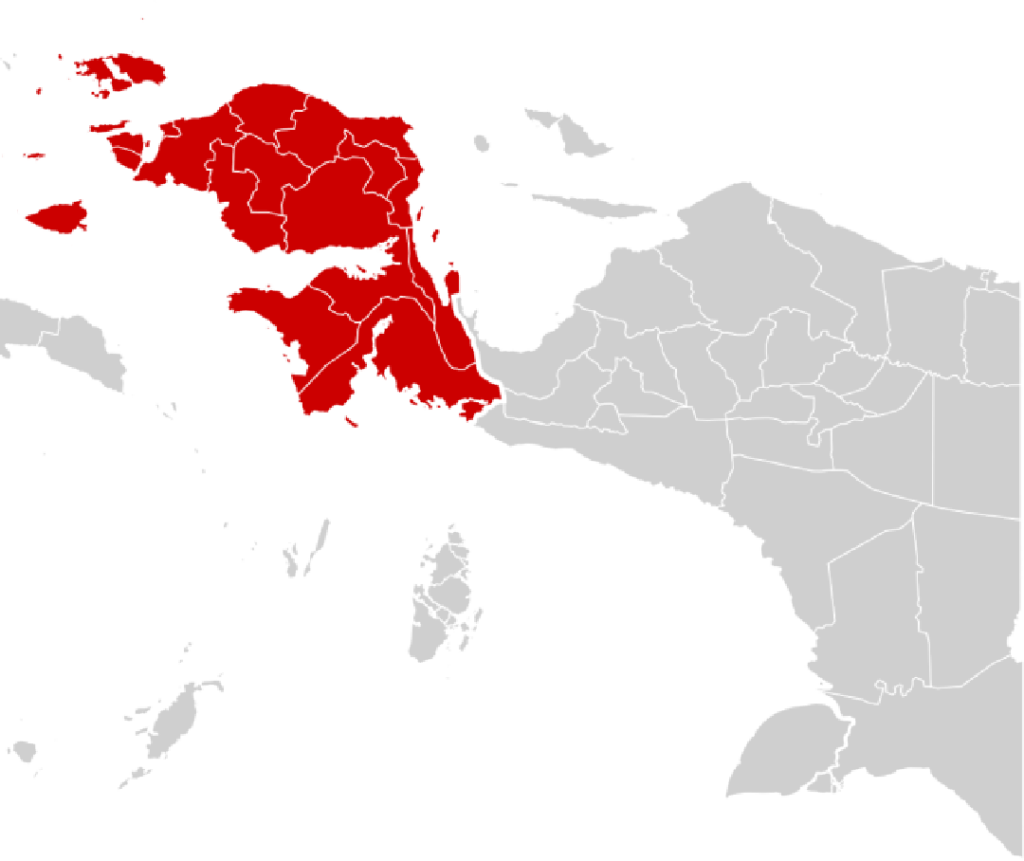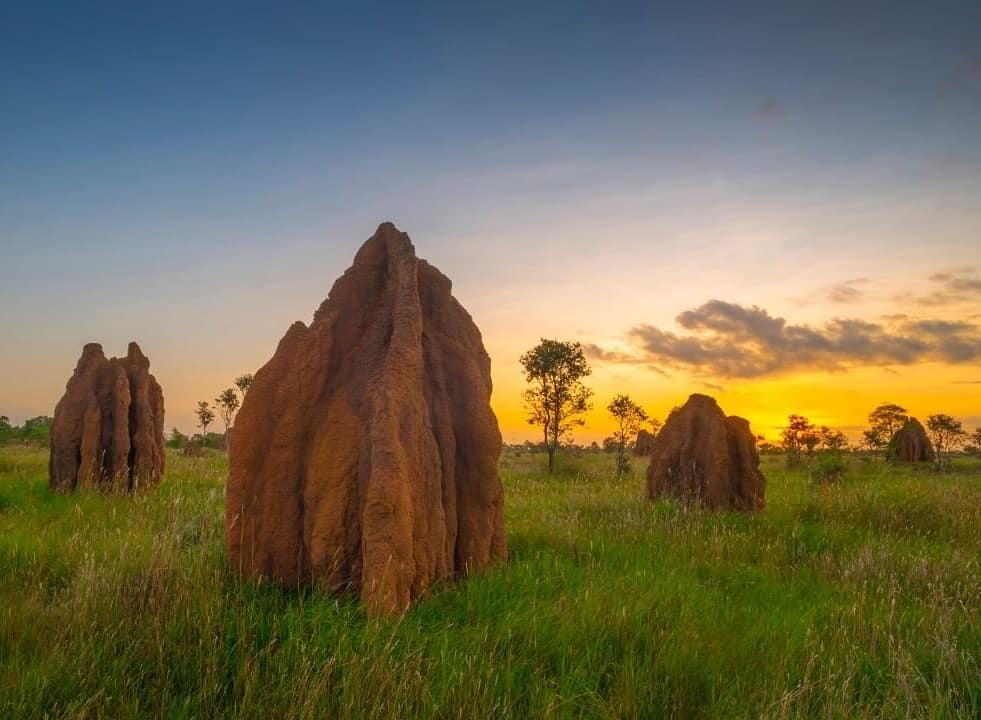
The musamus in Papua Selatan (South Papua) is among the region’s most unusual natural attractions. Rising several metres above the ground, these giant termite mounds can resemble small towers or monuments scattered across the landscape of Merauke.
Their story is especially striking in Salor Indah Village, Kurik District, Merauke Regency. What began as land that was difficult to cultivate eventually became Taman Wisata 1.000 Musamus, a community-managed tourism destination.
The transformation shows how a natural feature can become not only a tourism asset but also part of local culture and village economic activity.
From Difficult Land to Tourism Park
The story began around 2015 and 2016, when spatial planning was being conducted in Salor Indah.
Former village head Tohaman and a Merauke lawyer, Guntur, discovered numerous large mounds across 29 hectares of community-owned land. The structures were identified as termite nests belonging to Macrotermes sp. Their numbers continued to increase, while their rigid composition made the land difficult to cultivate. The mounds were made from materials including wood particles, soil and grass. Some reached heights of around three metres.
Instead of removing the structures, the two figures saw another possibility: turning the unusual landscape into a tourism destination.
Edi Dirhanto, chairman of BUMKam Bintang Terang, recalled that the mounds looked like “palaces” scattered across the area. That impression helped inspire the idea of protecting the site and developing it for visitors.
The destination was officially inaugurated in 2019 as Taman Wisata 1.000 Musamus. It is managed by BUMKam Bintang Terang under the Salor Indah village government.
Why It Is Called 1,000 Musamus
The name does not represent an exact scientific count of 1,000 large mounds.
Around 2021, students from Universitas Musamus conducted a survey. They counted approximately 800 large mounds, although the survey did not cover the entire area. Smaller structures below one metre were not included, despite their large numbers. The name “1,000 Musamus” therefore reflects the extraordinary abundance of the formations.
The park covers 29 hectares and lies about 1.5 to two hours from central Merauke. Visitors can reach it by motorcycle or car, although some roads remain unpaved. During the rainy season, dirt sections can become muddy and flooded, making the dry season more suitable for travel.
The Architecture of a Tiny Builder
Despite their appearance, musamus are not made by ants. They are giant nests constructed by Macrotermes termites.
The IndonesiaKaya account describes musamus as natural structures that can reach five metres in height and more than two metres in diameter. Their surfaces are generally ridged and reddish-brown, giving them the appearance of earthen towers.
The structures are built from dry grass, soil and termite saliva. Large colonies work together to create a strong shelter for the insects. Inside are complicated networks of passages that function as living spaces and ventilation channels, helping maintain a stable environment within the mound.
The scale is what makes Musamus remarkable. Tiny insects create structures many times larger than themselves through collective activity.
That natural engineering has also shaped the cultural interpretation of musamus in Merauke.
A Philosophy of Work and Cooperation
IndonesiaKaya connects musamus with a phrase attributed to an unnamed Papuan leader: “Do not ask about my work, but look at my work.”
The phrase was presented as an ideal of working quietly and allowing results to demonstrate achievement. The musamus became an inspiration for this philosophy because colonies of termites work collectively and persistently to create enormous structures.
The lesson has subsequently been interpreted as an encouragement for people in Merauke to work diligently, cooperate and avoid damaging the environment.
The symbolism has become so strong that the musamus is also represented in the coat of arms of Merauke Regency.
Thus, what began as a biological phenomenon has acquired a cultural meaning. The mound represents more than the activity of insects. It has become associated with cooperation, perseverance and tangible achievement.
A Natural Feature Becomes an Economic Asset
The transformation of Salor Indah also has an economic dimension.
The 29 hectares remain community-owned land belonging to 29 families. According to the Papua Selatan provincial government, 25 per cent of tourism revenue is allocated as village original revenue, while the remaining income is distributed between the management and community landowners.
The park has developed facilities, including toilets, a prayer room, food stalls and an observation tower. Visitors can also enjoy activities such as swimming, horse riding, riding a modified tractor known as a grandong, and ATV trips across the tourism area.
Weekend visitor numbers have reportedly reached around 200 people. The reported entrance fee is Rp10,000.
This development gives the musamus an economic role that did not exist when the land was viewed primarily as difficult to cultivate. Tourism now provides an additional activity connected directly to the village and its landowners.
BRI supports the site as part of the Desa BRILian programme. In one environmental initiative, BRI provided 110 longan seedlings to Salor Indah as part of its environmental responsibility programme.
Musamus Through a Spiritual Lens
The meaning of musamus extends beyond tourism and economics.
In March 2026, Muchamad Arifin, chairman of the Community Da’wah Institute of the Muhammadiyah Central Executive Board, encountered the structures during a Ramadan religious journey through Merauke.
Accompanied by Zaenal Arifin, head of the Muhammadiyah orphanage in Merauke and a forest ranger, he initially mistook the structures for small temples or monuments standing in the forest.
After Zaenal explained that they were giant termite nests, Arifin expressed his amazement at the ability of tiny insects to create such large and durable structures. He interpreted the experience as a reminder of the greatness of God’s creation.
Arifin also drew a lesson from the termites’ collective behaviour, associating it with cooperation, persistence and order.
For him, the experience demonstrated that reflection on nature can itself become part of religious learning. He described nature as a continuing source of signs that encourage people to think and be grateful.
That interpretation adds another dimension to the musamus story. For tourists, they are an unusual natural attraction. For residents, they form part of the landscape and identity of Merauke. For Arifin, they became an opportunity for spiritual reflection.
A Small Attraction With a Wider Development Story
The development of Taman Wisata 1.000 Musamus illustrates a broader possibility for tourism in Papua.
The attraction was not created by replacing the natural landscape. Its central feature already existed. Development began when local people recognised that the very formations preventing the conventional use of the land could become assets.
That approach has economic significance because tourism revenue is connected to the village and community landowners. It also has cultural significance because the musamus have become associated with Merauke’s identity.
The challenge going forward is to maintain the balance between tourism development and preservation of the natural formations that make the destination distinctive.
Infrastructure will also remain important. The provincial government notes that access roads are not uniformly paved, and rainy conditions can make travel more difficult. Better access could help visitors reach the destination more easily, while responsible management is needed to ensure that increased tourism does not damage the landscape.
Conclusion
The history of musamus in Papua Selatan is ultimately a story of changing perspective.
Around 2015 and 2016, large termite mounds were discovered across 29 hectares of community land in Salor Indah. Their abundance and hardness made cultivation difficult. Instead of treating them only as obstacles, local figures saw an opportunity to preserve the landscape and develop tourism. By 2019, Taman Wisata 1.000 Musamus had become an established destination.
The mounds themselves remain the heart of the attraction. Built by Macrotermes termites, they can reach several metres in height and contain complex internal passages. Their remarkable form has inspired both scientific curiosity and a local philosophy about cooperation and perseverance.
The story also demonstrates how natural heritage can contribute to village development. Through community-based management, tourism revenue is connected to village income and the families who own the land.
For international visitors, Musamus offers a rare glimpse into one of Papua’s distinctive natural landscapes. For Papua Selatan, it represents something broader: an example of how conservation, culture and local economic opportunity can develop around an asset that was already present.
The future value of Taman Wisata 1.000 Musamus will depend on maintaining that balance. The mounds must remain protected, access must continue to improve responsibly, and local communities must remain central to the tourism economy.
In Salor Indah, tiny termites have created structures large enough to shape a community’s tourism story. Their legacy serves as a reminder that sometimes the most valuable development opportunity doesn’t require starting from scratch. It is something already standing in the landscape.
Read Also
Wasur National Park Showcases Papua’s Biodiversity
Puncak Jaya’s Last Glacier in Oceania Faces a Warming World