
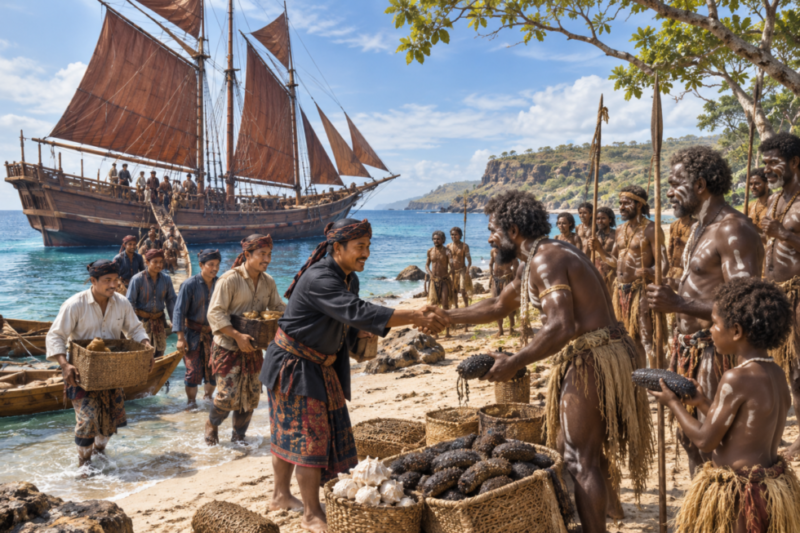
For centuries before European colonisation, Makassar sailors and Aboriginal Australia were already connected by a seasonal maritime trade that carried sea cucumbers, language, technology, culture and family ties across the Arafura Sea. The relationship reached northern Australia long before James Cook charted the continent’s eastern coastline in 1770 and before the British established a permanent colony in 1788.
This was not a story of European “discovery” of an empty land. Aboriginal peoples had lived in Australia for tens of thousands of years. Willem Janszoon’s voyage in 1606 is generally regarded as the first recorded European contact and mapping of part of the Australian continent, while Cook later charted the east coast and claimed it for Britain.
The older story is different.
It begins with wooden sailing vessels leaving Sulawesi, crossing thousands of kilometres of open sea and reaching Arnhem Land in northern Australia. The sailors were looking for trepang, or sea cucumbers, a valuable commodity traded onwards to China for food and medicinal purposes. In the process, they encountered Yolngu communities whose descendants still preserve memories of those encounters today.
The resulting relationship became one of the most remarkable examples of early maritime interaction between Southeast Asia and the Australian continent.
A Maritime Route Older Than Colonial Borders
The seasonal journeys of Makassar trepang traders are believed to have begun at least by the 1600s, with some historical accounts suggesting earlier contact. By the eighteenth century, the voyages had become a regular feature of life in northern Australia.
The sailors travelled from Sulawesi aboard traditional vessels, including the padewakang, a type of sailing boat that later contributed to the development of the celebrated Indonesian pinisi tradition. These vessels could carry crews of around 30 people and remain at sea for extended periods while travelling between the Indonesian archipelago and northern Australia.
Their destination included Arnhem Land, which Makassar sailors called Marege’.
The name is significant.
Marege was not the name of an Aboriginal tribe. Rather, it was the Makassar term used for the northern Australian region where the sailors collected trepang. The Yolngu, meanwhile, had their own terminology for the visitors. They referred to Makassan sailors as Maŋghatarra.
Over time, the name Marege became deeply associated with the historical memory of Makassar’s relationship with northern Australia.
The connection survives in place names, stories, art and cultural memory.
Trepang: The Commodity That Connected Two Worlds
At the heart of the relationship was a relatively humble marine animal.
Trepang, commonly known in English as sea cucumber, was highly valuable in Asian markets. Makassar traders collected it in northern Australian waters, processed it along the coast and transported it back to Southeast Asia before it entered wider Asian trading networks, particularly the Chinese market.
What began as a commercial activity gradually became something much larger.
The traders did not simply arrive, collect sea cucumbers and leave.
They established seasonal camps. They exchanged goods with local Aboriginal communities. They shared technologies and practices. Some Aboriginal people worked with or travelled alongside the Makassan crews, while some Makassan sailors formed families with local women. Over generations, these interactions produced cultural and linguistic connections that remain visible today.
The trade therefore created an unusual relationship between two societies separated by the Arafura Sea but connected by maritime technology and economic interests.
Yolngu Memories of the Makassans
Among the most important communities in this history are the Yolngu people of Arnhem Land.
For Yolngu communities, the Makassan period is not merely something found in European archives. It has survived through oral traditions, family stories, music, dance, art and language.
That memory has become particularly visible through contemporary Aboriginal artists.
SBS reported that Yolngu artist Dhambit Munuŋgurr has incorporated the history of Makassan visitors into her work. Her paintings portray Makassan vessels and the dangerous passages through which the sailors navigated the waters of northern Australia. One of her works, Makassans and Yolŋu, depicts men fishing, while another recalls the passage known as the “Hole in the Wall” between islands in the Wessel Islands.
The survival of these stories is significant.
It demonstrates that the Makassan presence was not simply an external commercial episode recorded by outsiders. It became part of Aboriginal historical memory.
Contemporary Yolngu communities continue to recognise the relationship as an important part of their cultural heritage.
Language Became a Lasting Bridge
Perhaps the most visible evidence of the relationship is language.
Historical accounts identify hundreds of words with Malay or Makassan connections that entered Yolngu languages through trade and sustained contact.
Among the words recorded are terms associated with money, flags, bottles, boats and axes. SBS cites examples including rrupiya for money, bandirra for flag, buthulu for bottle, lipalipa for canoe and baŋ’kulu for axe.
Detik also reported research indicating that more than 300 Malay words remained in use among Yolngu communities. According to the researchers cited by the publication, language became one of the strongest legacies of the relationship because it served as a practical medium for commerce.
This is an important detail because language rarely travels across cultural boundaries without sustained human interaction.
Words survive when people communicate repeatedly.
The vocabulary left behind therefore provides a linguistic record of a relationship that lasted for generations.
Boats, Metal and New Technologies
The exchange was not limited to words.
Makassan sailors introduced or exchanged various technologies and manufactured goods with Aboriginal communities.
According to research cited by detik, Yolngu communities gained access to metal objects and tools, including knives and cooking implements. Makassan sailors also introduced rice, tobacco and other commodities.
One particularly important technological influence involved small boats.
Yolngu communities adopted a canoe technology associated with the Makassan visitors. The vessels became known as lipa-lipa and were used in shallow waters for fishing and collecting marine resources.
The relationship also appears to have influenced the use of flags and other forms of visual identification within some Yolngu communities.
According to Paul Thomas of Monash University, cited by detik, different flags became associated with different Yolngu clans and were subsequently incorporated into ceremonial and territorial practices.
These examples show that the relationship was not simply an exchange of commodities.
It was an exchange of knowledge.
The Tamarind Trees That Still Tell the Story
One of the most evocative traces of the Makassan presence is the tamarind tree.
After collecting trepang, Makassan crews processed and dried the sea cucumbers along the northern Australian coast. Tamarind trees were planted at some of their temporary settlements and later became associated with the historical presence of the Makassan sailors.
The tree became more than a botanical introduction.
It became a cultural marker.
Modern exhibitions and artistic projects have used the tamarind tree as a symbol of the relationship between Makassar and First Nations communities.
In 2025, an exhibition at Monash University Museum of Art in Melbourne explored historical relationships between Australian First Nations peoples and Makassan sailors. One of the featured works focused on the tamarind tree as a shared cultural symbol and meeting place.
The image is powerful because it represents the nature of the historical relationship: people arriving from across the sea, establishing temporary communities and leaving behind elements that became incorporated into local memory.
The Journey of the Padewakang
It is also important to distinguish the historic padewakang from the modern pinisi.
Popular narratives sometimes describe the Makassan vessels simply as pinisi, but historical shipbuilding research cited by Dari Laut shows that the padewakang was an earlier type of Bugis-Makassar sailing vessel. The name “pinisi” itself became established much later, particularly from the twentieth century.
The distinction makes the story even more intriguing.
The maritime technology that carried Makassan sailors to northern Australia belonged to a long tradition of Indonesian boatbuilding. The padewakang was adapted to the demands of long-distance sailing, allowing crews to cross the waters between Sulawesi and northern Australia.
Today, the pinisi has become an internationally recognised symbol of Indonesia’s maritime heritage. UNESCO inscribed Indonesian pinisi boatbuilding traditions on its Representative List of the Intangible Cultural Heritage of Humanity in 2017, while contemporary expeditions have sought to revive the memory of Indonesia’s historic maritime routes.
The old vessels therefore remain relevant to a modern conversation about Indonesia’s maritime identity.
When Trade Became Family
Perhaps the most human part of the story is the evidence of intermarriage.
The Makassan and Yolngu relationship was not confined to markets or temporary coastal camps. Some Aboriginal people travelled to Makassar, while some Makassan sailors married local women in northern Australia. SBS reports that dozens, and possibly hundreds, of Aboriginal people travelled with Makassan crews to Sulawesi, while some Makassan sailors established families in Australia.
A more recent SBS report highlighted efforts to reconnect descendants of these historic relationships.
One story concerns Husaing Daeng Rangka, known to the Yolngu community as Yuching, whose family history included marriages in both Makassar and Yolngu society. The story demonstrates how maritime trade could produce family connections that survived long after the commercial voyages ended.
These connections complicate any simple distinction between “Indonesian” and “Australian” in the historical context.
Those modern national identities did not exist in their present form when the voyages began.
People were moving through a maritime world that existed before modern borders.
Islam Across the Arafura Sea
The Makassan presence also contributed to the transmission of Islamic cultural influences to northern Australia.
Detik reported that elements associated with Islam entered Yolngu society through contact with Makassan sailors, including circumcision practices and other cultural influences. DW similarly notes that Islam became part of the broader cultural and cosmological exchange between Makassan traders and Aboriginal communities.
The historical evidence should nevertheless be treated carefully.
It does not mean that northern Aboriginal societies became Islamic communities in the conventional sense. Rather, particular religious practices, concepts and cultural influences travelled through sustained interaction.
This is another example of how maritime trade can produce cultural change without replacing local identity.
A Relationship That Was Not Always Perfect
The history should not be romanticised.
Although many contemporary Aboriginal accounts remember the Makassan period as relatively peaceful and respectful, historical research also records conflict, exploitation and unequal encounters.
DW’s review of the history notes accounts involving conflict between Makassar crews and local communities, as well as evidence concerning Aboriginal people taken to Makassar whose later fate remains uncertain.
This complexity matters.
A credible historical account should acknowledge both cooperation and tension.
Nevertheless, the overall pattern described in the cited sources is one of sustained interaction based heavily on trade and mutual economic interests. That experience contrasts with the much more disruptive colonial transformation that followed European settlement.
European Colonialism Changed the Maritime System
The Makassan voyages continued for generations, but the relationship eventually came under pressure from European colonial policies.
British authorities introduced regulations, licences and taxes affecting the trepang trade. By the early twentieth century, these restrictions had severely reduced the ability of Makassan traders to continue their traditional seasonal voyages.
SBS reports that the trade effectively ended in 1906, while other accounts place the final phase around 1907. The key point is that colonial regulation brought an end to a maritime trading system that had survived for centuries.
The significance goes beyond the disappearance of a commercial route.
The restrictions disrupted a wider network of people, knowledge, family relationships and cultural exchange.
A maritime world that had existed before modern national borders was increasingly replaced by a system defined by colonial territorial boundaries, permits and controlled access.
Willem Janszoon and the European Record
This history also changes the way the word “discovery” should be understood.
Willem Janszoon’s voyage aboard the Duyfken in 1606 is recognised as the first recorded European contact and mapping of part of the Australian continent. His expedition reached Cape York and mapped part of its western coastline.
But Aboriginal Australians had already inhabited the continent for many thousands of years.
Nor was Janszoon the first human visitor from overseas to reach Australia. The Makassan voyages demonstrate that Southeast Asian maritime communities were already travelling to northern Australia and establishing seasonal relationships with its Indigenous inhabitants.
James Cook came much later.
In 1770, Cook charted Australia’s eastern coastline and claimed the eastern part of the continent for Britain, naming it New South Wales.
British colonisation followed in 1788 with the establishment of a penal colony at Port Jackson.
By then, the northern Australian coast had already experienced generations of interaction with Makassan sailors.
Bulukumba and a Shared Maritime Heritage
The historical connection continues to attract interest in Indonesia.
In July 2025, researchers from the Indigenous Knowledge Institute at the University of Melbourne, Aboriginal artists and researchers from the MAREGE Institute visited Bulukumba in South Sulawesi to investigate historical and cultural links between Bulukumba communities and Aboriginal Australians.
The delegation visited Tanah Beru in Bontobahari and the Ammatoa Kajang customary area as part of the “Gema dan Gelombang di Laut Arafura” cultural programme, which is supported by Australia’s Department of Foreign Affairs and Trade.
Researchers highlighted the continuing tradition of boatbuilding in Bulukumba and the historical importance of the padewakang.
They also noted an important difference in how the history is remembered.
In northern Australia, the “Trepang Route” has been passed down through generations and is taught to students. In Indonesia, the history has received considerably less attention in mainstream school curricula.
The researchers proposed building a shared database of traditional knowledge and historical information.
Such initiatives could turn an overlooked chapter of maritime history into a stronger bridge between Indonesia and Australia.
What This History Means for Indonesia Today
The Makassar Aboriginal relationship offers Indonesia a valuable lesson about its maritime identity.
Indonesia is often described as the world’s largest archipelagic state, but the historical evidence shows that its people did not merely live among islands.
They travelled between them.
The Arafura Sea was not simply a boundary separating Indonesia from Australia. For Makassan sailors, it was a route to economic opportunity. For Yolngu communities, the arrival of foreign sailors became part of a long process of cultural exchange.
That history has relevance for Indonesia’s contemporary maritime strategy.
The development of coastal economies, traditional boatbuilding, marine tourism and cultural diplomacy can draw upon this heritage. Rather than treating maritime history as a museum subject alone, Indonesia can use it to strengthen people-to-people ties with Australia.
This is especially relevant as both countries seek deeper cooperation across the Indo-Pacific.
A Story That Connects Indonesia, Australia and the Wider Region
The Makassar-Yolngu relationship also places Indonesia within a broader history of Asian maritime mobility.
For centuries, Southeast Asian sailors participated in trading networks extending across the Indian Ocean, Southeast Asian seas and the Pacific approaches.
The voyages to northern Australia show that Indonesian maritime communities were not isolated from the wider world.
They were active participants in it.
For Papua and eastern Indonesia, the history is particularly relevant. The Arafura Sea sits between Indonesia’s eastern provinces and northern Australia, and the centuries-old movement of people across the region demonstrates the importance of maritime connectivity to the wider eastern Indonesian world.
Today, strengthening legal, sustainable and peaceful maritime cooperation can build upon that older tradition while respecting modern sovereignty and international law.
The old trade routes can no longer operate as they once did. Modern states have territorial waters, immigration rules, environmental regulations and fisheries laws.
But the historical memory can still travel.
Conclusion
The story of Makassar sailors and Aboriginal Australia is one of the clearest reminders that history did not begin with European arrival.
For generations, Makassan seafarers crossed the Arafura Sea in search of trepang. They met Yolngu communities in Arnhem Land, traded goods, exchanged knowledge, introduced technologies, shared words, formed families and left cultural traces that remain visible today.
Their voyages predated British colonisation and existed within a maritime world that was not yet divided by today’s national borders.
Willem Janszoon’s 1606 voyage represents the first recorded European contact and mapping of part of Australia, while James Cook’s 1770 expedition later charted and claimed the eastern coastline for Britain. Neither event marked the beginning of Australia’s human history.
For Indonesia and Australia today, the Makassar-Yolngu relationship offers something more valuable than a nostalgic tale.
It provides historical evidence of connectivity.
It indicates that the Arafura Sea once functioned as a bridge between societies, that commerce could generate cultural exchange, and that maritime encounters could create relationships that survived for centuries.
As Indonesia and Australia look toward a more connected Indo-Pacific, recovering this shared history could help deepen cultural diplomacy, strengthen educational cooperation and encourage a more nuanced understanding of the region’s past.
The story of Marege is therefore not simply about where Makassan sailors once travelled.
It is about what happened when two maritime worlds met, long before colonial borders divided them.
And that memory, carried through Yolngu stories, Makassan traditions, language, art and family histories, remains one of the most remarkable chapters in the shared history of Indonesia and Australia.
Read Also
Sultan Nuku and Papua’s Mambri Against Dutch Colonialism
The History of The Melanesians in West Papua
Austronesian Language Traces: On Papuan Language and Culture
Melanesian Roots in Indonesia: A Legacy of Unity in Diversity

