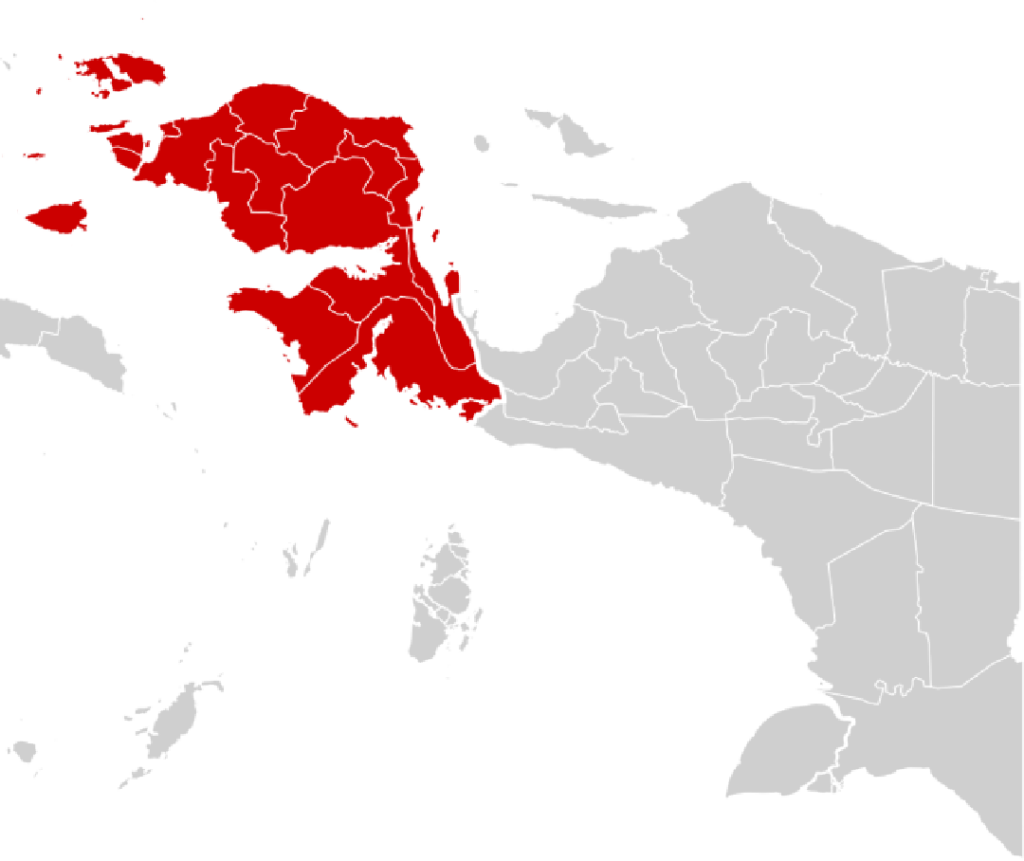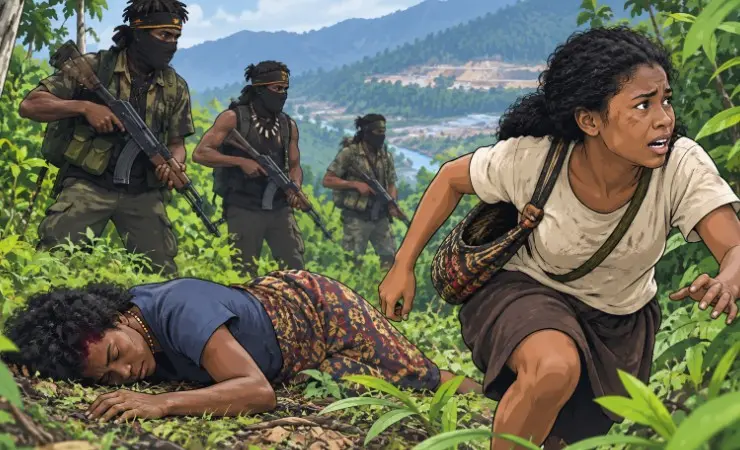
The reported Jila hostage crisis has taken a new turn after two of the nine women allegedly abducted in Jila District, Mimika Regency, Papua Tengah (Central Papua), reportedly managed to escape from their captors. The two women, identified in reports as Yonita Tsenawatme and Demerina Uamang, are now reported to have reached safety, offering the first significant breakthrough in a case that has raised serious concerns over the West Papua National Liberation Army from the Free Papua Movement’s (TPNPB OPM) treatment to civilians in Papua.
The reported escape also brings renewed attention to the circumstances surrounding the abduction of nine women in the remote Jila area. Earlier reports identified children, teenagers, and a young pregnant woman among those taken by an armed group. Indonesian authorities have been searching for the victims while local communities and Papuan leaders have repeatedly called for civilians to be kept out of armed confrontation.
The case has become one of the latest reminders that insecurity in remote parts of Papua can have consequences far beyond armed groups and security forces. For ordinary families, especially women and children, violence can turn a village into a place of fear almost overnight.
A Remote District Caught in Armed Violence
Jila is one of the more isolated areas of Mimika Regency. Access is difficult, communications can be limited, and transportation depends heavily on air links.
Those geographic conditions have complicated the response to the reported abduction.
According to earlier reports, the incident unfolded on August 17, 2026, after an armed confrontation in Jila. Residents subsequently reported that a group of armed men had taken civilians from the area.
The initial reports alarmed the public because they did not describe the victims as combatants. They were women and girls, including several schoolchildren and a reportedly pregnant teenager.
On August 20, the Mimika Police publicly confirmed that an armed group was holding nine female civilians. Police Chief AKBP Alfredo Agustinus Rumbiak said information about the victims had been obtained from police personnel in Jila and from their families. Most of those initially identified were between 13 and 17 years old.
The reported victims included Nemerina Wamang, 17, who was described as being in the early stages of pregnancy, along with three elementary school students, Alin Mesawarol, Nopi Aim, and Opinte Mesawaro.
The other names publicly reported at the time were Yonita Senawatme, Meria Nibilingame, Wena Katagame, Ilimin Onawame, and Miante Nibilingame.
The age profile of the group immediately turned the incident into a humanitarian concern rather than simply another episode in Papua’s armed conflict.
Reports of Two Women Escaping
The latest development came through reporting by Pos Kupang, which reported that two of the nine women had succeeded in escaping.
The two were identified as Yonita Tsenawatme and Demerina Uamang in the Pos Kupang report supplied for this article.
Their reported escape is significant because it could provide authorities and families with firsthand information about what happened after the women were taken and where the remaining victims may have been held.
However, because the available Pos Kupang Facebook video could not be independently accessed for verification, details surrounding the exact route, timing, and circumstances of the escape should be treated as reported information pending confirmation from Indonesian authorities.
Even so, the development changes the dynamics of the case.
The priority is no longer only to establish where the nine women are. Authorities may now have potential survivor testimony that could help reconstruct the movement of the group, identify locations where the victims were held, and determine the condition of the remaining women.
For families, however, the news carries mixed emotions. The escape of two women offers hope, but it also underscores the continuing uncertainty surrounding those who have not yet returned.
Earlier Reports Described a Violent Abduction
The circumstances surrounding the original incident were particularly disturbing.
According to information reported by Indonesian authorities, an armed group reportedly moved through the area following an armed clash and subsequently took several civilians.
Mimika Military District Commander Lieutenant Colonel Jozanda said troops were deployed after receiving reports that civilians had been forcibly taken.
“Don’t worry, we are already pursuing the perpetrators,” Jozanda said in a statement reported by ANTARA, adding that soldiers were attempting to locate and rescue the victims.
The military commander also described the incident as involving children, teenage girls, and a pregnant teenager.
At the time, authorities said the armed group was believed to number approximately 15 people. The precise identity of the group was initially still under investigation. Jozanda said investigators were examining where the group came from and noted that information about the perpetrators remained incomplete.
This point is important in assessing the case. While local reporting and subsequent statements have associated the incident with TPNPB OPM, the available early official reporting described the perpetrators as an armed group while authorities continued their investigation.
A Mother Was Reportedly Killed
The humanitarian consequences of the violence became even more serious after two other women were located.
One of them, Neregingget Magai, 48, was reported dead after suffering a gunshot wound.
Another woman, Inkolung Aim, was reportedly found injured after being thrown into a ravine. She suffered a broken leg and was evacuated by local residents for medical treatment.
According to Jozanda’s account reported by Indonesian media, the two women had resisted attempts to take their children. He said one was shot and killed while another was thrown into a ravine.
Jozanda condemned the actions as cruel and inhumane and said security personnel were pursuing the perpetrators to rescue the remaining civilians.
The reports remain part of an ongoing investigation, but the alleged treatment of civilians has already become one of the most disturbing elements of the Jila case.
It also illustrates the vulnerability of communities caught between armed groups and security operations.
Why the Case Raises Serious Civilian Protection Concerns
The Jila incident is particularly troubling because of the reported composition of the group.
Several of those initially listed as missing were children. One was a 13-year-old girl, while three were elementary school students. Another victim was reportedly pregnant.
International audiences often encounter Papua primarily through discussions of political status, security operations, and separatist conflict. But the Jila case demonstrates another dimension of the problem: the everyday human cost borne by civilians.
For a family in a remote Papuan village, armed conflict is not an abstract geopolitical debate.
It can mean a child disappearing on the way home, a mother being separated from her family, a school becoming empty, or farmers becoming too frightened to travel to their fields.
This is why civilian protection must remain at the center of any discussion about security in Papua.
Who Is Prisko Lokbere?
The Pos Kupang material supplied for this report also identifies Prisko Lokbere as the alleged leader of the group involved in the abduction.
That identification should be treated as an allegation pending judicial or investigative confirmation.
The significance of the claim is nevertheless considerable because establishing the chain of command behind an abduction is important for law enforcement. It could help investigators determine whether the incident was an isolated act by an armed faction or part of a broader pattern of organized violence.
The Indonesian authorities have previously stressed the importance of establishing facts through field investigations, intelligence gathering, and information from local communities.
That approach is particularly important in Jila because misinformation can spread quickly when communications are limited.
Indonesian Security Forces Face a Difficult Task
The Indonesian government faces two immediate responsibilities in the aftermath of the reported escape.
The first is ensuring that Yonita and Demerina receive appropriate medical, psychological, and family support following their reported captivity.
The second is using any reliable information obtained from the survivors to locate the remaining victims.
The Mimika Police previously announced plans to strengthen security in Jila and send personnel to conduct an investigation at the scene. Brimob personnel were also requested to reinforce the local police presence.
The military has similarly maintained a search effort.
The difficult terrain means that any operation must account for mountains, limited transportation infrastructure, and communication challenges. A forceful security response may be necessary where armed threats remain present, but civilian safety must remain a central consideration.
The government also faces a wider challenge: preventing the incident from disrupting essential services.
Violence Is Already Affecting Local Communities
The consequences of the Jila violence extend beyond the women who were reportedly abducted.
ANTARA reported that residents had become traumatised after the incident and had stopped farming, creating concerns about food supplies. The military said it was coordinating with local government authorities to support residents and planned to assist with food distribution.
This detail is important because it connects security directly with economic and social stability.
In isolated communities, agriculture is not simply an economic activity. It is often the foundation of household food security.
When people are afraid to leave their homes or travel to gardens, the effects can quickly spread to families, markets, and local government services.
The result is a cycle in which insecurity weakens economic activity, while weak connectivity and limited public services make communities more vulnerable during emergencies.
Papua Leaders Have Called for Civilian Protection
The Jila case has also generated condemnation from Papuan community figures.
As previously reported by West Papua Voice, youth and traditional leaders called for the protection of civilians and urged that women and children should not be used as instruments in armed confrontation.
The importance of these voices should not be underestimated.
The strongest argument against violence in Papua does not necessarily come only from Jakarta or Indonesian security institutions. It also comes from people living in Papuan communities.
Traditional leaders understand the social consequences of prolonged instability. They see how violence affects families, education, health services, and economic activity.
Their involvement can therefore complement government security measures by helping establish communication channels with communities and encouraging residents to reject retaliatory violence.
The Jila Case Fits a Wider Pattern
Papua has experienced several hostage-taking incidents involving armed groups over the past decades.
The Mapenduma hostage crisis in 1996 involved members of the Lorentz ’95 expedition and eventually required the involvement of the International Committee of the Red Cross.
More recently, New Zealand pilot Philip Mehrtens was held captive for more than 19 months after his aircraft was seized in Nduga in February 2023. He was released in September 2024 following a prolonged process involving Indonesian and New Zealand authorities and local figures. West Papua Voice has previously highlighted this broader history in its reporting on the Jila case.
These cases demonstrate that hostage-taking in Papua can develop into prolonged humanitarian and diplomatic challenges.
They also show why early civilian protection and effective communication are essential.
What the Escape Could Mean for the Search
The reported escape of Yonita and Demerina could become an important turning point.
If authorities are able to interview the two women safely and systematically, their testimony could potentially clarify the circumstances of the abduction, the movement of the group, and the condition of the remaining victims.
But the process must be handled carefully.
Survivors of captivity may be traumatized. Their immediate needs should therefore come before extensive questioning.
The government and local authorities should provide medical assistance, psychological support, and secure contact with their families while gathering information relevant to the investigation.
At the same time, information released publicly should be verified before it is circulated widely.
In a sensitive security environment, inaccurate information can expose survivors and their families to additional risks.
Development and Security Cannot Be Separated
The Jila case also highlights a broader issue in Papua: development cannot be separated from security.
Remote communities need functioning communications, reliable transportation, healthcare, education, and food supplies.
When those systems are weak, a security incident can quickly become a humanitarian emergency.
Conversely, better infrastructure and stronger local government services can improve the state’s ability to respond to emergencies while increasing community resilience.
This is why efforts to improve connectivity and public services in remote Papua are not merely development projects. They are also part of building long-term civilian security.
The Indonesian government’s challenge is to ensure that security measures are accompanied by sustained investment in communities.
Conclusion
The reported escape of Yonita Tsenawatme and Demerina Uamang provides a rare moment of hope in the Jila hostage crisis. Two women reportedly managed to break away from their captors after being among nine civilians taken during a period of armed violence.
But their escape should not obscure the larger humanitarian concern.
The fate of the remaining victims remains the central issue. Their safety, medical condition, and eventual return to their families must remain the priority.
The reported killing of Neregingget Magai and the injury of Inkolung Aim have already demonstrated how severely civilians can suffer when armed violence reaches their communities. The presence of children and a reportedly pregnant teenager among those taken makes the case even more serious.
For Indonesia, the response will be measured not only by its ability to pursue armed perpetrators but also by its ability to protect civilians, support survivors, and restore confidence in affected communities.
For Papuan leaders, the crisis reinforces the importance of speaking clearly against violence and supporting peaceful community mechanisms.
And for international observers, the Jila case is a reminder that Papua’s security debate should not be reduced to competing political narratives. Behind every incident are families, children, and communities whose lives can be permanently changed by violence.
The reported escape of two women may provide investigators with an important new path forward. The immediate objective should now be clear: find the remaining victims, bring them home safely, and ensure that civilians in Jila can once again live and work without fear.
Read Also
Nine Women Reported Abducted in Papua Violence
Papua Leaders Condemn Abduction as TNI Steps Up Search