
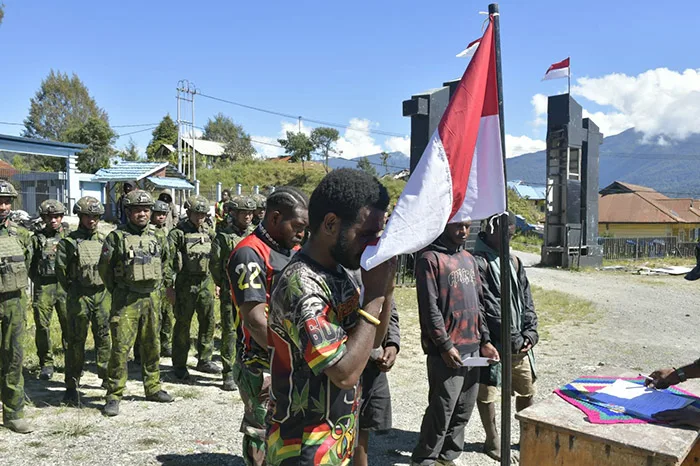
The humanitarian approach in Papua Tengah (Central) has produced a notable development, with six people described by Indonesian authorities as the West Papua National Liberation Army from the Free Papua Movement (TPNPB OPM) members or sympathisers declaring their allegiance to the Republic of Indonesia within two consecutive days. Five were from the group associated with the TPNPB OPM’s War Region Command (Kodap) VIII in Intan Jaya, while another was identified as a member of Kodap XXXIV in Beoga. The declarations followed persuasive communication and territorial engagement conducted by Indonesia’s National Armed Force (TNI) Habema Operations Task Force.
The ceremonies took place in Intan Jaya on September 6 and in Beoga on September 7, 2026. They brought together military personnel, local government representatives, customary leaders, religious figures and members of the surrounding communities.
For Indonesian authorities, the development represents more than a security statistic. It is being presented as an example of how communication, trust and a human-centred approach can create an alternative to armed conflict in Papua.
Yet the significance of the six declarations will ultimately depend on what happens after the ceremonies. Returning to civilian life requires family support, education, employment and acceptance within the community. In one particularly personal case, the family of a 22-year-old man asked that he be supported in continuing his education at a Bible school.
Six People, Two Days and a Different Choice
The first ceremony took place on Sunday, September 6, at the J2 post of the 744/SYB Infantry Task Force in Sugapa District, Intan Jaya Regency, Papua Tengah.
Five people identified by the authorities by the initials JJ, PB, RS, NS and MS declared their allegiance to the Republic of Indonesia.
According to the TNI Habema Operations Command, the five came from varied civilian backgrounds, including students, motorcycle taxi drivers and self-employed workers. Before making their decision, they reportedly underwent communication and persuasive dialogue after being identified as having interacted with leaders of the TPNPB OPM-linked group in Intan Jaya.
The second declaration came the following day in Beoga, Puncak Regency.
Erison Murib, also known as Buton Murib, 22, was identified as a member of TPNPB OPM Kodap XXXIV/Beoga, which the authorities associate with Arodi Kulla. He declared his allegiance at the 1717-03/Beoga Military District Command field on Monday, September 7.
The two events created a rare sequence in which six individuals made similar decisions within 48 hours.
For the military task force, that sequence demonstrates the potential of sustained engagement at the community level.
For the individuals involved, however, the decision carries a more personal meaning. It represents a transition away from an environment associated with armed groups and toward ordinary civilian life.
Dialogue Before the Ceremony
The most important part of the story may have happened before the flag ceremony.
According to the sources, the five individuals in Intan Jaya did not simply arrive at the ceremony and announce their decision. They had previously been involved in communication and persuasive dialogue with the TNI task force.
That process reflects a broader concept of territorial engagement used by the TNI in Papua.
Instead of relying exclusively on security operations, the approach seeks to maintain communication with communities, understand local circumstances and create opportunities for individuals who want to leave armed-group environments.
The strategy is particularly relevant in remote parts of Papua, where social relationships can be as important as formal institutions.
A military presence may provide security, but lasting stability also depends on whether residents trust authorities, whether local leaders participate and whether people who leave armed groups believe they have a viable future outside conflict.
The six declarations therefore offer an example of security policy being combined with social engagement.
The Human Side of Reintegration
The story of Erison Murib illustrates why reintegration cannot end with a declaration.
According to the sources, Erison had previously been described by the TNI as a logistics supplier for an armed group and as having been indicated as involved in the 2019 Julukoma unrest. These are claims attributed to the task force and should not be interpreted as an independent judicial finding.
During his ceremony, however, the focus shifted toward his future.
His family expressed appreciation for what they described as the humane treatment provided by TNI personnel during the communication and mentoring process. They also asked for assistance so that Erison could continue his education at a Bible school.
That request provides important insight into the meaning of reintegration.
Leaving an armed environment does not automatically solve the problems that contributed to a person’s vulnerability. Education, employment, family relationships and social acceptance can determine whether a return to civilian life becomes sustainable.
In that sense, reintegration is not simply about putting down weapons or signing a declaration. It is about rebuilding a person’s connection with ordinary society.
Education as Part of the Peace Process
The request for educational support is particularly significant.
Education can provide young people with an alternative pathway, especially in areas where access to formal employment and higher education remains limited.
A person who returns from a conflict environment needs more than security guarantees. He or she needs a reason to remain in civilian life.
For communities in Papua, education can therefore become part of a wider peace-building strategy.
Schools, vocational programmes, religious institutions and community organisations can all play a role in helping former members or sympathisers establish new social identities.
The experience described in Beoga suggests that such support could complement the government’s broader development agenda in Papua.
The Role of Local Leaders
The ceremonies in Intan Jaya and Beoga were not conducted solely between soldiers and former TPNPB OPM sympathisers.
Local government officials, customary leaders, religious figures and community members also attended.
Their presence matters because reintegration ultimately takes place inside communities.
Customary leaders can help rebuild social relationships. Religious leaders can provide moral and spiritual guidance. Local governments can connect individuals with education, employment and administrative services. Families can provide the emotional support needed during a difficult transition.
The involvement of these groups also provides the process a broader social foundation.
A security institution can facilitate a person’s return, but the community determines whether that person can genuinely feel accepted again.
This is why the TNI’s stated commitment to monitoring the social recovery process is important.
Symbols of Returning to Civilian Life
The ceremonies themselves carried several symbolic elements.
The participants wore batik clothing, signed declarations of allegiance, kissed the Indonesian flag and joined prayers led by local religious figures.
The symbolism is straightforward. The ceremony represents a break with the past and a formal declaration of commitment to the Indonesian state.
But the presence of religious and customary figures adds another dimension.
Papua’s social structure is deeply connected to family, customary communities and religious institutions. A formal declaration is therefore more meaningful when it is witnessed and supported by people who remain part of the individual’s daily social environment.
The ceremony serves as a public bridge connecting a private decision to community reintegration.
Why the Humanitarian Approach Matters for Security
The development also carries implications for Papua’s security environment.
Armed conflict is rarely resolved through security measures alone. While law enforcement and security operations remain necessary to protect civilians, dialogue can create opportunities for people who want to leave armed groups without further escalation.
The TNI Habema Operations Command has said it will keep its door open to individuals who want to leave armed groups and return to community life. Lieutenant Colonel Inf. M. Wirya Arthadiguna, head of public information for Koops TNI Habema, emphasised social communication and the safety and welfare of Papuan communities.
From a security perspective, successful reintegration could reduce the number of individuals supporting armed networks.
From a social perspective, it could strengthen families and communities.
From a development perspective, it could make it easier for local economies and public services to operate in a more stable environment.
These effects are interconnected.
Security and Development Cannot Be Separated
Papua’s development challenges are often discussed in terms of roads, telecommunications, schools, healthcare and economic opportunities.
But development also requires stability.
A community affected by persistent insecurity can face disruptions to education, transportation, trade and public services. Residents may find it difficult to plan businesses or invest in agricultural and other economic activities when security conditions are uncertain.
This makes social stabilisation an important part of the broader development picture.
The six declarations in Intan Jaya and Beoga should not be portrayed as proof that the security challenge in Papua has been solved. Six people represent only a small number in a much larger and more complicated environment.
Their significance lies elsewhere.
They demonstrate that there are individuals willing to respond to dialogue and consider a return to civilian life.
That possibility creates space for a policy approach that combines security, communication and development.
A Message Beyond the Six Individuals
The TNI has used the six declarations to encourage others still associated with armed groups to consider a peaceful return to community life.
The message is that there is an alternative path.
The approach also reflects an important principle: people who decide to leave an armed environment need an opportunity to become productive members of society rather than remaining permanently defined by their past.
This distinction can be important for long-term stability.
If reintegration is successful, former members can become part of the same communities that once experienced insecurity. Their personal experiences can potentially help reduce recruitment and create greater understanding of the consequences of prolonged conflict.
But such an outcome requires patience.
A declaration of allegiance is a beginning, not an endpoint.
The Next Test: Sustaining the Peace
The strongest test of the Habema approach will come after the ceremonies.
The question is whether the six individuals can safely return to their communities and build stable lives.
That means continued communication between the TNI, local government and families. It also means access to education and livelihoods.
The request from Erison’s family for support to continue his education offers one practical example of what that process could look like.
If such requests can be connected to appropriate public programmes, reintegration could become more than a security achievement. It could become a development outcome.
This situation is where Papua’s wider development agenda becomes relevant.
Infrastructure and public services can create the physical conditions for development. Education and employment create human opportunities. Security creates the environment in which both can function.
Together, these elements can strengthen community resilience.
Papua’s Broader Path Toward Stability
The six declarations also come at a time when the Indonesian government continues to pursue development and governance programs across Papua.
The region’s challenges are diverse, ranging from geographical isolation and limited infrastructure to economic inequality and security concerns.
No single policy can address all of them.
A human-centred security approach can nevertheless complement broader development policies by creating opportunities for individuals and communities affected by conflict.
For international observers, the developments in Intan Jaya and Beoga are therefore relevant beyond the immediate ceremonies.
They provide a small but concrete example of how a state can combine security responsibilities with dialogue and social engagement.
For Indonesia, the approach also presents an opportunity to demonstrate that maintaining national unity and improving civilian welfare do not have to be competing objectives.
They can reinforce each other when security policy is connected to local communities.
Conclusion
The decision by six people in Papua Tengah to declare their allegiance to the Republic of Indonesia within two consecutive days represents a significant development in the TNI Habema Operations Command’s reported efforts to use dialogue and a human-centred approach alongside territorial security measures.
Five people associated by authorities with Kodap VIII in Intan Jaya made their declaration on September 6. Erison Murib, identified by the authorities as a member of Kodap XXXIV in Beoga, followed one day later.
The ceremonies were accompanied by the presence of local government officials, customary and religious leaders and members of the community.
Yet the deeper significance of the development will not be measured by the ceremony itself.
It will be measured by whether these individuals can return safely to civilian life, rebuild family relationships, obtain education or employment and participate constructively in their communities.
That is why the family request for educational support is important. It illustrates that peace is ultimately built through ordinary opportunities: education, work, family, community and a sense of belonging.
The TNI’s stated commitment to continued social communication and monitoring of the reintegration process could therefore become an important part of the next stage.
The experience in Intan Jaya and Beoga suggests that in Papua, where security challenges intersect with complex social realities, the most durable progress may come when security institutions engage communities not only as areas to be secured but also as communities to be heard.
Six people have made a different choice.
The challenge now is to ensure that choice has a future.
Read Also
37 Former OPM Members Pledge Loyalty to Indonesian Government
From Rebels to Citizens: Three Former OPM Fighters Surrender in Papua, Signaling Shift Toward Peace in Indonesia
Humanitarian Approach Leads 17 Former TPNPB OPM Members in Intan Jaya to Pledge Loyalty to Indonesia

