
Papua Special Autonomy funds are once again at the centre of attention as Indonesia’s Ministry of Home Affairs pushes local governments across the Papua region to accelerate the administrative process required for the second phase of the 2026 disbursement.
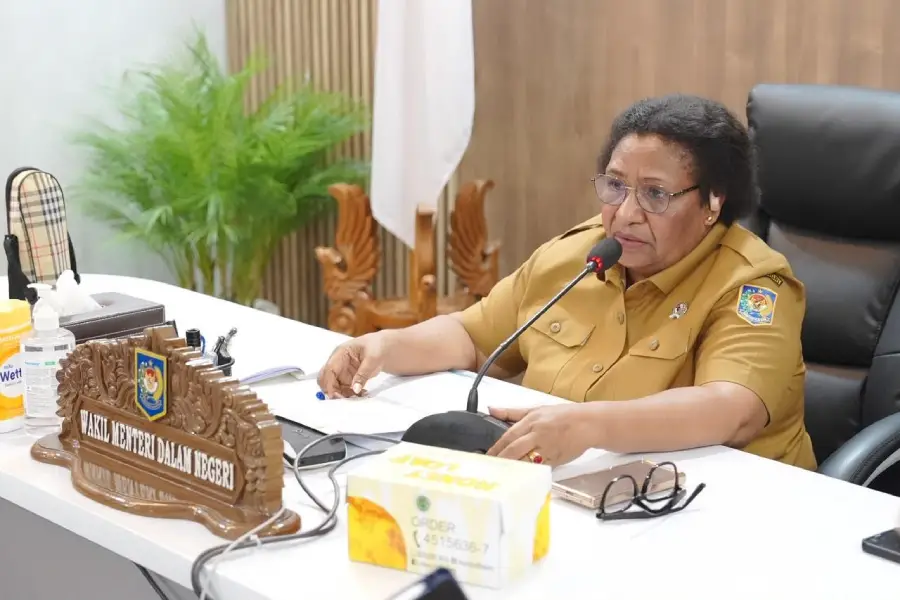
Vice Minister of Home Affairs Ribka Haluk has called on 26 local governments in the six Papua provinces to demonstrate greater commitment and seriousness in completing the requirements for the release of the second phase of Special Autonomy, or Otsus, funding.
As of early September 2026, the 26 local governments had not yet completed the administrative documents required for the second phase. The delay does not mean the central government has stopped the funding process. Rather, officials say the central government is ready to proceed once the necessary requirements have been fulfilled by the local governments.
For Ribka, the issue is therefore not simply about the availability of money. It is about whether the administrative machinery at the local level can move quickly enough to ensure that public funds reach development programmes and communities as intended.
“The central government is ready to serve. It now depends on the local governments,” Ribka said in Jakarta on September 8, according to reports on her statement. She stressed that the speed of Otsu’s disbursement and realisation ultimately depends on the readiness of local administrations.
The message reflects a broader effort by Jakarta to strengthen the management of Special Autonomy funding after years in which the effectiveness of the policy has been closely associated with the quality of local governance.
Six Papua Provinces Under Closer Attention
The 26 local governments are spread across the six provinces that make up the current administrative structure of Tanah Papua: Papua, Papua Barat (West Papua), Papua Tengah (Central Papua), Papua Pegunungan (Highland Papua), Papua Selatan (South Papua) and Papua Barat Daya (Southwest Papua).
The geographical scale matters.
Papua’s vast territory, difficult transportation links and uneven administrative capacity have long made public service delivery more complicated than in many other parts of Indonesia. Special autonomy funding was designed in part to address these challenges by providing additional fiscal support for development and public welfare.
That makes timely disbursement important. Delays in administrative processing can potentially affect the implementation of programmes that depend on Otsus funding, particularly when local governments are required to complete several reporting and accountability stages before the next tranche is released.
Ribka’s intervention therefore places responsibility on both sides of the system. The central government must maintain a mechanism that is clear and responsive, while local governments must ensure that planning, implementation and reporting are conducted properly.
The approach is significant because it shifts the discussion away from the size of the budget alone and towards the quality of public financial management.
As Ribka has repeatedly emphasised in 2026, the central concern is how Otsus funds are governed so they can be delivered on time, targeted towards the right beneficiaries and translated into measurable benefits for communities.
The Second Phase Does Not Require 100 Percent Realization
One of the key points in Ribka’s latest statement is the clarification surrounding the requirements for the second phase of Otsu’s disbursement.
Local governments do not have to account for 100 per cent of the first-phase budget before the second phase can be released. The minimum requirement is a 50 per cent realisation, accompanied by the necessary performance documentation.
The reports include a performance report, evidence of output achievement, and reports concerning the use of SiLPA, or remaining budget balances, as well as the previous year’s Dana Tambahan Infrastruktur, or Additional Infrastructure Fund.
This distinction is important because the administrative requirement is intended to establish a reasonable link between the release of additional funds and evidence that the previous allocation is being implemented.
Ribka argued that preparing the accountability documents should not be excessively difficult when programmes have actually been carried out according to the plans established at the beginning of the budget cycle.
In practical terms, the message is straightforward: local administrations that implement programmes according to plan should have the documentation needed to demonstrate progress.
That makes the current delay a test of administrative discipline rather than simply a question of budget availability.
From Budget Absorption to Public Benefit
The latest intervention is also part of a broader policy direction that Ribka has outlined throughout 2026.
The Ministry of Home Affairs has been promoting a governance framework known as the 5T principle. In the context of the latest Otsus policy, the five principles are intended to ensure that funding is delivered on time, reaches the intended targets, is distributed in the appropriate amount, reaches the correct recipients and is used for its intended purposes.
The significance of the framework goes beyond administrative compliance.
For Papua, the ultimate question is whether the funding produces visible improvements in people’s lives.
Ribka has emphasised that measuring the success of Otsus solely by the amount of money spent is insufficient. The more meaningful measure is the impact received by communities.
That means financial realisation should be connected to outcomes in areas such as public services, infrastructure, education, healthcare and economic opportunity.
The approach also strengthens the accountability relationship between local governments and the people they serve.
A budget report can show that money has been spent. A stronger governance system should also demonstrate the outcomes of that spending.
Building a More Integrated System
The effort to improve Otsus governance is not limited to individual local governments completing paperwork.
Earlier in 2026, the Ministry of Home Affairs said it was strengthening an integrated governance system together with the Ministry of Finance and the National Development Planning Agency, or Bappenas.
The system is intended to connect planning, budgeting, reporting, monitoring and evaluation, allowing the government to track the flow and implementation of Otsus funding more effectively.
This is an important institutional development.
For a funding mechanism covering six provinces and numerous provincial, regency and municipal administrations, fragmented information can make oversight difficult. An integrated system can provide a clearer picture of where funds have been allocated, how programmes are progressing and where administrative or implementation problems are emerging.
It also allows the central government to intervene earlier when local administrations encounter technical difficulties.
Ribka has emphasised that the Ministry of Home Affairs remains open to providing technical assistance to local governments that experience problems completing the necessary documents.
That creates a model based on supervision and assistance rather than simply punishment for administrative shortcomings.
2026 as a Turning Point for Otsus Governance
The government has also pointed to improvements in the management of Special Autonomy funding.
According to statements from the Ministry of Home Affairs earlier this year, the realisation of Otsus funding for the 2025 fiscal year reached 100 per cent. By mid-2026, all provincial and regency or municipal governments in Tanah Papua had also realised the first phase of Otsus disbursements.
The second phase, however, presents a different challenge.
The issue is no longer simply getting the first allocation distributed. The challenge is ensuring that the cycle of planning, implementation, reporting and subsequent disbursement operates consistently.
Ribka has described 2026 as a decisive moment for completing improvements in Otsus governance. Her stated sequence is clear: funding must first be delivered on time, then targeted properly and ultimately produce meaningful benefits.
This perspective places greater emphasis on institutional maturity within local governments.
After approximately 25 years of special autonomy, local administrations are expected to become increasingly capable of managing government programmes and public finances independently and professionally. Recent reporting has highlighted Ribka’s view that stronger administrative capacity at the regional level should accompany the length of the Otsus period.
Why Accountability Matters for Papua’s Development
The debate over Otsu’s funding is ultimately a development issue.
Papua’s infrastructure requirements remain substantial. Communities across the region also face challenges involving access to education, healthcare, connectivity, employment and local economic development.
In such an environment, delays in public funding can have consequences beyond government offices. They can affect the timing of programmes that communities expect to see implemented.
At the same time, faster spending without adequate oversight would not necessarily produce better results.
That is why the government’s current emphasis on accountability is important. The objective is not simply to accelerate expenditure but to establish a system in which speed and responsibility operate together.
This is also where the 5T principle becomes relevant.
If funding arrives on time but does not reach the intended beneficiaries, the objective is not achieved. If the right area receives the money but fails to use it effectively, the result remains incomplete. And if programmes are implemented but their outcomes are not properly documented, it becomes difficult for the government and the public to evaluate their effectiveness.
A stronger system must therefore connect funding, implementation and measurable public benefit.
A Broader Test of Government Capacity
For international observers, the current Otsus discussion offers a useful window into Indonesia’s wider approach to governing its easternmost region.
Papua’s Special Autonomy framework is not merely a fiscal mechanism. It is also part of the government’s broader development and governance strategy in a region with unique geographical, social and administrative characteristics.
The 26 local governments now facing administrative requirements are therefore part of a much larger institutional process.
Their ability to complete the documentation required for the second phase will help determine whether Otsus funding can continue moving through the system without unnecessary delays.
At the same time, Jakarta’s willingness to provide assistance is equally important.
A functioning decentralisation system requires local governments to take responsibility while allowing the central government to provide standards, coordination and technical support where necessary.
The latest position from Ribka reflects that balance. The central government says the funding mechanism is available, but local governments must fulfil their responsibilities to access it.
Conclusion
The attention being given to Papua’s Special Autonomy funds by Vice Minister of Home Affairs Ribka Haluk highlights a central challenge for Papua’s development: ensuring that public money does not stop at the level of budget allocation but reaches communities through programmes that produce tangible results.
The 26 local governments that had not completed the requirements for the second phase of 2026 now face a clear administrative task. They must complete their documentation, demonstrate at least the required level of first-phase realisation and provide evidence of performance and output.
For the central government, the next challenge is equally important. Oversight must remain consistent, transparent and supportive while local governments strengthen their capacity to manage public finances.
The direction outlined by Ribka is therefore broader than accelerating one round of disbursement. It is an attempt to build a more reliable governance cycle in which planning, spending, reporting and evaluation reinforce one another.
If that process continues, the significance of Otsus will increasingly be judged not by the size of allocations announced in Jakarta, but by what people in Papua can actually see and experience on the ground.
That is ultimately the strongest measure of whether Special Autonomy funding is fulfilling its development purpose.
Read Also
Papua Special Autonomy Funds Face Push for Faster Distribution
Papua Otsus Funds Stay Intact, Ribka Haluk Says
65 Papuan Students Begin New Chapter in Tangerang

