
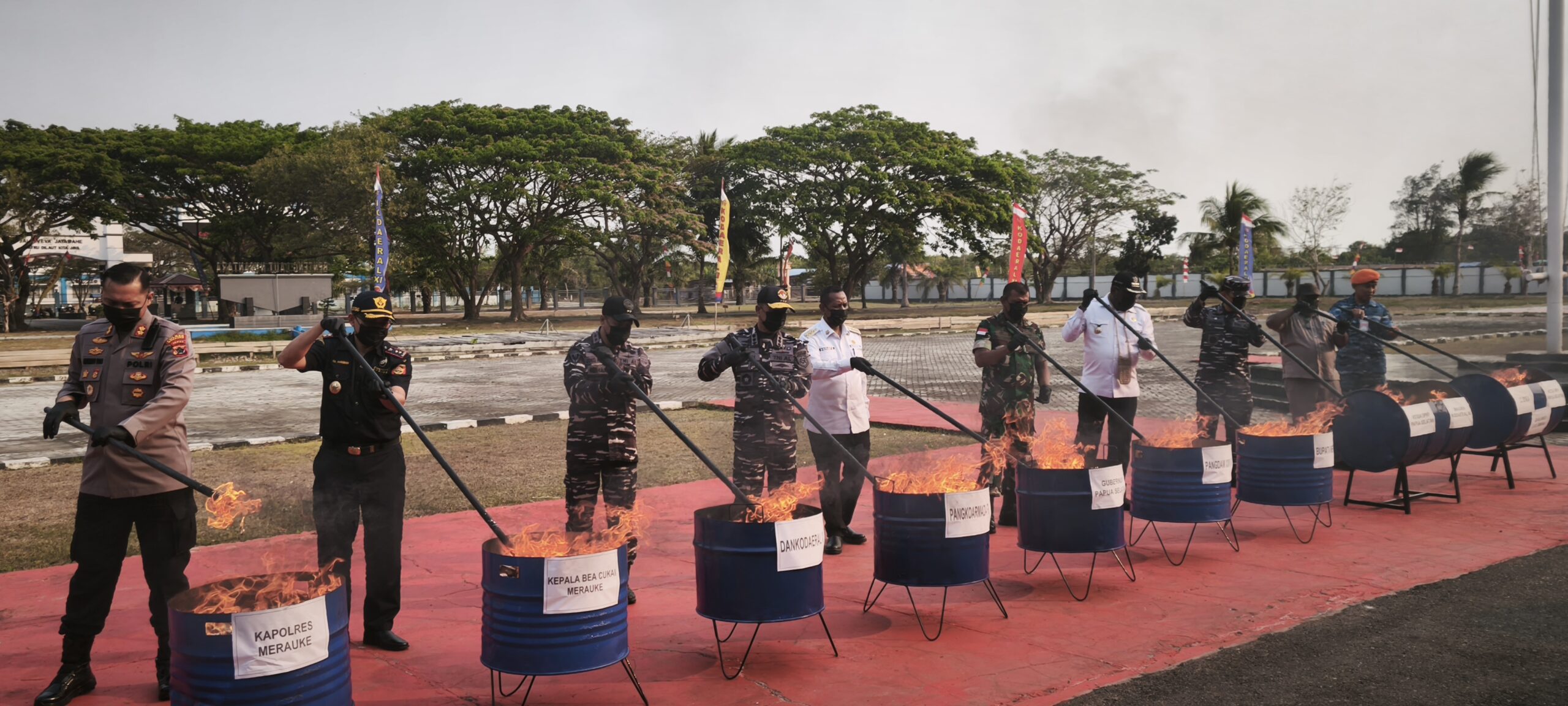
In Merauke, Papua Selatan (South Papua), the destruction of 1.49 million illegal cigarettes has brought a major tobacco enforcement case to a close while highlighting a wider challenge for Indonesia: protecting state revenue and legitimate businesses from illicit trade moving through regional supply chains.
The Indonesian Navy’s Naval Regional Command XI, or Kodaeral XI, together with Merauke Customs and other government agencies, destroyed 1,498,800 illegal cigarette sticks at the Kodaeral XI headquarters on September 2, 2026. The cigarettes had been seized during an operation in Merauke on July 28. Laboratory examination by experts from Peruri found that the excise stamps attached to the cigarette packages were counterfeit.
The case has a significant financial dimension. Authorities estimated the value of the seized cigarettes at around Rp2.22 billion, with an excise value of approximately Rp1.11 billion and potential state losses estimated at Rp1.45 billion. At the same time, a Rp3.35 billion administrative fine was paid into the state treasury on August 10 following the settlement of the case.
For Papua Selatan, the operation is more than the destruction of contraband. It offers a glimpse into how authorities are trying to secure one of Indonesia’s important eastern trade corridors while protecting public revenue and maintaining fair competition.
How the Illegal Cigarettes Reached Merauke
The operation began with information concerning a shipment of cigarettes suspected of being illegal.
According to the Indonesian Navy, the combined team of Naval Military Police and Kodaeral XI intelligence personnel acted after receiving information about an illicit shipment moving by sea from Surabaya to Merauke. The cigarettes were transported aboard the vessel KM Spill Hasya before being unloaded in Merauke and moved through a freight service.
The investigation eventually led officers to the KNS I area on Jalan Irian Seringgu in Merauke.
On July 28, the team seized 94 cartons containing 75,520 cigarette packages, equivalent to 1,498,800 individual sticks.
The scale of the shipment immediately made the case significant for local authorities.
Rather than being treated simply as a small retail violation, the seizure pointed to a larger distribution chain involving interregional transportation. That is important in Papua Selatan, where the movement of goods relies heavily on maritime connections because of the province’s geographical position and the limited availability of alternative transport networks in some areas.
Once the cigarettes were seized, the case was handed over to Merauke Customs for further legal processing.
That division of responsibilities became an important part of the operation.
The Navy carried out the initial enforcement action, while Customs handled the excise and administrative aspects of the case. Other institutions, including the police, prosecutor’s office and local government, were involved in the broader coordination.
Counterfeit Excise Stamps Raised the Stakes
One of the most important findings came from a laboratory examination.
The cigarette packages carried excise stamps that appeared to indicate compliance with Indonesian tobacco regulations. However, testing by experts from Peruri, the Indonesian state printing company responsible for producing official security documents and excise-related materials, determined that the stamps were counterfeit.
This finding transformed the case from a simple question of unauthorised distribution into a matter involving counterfeit government-controlled markings.
Excise duties are an important source of state revenue in Indonesia. Tobacco products are subject to specific excise requirements, and legitimate manufacturers and distributors must comply with those obligations.
When products enter the market outside that system, the government loses potential revenue while compliant businesses face competition from products that do not bear the same regulatory costs.
That is why authorities have repeatedly framed enforcement against illegal cigarettes as both a law enforcement and economic issue.
At the Merauke destruction ceremony, Pangkoarmada RI Laksamana Madya TNI Denih Hendrata said action against illegal cigarettes should not be viewed only as law enforcement. He described it as part of protecting state revenue, maintaining healthy trade competition and protecting public interests.
The economic logic is straightforward.
A legitimate tobacco producer must pay excise and comply with applicable regulations. An illicit producer or distributor that avoids those obligations can potentially sell at lower prices or generate higher margins.
That creates an uneven playing field.
Rp3.35 Billion Returned to the State
The financial outcome of the Merauke case is particularly notable.
Authorities said the case was resolved through an administrative penalty under an ultimum remedium approach. A fine of Rp3.35 billion was paid and deposited into the state treasury on August 10, 2026.
The physical destruction of the cigarettes followed after the Ministry of Finance’s Directorate General of State Assets approved it on August 20.
The cigarettes were then destroyed at Kodaeral XI’s headquarters in Merauke on September 2.
This sequence matters because it shows that the destruction was not an immediate disposal of seized goods. The evidence first went through enforcement and administrative procedures before the authorities obtained formal authorisation to destroy it.
The process also provides a measure of transparency.
At the September 2 press conference, officials presented the chronology from seizure and case settlement through recovery of state rights and final destruction. RRI reported that the event was attended by representatives of the Navy, provincial and regency governments, Customs, police, prosecutors and other agencies.
For a remote region such as Papua Selatan, such institutional coordination can be particularly important.
Papua Selatan’s Trade Routes Need Stronger Oversight
The case also highlights the importance of Merauke’s position within eastern Indonesia’s logistics network.
Goods entering Papua Selatan move through ports, shipping companies, freight operators, warehouses and distribution networks before reaching retailers and consumers.
That system is essential to the provincial economy.
But the same network can potentially be exploited for illegal trade if monitoring is inadequate.
Governor Apolo Safanpo has therefore emphasised stronger oversight of the movement of goods into and out of Papua Selatan. He said the provincial government had coordinated with Pelindo, harbour authorities, shipping companies and logistics networks to improve monitoring of the supply chain.
The governor also connected trade supervision with the cost of living.
Papua Selatan depends on long-distance transportation for many consumer goods. Some shipments benefit from government-supported maritime transport programmes, including the Tol Laut system.
Safanpo argued that orderly and properly monitored distribution should ultimately benefit consumers through more reasonable prices. Conversely, irregularities in supply chains can hurt consumers as well as legitimate businesses.
That makes enforcement against illegal goods part of a larger economic policy.
The objective is more than preventing prohibited products from reaching stores. It is also to ensure that government-supported logistics systems function as intended and that their economic benefits reach consumers.
A Limited Customs Workforce Faces a Large Territory
Merauke Customs officials have acknowledged that monitoring Papua Selatan presents a considerable logistical challenge.
Merauke Customs head Isa Ramadhan said his office has only 29 personnel responsible for monitoring the entire Papua Selatan region. He said the situation makes cooperation with other law enforcement and government institutions essential.
The geographic scale of the province means that conventional enforcement methods have limitations.
Papua Selatan covers a vast territory with long distances between communities and economic centres. Maritime transport connects the region with other parts of Indonesia, while roads and other transport links support internal distribution.
Monitoring every shipment physically would require resources far beyond the capacity of a single institution.
This is why intelligence sharing becomes increasingly important.
Isa said Customs planned to strengthen cooperation with the TNI, Polri and other agencies, particularly through better exchange of intelligence information. He suggested that intelligence units across institutions could be integrated to create a more complete picture of potential smuggling activities.
The approach reflects a wider shift in modern customs enforcement.
Rather than relying entirely on inspections after goods arrive, authorities can use information about shipments, routes, companies and distribution patterns to identify higher-risk movements.
In Papua Selatan, such coordination could become increasingly important as trade and connectivity expand.
Why Illegal Cigarettes Matter to the Local Economy
Illegal cigarettes are sometimes viewed primarily as a consumer issue. But their economic consequences extend further.
The first impact is on state revenues.
Excise collected from legal tobacco products contributes to government finances. When cigarettes are distributed without valid excise compliance, that revenue stream can be reduced.
The second impact falls on legitimate businesses.
Legal producers, wholesalers and retailers must operate within a regulatory framework. Illegal products that avoid those obligations can distort competition.
The third impact concerns the integrity of the supply chain.
When illicit goods move through legitimate logistics infrastructure, businesses and authorities face greater risks of regulatory violations and reputational damage.
Finally, there is a governance dimension.
Effective enforcement demonstrates that ports, shipping routes and distribution networks are subject to Indonesian law.
For a strategically located province such as Papua Selatan, maintaining confidence in these systems is important for legitimate trade and investment.
Maritime Enforcement Has a Strategic Role
The involvement of Kodaeral XI also illustrates the maritime dimension of economic security.
The cigarettes seized in Merauke had reportedly travelled by sea from Surabaya. That means the enforcement operation was not limited to a local market investigation. It involved monitoring a supply route connecting Java and Papua.
Indonesia is an archipelagic country, and maritime transport is fundamental to its domestic economy.
The same shipping network that carries food, construction materials, consumer products and industrial supplies can potentially be used by illicit traders.
This creates a continuing requirement for cooperation between maritime authorities and customs.
In Papua, this cooperation is particularly significant because sea transport is essential for connecting isolated and distant communities to national markets.
Protecting legitimate maritime commerce therefore means keeping those routes open while preventing their exploitation by illegal networks.
The Merauke operation shows how those two objectives can be pursued simultaneously.
Enforcement and Fair Competition
The case also carries a message for businesses operating in Papua Selatan.
The government aims to foster legitimate commerce, which necessitates a fair competitive environment.
Governor Apolo said the province’s supply chain monitoring was intended to minimise violations while maintaining economic stability. He also argued that proper supervision should help ensure that transportation subsidies ultimately translate into more affordable prices for consumers.
This is an important policy connection.
Infrastructure and transportation subsidies can lower the cost of moving goods to Papua. But if illegal distribution networks exploit those same logistical systems, the benefits of improved connectivity can be undermined.
Effective enforcement can therefore complement economic development.
The goal is not to restrict trade. It is to ensure that trade occurs within a predictable legal framework.
The Case Shows Why Intelligence Sharing Matters
The next challenge is preventing similar shipments from reaching Merauke.
The seizure itself was successful, but enforcement agencies face a much larger question: how many other shipments might move through the same network without being detected?
No single seizure can answer that question.
The response proposed by Merauke Customs is to improve information sharing among institutions. Isa said intelligence from different law enforcement bodies could be connected through a more integrated command and control system.
Such a system could potentially help authorities identify suspicious cargo earlier.
It could also improve the allocation of limited personnel.
With only 29 Customs officers covering Papua Selatan, intelligence-based targeting may be more practical than attempting to inspect every shipment equally.
The success of such an approach will depend on the quality of information, institutional trust and the ability of agencies to act on shared intelligence while respecting their respective legal mandates.
A Wider Test for Papua’s Economic Governance
The illegal cigarette case comes at a time when Papua Selatan is seeking stronger economic growth.
Merauke is becoming increasingly important in discussions about agriculture, food production, logistics and regional connectivity. Government programmes are intended to strengthen the province’s role in supporting national food security and the economy of eastern Indonesia.
Those ambitions require reliable supply chains.
Investors and businesses need confidence that goods can move legally and predictably. Consumers need protection from distorted markets. Government needs to ensure that public subsidies and tax systems are not undermined by illicit commerce.
That makes the September 2 destruction relevant beyond tobacco.
It is an example of how economic governance and security enforcement increasingly overlap in Papua Selatan.
The more effectively authorities can protect trade routes, the stronger the foundation becomes for legitimate economic activity.
Conclusion
The destruction of 1.49 million illegal cigarettes in Papua Selatan represents the final stage of an enforcement process that began with a July 28 seizure in Merauke.
The operation removed 1,498,800 cigarette sticks from circulation, identified counterfeit excise stamps and resulted in an Rp3.35 billion administrative fine being deposited into the state treasury. Authorities estimated the potential state loss from the seized goods at around Rp1.45 billion.
More importantly, the case has exposed the complexity of protecting Papua Selatan’s economy.
The province’s geographical position makes maritime and interregional trade essential, but that same connectivity creates opportunities for illicit distribution. With limited enforcement personnel, authorities increasingly need cooperation, intelligence sharing and coordinated supply-chain monitoring.
The response involving Kodaeral XI, Customs, the provincial government, police, prosecutors and other agencies demonstrates how that cooperation can work in practice.
For Indonesia, the broader objective is clear: legitimate trade must be protected, state revenue must be secured and government-supported logistics systems must deliver their intended benefits to communities.
For Papua Selatan, stronger enforcement can also contribute to a healthier business environment.
The destruction of the cigarettes may have ended this particular case, but the more important work continues along the province’s ports, roads, warehouses and markets.
The long-term measure of success will not be the number of cigarettes destroyed. It will be whether illegal supply chains become harder to operate while legitimate businesses and consumers gain greater confidence in Papua Selatan’s growing economy.

