
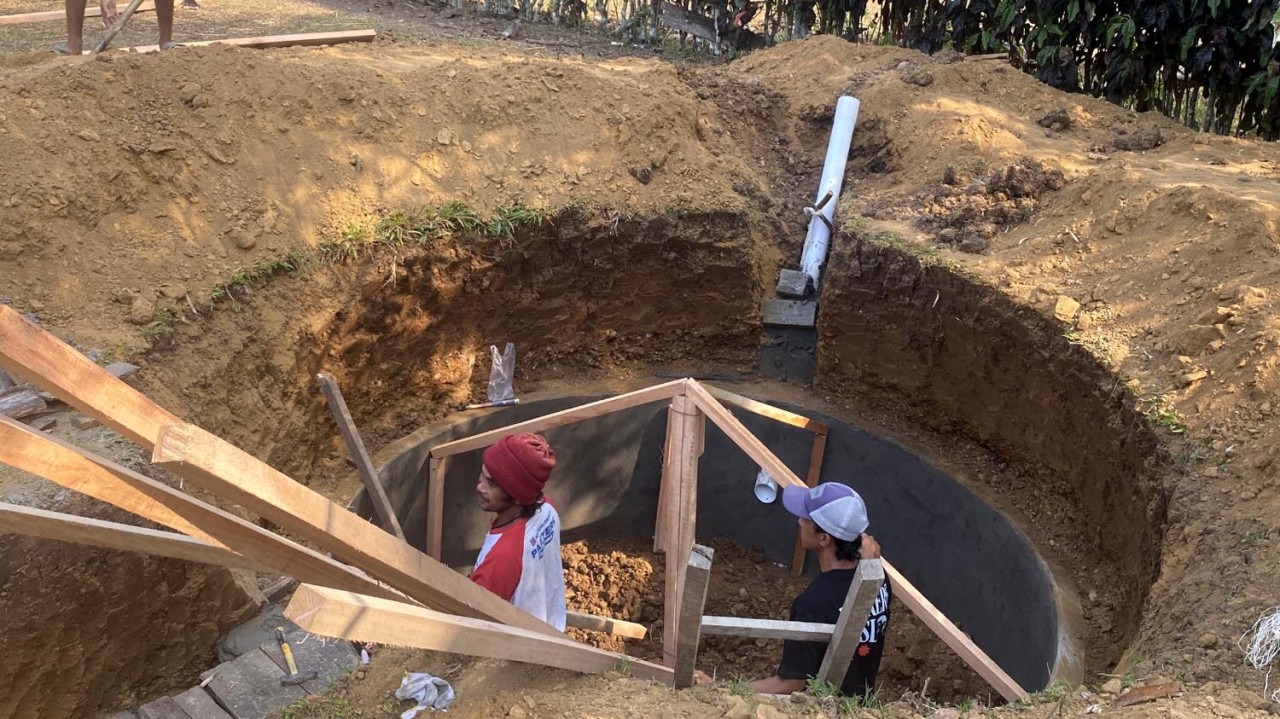
In Momi Waren, Papua Barat (West Papua), a problem that once appeared to be purely environmental is being turned into an opportunity for energy and economic development. Through its Patriot Expedition Team, Institut Teknologi Sepuluh Nopember, or ITS, is developing a community biogas system in Papua Barat that converts livestock manure and agricultural waste into energy while producing organic fertiliser as a byproduct.
The initiative is taking place in the Momi Waren Transmigration Area in Oransbari District, South Manokwari Regency. The project responds to two practical challenges identified in the area: organic waste that has not been optimally managed and limited access to everyday energy sources, particularly liquefied petroleum gas, or LPG.
Rather than bringing in a solution that depends entirely on outside supplies, the ITS team is working with resources already available around the community.
That distinction matters in remote and developing areas of Papua. Energy access is not simply an infrastructure issue. It affects household activities, agriculture, local businesses and the ability of communities to turn natural resources into economic value.
The Momi Waren project suggests that part of the answer may already be sitting in local farms and livestock facilities.
Turning Waste into an Energy Resource
The concept behind the project is straightforward but potentially significant.
Livestock manure and agricultural waste are collected and mixed with water before being introduced into an anaerobic biodigester. Inside the reactor, the organic material undergoes an anaerobic process that produces biogas. The gas is then transported through a piping system for use as an energy source by the community.
The system developed by the ITS Patriot Expedition Team is not simply a standalone reactor.
It includes a community biodigester, a distribution network, energy utilisation and process monitoring. The objective is to make the production and use of biogas measurable and manageable, allowing the facility to operate on a sustainable basis.
Dr Ir Arief Abdurrakhman, the team leader and a lecturer in ITS’s Department of Instrumentation Engineering, said the project was designed around problems experienced directly by residents.
The basic idea is to transform material previously regarded as waste into something that serves two purposes: energy and fertiliser.
That approach reflects a broader shift in development thinking.
Waste is no longer necessarily the final stage of a production process. In a circular economy, it can become the starting point for another one.
Why Energy Access Matters in Momi Waren
The project comes at a time when energy access remains an important development consideration in remote areas.
According to ITS, LPG, one of the everyday energy sources required by residents, is difficult to obtain in the Momi Waren area. This creates a practical problem for households that depend on conventional fuel supplies brought from elsewhere.
For communities located away from major distribution centres, energy availability can depend heavily on logistics.
The challenge is not necessarily the absence of energy resources in the broader region. It can be the difficulty of bringing conventional fuels to communities consistently and affordably.
Momi Waren offers a different possibility because its livestock and agricultural activities generate organic material that can be processed locally.
The biogas model does not mean conventional energy sources suddenly become unnecessary. Rather, it provides an additional source of energy that can be produced from materials available within the community.
That local dimension is one of the project’s most important features.
A Community System, Not Just a Technology Project
One of the distinguishing elements of the ITS initiative is its emphasis on community participation.
The team is not only constructing the biodigester. It is also providing socialisation and training to village officials and residents involved in the system. The project team introduces them to the operation and maintenance of the facility, enabling independent management of the technology in the future.
This training is critical.
A sophisticated piece of equipment can have limited development value if local users cannot maintain it after the project team leaves.
The ITS approach therefore places ownership at the centre of the programme.
Residents must learn how the system works, how to supply organic material, how to maintain the facility, and how to use the energy it produces.
The long-term objective, according to Arief, is for local communities to make optimal use of their resources and genuinely own and manage the system.
This emphasis on local management also fits a wider development challenge in Papua: ensuring that infrastructure and technology are accompanied by skills, institutional capacity and community participation.
From Household Energy to Agricultural Productivity
The most intriguing part of the project may be what remains after the biogas has been produced.
The anaerobic digestion process leaves behind a material known as bio-slurry. According to ITS and reports from InfoNews and Jatimnow, the residue can be processed into organic fertiliser.
This creates a second economic pathway.
The same livestock manure and agricultural waste that initially enter the system as raw material can generate energy and then produce an agricultural input.
In simple terms, one resource serves two purposes.
That could be particularly relevant in a community where agriculture and livestock are already part of the local economy. Instead of treating manure and agricultural residues as unwanted materials, they can become inputs in a circular production system.
The economic potential is therefore broader than the replacement of LPG alone.
Biogas can provide an energy service, while bio-slurry can support agricultural activity.
This creates the possibility of linking energy management with food production and rural economic development.
The Circular Economy Comes to a Transmigration Area
The project is part of a strategic initiative of Indonesia’s Ministry of Transmigration and is being implemented in the Momi Waren Transmigration Area. The Patriot Expedition Team sent by ITS consists of five members and is led by Arief Abdurrakhman.
The project’s stated theme is the development of renewable energy based on biogas from organic waste to support energy independence and sustainable agriculture.
That theme places Momi Waren within a much larger national development conversation.
Transmigration areas are expected to develop not simply as residential settlements but as communities with productive economic activities and supporting infrastructure.
Energy is part of that equation.
Without reliable energy, agricultural processing, household activities and small-scale economic enterprises can face limitations. A locally managed renewable energy source could therefore complement broader infrastructure development.
The Momi Waren initiative does not solve every development challenge. But it demonstrates how a local resource can be incorporated into a practical development model.
Why Local Potential Matters in Papua
Papua’s geography makes locally appropriate development particularly important.
Communities are spread across large areas, while transportation and logistics can be challenging. A solution that works in a densely populated urban area cannot necessarily be transferred directly to a remote settlement.
This is why the approach taken in Momi Waren is noteworthy.
The system begins with resources already available in the area. It does not require the community to depend entirely on a continuous supply of an externally sourced raw material.
Livestock manure and agricultural residues are generated locally. They can be collected locally, processed locally and used locally.
That creates a shorter production chain.
For Papua Barat, where agriculture remains an important part of rural livelihoods, the concept could potentially be relevant beyond Momi Waren if technical, social and economic conditions are suitable.
However, such expansion would need to be based on local assessments of feedstock availability, community demand, technical maintenance capacity and economic feasibility.
The success of one installation should not automatically be treated as proof that the same model will work everywhere.
Technology With a Human Dimension
The Momi Waren story is also about something less visible than the biodigester itself: knowledge transfer.
The ITS team is working directly with village officials and community members. This creates an opportunity for local residents to acquire practical knowledge about renewable energy technology and facility management.
That matters because development is more durable when communities can maintain and adapt the infrastructure they receive.
For Indonesia, strengthening local technical capacity is particularly important in regions where access to specialist services may be limited.
A biogas system that can be operated and maintained by trained local residents has a different developmental value than a facility that requires frequent intervention from technicians hundreds or thousands of kilometres away.
The distinction is simple: infrastructure provides a physical asset, while knowledge provides the capacity to sustain it.
A Potential Model for Sustainable Rural Development
ITS describes the Momi Waren initiative as a potential model for energy independence and a circular economy based on local resources.
The concept can be visualised as a cycle.
Agricultural and livestock activities produce organic waste. That material enters the biodigester. The process generates biogas for energy. The remaining bio-slurry becomes organic fertiliser. The fertiliser can then support agricultural production.
The cycle connects waste management, energy and agriculture.
The cycle is particularly relevant to the global discussion about sustainable development because it reduces the distance between resource production and resource consumption.
Instead of seeing energy, agriculture and waste as separate sectors, the system links them.
For rural Papua, that integrated approach can be more meaningful than focusing on a single infrastructure indicator.
A community does not necessarily become more resilient simply because it has a new facility. Resilience comes when the facility is connected to livelihoods, skills, local resources and institutions capable of keeping it functional.
Supporting Indonesia’s Sustainable Development Agenda
The ITS project is also linked to the United Nations Sustainable Development Goals.
According to ITS, the initiative contributes particularly to SDG 7, which focuses on affordable and clean energy, and SDG 11, which concerns sustainable cities and communities.
The connection to SDG 7 is direct.
Biogas is a renewable energy source produced from organic material, and the Momi Waren project is specifically intended to address limited access to conventional household energy.
The relationship with SDG 11 is broader.
Sustainable communities require effective management of waste, energy and local resources. A community-scale system that integrates those elements can contribute to a more sustainable settlement model.
For Indonesia, the initiative also demonstrates how universities can contribute to national development outside of major urban centres.
Universities and the Development of Eastern Indonesia
The role of ITS is significant beyond the technology itself.
Universities possess technical expertise, research capacity and human resources that can help solve practical problems in communities.
The Patriot Expedition Team model places academics directly in the field, where they can observe local conditions and adapt technology to the needs of residents.
That relationship can be valuable for Papua.
Development challenges in eastern Indonesia cannot always be addressed through standardised solutions designed elsewhere. Local conditions matter. So do community practices, economic activities and resource availability.
Universities can play a crucial role in connecting research with practical implementation.
In Momi Waren, that bridge takes the form of a biodigester, but the broader lesson concerns how academic institutions can participate in regional development.
The Broader Economic Opportunity
Energy is often treated as a cost in rural development.
The Momi Waren project introduces another perspective: energy can become part of a local economic cycle.
If organic waste can generate biogas and bio-slurry, the material has economic value at more than one stage of the process.
The immediate benefit is energy production.
The secondary benefit is fertiliser.
The longer-term opportunity is the creation of local skills and a community system capable of managing a renewable energy asset.
That does not guarantee a large-scale economic transformation. The actual impact will depend on how much feedstock is available, how many households can be served, how well the facility is maintained and whether the community can sustain the operating system.
Those factors will determine whether the initiative remains a demonstration project or develops into a durable community energy model.
What Comes Next for Momi Waren?
The most important test for the Momi Waren project will come after construction.
Can the community maintain the system?
Can residents ensure a consistent supply of organic material?
Can the biodigester operate reliably?
Can the resulting fertiliser be integrated into local agricultural production?
And can the model remain economically viable without continuous external intervention?
ITS has already identified community ownership as a key condition for success. The team therefore views technology transfer and local management as essential parts of the project rather than optional additions.
If those elements work, Momi Waren could offer a useful reference for other rural areas with similar combinations of livestock, agriculture, organic waste and limited access to conventional energy.
The next stage should therefore focus not only on construction but also on monitoring, maintenance, training and evidence of real household and agricultural benefits.
Papua Barat’s Development Story Is Also About Local Innovation
Development in Papua is often discussed through the lens of major infrastructure, connectivity and public investment.
Those areas remain important.
But smaller innovations can also influence the daily lives of communities.
A biogas reactor may not attract the same attention as a major road, bridge or telecommunications project. Yet for a household that has difficulty obtaining LPG, a locally available source of cooking or household energy can have an immediate practical meaning.
For farmers, organic fertiliser produced from the same process can provide another potential benefit.
This situation is where development becomes tangible.
It is not only about the size of a project but also whether it responds to a problem that people experience in their daily lives.
The Momi Waren project demonstrates that principle through a relatively simple proposition: use what the community already has to address what the community needs.
Conclusion
The community biogas project in Papua Barat developed by ITS through the Patriot Expedition Team represents a practical attempt to connect environmental management, energy access and rural economic development.
In Momi Waren, South Manokwari, livestock manure and agricultural waste are being transformed through an anaerobic biodigester into biogas, while the remaining bio-slurry can be processed into organic fertiliser.
The significance of the initiative lies not simply in the technology.
It lies in the decision to build the solution around local resources and local participation.
The project responds to limited access to LPG while addressing organic waste that had previously not been optimally utilised. At the same time, ITS is training local residents and village officials to operate and maintain the facility, with the broader goal of establishing community ownership.
For Papua Barat, that approach offers an encouraging example of how renewable energy can be connected to agriculture and the circular economy.
For Indonesia, it shows how universities, government programmes and local communities can work together to develop solutions suited to the realities of eastern regions.
And for Momi Waren, the hope is straightforward: waste that once created a problem can become a source of energy, fertiliser and economic value.
The long-term measure of success, however, will not be the reactor’s completion.
It will be whether the community can keep it running, manage its resources and make the technology part of everyday life.
If that happens, the project could become more than an experiment in renewable energy. It could become a small but meaningful example of a broader development principle for Papua: sustainable progress is strongest when local communities are not simply recipients of technology but become its owners, operators and beneficiaries.
Read Also
Papua Barat Explores Waste-to-Energy Development in Manokwari
Turning Waste into Wealth: How Mimika Regency Transforms Trash into Economic Value
From Kitchen Waste to Clean Fuel: Uncen’s Biodiesel Initiative Empowers Yoboy, Papua

