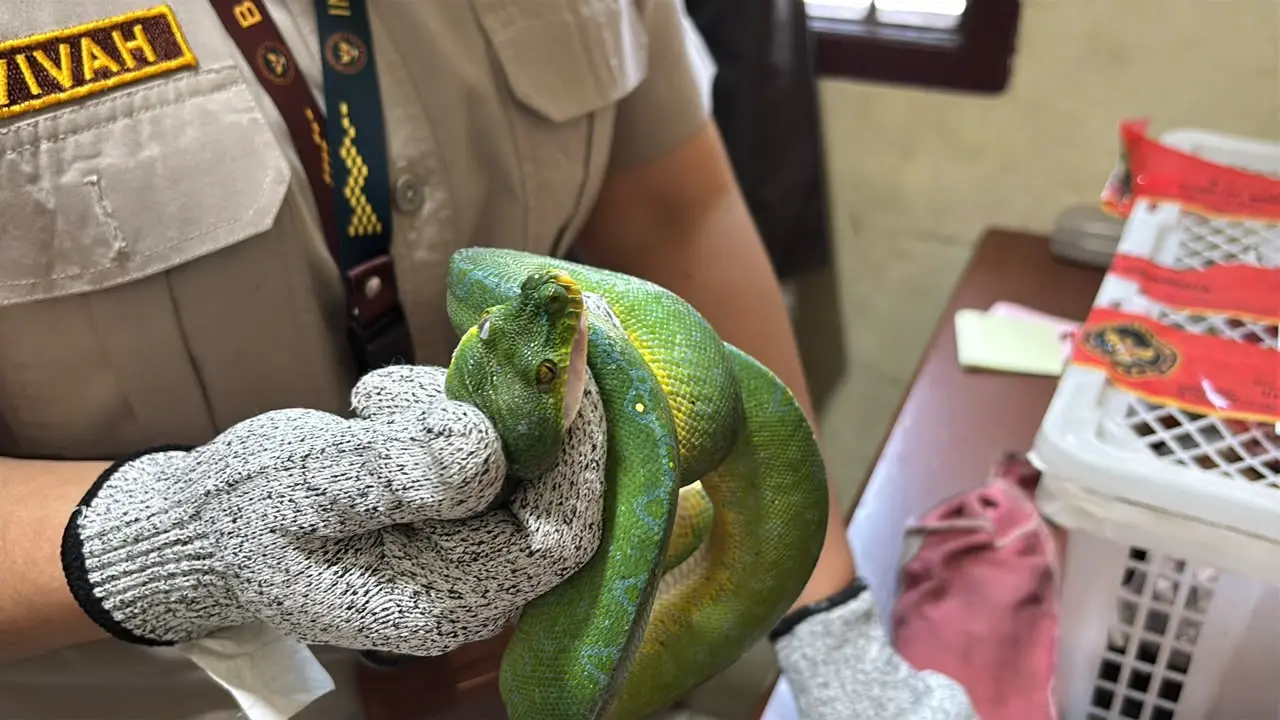
A routine inspection aboard KM Sinabung ship at Bitung Port, Sulawesi Utara (North Sulawesi), turned into a wildlife protection operation after quarantine officers discovered 17 snakes from Papua hidden inside two baskets beneath a passenger berth. Sixteen of the snakes were alive, while one had already died when officers found them on Wednesday, September 23, 2026.
As the passenger ship transited Bitung on its route from Papua to Surabaya, officers made the discovery. No passenger claimed ownership of the baskets, and officers found that the animals were being transported without the quarantine and wildlife transportation documents required under Indonesian regulations.
For Indonesian authorities, the case illustrates why wildlife protection cannot stop at the source of an animal’s habitat. Papua’s extraordinary biodiversity also imposes a responsibility to ensure the legal, safe, and properly documented transport of wildlife leaving the region.
The case also highlights the importance of quarantine officers stationed at Indonesia’s ports. A seemingly ordinary pair of baskets became the focus of an inspection that ultimately prevented 17 wild snakes from continuing their journey toward Surabaya.
A Routine Inspection Reveals Something Unusual
The discovery began without an obvious sign of illegal activity.
On September 23, officers from the Animal, Fish, and Plant Quarantine Agency of Sulawesi Utara were conducting routine monitoring aboard KM Sinabung while the ship was at Bitung Port. The vessel serves a route connecting Papua with Surabaya, making its passenger and cargo areas important points for monitoring the movement of biological resources between regions.
During the inspection on Deck 5, in the passenger accommodation area, officers noticed two baskets tucked underneath a passenger berth.
The location immediately raised questions.
No passenger came forward to acknowledge ownership of the baskets. The absence of a clear owner, combined with the concealed position of the containers, prompted officers to inspect them more closely.
Inside, they found snakes.
The animals had not simply been placed loose inside the baskets. According to the quarantine authority, the snakes were kept inside used drinking bottles that had been perforated to provide air. The bottles were then wrapped in sackcloth before being placed inside the baskets.
The arrangement allowed the animals to be transported in a relatively concealed manner, but it also placed them inside restricted containers during the voyage.
Officers secured all of the animals and began an initial identification process.
Seventeen Snakes, Three Identified Groups
The first identification by the Sulawesi Utara quarantine authority recorded three groups of snakes.
There were two Candoia sp., 14 green tree pythons, Morelia azurea, and one brown python, Leiopython albertisii.
Sixteen animals were still alive.
One snake had died before officers completed the inspection.
The condition of the animals added another concern to the case. Wildlife transportation is not simply a question of whether an animal possesses economic value. The method used to transport a live animal can affect its survival and welfare, particularly when it is confined for an extended period in a small container during a sea voyage.
In this case, the quarantine authority specifically highlighted the limited containers used to transport the snakes from Papua to Surabaya.
That detail is significant because the animals were not being moved through a controlled wildlife transportation process with the documentation and safeguards expected by the authorities.
No Quarantine or Wildlife Transport Documents
The central legal issue emerged when officers examined the documentation.
There were no required quarantine documents accompanying the shipment.
The animals also did not have a Domestic Transport Permit for Plants and Wildlife, or SATS-DN, issued through the relevant conservation authority.
Agus Mugiyanto, Head of the Sulawesi Utara Quarantine Agency, said the movement of the animals was not accompanied by the documents required under Law No. 21 of 2019 concerning animal, fish, and plant quarantine.
“This attempt to traffic wildlife was completely devoid of the quarantine documentation required under Law Number 21 of 2019,” Agus said in a statement cited by the media.
He also pointed to the absence of the SATS-DN document from the conservation agency.
Based on those circumstances, the Sulawesi Utara quarantine authority categorized the shipment as illegal wildlife circulation.
That classification is important because the available information does not identify the owner of the baskets.
As of the latest reports, investigators and authorities had not established who placed the snakes inside the baskets or who intended to receive them at the destination.
The distinction is relevant for responsible reporting. The illegal status described by authorities concerns the undocumented movement of the wildlife. It does not establish the identity or criminal responsibility of a particular person.
The Journey from Papua to Surabaya
The route taken by KM Sinabung provides the broader context.
While transiting at Bitung, the vessel traveling from Papua toward Surabaya discovered the snakes.
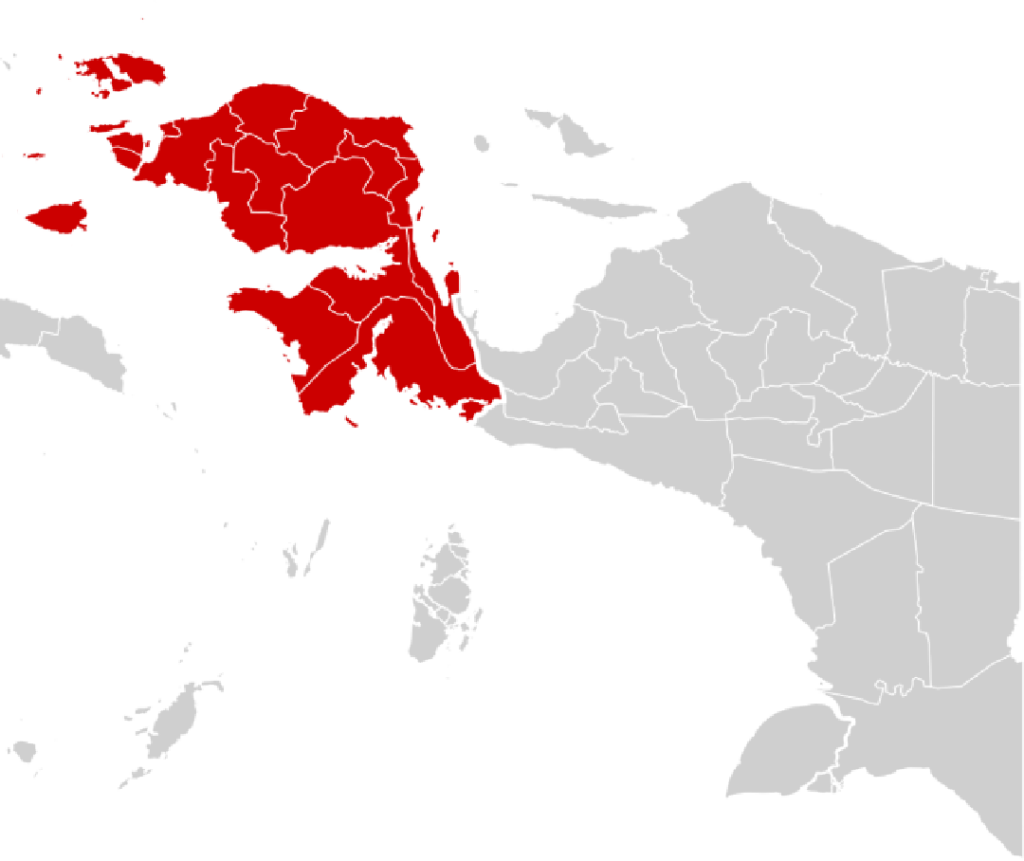
Papua is home to a remarkable range of wildlife, much of which has become associated with the region’s natural identity. Moving animals from Papua to other parts of Indonesia therefore requires more than ordinary passenger or cargo handling.
Wildlife movements cross administrative boundaries, which means that quarantine and conservation authorities need to maintain oversight at multiple points.
In this case, the discovery in Bitung demonstrated the value of monitoring at a destination or transit port.
The snakes had already travelled from Papua before being discovered.
Had the two baskets passed through the port without inspection, the animals could have continued farther along the transportation chain without the authorities knowing who had shipped them or where they were ultimately intended to go.
The inspection therefore interrupted the movement before the responsible authorities could lose track of the animals.
Why Port Inspections Matter for Papua
The incident is more than an unusual discovery aboard a passenger ship.
It highlights a broader challenge facing Indonesia’s biodiversity protection system.
Wildlife trafficking does not necessarily take place in remote forests or protected areas. Animals can be moved through ordinary transportation networks, including passenger ships, road vehicles, airports, and ports.
That makes the work of quarantine officers particularly important.
The officers who discovered the snakes were not responding to a public complaint or a known criminal investigation. They were conducting routine monitoring when they noticed something unusual beneath a passenger berth.
The case demonstrates how routine enforcement can become an important line of defense for biodiversity.
The issue holds significant importance for Papua.
Wildlife is part of the region’s ecological wealth and increasingly contributes to discussions about conservation, sustainable tourism, and the long-term value of natural ecosystems. Protecting that resource requires both enforcement and public awareness.
The movement of animals without documentation creates risks not only for conservation but also for quarantine control.
The Authorities Move the Snakes to BKSDA
Once the snakes had been identified and secured, the quarantine authority coordinated with the Sulawesi Utara Natural Resources Conservation Agency, or BKSDA.
On the same day, all 17 animals were formally handed over to BKSDA Sulawesi Utara for further handling.
This handover represents an important second stage in the operation.
Finding illegally transported wildlife is only the beginning. Authorities must also determine how the animals can be handled safely and appropriately after seizure.
The available reports do not provide details on the final destination or rehabilitation program for the individual snakes.
They also do not establish whether the animals will ultimately be returned to Papua or placed under another conservation management arrangement.
Those decisions remain with the competent conservation authorities.
A Warning from Sulawesi Utara Quarantine Officials
Agus said the authorities would continue strengthening surveillance at entry and exit points to prevent undocumented wildlife movements.
He also called for cooperation among different parties to combat illegal wildlife circulation.
His message was straightforward: ports are not merely places where passengers board and leave ships. They are also important checkpoints for biological resources moving between Indonesian regions.
That approach is increasingly relevant as transportation networks become more connected.
Greater connectivity creates significant economic and social benefits. It allows people to travel, businesses to move goods, and remote communities to maintain links with larger urban centers.
But the same connectivity can be exploited to move wildlife illegally.
Effective oversight therefore needs to accompany improved connectivity.
Papua’s Biodiversity and the Responsibility to Protect It
This snake smuggling case also relates to the broader picture of Papua’s natural environment.
Papua’s forests, wetlands, mountains, and coastal ecosystems harbor vital biological resources, not only for Indonesia but also for global biodiversity.
Papua’s natural environment is increasingly viewed not merely as a remote landscape but as part of Indonesia’s ecological heritage and a source of potential for responsible tourism.
Wildlife protection is an integral part of this picture.
The discovery of 17 snakes aboard the KM Sinabung demonstrates that conservation efforts, much like the designation of protected forest areas, depend on effective regulatory enforcement.
An animal can leave its natural habitat in a matter of hours, yet tracing its origins and ultimate destination becomes far more difficult once it enters informal transport networks.
This is why documentation is crucial.
A Case with an Important Unanswered Question
Despite the successful interception, one major question remains unanswered.
Who owned the two baskets?
The latest information available from the quarantine authority says that no passenger admitted ownership and that the owner had not been identified.
That means the operation has prevented the immediate movement of the animals, but the wider investigation could still determine whether other people were involved in obtaining, transporting, or receiving them.
The sources available for this report do not provide information about arrests or criminal suspects connected to the shipment.
That uncertainty should remain explicit.
It would be premature to attribute the shipment to a particular individual, organization, or commercial network without additional evidence.
What is already established is that 17 snakes were found; the animals originated from Papua according to the authorities, they were concealed beneath a passenger berth, the required documents were absent, and the animals were subsequently transferred to BKSDA Sulawesi Utara.
Those facts are sufficient to demonstrate why the interception matters.
Protecting Wildlife While Keeping Papua Connected
There is also a wider policy lesson.
Papua needs connectivity.
Ships, aircraft, and roads connect communities with markets, schools, hospitals, and government services. Improving transportation is essential to economic development and social integration.
But connectivity must be accompanied by effective regulation.
The KM Sinabung incident shows what that balance looks like in practice.
A transportation network can remain open to legitimate passengers and goods while authorities conduct targeted inspections to prevent the movement of protected or undocumented wildlife.
That does not require restricting ordinary mobility.
Instead, it requires professional monitoring, cooperation between institutions, and clear enforcement procedures.
In this case, quarantine officials detected the animals, conducted identification, coordinated with BKSDA, and transferred the snakes for further handling.
The process illustrates how different government institutions can work together to protect Indonesia’s natural resources.
Conclusion
The discovery of 17 snakes from Papua aboard KM Sinabung at Bitung Port is a reminder that wildlife protection often begins with seemingly ordinary acts of vigilance.
Two baskets hidden beneath a passenger berth attracted the attention of quarantine officers during a routine inspection on September 23. Inside were 17 snakes, including two Candoia sp., 14 green tree pythons, and one brown python. Sixteen were alive, and one had died.
None of the required quarantine and wildlife transportation documents were found.
The snakes were subsequently handed over to BKSDA Sulawesi Utara for further handling, while the owner of the baskets remained unidentified.
For Papua, the incident carries a message that reaches beyond one ship and one port.
The region’s biodiversity is a valuable natural asset. Protecting it requires vigilance from the point where animals are found in their habitats to the transportation routes through which they might otherwise be moved illegally.
The success of the Bitung inspection also shows why Indonesia’s conservation system depends on cooperation between quarantine officials, conservation agencies, port authorities, and the wider public.
As transportation links between Papua and other parts of Indonesia continue to support economic activity and social connectivity, stronger monitoring will be essential to ensure that those same routes are not misused for illegal wildlife trade.
The 17 snakes may have been hidden beneath a passenger berth, but their discovery has brought a much larger issue into view: protecting Papua’s natural heritage requires constant attention, even in the most ordinary corners of Indonesia’s transportation network.
Read Also
Raja Ampat Turtle Case Moves to Legal Process
Papua Wildlife Trade Foiled in Social Media Crackdown