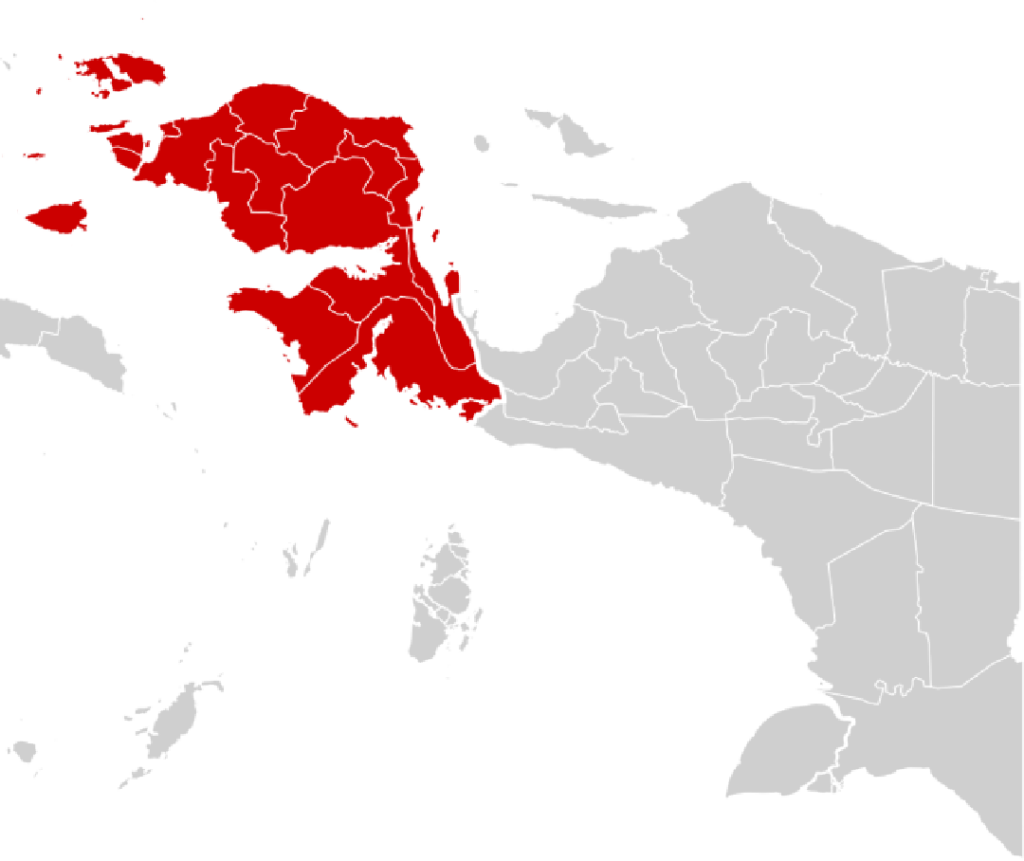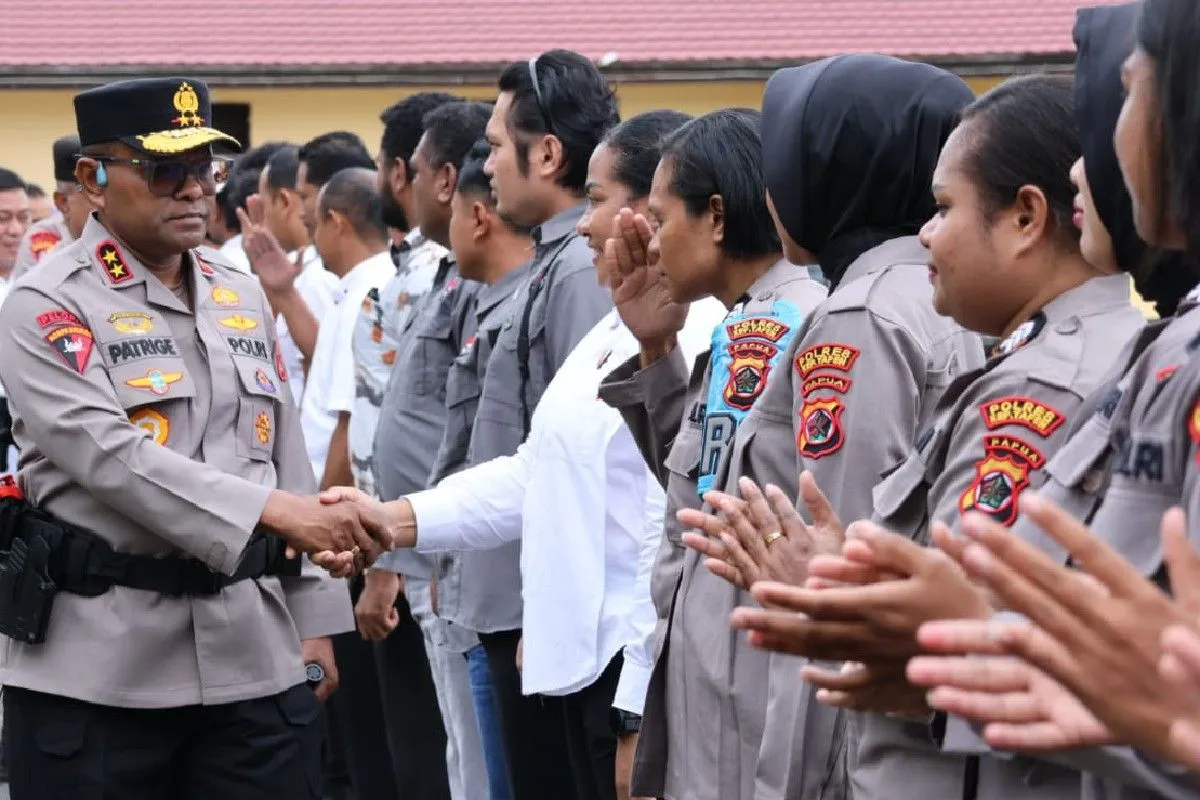
The Papua Pegunungan (Highland Papua) security situation has prompted a stronger joint response from the provincial government and Papua Police after authorities recorded 76 security disturbances between January and September 2026, resulting in 29 deaths, including 25 civilians and four members of the Indonesian security forces.
The figures were presented by Papua Police Chief Inspector General Patrige Renwarin during a security and public order coordination meeting with the Papua Pegunungan provincial government in Wamena on Wednesday.
The meeting brought together the provincial administration and leaders from the eight regencies that make up Papua Pegunungan. Rather than treating security as the responsibility of police and military personnel alone, officials used the forum to develop a broader coordination mechanism involving local governments, community leaders, and security institutions.
For Governor John Tabo, the numbers are impossible to ignore.
He described the continuing loss of life among both security personnel and unarmed civilians as a serious humanitarian tragedy and called for stronger communication and joint strategic measures to address security problems.
The meeting therefore came at a critical point for a province where security conditions can directly affect transportation, education, healthcare, economic activity, and the delivery of government services.
29 Deaths Recorded Through September
According to Patrige, the Papua Police recorded 642 security-related cases in Papua Pegunungan from January to September 2026.
Within that broader figure, police recorded 76 actions attributed to armed criminal groups, involving shootings, arson, armed clashes, assault, road blockades, hostage taking, threats, and seizure of firearms.
The reported death toll reached 29.
Of those killed, 25 were civilians, while two members of the Indonesian National Army Force, or TNI, and two members of the Indonesian National Police, or Polri, also died.
The distribution of victims is significant.
It shows that the security problem is not confined to direct confrontations between armed groups (TNPNPB OPM) and government security forces. Ordinary residents are also among those affected.
That reality was one of the reasons Patrige urged all stakeholders to become involved in the response.
“Handling security problems cannot be done by security forces alone,” he said, stressing the need for cooperation among Polri, TNI, regional governments, customary leaders, religious figures, and community representatives.
Violence Has Taken Different Forms
Police recorded various incidents, not just shootings.
According to Patrige, the 76 actions included arson, armed contact, physical attacks, road blockades, hostage taking, threats, and the seizure of firearms.
This range of incidents creates a complex security environment.
A shooting can immediately threaten lives. A road blockade can prevent people from travelling or delay the movement of food and medical supplies. Arson can damage homes or public facilities. Hostage taking can create fear well beyond the immediate location.
The cumulative effect can therefore be larger than the individual incidents suggest.
Provincial authorities closely connect the prevention of such incidents to the maintenance of public services and the protection of communities.
John Tabo: Security Cannot Be Ignored
Governor John Tabo used the Wamena meeting to make a direct assessment of the situation.
He said law enforcement operations conducted by authorities had followed procedures and standard operating procedures. At the same time, he argued that government institutions needed stronger communication and coordination to address emerging problems more quickly.
Tabo did not minimize the consequences of the violence.
He stated, “We cannot ignore the current security dynamics, as many victims have fallen, including civilians who do not carry weapons, making the situation an extraordinary humanitarian tragedy.”
The statement is important because it places civilian protection at the center of the provincial government’s response.
For Papua Pegunungan, where many communities live in difficult terrain and some areas are far from administrative centers, security disruptions can quickly become humanitarian and development challenges.
A resident who cannot travel safely may struggle to reach a hospital. A teacher may have difficulty reaching a school. A government worker may be unable to deliver assistance. Traders may face disruptions in transporting goods.
Security therefore becomes a prerequisite for the continuity of ordinary life.
Eight Regencies Join the Coordination Effort
The coordination meeting brought together the heads of all eight regencies in Papua Pegunungan.
They are Jayawijaya, Mamberamo Tengah, Lanny Jaya, Tolikara, Yalimo, Pegunungan Bintang, Nduga, and Yahukimo.
Their participation is important because security conditions vary across districts.
A provincial strategy needs to be translated into practical measures at the local level. District governments understand their communities, transportation routes, and public service conditions, while police and security agencies possess operational capabilities.
The Wamena meeting was therefore designed to improve communication between these different levels of government.
Rather than operating through isolated responses, authorities are seeking a common framework for identifying problems and developing preventive measures.
That approach also reflects Tabo’s broader emphasis on building Papua Pegunungan through cooperation between government and society.
Police Strengthen Patrols on Vulnerable Routes
One of the concrete measures highlighted by Patrige is the strengthening of security and patrols along routes considered vulnerable.
These include the Wamena to Tolikara, Wamena to Yalimo, Wamena to Lanny Jaya, and Wamena to Nduga corridors.
The routes are important because road connectivity is closely linked to the movement of people and goods in Papua Pegunungan.
When security conditions deteriorate along a major route, the consequences can reach beyond the immediate area.
Residents can face difficulties travelling between districts. Commercial activity can slow. Public servants can experience difficulty reaching remote communities. Medical referrals and emergency transportation can also become more complicated.
For that reason, patrols are being positioned not simply as security operations but as part of an effort to protect mobility and the functioning of public services.
Law Enforcement Combined with a Human Approach
Patrige said the Papua Police and the Damai Cartenz 2026 Task Force continue to conduct law enforcement firmly, professionally, and proportionately.
At the same time, authorities are maintaining a human-centered approach through the Binmas Noken program.
This dual approach is important in Papua.
Law enforcement is necessary when armed violence threatens public safety. But security measures alone cannot address every factor influencing the relationship between communities and government institutions.
The Binmas Noken program includes community engagement, youth development, and health services.
These activities are intended to create direct contact between authorities and communities outside the context of security operations.
Building Trust Beyond Security Operations
Community engagement can become especially important in areas where residents may have limited contact with government institutions.
Youth development programs can provide opportunities for younger residents to interact with state institutions through education and community activities rather than through security encounters.
Health services offer another avenue for engagement.
By combining security with social programs, authorities are attempting to strengthen public confidence while maintaining law enforcement responsibilities.
Patrige said the combined approach was intended to support security, peace, and the continuity of public services in Papua Pegunungan.
The TNI, Polri, and Regional Government Have Different Roles
The meeting also reinforces the importance of distinguishing the responsibilities of different institutions.
The police are responsible for law enforcement and maintaining public order, while the military has a separate role under Indonesia’s legal framework.
Regional governments, meanwhile, are responsible for delivering public services and implementing development programs.
A functioning security strategy requires these roles to complement one another without eliminating institutional boundaries.
The coordination approach described by Patrige reflects that principle.
He said Papua Police and the Papua Pegunungan government would strengthen coordination while developing joint measures that prioritize community protection, law enforcement, and a human-centered approach.
That model also brings customary, religious, and community leaders into the process.
Why Community Leaders Matter
Papua’s social structure assigns customary and religious leaders an important role in community life.
Patrige specifically identified customary leaders, religious figures, and community leaders as part of the broader group needed to help create a secure and conducive environment.
Their involvement can help government institutions understand local concerns and communicate security messages through trusted community networks.
It can also help prevent misinformation and reduce tensions before they develop into larger problems.
The approach recognizes that maintaining security in a geographically challenging province cannot rely exclusively on patrols or enforcement operations.
It requires relationships.
Security and Development Are Closely Connected
The security meeting in Wamena also has implications for Papua Pegunungan’s development agenda.
The province is working to improve infrastructure, education, healthcare, and economic opportunities. Those programs require a minimum level of security for personnel, residents, and businesses to operate.
The connection is particularly visible in remote districts.
A road project needs workers to reach construction sites. Health facilities need staff and supplies. Schools need teachers. Agricultural programs need extension workers and farmers to travel safely.
Insecurity can delay or complicate the implementation of development projects.
This is why the provincial government’s security coordination should be understood as part of a wider effort to maintain the conditions necessary for development.
The issue is not security for its own sake.
It is about creating an environment where communities can live, work, and access public services.
Protecting Civilians Is the Central Measure
The fact that 25 of the 29 reported deaths were civilians gives particular weight to the government’s stated emphasis on community protection.
For the provincial government, reducing civilian casualties is not simply a security objective.
It is a humanitarian responsibility.
The figures also reinforce the need for accurate information and careful operational planning.
In areas where armed groups are active, civilians can become exposed to violence simply because they live, work, or travel in affected locations.
A security response therefore needs to consider the movement of ordinary residents and the functioning of essential services.
The stronger the coordination between government institutions, the greater the potential to identify risks before they become incidents.
Papua Pegunungan’s Security Challenge Is Not Simple
The 642 reported security cases during the January to September period illustrate the scale of the challenge.
But the number alone does not explain the causes of every incident.
The sources provided do not establish a single explanation for the violence, nor do they provide a district-by-district breakdown of all 642 cases.
It would therefore be misleading to reduce the security situation to one factor.
What is clear is that provincial authorities view the current level of insecurity as serious enough to require stronger coordination.
The police leadership and the provincial government share that assessment.
From Reactive Response to Prevention
The significance of the Wamena meeting lies partly in its emphasis on prevention.
Authorities are not only responding after incidents occur. They are discussing vulnerable routes, stronger patrols, community engagement, and closer coordination between institutions.
The provincial government and police also want local leaders to participate in identifying security problems.
This can establish an early warning system that communicates concerns before they escalate into violence.
Such an approach proves especially valuable in remote regions, where geography can impact response times.
The objective is to reduce the space in which armed groups can disrupt civilian life.
A Wider Development Message
The security initiative also complements Papua Pegunungan’s broader development agenda.
Governor John Tabo has repeatedly framed the province’s future around education, infrastructure, healthcare, and the participation of young people.
For a young province, these areas are important foundations for long-term development.
Security allows those programs to function.
In this sense, the Wamena meeting is not separate from the province’s development strategy. It is part of the institutional effort to create conditions in which development can continue.
These initiatives face a common requirement: communities must be able to access public services safely and consistently.
What Comes Next?
The immediate task for Papua Police and the provincial government is to turn the commitments made in Wamena into sustained action.
That includes maintaining patrols on vulnerable routes, improving communication between institutions, involving community leaders, and ensuring that law enforcement remains professional and proportionate.
The authorities also need to ensure that civilian protection remains central to operational planning.
The reported figure of 25 civilian deaths makes that priority particularly clear.
The use of a human-centered approach through Binmas Noken indicates that the security strategy extends beyond enforcement.
Youth development and health services provide additional channels for engagement with communities.
Whether these measures reduce violence over time will depend on their implementation and on conditions that can change rapidly across the province.
The sources do not provide a forecast of future casualty figures, so it would be premature to predict a particular security outcome.
What can be observed is a clear institutional commitment to closer coordination.
Conclusion
The latest security coordination in Papua Pegunungan comes against a sobering backdrop.
Papua Police recorded 76 security disturbances attributed to armed criminal groups and reported 29 fatalities from January to September 2026. Twenty-five of the victims were civilians, alongside two TNI personnel and two police officers.
The figures explain why Governor John Tabo and Papua Police Chief Patrige Renwarin are calling for a stronger collective response.
Their approach combines several elements: law enforcement, patrols on vulnerable routes, cooperation between TNI and Polri, coordination with the provincial and district governments, involvement of customary and religious leaders, and community-based programs.
The objective is not simply to respond to armed incidents after they occur.
It is to prevent violence from disrupting the lives of ordinary people.
For Papua Pegunungan, that distinction matters.
A secure road means a farmer can transport produce. A safe route allows a patient to reach a hospital. A stable community gives teachers and health workers greater space to serve residents. A predictable security environment gives development programs a better chance to operate.
The province’s security challenge remains serious, and the reported figures demonstrate that much work remains.
But the Wamena coordination meeting also shows a clear direction: stronger cooperation between the provincial government, police, military, local leaders, and communities, combined with law enforcement and a human-centered approach.
Ultimately, the most meaningful measure of that strategy will be whether fewer civilians are killed, public services can continue without disruption, and communities across Papua Pegunungan can pursue everyday life with greater security and confidence.
Read Also
Why TPNPB OPM Targets Civilians in Papua
Papua’s Conflict Shifts Toward Racial Tensions, Natalius Pigai Warns