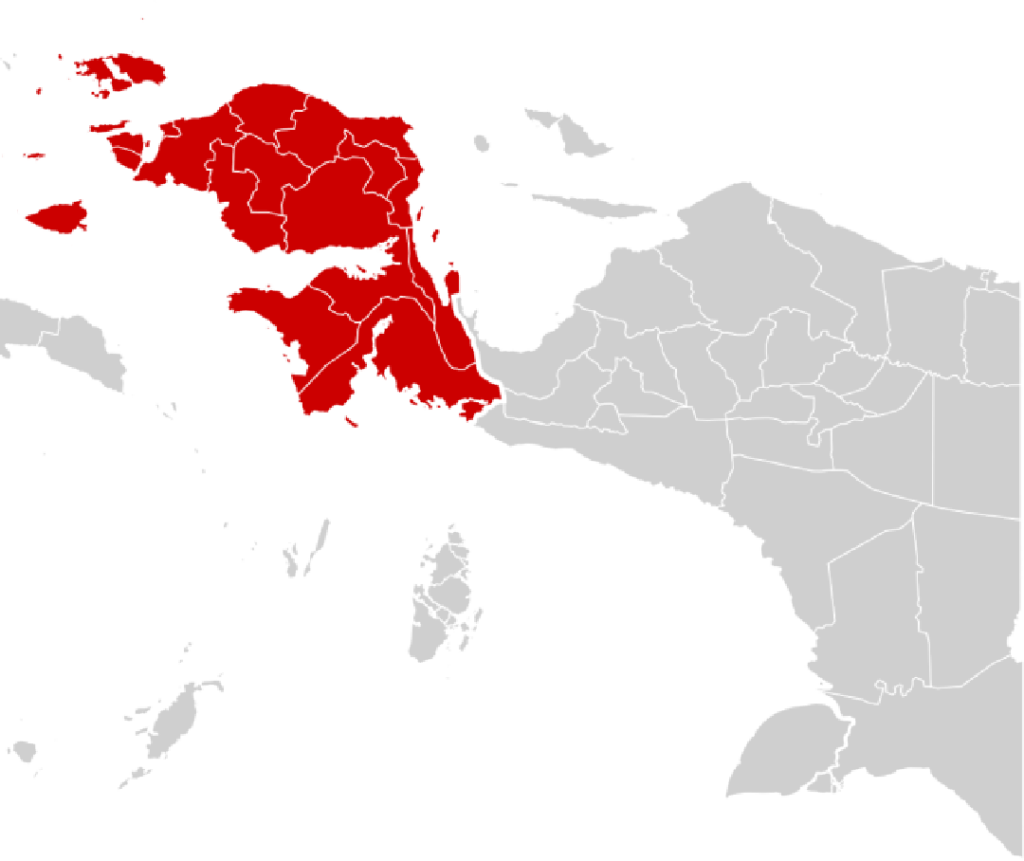
A series of security operations at two airports in Papua Pegunungan has exposed separate alleged attempts to acquire and transport weapons through the region’s air transportation network. The operations resulted in the arrest of Abdon Kisamdu, identified by authorities as Deputy Commander of the West Papua National Liberation Army from the Free Papua Movement (TPNPB OPM) from War Regional Command (Kodap) 35 Bintang Timur, at Nop Goliat Dekai Airport in Yahukimo, followed days later by the arrest of Weminus Wandik at Wamena Airport after a suspicious cargo package containing an air rifle and other items was intercepted.
The two cases unfolded separately, but they share one important feature: the use of civilian aviation infrastructure in an attempt to move or obtain items that authorities considered potentially connected to armed activity.
For security officials, the incidents underline the importance of screening passengers and cargo while maintaining the safety of airports that remain essential lifelines for communities across Papua’s mountainous interior.
The operations also highlight the increasingly important role of aviation security in Papua Pegunungan, where difficult terrain makes air transportation indispensable for people, government services, trade and logistics.
Abdon Kisamdu Arrested at Nop Goliat Airport
The first operation took place in Yahukimo on Saturday, September 19, 2026.
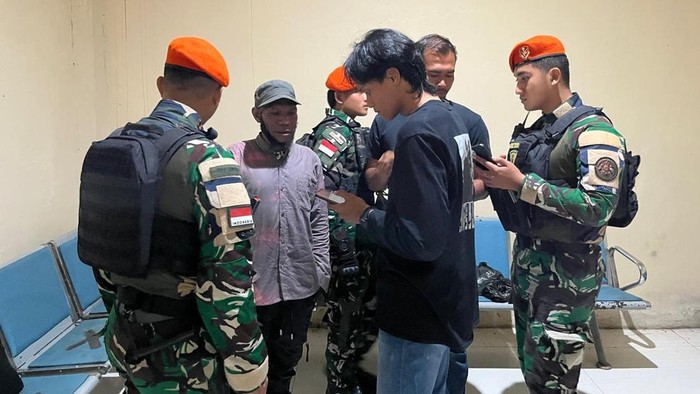
According to the Kopasgat command, personnel from the Mandala Koops TNI Habema Task Force (Satgas), supported by Pasgat personnel, arrested Abdon Kisamdu shortly after he landed at Nop Goliat Dekai Airport aboard a Trigana Air Boeing 737. The aircraft was identified as flight PK YSC.
Detik reported that Abdon arrived at approximately 2:59 p.m. local time and had already been listed as a wanted person by the Indonesian National Police. Authorities had information indicating that he was travelling to Yahukimo to acquire firearms.
The operation was conducted immediately after Abdon left the aircraft.
According to Lieutenant General Lucky Avianto, commander of Kogabwilhan III, security personnel had secured access points around the airport before intercepting him. He was then taken to an airport isolation room for further examination.
The arrest took place without reported disruption to airport operations.
That point is significant in a region where airports are not merely transportation facilities. For many communities in Papua’s interior, aviation provides an essential connection to provincial capitals, health services, markets, government offices and other parts of Indonesia.
Alleged Weapons Transaction in Kali Seng
During the initial examination, Abdon reportedly told investigators that he had travelled to Dekai to meet an individual in the Kali Seng area to purchase firearms.
Authorities said the statement was supported by conversations found on his mobile phone. The conversations allegedly indicated preparations for a weapons transaction in the Kali Seng area of Dekai District.
Okezone reported that Abdon allegedly told investigators he had transferred money three times to an individual identified only by the initials BA.
According to the account presented by Lieutenant General Lucky Avianto, the arrangement was for Abdon to receive the firearms in Kali Seng. A relative identified by the initials K P was allegedly expected to pick him up after his arrival at Nop Goliat Airport and take him to the transaction location.
The plan was disrupted before that journey could take place.
Authorities subsequently began investigating the alleged supplier and possible wider network involved in the transaction. Okezone reported that the investigation was intended to trace the source of the weapons and determine whether other individuals were involved.
However, investigators are still probing the identities of individuals allegedly linked to the transaction.
A Second Operation Unfolds in Wamena
Only days after the Yahukimo operation, security personnel in Wamena detected another suspicious weapons-related shipment.
The case began in Sentani, Jayapura, on Monday, September 21.
According to Okezone, personnel from Yonif 462 Kopasgat and aviation security officers received information about a suspicious cargo package at Sentani Airport. The package was being sent from Sentani to Wamena using Trigana Air Cargo Services.
The shipment was registered in the name of Weminus Wandik.
The package was subjected to examination and subsequently monitored as it moved through the air cargo system towards Wamena.
The following day, Tuesday, September 22, Weminus travelled to Wamena himself, using a different airline from the one carrying the cargo. Okezone reported that he travelled aboard Sriwijaya Air on flights SJ 0758 and SJ 0786.
The timing drew the attention of investigators.
Lieutenant General Lucky Avianto stated that airport personnel viewed the movement as an attempt to evade detection. The package itself had travelled by cargo, while Weminus travelled separately the following day.
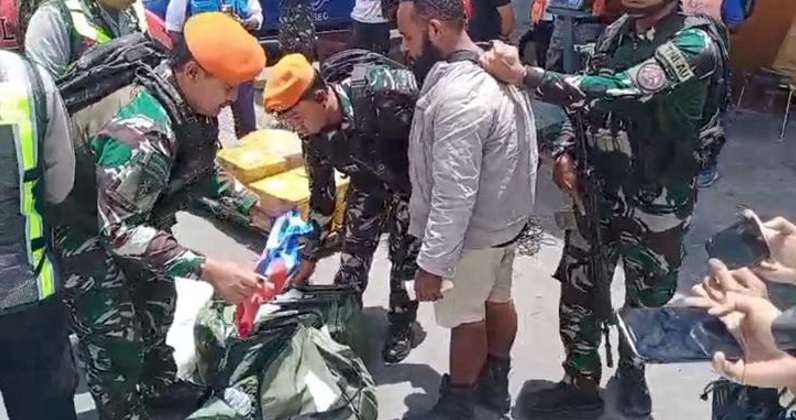
When Weminus arrived to collect the package at the Trigana Air cargo warehouse in Wamena, personnel moved to intercept him.
What Was Found Inside the Package?
The inspection produced several items.
Authorities reported finding one 4.5 millimetre air rifle, a telescopic sight, a suppressor, a knife, three mobile phones, a chain and a large Bintang Kejora flag. Other reports also referred to camouflage clothing among the items seized.
The presence of an air rifle is particularly relevant to the security authorities’ assessment.
Lieutenant General Lucky Avianto said security forces had previously encountered modified air rifles in cases involving armed groups in Papua. According to his statement, such weapons can be modified to fire more lethal ammunition.
That assertion was presented by the military commander as part of the security assessment surrounding the seized equipment. The actual condition, intended use, and legal classification of the weapon remain subjects that authorities will further examine.
Personnel from Pasgat and the Polsek KP3 Airport Wamena subsequently took Weminus for further questioning. ANTARA also reported that he was secured for examination following the discovery of the suspicious package.
How the Wamena Operation Was Detected
The Wamena case illustrates how cargo screening can become the first point of detection.
The suspicious package was initially identified through airport screening at Sentani. The information was then communicated to personnel in Wamena, allowing the receiving unit to monitor the package and identify its owner when he arrived to collect it.
This coordination was central to the operation.
Rather than treating the cargo inspection as an isolated airport security incident, personnel followed the shipment through its destination and waited for the person associated with the package to appear.
According to the military account, this enabled officers to secure the package and its owner without disrupting normal airport activity.
The case was then handed over for further legal examination.
Authorities said investigators would examine the origin of the items, their intended destination and the possible involvement of other people in the shipment.
That distinction is important because the discovery of suspicious equipment does not by itself establish the complete structure of an alleged weapons network. The investigation must identify the suppliers of the items, the financiers, their intended purpose, and any additional individuals involved.
Two Airports, One Security Challenge
The incidents at Nop Goliat and Wamena occurred at different airports and involved different individuals.
Abdon Kisamdu was arrested after arriving in Yahukimo and was allegedly preparing to meet a weapons supplier.
Weminus Wandik was detained after arriving to collect a cargo package that authorities said contained an air rifle and other equipment.
The cases should therefore not be treated as a single operation.
Nevertheless, their timing has drawn attention to the security of aviation routes in Papua Pegunungan.
For the Indonesian security authorities, the incidents demonstrate why passenger and cargo screening remains important across Papua’s air transportation network.
Papua’s geography makes this particularly challenging.
Mountainous terrain, long distances and limited road connections mean that aircraft are essential for moving people and goods. The same transportation infrastructure that supports economic and social activity can also become a route that criminals or armed groups attempt to exploit.
That creates a difficult balance.
Security measures need to prevent dangerous goods from entering or moving through airports without undermining the normal movement of civilians, businesses and government services.
TNI Signals Tighter Cargo Monitoring
Following the Wamena incident, Lieutenant General Lucky Avianto said the military would strengthen coordination with aviation security personnel at airports across Papua.
He said the discovery demonstrated the need for tighter monitoring of cargo distribution routes and efforts to prevent dangerous goods from being moved through the air transportation system.
The statement also points to a broader security approach.
Rather than focusing exclusively on remote areas where armed groups operate, authorities are paying greater attention to logistical infrastructure that connects Papua’s interior with larger population centres.
Airports such as Sentani and Wamena are critical nodes within that system.
Sentani serves as a major gateway into Papua, while Wamena provides an important connection to communities across Papua Pegunungan.
Maintaining security at these locations therefore has implications beyond the immediate incidents.
The Investigation Now Moves Beyond the Airports
The next stage of the investigations will be more complicated.
In the Abdon Kisamdu case, authorities are seeking to identify the alleged supplier connected to the planned transaction in Kali Seng. Okezone reported that investigators were examining communications and financial transfers allegedly associated with the planned purchase.
In the Wamena case, investigators are expected to establish where the cargo originated, who arranged its shipment and what purpose the equipment was intended to serve.
These questions matter because weapons trafficking is rarely limited to the person who physically carries or receives an item.
A complete investigation requires tracing the supply chain.
It must identify the supplier, financier, transporter, recipient, and end user.
That process is now in the hands of the relevant law enforcement authorities.
Protecting Civilian Aviation in Papua
For communities in Papua Pegunungan, the security of airports has a direct connection with daily life.
Flights carry food, medicines, passengers, business goods and government personnel. In areas where road infrastructure remains limited by geography, aviation can determine whether people can reach hospitals, schools, markets and administrative centres in a reasonable period.
That makes airport security a public interest issue rather than simply a military concern.
The recent operations demonstrate the importance of cooperation between military units, police, aviation security officers and airport operators.
The Wamena case, in particular, began with cargo screening and developed through coordination between personnel at different locations.
Such cooperation can help authorities address security threats while allowing legitimate passengers and businesses to continue using the aviation network.
Papua’s Security and Development Are Closely Connected
The latest arrests also come as the Indonesian government continues to emphasise infrastructure, connectivity and public services in Papua.
The Indonesian government is working to upgrade airports and road connectivity, as well as develop new educational and healthcare infrastructure across Papua. Furthermore, the government continues to ensure security stability in the region, particularly against terror threats posed by the TPNPB-OPM.
These developments demonstrate the inseparable nature of security and development in Papua.
A safe transportation network supports commerce, public services and government access. At the same time, the same network requires effective security measures to prevent its misuse.
The challenge for authorities is therefore not simply to secure airports but to ensure that security measures protect the infrastructure that communities depend upon.
What the Two Arrests Reveal
The arrests of Abdon Kisamdu and Weminus Wandik do not, by themselves, establish the full extent of any alleged weapons network.
However, based on the statements released by Indonesian military authorities and reports from the cited media, both cases point to efforts involving firearms or potentially weapon-related equipment and the use of aviation routes in Papua.
The Abdon operation also shows the importance of intelligence and surveillance around airport movements. Authorities identified his presence before his arrival and prepared security personnel to intercept him.
The Wamena case demonstrates the role of cargo screening and interairport coordination.
Together, the incidents underscore a simple but important point: aviation security has become an increasingly significant component of Papua’s wider security architecture.
Conclusion
The arrests of Abdon Kisamdu at Nop Goliat Dekai Airport and Weminus Wandik at Wamena Airport have placed renewed attention on the security of Papua’s air transportation routes.
In Yahukimo, authorities said Abdon was intercepted after arriving to pursue an alleged firearm transaction. In Wamena, security personnel intercepted a suspicious cargo shipment and detained its alleged recipient after finding an air rifle and other items inside the package.
The cases remain subject to further investigation and legal proceedings. Claims concerning wider networks, suppliers and intended use of the seized equipment therefore require confirmation through the investigative and judicial process.
Yet the immediate lesson is clear.
Papua’s airports are not only gateways for passengers. They are vital economic and social arteries connecting remote communities with the rest of Indonesia. Protecting those routes from the movement of weapons and other dangerous goods is therefore part of protecting civilian mobility and the continuity of development.
The effectiveness of future security operations will depend not only on arrests but also on the ability of authorities to trace supply chains, strengthen cargo screening, coordinate across agencies and maintain public confidence in the safety of Papua’s transportation infrastructure.
For Papua Pegunungan, where geography makes aviation indispensable, keeping the skies open and secure will remain an important part of the wider effort to maintain stability and support development.
Read Also
Police Foil Illegal Arms Smuggling to Papua
Indonesian Security Forces Crackdown Illegal Arms Network in Papua