The relationship between Indonesia and the Solomon Islands is entering a more constructive chapter, marked by the arrival of Indonesia’s new ambassador and renewed emphasis on practical bilateral cooperation.
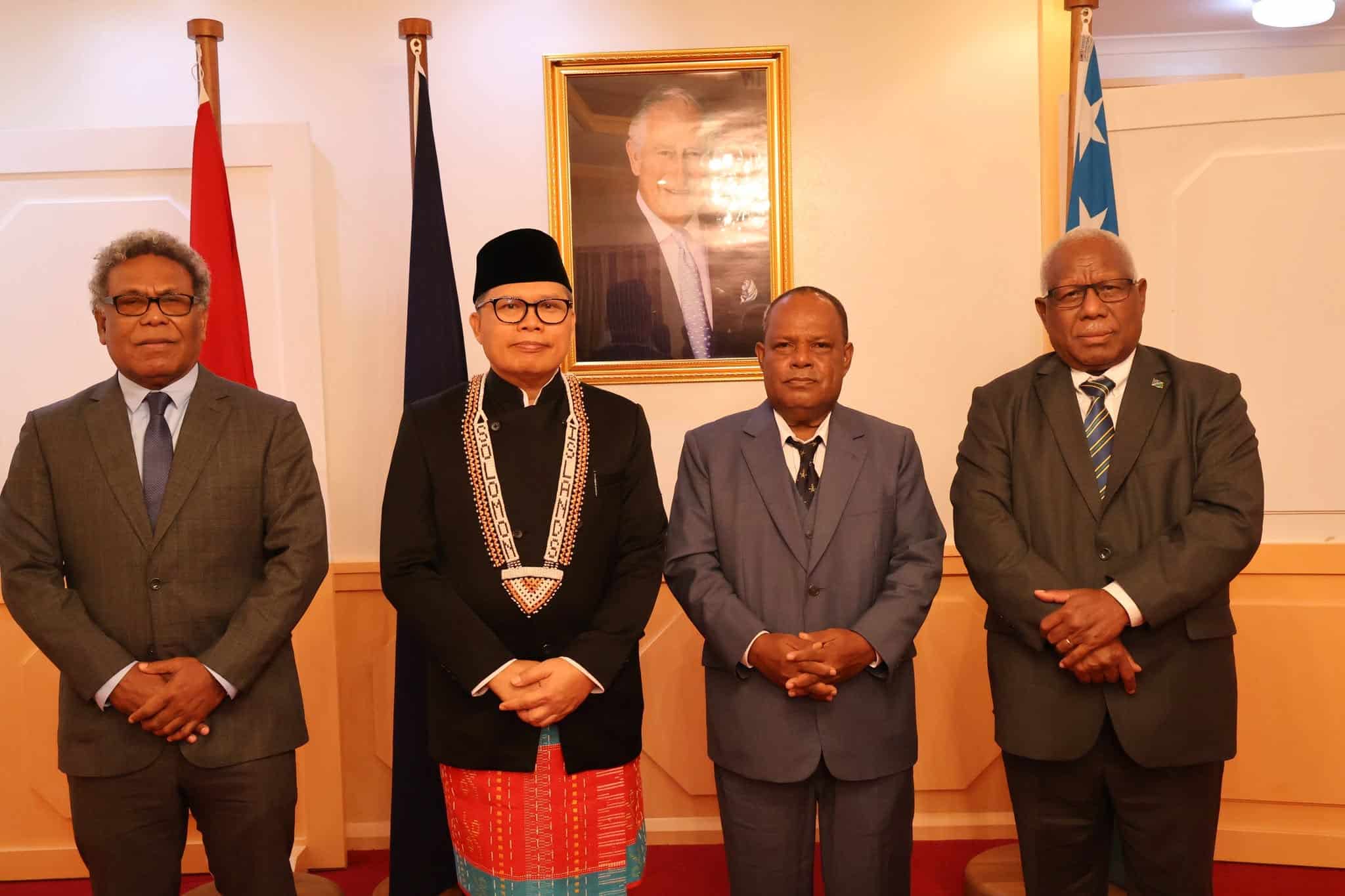
On 12 August 2026, Solomon Islands Governor General Sir David Tiva Kapu received Indonesia’s newly appointed ambassador, Okto Dorinus Manik, for the presentation of his credentials. The diplomatic ceremony in Government House Honiara carries significance beyond protocol. It comes after years in which bilateral relations were tested by disagreements over Papua and the Solomon Islands’ statements at the United Nations concerning human rights and self-determination.
The latest engagement suggests that both countries are increasingly putting greater weight on cooperation, regional stability, and people-to-people relations. At the same time, the history of disagreements over Papua remains an important part of the relationship, particularly because the issue has periodically shaped political debate in the Pacific.
A Diplomatic Ceremony with Wider Significance
The presentation of credentials is a standard element of diplomatic practice, but in this case it comes against a particularly important regional background.
Sir David Tiva Kapu serves as Governor General of the Solomon Islands, while Okto Dorinus Manik represents Indonesia as ambassador to Papua New Guinea and the Solomon Islands. Indonesian diplomatic records confirm that Manik formally began his diplomatic assignment in the region after presenting his credentials to Papua New Guinea Governor General Sir Bob Dadae in May 2026.
His subsequent engagement in Honiara provides an opportunity for Jakarta to maintain direct communication with one of its important Melanesian partners.
For Indonesia, the Solomon Islands occupies a strategic position in the Pacific. The country is a member of the Pacific Islands Forum (PIF) and the Melanesian Spearhead Group (MSG), two regional groupings that remain relevant to Indonesia’s engagement with Pacific Island states. Indonesia has been a dialogue partner of PIF since 2011 and associate member of MSG since 2015.
That regional connection gives bilateral relations a significance beyond trade or diplomatic representation. It also places Indonesia’s engagement with Honiara within the wider effort to strengthen relations between Southeast Asia and the Pacific.
From Political Tension to Practical Cooperation
The relationship has not always been smooth.
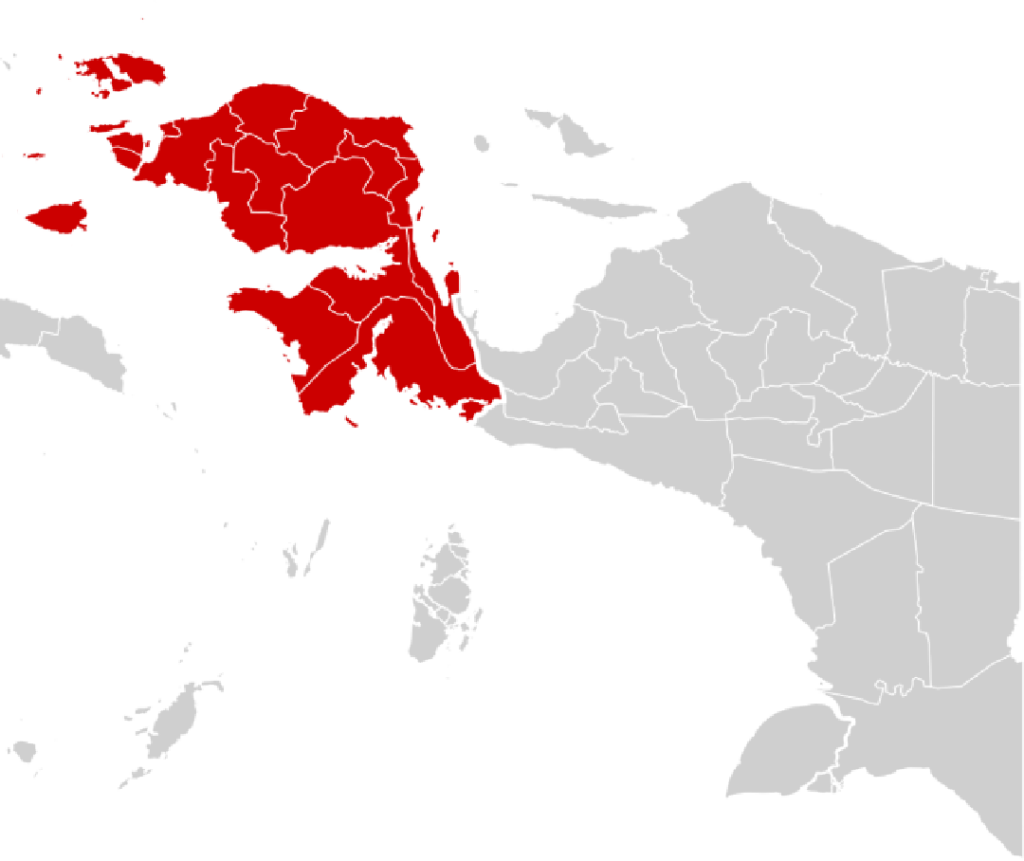
The most visible period of tension came during 2014 until 2019, when Papua became a prominent subject in the Solomon Islands’ foreign policy. In 2016 and 2017, at the United Nations General Assembly, then Prime Minister Manasseh Sogavare raised allegations concerning human rights in Papua and linked them to the question of self-determination.
Contemporary reporting recorded a strong Indonesian response. Jakarta regarded the statements as interference in Indonesia’s internal affairs and a challenge to its sovereignty and territorial integrity.
The issue did not arise spontaneously. Research on Pacific diplomacy shows that Solomon Islands and several other Pacific countries had increasingly raised concerns about Papua at international forums during this period. A 2017 analysis by the Institute for Policy Analysis of Conflict noted that Solomon Islands had raised the Papua issue at the UN since 2014, before it became more prominent during the 2016 and 2017 General Assembly.
The disagreement illustrated a difficult diplomatic balance. Pacific governments were increasingly attentive to questions of human rights and the political aspirations associated with West Papua, while Indonesia regarded Papua as an integral part of its sovereign territory and rejected international efforts that it viewed as interference.
Yet bilateral relations did not remain defined solely by that dispute.
Cooperation Gradually Widened
Over subsequent years, Indonesia and Solomon Islands continued to maintain channels for practical cooperation.
This has included areas such as development, education, culture, sports, and economic relations. Indonesia has also sought to strengthen its engagement with Pacific countries through development assistance and capacity building.
The broader approach reflects a shift from an exclusively political conversation toward a more diversified relationship.
One example of this practical diplomacy came through Indonesia’s support for the development of sports facilities in Solomon Islands. Indonesian assistance in constructing a futsal facility in Honiara in 2022 became one visible symbol of cooperation between the two countries. This sports facility was used for the 2023 Pacific Games held in the Solomon Islands. The project demonstrated how bilateral relations can also be built through projects that directly affect communities rather than through high-level political meetings alone.
Such initiatives matter because political statements alone rarely sustain diplomatic relationships. They depend on networks of officials, students, businesses, community organizations, and professional exchanges that create practical interests in maintaining stable relations. In addition, Indonesia actively provides opportunities for dozens of Solomon Islanders to pursue higher education in the country through the Developing Countries Partnership (Kemitraan Negara Berkembang, or KNB) Scholarship and the Indonesia Aid Scholarship (TIAS).
Papua Remains Part of the Diplomatic Background
The improved atmosphere should not be interpreted as meaning that differences over Papua have simply disappeared.
The issue remains part of the wider political environment in the Pacific. Solomon Islands has previously expressed concerns regarding Papua, particularly in relation to human rights, while Indonesia has consistently defended its sovereignty and territorial integrity.
Indonesian government documents also show that Solomon Islands later adopted a more nuanced position. During a 2019 UN General Assembly discussion, the Solomon Islands’ foreign minister reaffirmed Indonesian sovereignty over Papua while continuing to express concern about reports of violence and alleged human rights violations. The Solomon Islands also welcomed Indonesia’s invitation to the UN High Commissioner for Human Rights to conduct an assessment in Papua.
That distinction is important.
It demonstrates that the Papua question does not necessarily have to become a zero-sum issue between Jakarta and Pacific capitals. A government can raise concerns about human rights while simultaneously recognizing another country’s territorial sovereignty.
For Indonesia, the situation provides space for continued diplomatic engagement rather than confrontation.
Why the Pacific Relationship Matters for Indonesia
Indonesia’s engagement with the Solomon Islands also reflects a broader strategic reality.
Indonesia is both a Southeast Asian and a Pacific country. Its eastern provinces, including Papua, Papua Highlands, South Papua, and other parts of eastern Indonesia, give the country substantial geographic and cultural links with the Pacific.
The Indonesian government has consequently placed greater emphasis on relations with Pacific Island countries in recent years. Its participation in the Melanesian Spearhead Group provides an institutional platform for engagement on economic development, culture, trade, and regional issues.
Solomon Islands is particularly relevant because of its position within Melanesian regional diplomacy.
For Honiara, stronger ties with Indonesia also offer opportunities in areas such as trade, education, infrastructure, health, agriculture, and technical cooperation.
The relationship therefore has room to grow beyond political disagreements.
Development Diplomacy Can Build Trust
One of the most important lessons from the Indonesia-Solomon Islands relationship is that diplomacy becomes more resilient when it produces tangible benefits.
Indonesia’s cooperation with Pacific states has increasingly involved humanitarian assistance, development programs, scholarships, and technical exchanges. Such initiatives allow governments to interact on issues where interests overlap, even when political perspectives differ.
This approach is particularly relevant in the Pacific, where small island states face considerable challenges linked to climate change, infrastructure, connectivity, and economic vulnerability.
Indonesia can contribute experience from its development programs, while the Solomon Islands brings knowledge of Pacific priorities and regional dynamics.
That creates a foundation for a more balanced partnership.
A New Ambassador and A Broader Diplomatic Agenda
For Ambassador Okto Dorinus Manik, the assignment comes at a decisive moment.
His task is not simply to maintain diplomatic communication. He will operate in a region where Indonesia’s image is closely connected to perceptions of Papua, Melanesian identity, and Indonesia’s broader role in the Pacific.
That makes public diplomacy especially important.
Indonesian engagement will likely benefit from emphasizing practical cooperation while maintaining open channels for discussion on sensitive issues. Education, cultural exchanges, sports, and economic cooperation can provide opportunities to develop relationships at the community level.
At the same time, Jakarta will need to continue explaining its policies in Papua to international audiences through credible information and transparent engagement.
For Solomon Islands, maintaining constructive relations with Indonesia offers similar advantages. Indonesia is one of the region’s larger economies and an increasingly active partner in the Pacific. Stronger bilateral ties can provide additional opportunities for economic and technical cooperation without requiring Honiara to abandon its own foreign policy priorities.
From Disagreement to Dialogue
The evolution of Indonesia-Solomon Islands relations offers a useful lesson in regional diplomacy.
The disagreements of 2016 and 2017 demonstrated how quickly Papua could become a source of tension between Jakarta and Pacific governments. The subsequent development of practical cooperation shows, however, that political differences do not necessarily prevent countries from building broader relationships.
Therefore, we can view the latest credentials ceremony involving Sir David Tiva Kapu and Okto Dorinus Manik as another step in that longer process.
It does not erase the disagreements of the past. Nor does it suggest that Jakarta and Honiara will always share identical positions on Papua.
What has changed is the space available for engagement.
Rather than allowing a single contentious issue to define the entire relationship, Indonesia and Solomon Islands have increasingly demonstrated the value of maintaining communication across multiple sectors.
Looking Ahead
The next phase of Indonesia-Solomon Islands relations will likely focus more on the outcomes that follow ceremonial diplomacy.
Trade, education, cultural exchanges, development assistance, and cooperation in areas such as agriculture, fisheries, sports, and human resource development could give the relationship greater substance. These practical connections can also create stronger foundations for political dialogue when sensitive regional issues emerge.
For Papua, the implications are significant. Indonesia’s engagement with the Solomon Islands is not only about bilateral diplomacy. It is also part of a broader effort to ensure that discussions about Papua take place alongside wider conversations about development, social welfare, regional connectivity, and cooperation.
The arrival of a new Indonesian ambassador in Honiara therefore represents more than a change of diplomatic personnel. It offers an opportunity to deepen a relationship that has survived political disagreement and now has the potential to become more pragmatic and forward-looking.
In the Pacific, where geography makes cooperation unavoidable, sustained dialogue may ultimately prove more durable than political confrontation.