
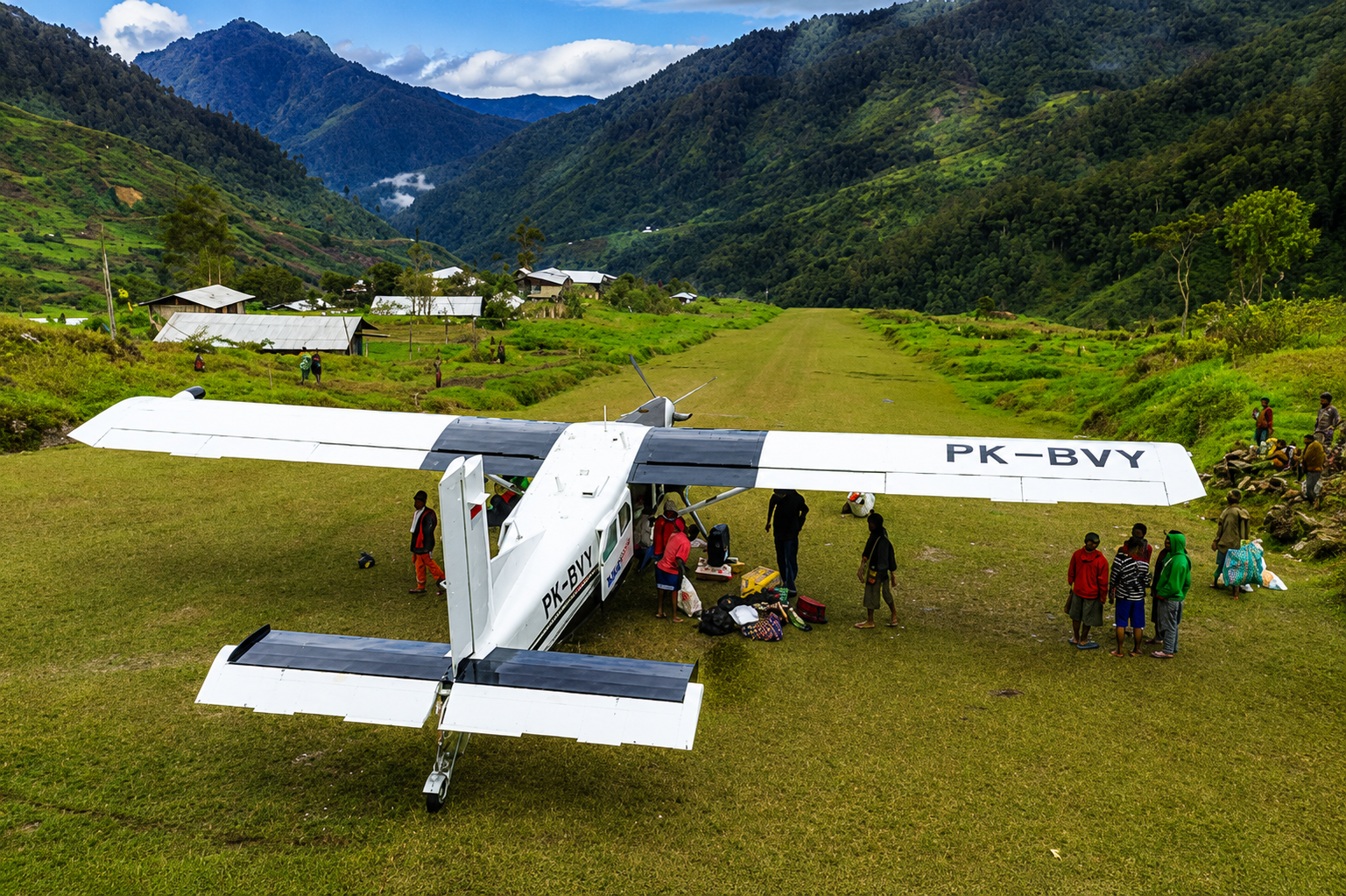
For communities living deep in the mountains of Papua, an airplane is often more than a means of travel. It can be the link to a hospital, a school, a government office, a market, or a family member living in another district. That reality is behind a new Papua Tengah (Central Papua) subsidized flight program, launched by the provincial government to improve access to remote areas while helping move people and essential goods at more affordable costs.
The program covers six pioneer aviation routes serving six regencies in Papua Tengah and was launched by Governor Meki Fritz Nawipa during Indonesia’s 81st Independence Day celebrations on 17 August 2026. The provincial government is working with AMA, an airline operator that serves remote areas, as part of the effort to maintain regular air connectivity where conventional road infrastructure remains difficult or, in some places, unavailable.
The policy, which takes effect on 24 August 2026, also has economic objectives. By reducing costs and enhancing the reliability of air transport, the provincial government hopes to facilitate the distribution of food, fuel, medicines, and other essential goods. In regions where transportation costs directly impact retail prices, improving the logistics system is closely linked to government efforts to control inflation.
Air Connectivity as a Development Tool
Papua’s geography makes transportation policy fundamentally different from that of many other parts of Indonesia. Mountains, dense forests, rivers, and long distances between settlements have historically made the construction and maintenance of conventional road networks particularly challenging.
For people living in remote highland communities, therefore, air services can become an essential part of the public infrastructure system.
The new subsidy program reflects that reality. Rather than treating pioneer aviation simply as a commercial service, the provincial government is using public funds to support routes whose social and economic value may be greater than their immediate commercial returns.
This is an important distinction.
Commercial airlines naturally tend to concentrate on routes with sufficient passenger demand to generate sustainable revenue. Remote Papua often presents the opposite conditions. Passenger numbers can be limited, operating costs can be high, and weather conditions can complicate aviation operations.
Without government intervention, some routes may therefore be economically difficult to maintain.
The subsidy is designed to bridge that gap.
Connecting Six Remote Areas
According to reports from Indonesian media, the Papua Tengah provincial government has launched subsidized pioneer flights serving six regencies.
The subsidized flight routes are: Nabire Regency to Ilaga (Puncak Regency), round-trip three times a week; Nabire to Mulia (Puncak Jaya Regency), round-trip three times a week; Nabire Regency to Bilogai (Intan Jaya Regency), round-trip three times a week; Nabire to Enarotali (Paniai Regency), round-trip twice a week; Nabire to Moanemani (Dogiyai Regency), round-trip twice a week; and Nabire to Waghete (Deiyai Regency), round-trip twice a week.
The program is intended to strengthen connectivity between provincial and district centers and communities that remain heavily dependent on air transport.
The partnership with AMA is particularly relevant because pioneer aviation has long played a role in connecting isolated settlements across Papua.
The program is not simply about getting passengers from one airport to another. Every flight also has potential implications for the local supply chain.
A plane arriving in a remote district can carry food, medicines, educational materials, and other essential goods. The return flight can carry agricultural products and other commodities toward larger markets.
That creates a two-way economic connection.
Why Subsidies Matter for Household Prices
The strongest economic argument for the policy lies in logistics.
In many remote areas, the final price of a product does not reflect only its production cost. Transportation can represent a significant part of the price paid by consumers.
A sack of rice, a box of medicine, or a basic household product may travel through several stages before reaching a remote community. When transportation is expensive or irregular, those costs are eventually reflected in retail prices.
Air freight is expensive, but in some mountainous parts of Papua it can nevertheless be the most practical way to move goods. Subsidizing pioneer aviation can therefore reduce part of the transportation burden and make supplies more predictable.
The provincial government’s objective of supporting inflation control should be understood in this context.
Better connectivity does not automatically guarantee lower prices. Markets, supply availability, weather, fuel costs, and distribution networks all influence the final cost of goods. However, reliable transportation can reduce one of the structural obstacles that contributes to high prices in isolated areas.
From Passenger Mobility to Food Security
The connection between aviation and food security is particularly important.
Remote communities depend partly on supplies coming from outside their immediate area. When flights are disrupted for extended periods, stocks of certain products can become limited. Shortages can then place upward pressure on prices.
Regular subsidized flights provide a more predictable logistical channel.
This matters not only for consumers but also for government programs. Health services, schools, and other public institutions in remote areas depend on the timely arrival of supplies.
A functioning aviation network can consequently support several government priorities at the same time.
Supporting Health and Education
Transportation is closely linked to access to essential services.
For a resident of a remote mountain district, reaching a hospital may require considerably more time and resources than it would for someone living in an urban center. In emergencies, the difference can become critical.
Regular flights can make referrals and medical travel more manageable.
Education also faces similar challenges. Teachers, school administrators, and educational materials need reliable transportation. Students from remote communities may also need to travel to larger population centers to continue their education.
The provincial subsidy therefore has implications beyond transportation policy. It forms part of a broader effort to reduce the geographic isolation that can limit access to public services.
This is especially relevant as Papua Tengah continues to strengthen its provincial institutions and develop its network of public services.
Building an Economy Beyond Major Cities
Connectivity also matters for local economic development.
A remote community may have agricultural products, livestock, or other commodities with potential market value, but production alone does not guarantee income. Producers need access to buyers.
Transportation is the bridge between production and markets.
For Papua Tengah, subsidized aviation could help create that bridge for communities that cannot depend exclusively on road transportation. Farmers and small businesses may gain greater opportunities to send products to district centers, while consumers can obtain goods from outside their immediate locality.
The effect will depend heavily on the frequency, capacity, and reliability of the flights. A route that operates only sporadically may have limited economic impact. A dependable service, however, can gradually influence how businesses plan production and distribution.
Opportunities for Local Entrepreneurs
Improved mobility can also support small businesses.
When transportation becomes more predictable, entrepreneurs can plan inventories more effectively. Traders can travel between districts with greater certainty. Service providers can reach customers in areas that were previously difficult to access.
Over time, such improvements can contribute to a broader local economic ecosystem.
The provincial government’s challenge will be ensuring that the benefits of the subsidy are not limited to passengers alone. The greatest development impact would come if the program strengthens the entire local supply chain.
That means linking aviation policy with agriculture, fisheries, small businesses, markets, and public services.
A Policy Designed Around Papua’s Geography
The Central Papua initiative also illustrates why development policy in Papua cannot always follow a single national template.
Infrastructure solutions that work well in densely populated lowland regions may be less effective in mountainous areas. Building a road through difficult terrain can require years of planning and substantial investment. Even after construction, maintenance can remain challenging.
Air transport offers an alternative.
It does not eliminate the need for roads, bridges, and other physical infrastructure. Instead, it can provide an important transportation layer while larger infrastructure projects continue.
This makes pioneer aviation particularly valuable during periods when road connectivity is still being developed.
In that sense, subsidized flights should not be interpreted as a replacement for infrastructure development. They are better understood as a complementary measure.
The Human Dimension of Connectivity
Behind the policy figures are individual journeys.
A passenger boarding a small aircraft in Papua Tengah may be traveling to visit family. Another may be going to a hospital. A teacher may be traveling to a school. A trader may be carrying goods to a market.
For these passengers, connectivity is measured not in policy documents but in hours saved, opportunities gained, and uncertainty reduced.
This human dimension is important when evaluating the success of a public transportation subsidy.
A government program can be considered successful not merely when aircraft fly according to schedule but when people can use those flights to improve their daily lives.
Challenges That Still Need Attention
The subsidy program also faces practical challenges.
Weather remains an important factor in Papua’s aviation environment. Mountainous terrain and rapidly changing conditions can affect flight schedules. Aircraft availability, fuel costs, and airport infrastructure can also influence operational reliability.
There is also the question of long-term sustainability.
A public subsidy can provide an important bridge, but policymakers must continually evaluate whether routes are achieving their intended social and economic objectives.
Passenger numbers, cargo volumes, ticket affordability, service frequency, and changes in commodity prices could provide useful indicators.
Such monitoring would allow the provincial government to determine which routes require continued support, whose schedules need adjustment, and where additional logistical interventions may be necessary.
Linking Aviation With Broader Development
The greatest potential of the program will emerge when air connectivity is integrated with other development policies.
If agricultural producers receive support to increase output but cannot transport their products efficiently, the economic benefit remains limited.
If health facilities receive medical equipment but patients cannot reach them, improved infrastructure alone will not solve access problems.
If schools receive educational programs but teachers and learning materials cannot travel reliably, educational reforms may struggle to reach remote communities.
Transportation therefore acts as an enabling system.
The six subsidized routes can help connect different parts of the development agenda, from healthcare and education to food distribution and local enterprise.
This is why the policy has significance beyond the aviation sector.
A More Connected Papua Tengah
The launch of subsidized pioneer flights represents a practical response to one of Papua’s most persistent development challenges: distance.
Papua Tengah’s provincial government is attempting to reduce the effect of geographical isolation by ensuring that essential air connections remain available to communities that cannot rely entirely on conventional transportation.
The policy also reflects a broader principle of public administration. Infrastructure should not be measured only by concrete, steel, or kilometers of road. In remote regions, connectivity itself can be an essential public service.
A small aircraft linking an isolated settlement with a district center may have a development impact disproportionate to its physical size.
A Test of Long-Term Policy Effectiveness
The next stage will be implementation.
The provincial government will need to ensure that the subsidy reaches its intended beneficiaries, that flights remain reliable, and that the program contributes meaningfully to lower logistics costs.
Transparent monitoring will be important. So will coordination between the provincial government, district administrations, aviation operators, and communities.
If those elements work together, the program could become more than a transportation subsidy. It could become part of a wider strategy to reduce economic disparities between urban centers and remote communities.
Conclusion
The Papua Tengah subsidized flight program represents an attempt to address a problem that has shaped economic and social life in the region for decades: geography.
By supporting six pioneer aviation routes to remote areas, the provincial government is seeking to make travel more accessible, strengthen the movement of essential goods, and support efforts to control inflation. The program also has wider implications for healthcare, education, food security, and local economic activity.
Its success, however, will ultimately be judged by what happens on the ground.
If flights remain reliable, passenger costs become more manageable, and essential commodities can move more efficiently, the subsidy could provide tangible benefits for communities in the interior. If it is combined with improvements in airports, roads, local production, and market access, its impact could extend well beyond aviation.
For Papua Tengah, connectivity is not simply about moving aircraft. It is about moving people, goods, services, and opportunities.
That is the broader promise of the new policy. By reducing the burden created by distance, the provincial government is seeking to make remote communities more closely connected to the economic and public service networks of Papua and Indonesia. The challenge now is to ensure that the investment produces measurable, lasting benefits for the people it was designed to serve.

