
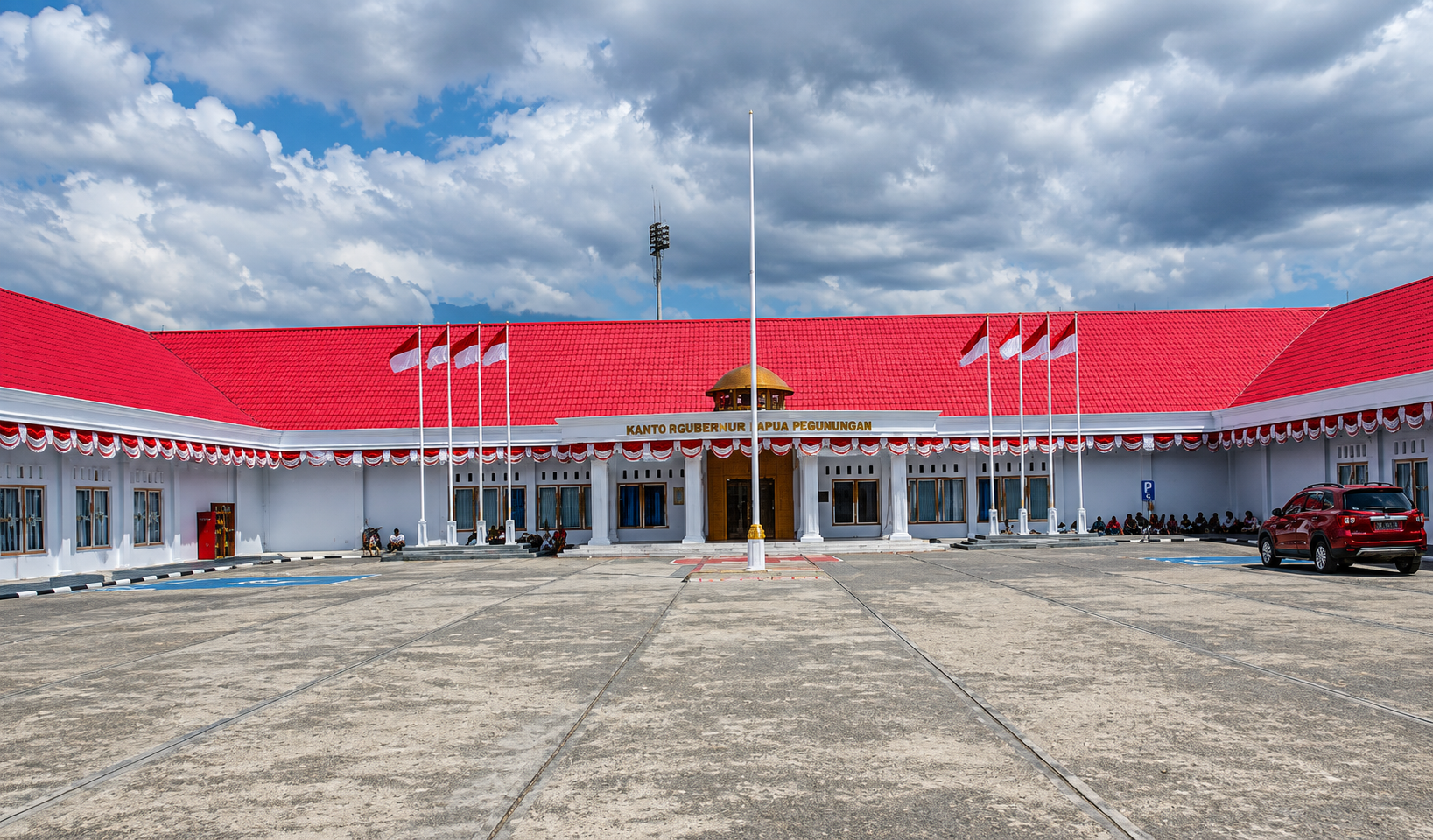
The Papua Pegunungan (Papua Highlands) provincial government is set to receive an additional Rp456 billion in Special Autonomy Funds, known as Otsus, in 2026, giving the young province greater fiscal room to accelerate infrastructure development and expand services for communities across its mountainous territory.
The additional allocation comes after the province had received approximately Rp260 billion at the beginning of 2026. According to the Papua Pegunungan Regional Revenue, Finance, and Asset Management Agency, the new allocation was provided by the central government through the Ministry of Finance following requests from regions across Papua.
For a province where mountainous terrain, limited transport links, and high logistics costs remain major development challenges, the additional funding could have significance well beyond the provincial budget. Its effectiveness, however, will depend on whether the money is converted into functioning roads, bridges, air transport facilities, telecommunications infrastructure, and better access to essential services.
Increased oversight accompanies the development of the funding package. The Papua Pegunungan branch of the Body for the Acceleration of Special Autonomy Development in Papua, or BP3OKP, has started to improve its monitoring of Otsus programs in all eight regencies of the province.
Together, the additional funds and stronger oversight point to an increasingly important phase in Papua’s special autonomy policy: moving from the allocation of resources toward measurable development outcomes.
A Larger Fiscal Space for Papua Pegunungan
The additional Rp456 billion represents a substantial increase compared with the initial Otsus allocation received by Papua Pegunungan earlier this year.
Noak Tabo, head of the provincial BPPKAD, said the province initially received around Rp260 billion in Otsus funds in early 2026 before receiving the additional Rp456 billion. He described the additional allocation as important for accelerating development and improving basic physical facilities.
The funds are particularly relevant for a region where geography directly affects the cost and speed of development.
Papua Pegunungan is dominated by rugged mountainous landscapes. Communities are spread across eight regencies, with access between population centers often dependent on roads, small aircraft, and other limited forms of transportation.
As a result, infrastructure investment can have an impact far beyond construction itself.
A new road can reduce travel time. A bridge can reconnect communities. Better air facilities can improve the movement of people and essential goods. Telecommunications infrastructure can make it easier for residents in remote areas to access government services, education, and information.
These are the types of investments that the provincial government intends to prioritize through the additional allocation.
Infrastructure at the Center
According to the provincial government, part of the Otsus allocation categorized as Additional Infrastructure Funds, or AIF, will focus on basic physical infrastructure. The priorities include roads, bridges, improvements to air transportation facilities, and expansion of digital telecommunications.
The responsibilities will be distributed among technical agencies, including the provincial public works and housing agency, transportation agency, and communications, informatics, statistics, and encryption agencies.
This approach reflects a practical reality in Papua Pegunungan. Infrastructure cannot be viewed as a single sector.
Road construction, for example, has implications for food distribution and local trade. Air transport affects health referrals, education access, and the movement of essential supplies. Digital connectivity can reduce the isolation of communities that remain physically distant from administrative centers.
The province’s own 2026 development framework identifies basic infrastructure, education, health, and economic productivity as four central areas of development. The infrastructure agenda specifically aims to enhance connectivity, streamline logistics distribution, and lower the cost of basic goods in the highlands.
Otsus Funding Has Two Main Forms
The additional allocation also highlights the structure of special autonomy financing.
The Papua Pegunungan government explains that Otsus funding consists of block grants and specific grants.
Block grant funding provides regional governments with greater flexibility to determine how money is allocated according to local needs. Specific grant funding, by contrast, is directed toward predetermined priorities and must be used according to applicable rules.
This distinction matters because additional money does not automatically mean unlimited spending flexibility.
For specific grants, the central government determines the intended sectors and objectives. The provincial government says these funds are directed toward areas including education, health, community economic empowerment, and infrastructure development.
The arrangement is designed to ensure that Special Autonomy resources address the sectors that have traditionally been central to the policy.
It also creates a clear responsibility for provincial and regency governments: funding must be transformed into programs that can be measured and evaluated.
Expanding Services Beyond Infrastructure
While infrastructure is a major component of the new allocation, the broader Otsus framework also covers social development.
Education and health are among the sectors identified for specific grant financing. Economic empowerment is another major area, particularly for Indigenous Papuan communities, or Orang Asli Papua (OAP).
This means the potential impact of the additional funding is not limited to construction projects.
In education, funding can support efforts to improve access and quality in a region where distance remains a major obstacle. Papua Pegunungan has previously identified community-based education as an important component of its Papua Cerdas initiative.
Health presents a similar challenge.
The provincial government has described Papua Sehat as a program focused on improving medical services, access to health facilities, addressing stunting, and expanding mobile clinics in remote areas. The underlying objective is to make communities healthier and more economically productive.
Economic empowerment is equally important.
Papua Pegunungan has sought to develop local economic potential and improve residents’ skills under its Papua Produktif agenda. The goal is to strengthen local economic independence across the province’s eight regencies.
The additional Otsus funds could therefore support a combination of physical and social development, provided allocations are properly targeted and implemented.
Eight Regencies in the Spotlight
Papua Pegunungan consists of eight regencies: Jayawijaya, Nduga, Mamberamo Tengah, Yalimo, Tolikara, Yahukimo, Pegunungan Bintang, and Lanny Jaya.
The geographical spread makes coordination particularly important.
A provincial program cannot assume that the same approach will work equally well in Wamena, Yahukimo, Pegunungan Bintang, or Nduga. Local geography, infrastructure, population distribution, and economic conditions differ considerably.
That is why the government’s stated emphasis on coordination and oversight is significant.
The additional funds provide greater fiscal capacity, but regency governments remain important actors in determining how development programs reach communities.
Oversight Becomes More Important
The announcement of additional funding came alongside a separate development: the strengthening of Otsus oversight by BP3OKP Papua Pegunungan.
According to ANTARA, BP3OKP is working with provincial and regency governments to monitor the implementation of programs financed through special autonomy funds. The organization operates under the vice president and has a mandate to help supervise and direct Otsus-related programs.
So far, BP3OKP Papua Pegunungan has conducted socialization and coordination activities in Lanny Jaya and Jayawijaya, while activities in the other six regencies are scheduled for subsequent stages.
Gaad P Tabuni, a member of BP3OKP Papua Pegunungan, said the organization is meant to remind, oversee, and help local governments ensure that Otsus-funded programs obey the law.
That role becomes increasingly relevant as the amount of funding grows.
Preventing Misuse Before It Happens
BP3OKP has stressed that prevention is preferable to dealing with problems after funds have been spent.
The organization says Otsus allocations are regulated for sectors including education, health, infrastructure, and the economic empowerment of Indigenous Papuans. It is therefore encouraging regency governments to coordinate their planning so that programs are consistent with the legal framework and reach the intended communities.
The emphasis on early supervision is significant.
Large public budgets inevitably create demands for transparency. In remote regions, monitoring can be especially challenging because of geographic distances and limited administrative capacity.
Regular coordination between provincial authorities, regency governments, and oversight institutions can help reduce the risk of programs drifting away from their original objectives.
For international observers of Papua’s development, this is an important part of the story. The question is not simply how much money is transferred, but how effectively institutions manage it.
Development, Connectivity, and the Cost of Isolation
One of the strongest arguments for infrastructure spending in Papua Pegunungan is its potential effect on the cost of living.
The province has previously identified improved roads and connectivity as a way to facilitate logistics distribution and reduce the price of basic commodities.
This is particularly important in mountainous communities.
When goods have to travel long distances through difficult terrain or depend on air transport, transportation expenses can become part of the final price that consumers pay.
Better infrastructure can gradually reduce these barriers.
The same principle applies to agricultural products. Farmers and small producers need reliable connections to markets if they are to increase production and income.
In that sense, infrastructure is not only a construction issue. It is an economic policy.
Digital Connectivity as a Development Tool
The inclusion of telecommunications infrastructure in the DTI priorities also reflects the changing nature of public services.
Digital connectivity can improve access to information and support communication between communities and government institutions. It can also create opportunities for education, business, and administrative services.
For remote communities, a reliable internet connection can sometimes provide access to services that would otherwise require a long physical journey.
That does not mean digital infrastructure can replace roads, health facilities, or schools. Rather, it can complement them.
For Papua Pegunungan, combining physical connectivity with digital connectivity could become an important element of its long-term development strategy.
What the Additional Funds Could Mean for Communities
The immediate expectation surrounding the Rp456 billion allocation is acceleration.
But acceleration should not simply mean spending money more quickly.
The more meaningful measure is whether communities experience tangible improvements.
A bridge should make travel safer and easier. An improved air facility should support reliable transportation. Telecommunications investment should provide actual connectivity. Education spending should reach students. Health programs should improve access to medical care. Economic programs should strengthen household incomes.
These outcomes are easier to communicate when government agencies maintain transparent data and allow communities to see how public resources are being used.
The involvement of BP3OKP could help reinforce this process.
A Test for Special Autonomy
The new allocation also places Papua’s special autonomy policy under another practical test.
Special Autonomy has always carried an important development objective: ensuring that additional fiscal resources can address the distinctive needs of Papua.
For Papua Pegunungan, one of the newest provinces, the challenge is particularly significant.
The province must build institutions while simultaneously delivering services across difficult terrain.
The additional Rp456 billion provides greater room to do so. But it also increases the responsibility of provincial and regency administrations to demonstrate that public resources are producing public benefits.
The combination of funding and oversight is therefore potentially more important than either element on its own.
Looking Ahead
Papua Pegunungan now has an opportunity to turn a larger fiscal allocation into visible improvements in daily life.
The province entered 2026 with approximately Rp260 billion in Otsus funding and has now received an additional Rp456 billion. While the two figures should not automatically be treated as a single unrestricted budget because Otsus consists of different funding categories and purposes, the additional allocation clearly expands the resources available for development priorities.
The challenge ahead will be implementation.
With eight regencies, difficult geography, and significant infrastructure gaps, Papua Pegunungan will need strong coordination between provincial and regency administrations, technical agencies, oversight institutions, and local communities.
The role of oversight will be equally important. BP3OKP’s efforts to engage local governments before programs are implemented could help ensure that Otsus spending remains aligned with national regulations and the development priorities established for Papua.
For residents, the success of the policy will ultimately be measured in practical terms: easier travel, more reliable communications, better access to schools and health services, stronger local businesses, and lower barriers to economic participation.
The real test of the Rp456 billion allocation will occur in this context.
Conclusion
The additional Rp456 billion in 2026 Special Autonomy funding for Papua Pegunungan gives the province an important opportunity to accelerate development at a time when basic infrastructure and public services remain central challenges. The money is expected to support infrastructure such as roads, bridges, air transportation, and telecommunications, while specific Otsus grants can also support education, health, and economic empowerment for Indigenous Papuan communities.
Yet funding alone will not determine the outcome.
The parallel strengthening of BP3OKP oversight suggests that accountability is becoming an increasingly important part of Papua’s development agenda. Monitoring, coordination, and adherence to the legal framework can help ensure that additional resources reach the communities for whom they are intended.
For Papua Pegunungan, the next chapter is therefore not simply about receiving more money. It is about turning that money into roads that connect communities, services that reach remote residents, opportunities that strengthen local economies, and institutions that can manage public resources responsibly.
If that transition is achieved, the additional Otsus allocation could become more than a budget increase. It could become a practical instrument for narrowing the distance between government investment and the everyday needs of people living across the highlands.

