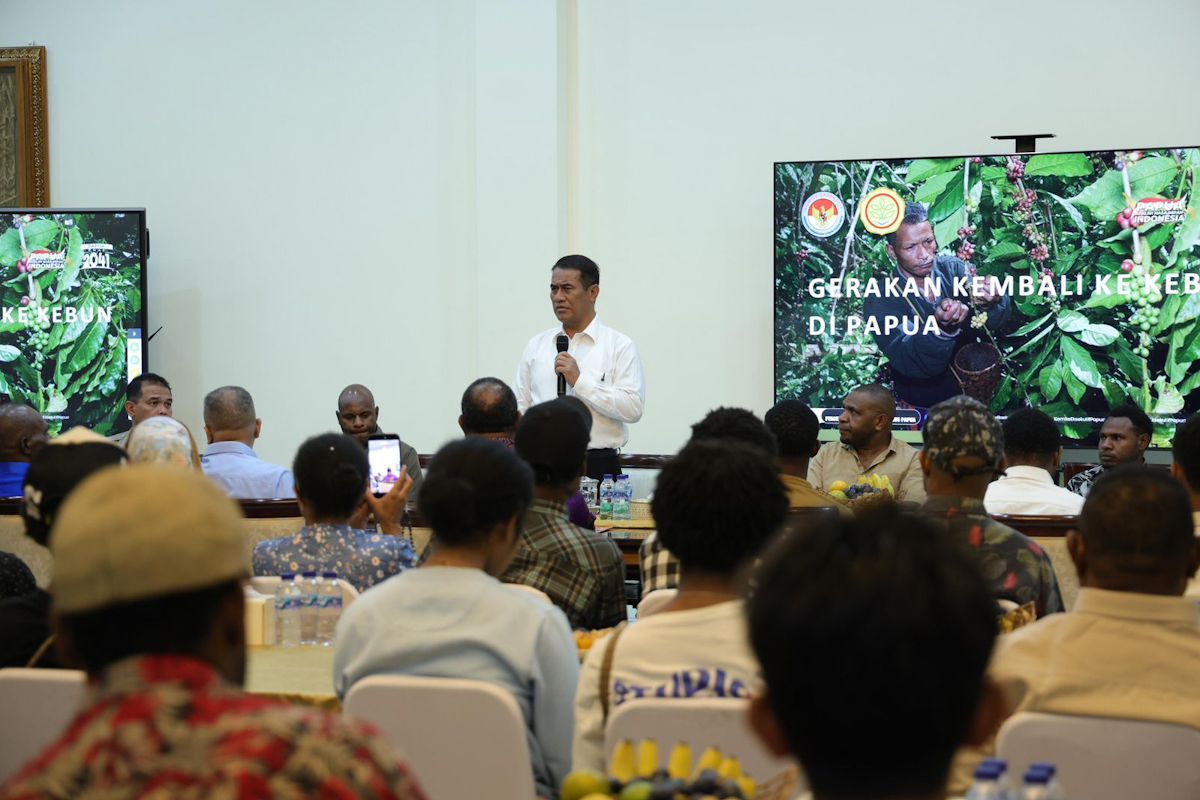
Papua’s rich agricultural heritage has the potential to play a bigger role in strengthening regional food security following a dialogue between Indonesia’s Minister of Agriculture and 150 Papuan university students, where discussions focused on a “Back to Farming” movement that aims to promote greater use of indigenous crops and locally adapted farming systems.
The meeting, held as part of the government’s broader agricultural development agenda, stressed that Papua’s future food resilience should be built on its own ecological strengths, rather than relying on production models developed elsewhere. Officials pointed to strategic commodities such as sweet potato, sago, cocoa, coffee, nutmeg and livestock as sectors that could support both household food security and long-term rural economic growth.
The dialogue was symptomatic of a growingly important shift in Indonesian agricultural policy in its embrace of regional diversity. Rather than a one-size-fits-all approach to farming across the archipelago, policymakers emphasised that development approaches must be adapted to local geography, climate, culture and traditional agricultural knowledge.
For Papua, a region where indigenous communities have been growing local crops for generations, many experts believe this approach comes with opportunities to marry traditional farming methods with modern agricultural technology.
Agriculture Designed Around Papua’s Natural Advantages
One of the key messages conveyed during the discussion was that the development of agriculture should respect the environmental characteristics of Papua.
“Rice is still the main staple food in Indonesia, but each region has different agricultural advantages,” the minister said. In the Papua Pegunungan (Papua Highlands), much of the landscape is characterised by cooler temperatures and mountainous terrain, and sweet potato has long been a significant staple food that is still well suited to the local conditions.
Hence, officials emphasised that food security does not necessarily require all regions to produce the same commodities. Instead, by increasing the production of locally adapted crops, a more resilient national food system can be created while preserving regional food traditions at the same time.
The discussion also emphasised the need to expand the growing of sago, a tough crop that is integral to Papuan culture, along with commercially important commodities such as coffee, cocoa and nutmeg, which already generate income in several districts.
A Dialogue with Papua’s Young Generation
The appointment of 150 Papuan students was interpreted as a sign of the government’s desire to involve the younger generation in the process of shaping the future of agriculture.
The conversation wasn’t about agriculture as just manual labour but its increasing importance in a modern economy shaped by technology, entrepreneurship, environmental sustainability and value addition.
Students were encouraged to see agriculture not only as a food production sector but also as a sector that can create innovation, employment and business opportunities.
Officially, educated youth are seen to have a crucial role to play in the introduction of improved farming techniques, digital marketing, agribusiness management and sustainable land-use practices that can boost rural economies.
The exchange also allowed students to share their views on challenges facing agriculture in their home regions, such as market access, transportation, infrastructure, financing and human resource development.
Sweet Potato Remains Central to Highlands Food Systems
Of the commodities discussed, sweet potato received particular attention due to its long-standing importance in the Papua Pegunungan.
Indigenous peoples have grown many different kinds of sweet potato for centuries, suited to different elevations and climates. As well as being a staple food, the crop also supports traditional livestock systems, especially pig farming, which is a culturally and economically important activity in many highland communities.
Agricultural specialists generally view sweet potatoes as well adapted to mountain environments due to their adaptability and relatively short growing cycle.
“Future agricultural programmes in the Papua Pegunungan will continue to focus on crops that suit local ecological conditions rather than replacing existing food traditions,” said government officials.
This approach mirrors broader international debates on food security, where the maintenance of locally adapted food systems is increasingly recognised as an important element of sustainable development.
Diversifying Agriculture Beyond Staple Foods
Food crops are still important, but the dialogue also looked at opportunities to boost Papua’s plantation and horticulture sectors.
The unique quality of coffee production in Papua Pegunungan is gaining recognition, while cocoa production continues to generate income for farming communities in various regions.
Similarly, improving cultivation and post-harvest processing can unlock the export potential of nutmeg, a spice long associated with eastern Indonesia’s trade.
“Diversified agriculture reduces dependency on a single commodity and increases household resilience to market fluctuations and climate variability,” officials said.
Livestock development was also considered an important complement to crop production, contributing to nutrition, household income and integrated farming systems.
Linking Agriculture with Rural Development
Agricultural development has implications far beyond food production, say experts.
Better farming productivity can generate demand for transportation services, local markets, processing industries, storage facilities, financial services, and small businesses throughout the rural community.
Higher agricultural output can also lead to investment in roads, irrigation, digital connectivity and logistics infrastructure that serve multiple sectors at the same time.
Stronger rural economies could help drive wider regional development for Papua, where agriculture remains an important source of livelihood, while providing opportunities for younger generations to stay in their home communities.
Officials also emphasised the need to strengthen farmer organisations, agricultural cooperatives and extension services capable of transferring technical knowledge to producers.
Combining Traditional Knowledge with Modern Innovation
A constant message that emerged from the dialogue was the importance of combining scientific innovation with indigenous knowledge of agricultural practices.
Papuan communities have generations of experience in managing local crops in a variety of environmental conditions. Rather than supplanting these traditions, policymakers argued that modern agricultural research should complement existing knowledge.
Better seed varieties, better soil management, climate change adaptation, digital farming tools and better post-harvest handling could all increase productivity while maintaining ecological sustainability.
Researchers are increasingly recognising that combining traditional methods with contemporary technology often results in more robust agricultural systems, especially in areas susceptible to environmental impacts.
Challenges Remain
Papua’s agricultural development has a lot of potential, but it still has to face many challenges.
Mountainous terrain, limited transport infrastructure, high logistics costs, fragmented markets and variable internet connectivity all impact the ability of farmers to scale up production and reach wider markets.
Climate change also requires careful planning to ensure long-term sustainability.
Agricultural economists say sustained investment in rural infrastructure, irrigation, extension services, education and agricultural finance will be critical to translate production potential into tangible gains in household welfare.
As agriculture moves towards more technology-driven approaches, the involvement of universities and young professionals may also be becoming increasingly important.
Looking Ahead
The conversation between Indonesia’s Minister of Agriculture and 150 Papuan students points to increasing attention to locally adapted food systems as part of Papua’s long-term development. The initiative’s focus on indigenous crops like sweet potato and sago, as well as high-value commodities such as coffee, cocoa and nutmeg, indicates an approach that aims to boost food security while leveraging Papua’s unique environmental and cultural advantages. The cooperation between government institutions, universities, researchers, local communities and farmers will continue to be necessary to guarantee that agricultural development is productive, sustainable and meets the needs of each region.
Conclusion
The proposed “Back to Farming” movement demonstrates a method of agricultural development that prioritises local strengths over generic solutions. The initiative could foster continued cultivation of crops well adapted to the varied landscapes across Papua, supporting rural livelihoods, strengthening household food security and preserving indigenous agricultural traditions. Locally based agriculture has the potential to be an increasingly important driver of inclusive and sustainable economic development across Papua, if coupled with continued investment in infrastructure, farmer training, research and market access.