
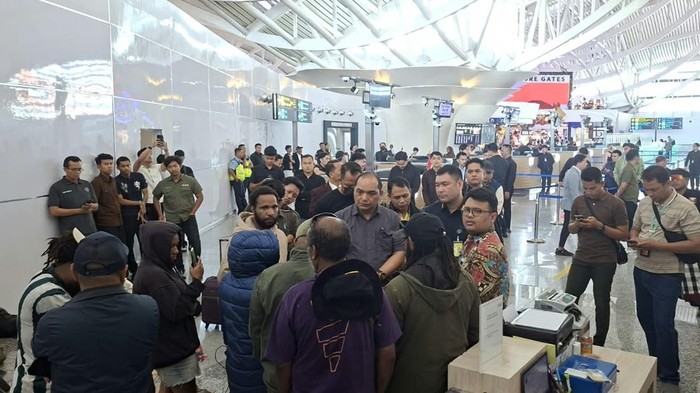
Immigration officers disrupted a planned journey by 12 members of the United Liberation Movement for West Papua (ULMWP) to Vanuatu at I Gusti Ngurah Rai International Airport on November 27, 2026, by referring the group for additional checks and withholding several travel documents. The incident has drawn attention to Indonesia’s efforts to safeguard national sovereignty, the activities of overseas political networks, and the importance of transparent immigration procedures.
The delegation, led by ULMWP Secretary Markus Haluk, was scheduled to travel from Denpasar to Port Vila through Sydney aboard Jetstar Airways. Its stated purpose was to attend a reconciliation and reunification meeting involving ULMWP representatives in Vanuatu. However, the journey did not proceed as planned after passport checks at the airport’s immigration area resulted in a prolonged examination.
The Indonesian military subsequently confirmed that six of the 12 travellers had been prevented from continuing their journey. Major General Rio Firdianto, Assistant for Intelligence to the Commander of the Indonesian National Armed Forces (TNI), said the six were identified by the military as members of the Papua independence movement and were due to attend the ULMWP meeting in Vanuatu.
Rio said the planned overseas activity raised concerns about the potential use of the gathering to advance political narratives concerning Papua. At the same time, Human Rights Minister Natalius Pigai offered a different explanation, describing the incident as an error by immigration personnel rather than a formal travel ban.
The contrasting accounts have made the case more than a routine airport incident. It has become a test of how Indonesia balances national security considerations, immigration authority, political activity and the rights of citizens to travel abroad.
How the Airport Incident Unfolded
Check-in was completed, but passport screening raised questions
According to accounts provided by the delegation and reported by BBC News Indonesia, the 12 travellers had completed airline check-in and received boarding passes for the Denpasar-Sydney-Port Vila route. They also said their baggage had passed the airport screening process without difficulty.
The group maintained that its members had valid passports, visas issued by the Vanuatu government and invitations to attend the planned reconciliation and reunification meeting.
The difficulty emerged during immigration clearance. Several passports reportedly could not be processed through the airport’s automated immigration gates. The travellers were consequently directed to manual counters for further examination.
Markus Haluk said immigration officers collected the group’s passports and boarding passes before taking the documents to a separate room. The officers reportedly explained that they needed to consult senior officials before allowing the travellers to proceed.
The delegation said it was initially unclear why the documents had been taken or how long the examination would last. According to its account, only two people were initially permitted to continue, while the passports of the other ten were retained.
After members of the group raised objections, four additional travellers were reportedly allowed to retrieve their documents. However, the delegation said that six people who had initially received permission to proceed were subsequently stopped again at the departure gate.
As a result, none of the 12 completed the planned journey to Vanuatu.
The sequence was described differently in the military’s subsequent account. Rio said the immigration authorities had delayed the departure of six of the 12 travellers. He identified the six as Markus Haluk, Samuel Awom, Habel Nawipa, Jefry Wenda, Samuel Womsiwor and Helena Murib.
The distinction matters. The initial disruption affected the entire group through additional checks and delays, but the TNI’s public explanation specifically referred to six individuals whose departure had been postponed.
Tensions increased as supporters arrived
The situation continued into the night. According to Rio’s account, the 12 Papuans were at the immigration counter for passport checks before a gathering developed in the departure area at around 10.30 p.m. local time.
The group reportedly questioned the reason for the travel delay and sought clarification from immigration officials.
Rio said the 12 remained in front of the international departure immigration office until approximately 11.49 p.m. He further stated that around 50 Papuans arrived at the airport at approximately 1.20 a.m. on November 28 and entered the international departure terminal.
The military intelligence official warned that the situation could potentially develop into a larger gathering, disrupt airport activities and attract wider public and international attention if not handled appropriately.
His remarks reflected the security authorities’ concern that a local administrative dispute could expand into a public order issue. Airports are critical national infrastructure, and authorities have a responsibility to maintain safe and orderly operations while ensuring that disputes are handled through proper channels.
Nevertheless, the airport management said the incident did not disrupt flight operations or the wider functioning of the facility.
Gede Eka Sandi Asmadi, Head of the Communication and Legal Division at I Gusti Ngurah Rai International Airport, said the airport had coordinated with relevant agencies following reports about the passengers who had been unable to depart.
He confirmed that airport services continued normally and urged passengers to maintain order and comply with applicable regulations.
TNI Explains Its Security Concerns
Six travellers identified by military intelligence
The TNI’s explanation provided a security dimension to the incident. Rio Firdianto said six of the 12 travellers had been identified as members of the Papua independence movement and were scheduled to attend a ULMWP reconciliation meeting in Vanuatu.
According to Rio, the planned overseas activity indicated the potential for issues involving the group’s activities outside Indonesia, particularly in relation to the political agenda surrounding the meeting.
He also warned that the incident could be used to construct a narrative portraying the authorities as restricting the movement of Papua-related political groups. Such a narrative, he said, could attract attention from supporters and networks both inside and outside Indonesia.
His comments highlighted the importance that Indonesian security institutions attach to the international dimension of the Papua issue. Political developments involving Papua are not confined to the country’s domestic political environment. They can also involve advocacy networks, regional organisations and diplomatic engagement in the Pacific.
Vanuatu has particular significance in this context. ULMWP was established there in 2014 through an initiative intended to bring together several pro-independence organisations. Its activities have since become part of the broader international debate surrounding Papua.
For Indonesia, the existence of overseas advocacy networks presents a diplomatic and political challenge. The government seeks to maintain its territorial integrity while engaging with regional partners and communicating its position on Papua’s political and development trajectory.
However, the TNI’s assessment of potential political activity should not automatically be treated as proof that the planned meeting constituted an unlawful act or a direct threat to national security. The available reports do not establish that the travellers committed a criminal offence. Any formal restriction on their movement must therefore be distinguished from a security assessment or political concern.
The government’s position requires clear institutional communication
The incident also prompted a response from Human Rights Minister Natalius Pigai. In a public statement reported by BBC News Indonesia, Pigai said there had been no formal travel ban or superior-level order to prevent the delegation from leaving Indonesia.
Instead, he described the incident as an error by immigration personnel in Bali.
“There was no court decision and no order from a superior at the ministerial level. It was an error by our staff and field officials, namely immigration officers in Bali,” Pigai said in a statement posted on Saturday, November 28.
He added that other possible technical errors needed to be examined.
Pigai’s explanation is important because it introduces a distinction between the security concerns expressed by the TNI and the administrative actions taken by immigration officers. While the military described its assessment of the delegation’s political activities, the minister indicated that the airport incident should not be interpreted as a formal government decision to prohibit the group’s travel.
This distinction is relevant for public confidence. National security and sovereignty are legitimate responsibilities of the state, but administrative decisions affecting citizens must also be grounded in clear authority and communicated properly.
An explanation from the relevant immigration leadership is therefore essential to establish precisely why the passports were referred for further examination and what legal or administrative status applied to the six individuals.
ULMWP’s Stated Purpose and the International Dimension
The delegation said its intended destination was Port Vila, where it planned to attend an internal reconciliation and reunification process involving ULMWP representatives.
Markus Haluk explained that the meeting was intended to bring together Papuans living overseas, including people involved in armed and political movements, to discuss political issues and the future of Papua through a political process.
He described the planned gathering as an effort to pursue reconciliation and reunification within the organisation.
The delegation also maintained that its travel arrangements had been completed properly. It said the members held valid travel documents, Vanuatu visas and official invitations from the Vanuatu government.
These claims were central to the objections raised by the delegation and its legal representatives. They argued that the group had fulfilled the ordinary administrative requirements for international travel and should have received a clear explanation if any restriction applied.
The political significance of the planned meeting, however, cannot be separated from the broader relationship between Indonesia and Vanuatu. Papua has been an issue of diplomatic discussion in parts of the Pacific, where historical, cultural and Melanesian connections have shaped regional interest in the territory.
Indonesia has consistently maintained that Papua is an integral part of the Republic of Indonesia. Its approach to the issue includes diplomatic engagement, domestic governance, economic development and security measures aimed at maintaining stability.
In this environment, overseas political meetings can attract considerable attention. They may influence international perceptions, generate advocacy campaigns and become subjects of discussion among regional governments and civil society organisations.
For Jakarta, the challenge is to respond to such developments through effective diplomacy, accurate public communication and lawful institutional procedures. A response that is transparent and consistent with the law can strengthen Indonesia’s credibility when addressing international questions about Papua.
Legal Questions and the Need for Transparency
The delegation’s representatives raised concerns about the legal basis for the travel delay. Ignatius Rhadite, Head of Advocacy at the Indonesian Legal Aid Foundation’s Bali Legal Aid Institute (YLBHI-LBH Bali), said the group had been left without a sufficiently clear explanation from immigration officials.
The legal representatives referred to Article 16 of Indonesia’s Immigration Law, Law No. 6 of 2011. As cited in the BBC report, the provision sets out circumstances in which immigration officers may refuse a person permission to leave Indonesia, including when the person lacks valid travel documents, when a competent authority requests action for an investigation or inquiry, or when the person’s name appears on a prevention list.
Rhadite argued that the delegation’s circumstances did not meet those conditions. He called for written clarification of the reasons for the action and the legal authority behind it.
The delegation also demanded information about its immigration status and sought permission to reschedule its journey.
These objections represent the position of the legal representatives, rather than a judicial determination that the immigration action was unlawful. The relevant authorities must provide the information necessary to establish the facts and allow the matter to be assessed under Indonesian law.
A later report by Jubi said the delegation met the head of immigration at Ngurah Rai Airport on Saturday afternoon, with mediation from a staff member of the Human Rights Ministry. According to Markus Haluk’s account of that meeting, the airport immigration chief said the passport status of six members had been flagged by the Directorate General of Immigration.
The meeting represented a further step in seeking clarification, although the delegation continued to request a definitive explanation and formal certainty about the restriction.
A written account from the immigration authorities would help resolve the remaining questions. It should identify the applicable administrative basis, the authority responsible for the decision and whether the measure was temporary or part of a formal prevention process.
Such clarity would serve both national interests and the rights of the individuals involved.
Why the Case Matters for Indonesia’s Papua Policy
The incident illustrates the complex relationship between sovereignty, political advocacy and the management of Papua-related issues in the international arena.
Indonesia has a legitimate interest in monitoring activities that may threaten national security or territorial integrity. Its institutions are responsible for assessing risks, maintaining public order and ensuring that international travel complies with applicable regulations.
At the same time, the credibility of those responsibilities depends on the quality of institutional procedures. Decisions involving travel restrictions should be based on identifiable legal authority, applied consistently and explained to the affected individuals.
The case also demonstrates why security and diplomacy need to work together. A politically sensitive event at a major international airport can quickly attract domestic and overseas attention. If authorities fail to communicate the reasons for their actions, the resulting uncertainty may become a larger diplomatic and reputational issue.
Indonesia can address this problem by making sure that its immigration, security, and human rights agencies all give the same answers. This would help distinguish genuine security measures from administrative errors and prevent misunderstandings from escalating.
For Papua, the wider objective should remain the creation of stable conditions that allow communities to pursue education, economic opportunities and social development. National unity and public welfare are strengthened when security institutions operate professionally and citizens have confidence in the law.
Conclusion
The disruption of the ULMWP delegation’s planned journey to Vanuatu at Ngurah Rai Airport has exposed the intersection of security concerns, political advocacy and immigration administration. The TNI said six of the 12 travellers were identified as members of the Papua independence movement and that their planned overseas activity raised concerns. The Human Rights Minister, meanwhile, said the incident was an error by immigration personnel rather than a formal travel ban.
The competing explanations make a clear official account particularly important. Indonesia has the responsibility to protect its sovereignty and maintain public security, but those objectives are best served when every administrative measure is supported by transparent legal procedures.
The next steps should include a definitive explanation from the Directorate General of Immigration, clarification of the status of the six passports and appropriate communication with the affected travellers. Such action would help prevent the incident from becoming a prolonged political controversy.
Indonesia’s position on Papua will depend on its commitment to territorial integrity and the professionalism of its institutions. A firm approach to national security, combined with respect for the rule of law and effective diplomacy, offers the strongest foundation for maintaining public confidence and advancing stability across the country.
Read Also
Why ULMWP Remains an MSG Observer
Fractures Within ULMWP and OPM: Why Papuans Reject Empty Rhetoric and Embrace Indonesia’s Path to Progress

