
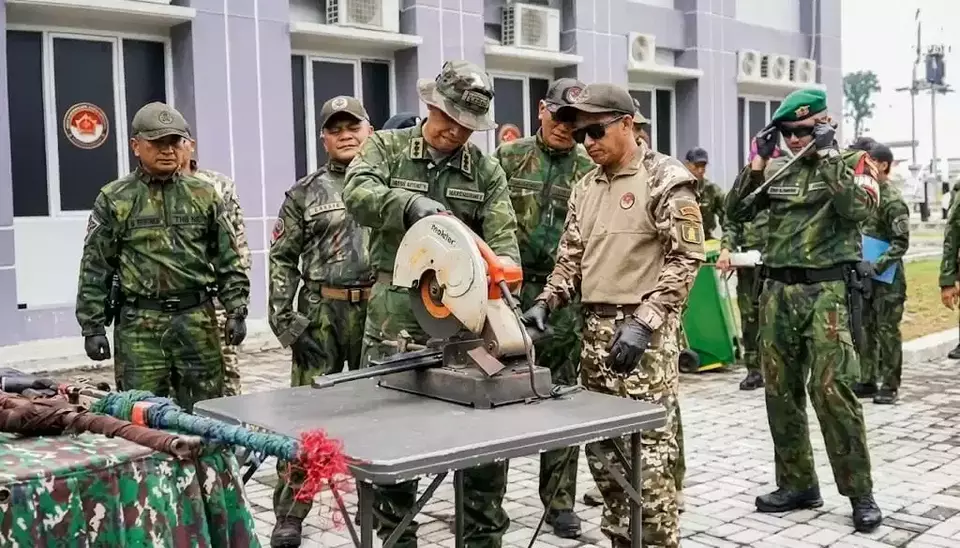
The destruction of dozens of firearms and bladed weapons seized from armed groups, including the West Papua National Liberation Army of the Free Papua Movement (TPNPB OPM) in Papua marks another effort by Indonesia’s military to reduce the threat posed by illegal weapons and strengthen public security in the region. The operation, conducted by the Joint Regional Defence Command III (Kogabwilhan III), followed successful weapons seizures by three military task forces in separate areas of Papua.
The weapons had been secured by personnel from Infantry Battalion Task Force 200, Infantry Battalion Task Force 623, and Task Force 744 under the Habema Operations Command. Before the destruction took place, Kogabwilhan III also recognized soldiers from the three units for their role in recovering the weapons.
Lieutenant General Lucky Avianto, Commander of Kogabwilhan III, said the seized firearms and bladed weapons were believed to have been used in acts of violence, including attacks against local communities and Indigenous Papuans. He stressed that leaving such weapons in the hands of armed groups could expose civilians to further danger.
The destruction was therefore intended to ensure that the recovered weapons could no longer be used. It also carried a broader message from the military leadership: armed violence should end, and those still involved in armed groups should consider surrendering and returning to civilian life.
Three Task Forces Behind the Weapons Seizures
The weapons destroyed by Kogabwilhan III were not collected through a single operation. They represented the results of activities conducted by three separate military task forces in three different areas.
The units involved were Infantry Battalion Task Force 200, Infantry Battalion Task Force 623, and Task Force 744 of the Habema Operations Command. All operated under the command structure of Kogabwilhan III.
According to Lucky, the three task forces had secured several firearms and other items during their respective operations. The seizures included weapons recovered from locations where they had allegedly been hidden, as well as weapons taken directly from armed group members during encounters with TNI personnel.
“We have seen the results of operations conducted by these three task forces in three different areas. Several weapons, along with other evidence, were seized,” Lucky said, as quoted by iNews on November 28, 2026.
The military reports did not provide a complete breakdown of the exact number of firearms recovered by each unit or identify all three operational locations. Nevertheless, the combined seizures were described as involving dozens of firearms and various types of bladed weapons.
The distinction between the two categories is important. The destruction involved not only firearms but also sharp weapons that, according to the military commander, had been taken from armed groups during the operations.
The results also demonstrate the contribution of different units operating across Papua’s challenging geographical terrain. In a region where dense forests, valleys, and mountainous areas can complicate security operations, locating weapons caches requires information gathering, field assessment, and sustained coordination.
Weapons Hidden in Remote Forests and Mountainous Areas
One of the main challenges described by Lucky was the difficulty of locating weapons that had been concealed in remote parts of Papua.
According to his account, some firearms were hidden in areas far from major settlements, including dense forests, caves, valleys, hills, and mountainous terrain. Such locations can make weapons difficult to detect and allow them to remain outside the immediate reach of security personnel.
The military commander said the discovery of these weapons resulted from a combination of intelligence information, community reports, and field operations conducted by TNI personnel.
He specifically acknowledged information from Indonesia’s National Intelligence Agency (BIN), which he said contributed to identifying the locations where some weapons were being stored. Reports from residents living around the operational areas also helped provide information for further investigation.
The contribution of local communities is significant in this context. Residents who understand the geography and daily activities of their surroundings may be able to identify unusual movements or suspicious activity. When handled through appropriate channels, such information can help security personnel assess potential threats and determine where further investigation is required.
The military’s account also indicates that not all weapons were discovered in hidden storage locations. Some were reportedly seized directly from members of armed groups who became involved in armed encounters with TNI personnel.
This means the recovery process involved more than searching for concealed equipment. It also included weapons seizures during field operations, although the available reports do not provide the dates, precise locations, or detailed circumstances of each encounter.
Lucky said the operations followed earlier persuasive approaches and attempts to resolve the situation peacefully. According to him, those efforts had not received a positive response from the armed groups concerned.
The combination of intelligence-led activity, community information, and field operations ultimately enabled the three task forces to secure the weapons.
TNI Destroys Firearms and Bladed Weapons
After the weapons had been collected, Kogabwilhan III proceeded with their destruction to prevent them from returning to circulation.
The process involved cutting non-standard firearms and various bladed weapons using an electric angle grinder. The method physically damaged the weapons, making them unusable.
The destruction was preceded by an award ceremony for soldiers from the three task forces. Kogabwilhan III recognized their contributions in securing the weapons during operations in the three separate areas.
The recognition was intended to acknowledge the work of personnel involved in the recovery effort. It also highlighted the importance of coordination among military units operating under the command of Kogabwilhan III.
In his statement, Lucky said the weapons had previously been used in violent acts, including attacks against members of the public and Indigenous Papuans.
“Firearms and bladed weapons seized by TNI task forces under Kogabwilhan III had previously been used by armed extremist groups in acts of terror, violence, and killings against communities, including Indigenous Papuans,” he said, according to a statement reported by Holopis.
The statement reflects the military’s assessment of the threat posed by the recovered weapons. However, the available reports do not provide individual forensic findings linking each firearm to a particular incident. The claims about their previous use should therefore be understood as the commander’s account rather than a separately documented examination of every weapon.
For the military, removing these weapons from circulation is a preventive security measure. A firearm that is no longer usable cannot be returned to an armed group or transferred to another individual through the same channels.
The destruction also provides a public record of the military’s reported seizure results and its subsequent handling of the recovered equipment.
Lucky Avianto Urges Armed Groups to Surrender
Beyond the physical destruction of weapons, Lucky used the occasion to deliver a direct appeal to the leaders, members, and supporters of armed groups still operating in Papua’s forested areas.
He urged them to stop armed activities, lay down their weapons, and return to civilian life. He also encouraged them to work alongside the TNI and local communities in supporting Papua’s development.
“I once again appeal to the leaders, members, and supporters of armed groups who remain in the forests to surrender immediately, lay down their weapons, and return to the embrace of the motherland. Together with the TNI and the community, let us build Papua,” Lucky said, according to Holopis.
The appeal was accompanied by a warning that the military would continue to respond if armed groups carried out actions that threatened public safety.
Lucky said TNI personnel would take firm and measured action when circumstances required it, particularly in urgent situations. He emphasized that military operations must remain consistent with applicable laws and rules of engagement.
This distinction is important in understanding the military’s stated approach. The commander’s message combined an invitation to surrender with a commitment to respond to armed threats under the applicable legal framework.
For residents, the central concern is the reduction of violence and the restoration of conditions in which ordinary activities can continue without fear. Security operations are most meaningful when they contribute to safer communities, protect civilian lives, and create space for public services and economic activity.
Public Safety at the Centre of Papua’s Security Agenda
Lucky also referred to the Latin legal principle salus populi suprema lex esto, commonly translated as “the welfare or safety of the people is the supreme law.”
He presented the principle as a guiding value for soldiers carrying out security duties in Papua. In his view, the protection of civilians must remain the central consideration when dealing with armed threats.
The emphasis on public safety is particularly relevant in Papua, where security challenges can affect more than the immediate locations of military operations. Violence and the presence of illegal weapons can create uncertainty for residents, disrupt local economic activity, and complicate access to public services.
Markets, schools, transport routes, and community facilities all depend on a reasonably secure environment. When residents feel unsafe, daily activities can be affected, while businesses may face additional difficulties operating in areas exposed to security incidents.
For this reason, efforts to reduce the circulation of firearms have implications beyond military objectives. They are also connected to the wider goal of maintaining conditions that allow communities to participate in education, employment, and regional development.
However, the destruction of seized weapons alone cannot resolve all security challenges. Long-term progress also requires effective law enforcement, reliable intelligence, cooperation with local communities, and opportunities for individuals to disengage from armed activity.
Lucky’s appeal for surrender and reintegration into civilian life therefore represents an important part of the message delivered by Kogabwilhan III. It suggests that the military’s stated objective is not limited to removing weapons but also includes encouraging an end to armed confrontation.
Security Operations and the Future of Papua
The latest action by Kogabwilhan III demonstrates how weapons recovery can form part of a broader security strategy in Papua. The involvement of three task forces, the use of intelligence information and community reports, and the eventual destruction of the seized equipment all point to a coordinated effort to prevent illegal weapons from remaining available to armed groups.
The recognition given to the soldiers also underlines the importance of operational cooperation among military units. In geographically difficult areas, the ability to combine information, field experience, and coordination can be essential to achieving security objectives.
At the same time, the next phase will be measured by whether the operations contribute to a sustained reduction in violence. Authorities will need to continue assessing security conditions, investigating weapons-related incidents, and ensuring that military actions comply with applicable laws and rules of engagement.
The role of local communities will remain equally important. Residents should be able to report credible security concerns through safe and appropriate channels, while authorities must handle information responsibly and distinguish verified reports from unsubstantiated allegations.
Papua’s long-term development also depends on maintaining a balance between security measures and the broader needs of its population. Infrastructure, education, healthcare, and economic opportunities are more difficult to strengthen when communities face persistent insecurity.
A safer environment can help create the conditions needed for these priorities to advance. But lasting stability will require consistent public institutions, community trust, and practical pathways for peaceful participation in society.
Conclusion
The destruction of dozens of firearms and bladed weapons by Kogabwilhan III represents a significant outcome of operations conducted by three TNI task forces in separate areas of Papua. The seizures, which the military said were supported by intelligence information and reports from local residents, were followed by recognition for the soldiers involved and the physical destruction of the recovered weapons.
Lieutenant General Lucky Avianto warned firmly against armed violence while appealing for surrender and peaceful reintegration. The lasting significance of the operation, however, will depend on whether it helps reduce threats to civilians and supports more stable conditions across Papua.
Ultimately, the removal of illegal weapons is one part of a wider effort to protect communities. Sustained security, respect for the law, public cooperation, and opportunities for peaceful development will be essential to building a safer and more prosperous future for Papua.
Read Also
TNI Clash in Paniai Leaves TPNPB OPM Member Niko Gobai Dead
TPNPB OPM’s Violence and TNI’s Humanitarian Approach in Papua

