
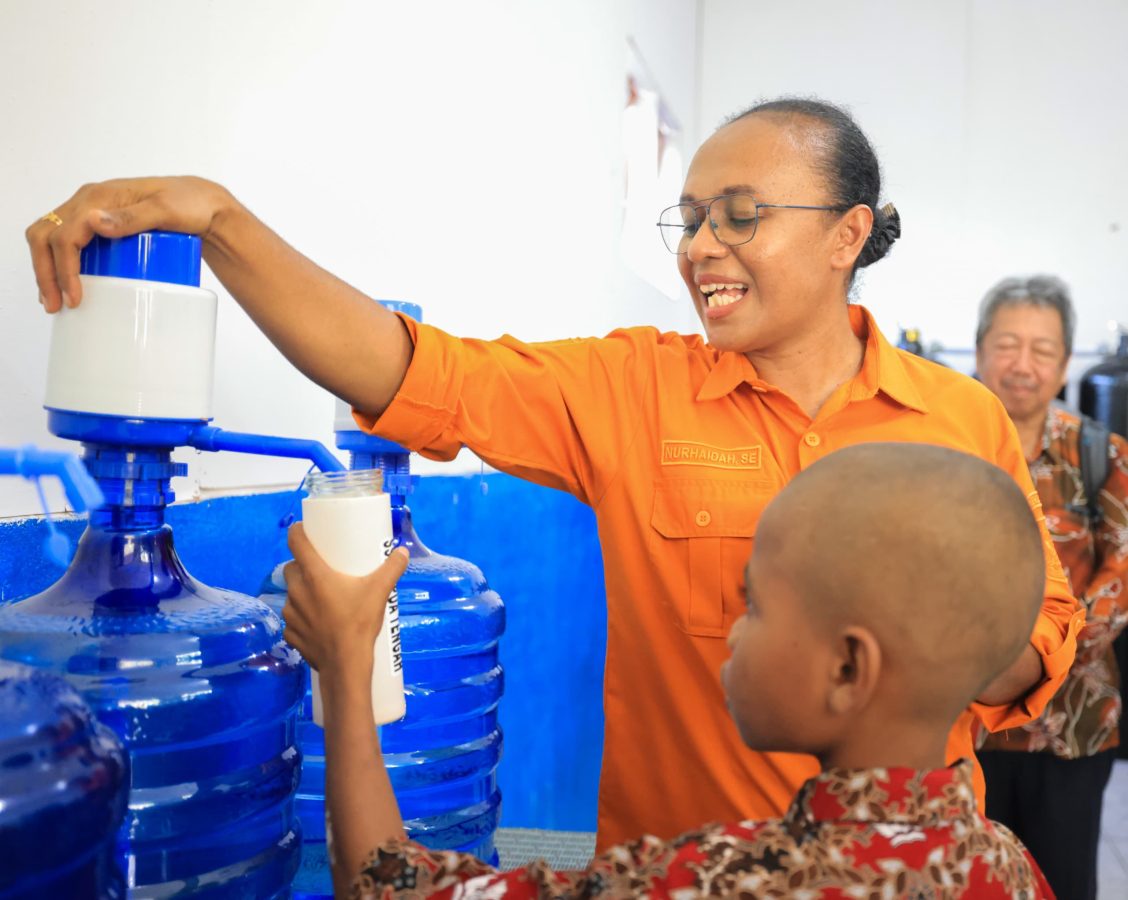
Access to safe drinking water is a basic need that can shape a child’s experience at school. In Papua Tengah (Central Papua), the provincial government is addressing that need through a new drinking water facility at SD YPK Mara Hariti, located in Kampung Hariti, Moora District, Nabire Regency. The initiative is part of the government’s broader effort to improve educational facilities in remote and island communities.
The facility was officially inaugurated on November 20, 2026, by Nurhaidah, Head of the Papua Tengah Provincial Education and Culture Office. Developed as part of the Sekolah Sepanjang Hari (SSH), or All-Day School programme, the facility is intended to ensure that pupils have access to drinking water while taking part in school activities.
The inauguration was more than a ceremonial addition to the school’s infrastructure. It addressed a practical challenge faced by communities in remote parts of Papua Tengah, where access to clean water remains difficult in some villages.
Nurhaidah said the provision of safe drinking water was part of the government’s responsibility to fulfil children’s rights and create a healthy, safe and comfortable learning environment.
She also delivered a direct message to school administrators: pupils should not be restricted from accessing the drinking water, even when they need to refill their containers several times.
The initiative reflects a broader understanding of educational development. A school needs more than classrooms and teachers. Children also require basic facilities that support their health, comfort and ability to learn throughout the day.
A New Water Facility Opens in Kampung Hariti
The facility was inaugurated at SD YPK Mara Hariti in Kampung Hariti, Moora District, Nabire Regency, on November 20, 2026.
Nurhaidah led the inauguration, accompanied by Dr Agus Irianto Sumule, a member of the SSH programme team from the University of Papua (Unipa). Representatives from the Nabire Regency Education Office, school administrators, teachers and pupils also attended the event.
The ceremony was marked by a ribbon-cutting, followed by a direct inspection of the drinking water facility. Pupils and members of the Kampung Hariti community welcomed the new infrastructure.
The inauguration represented the completion of an important supporting facility for the school’s all-day education programme. Rather than treating drinking water as an additional convenience, the provincial government has placed it among the basic requirements needed to support students during their time at school.
According to the Papua Tengah Education and Culture Office, the facility was provided to help meet pupils’ drinking water needs in an area where access to clean water remains a challenge.
The government expects the new installation to support daily school activities and contribute to a healthier learning environment.
A commitment to children’s access to water
In her remarks, Nurhaidah emphasised that the availability of safe drinking water is essential to creating a healthy, safe and comfortable school environment.
She said the government remained committed to improving educational infrastructure, particularly in island communities and remote areas.
Her message also focused on the public nature of the facility. The water infrastructure was built using state funds and should therefore be used optimally for the benefit of the community, especially children.
“The clean water facility was built using state funds, so its use must be optimised for the community, particularly children as the future generation of regional development,” Nurhaidah said, as quoted by ANTARA.
She also asked school administrators not to limit pupils who wanted to collect drinking water, including those who needed to refill their bottles more than once.
The instruction is significant because the availability of infrastructure does not automatically guarantee that students can use it freely. Proper management and a clear commitment from school administrators are necessary to ensure that the facility serves its intended beneficiaries.
The Education and Culture Office said it would monitor the use of the facility to help ensure its continued operation.
Supporting the School All-Day Programme
The drinking water facility is part of the provincial government’s Sekolah Sepanjang Hari programme, which seeks to expand educational access, improve literacy, and strengthen students’ independence and character development.
The SSH programme is one of the initiatives developed by the Papua Tengah provincial administration to improve educational opportunities in areas where geographical conditions can make public service delivery more difficult.
For schools in island and remote communities, providing a suitable learning environment requires attention to facilities beyond conventional classroom infrastructure. Water, electricity and internet access are among the supporting components identified by the SSH programme team.
The facility at SD YPK Mara Hariti therefore forms part of a wider effort to improve the conditions under which pupils learn and spend their school day.
ANTARA reported that the Moora school is one of 10 SSH schools established by the provincial government. The programme is intended to expand access to education while supporting literacy, independence and character education.
The integration of basic facilities into the programme reflects an approach that connects education with children’s wider welfare.
A student who has access to drinking water throughout the school day is better placed to meet basic hydration needs without depending entirely on bringing sufficient supplies from home. The facility also gives the school a practical way to encourage healthier daily habits.
Why Safe Drinking Water Matters in Education
Health, hydration and concentration
Dr Agus Sumule, chairman of the SSH team from the University of Papua, said water, electricity and internet access were important components of the all-day school concept.
He explained that access to safe drinking water could reduce the risk of diseases associated with contaminated water, help prevent dehydration and support students’ health and concentration during lessons.
The availability of drinking water can also help reduce children’s dependence on sweetened beverages.
These benefits are particularly relevant in schools where pupils spend extended periods participating in lessons and other educational activities. Drinking water is a basic requirement for maintaining normal bodily functions, and inadequate hydration can affect comfort and concentration.
Providing access within the school environment also makes it easier for children to develop regular drinking habits. Instead of waiting until they return home or relying on drinks purchased outside school, pupils can refill their containers during the day.
However, the long-term benefits depend on the facility being properly maintained and the water continuing to meet appropriate safety standards. Regular monitoring, maintenance and responsible management are therefore important parts of ensuring that the infrastructure remains useful.
A healthier alternative to sweetened drinks
The SSH team also highlighted the potential to reduce pupils’ dependence on sweetened beverages.
Making drinking water readily available can encourage children to choose water more frequently throughout the day. This supports the development of healthier habits from an early age.
Schools can reinforce the initiative through simple educational activities that explain the importance of hydration and responsible use of water facilities.
The availability of personal drinking containers can also help pupils make use of the facility more conveniently. Local media reported that students in Kampung Hariti received reusable drinking bottles to support the habit of drinking water.
Together, access to drinking water and health education can help make the facility part of everyday school life rather than simply an infrastructure project.
Addressing Infrastructure Gaps in Remote Papua
Clean water remains a challenge in some villages
Nurhaidah acknowledged that access to clean water remained a major difficulty for residents in several villages across remote and underdeveloped areas of Papua Tengah.
The challenge is particularly relevant to island communities, where geographical conditions can complicate the provision of basic infrastructure.
For schools in such locations, access to water cannot always be taken for granted. A lack of reliable facilities can affect hygiene, sanitation and the comfort of pupils and teachers.
The provincial government’s decision to include drinking water infrastructure in the SSH programme reflects recognition of these practical conditions.
Improving educational access in remote communities requires more than establishing schools. It also involves ensuring that facilities can support pupils’ everyday needs.
This is an important consideration for Papua Tengah, where communities are spread across a large and geographically diverse territory. Development programmes must account for local conditions rather than relying on a uniform approach.
The new facility in Kampung Hariti represents one local response to that challenge. Its significance lies in addressing a basic need within a school environment, while also demonstrating how provincial education programmes can incorporate health and welfare considerations.
Expanding similar facilities to other locations
The provincial Education and Culture Office has also developed similar drinking water facilities in Rifasi and Deiyai Regency, according to ANTARA.
Meanwhile, another ready-to-drink water facility in Kokonao, Mimika Regency, was scheduled for inauguration during the first or second week of December 2026.
These developments indicate that the initiative is not limited to SD YPK Mara Hariti. The provincial government is seeking to extend access to similar facilities in other locations, although the available reports do not provide a complete implementation schedule or a total number of schools that will receive installations.
The planned facility in Kokonao is particularly relevant because it would extend the initiative to another community in Papua Tengah.
The expansion of such infrastructure will require continued coordination between the provincial government, education offices, schools and technical partners. Ensuring that facilities remain functional after inauguration will be as important as completing their construction.
Cooperation Between Government and Academic Institutions
The development of the facility at SD YPK Mara Hariti involved the Papua Tengah Provincial Education and Culture Office and the SSH team from the University of Papua.
The involvement of an academic institution provides a technical and educational dimension to the programme. Dr Agus Sumule’s explanation of the relationship between water, electricity and internet access demonstrates that the SSH concept considers the broader conditions required for all-day learning.
Government institutions, meanwhile, are responsible for providing policy direction, allocating resources and overseeing implementation.
The inauguration was also attended by representatives from the Nabire Regency Education Office, school leaders and teachers. Their participation is important because the daily operation of the facility will depend heavily on local management.
The provincial government has said it will monitor the facility’s use to support its sustainability. This commitment is necessary to ensure that the infrastructure continues to serve pupils beyond the inauguration ceremony.
The experience in Kampung Hariti could also provide useful lessons for future installations, particularly in relation to maintenance, water quality monitoring and the management of access for students.
Education Development Must Include Basic Needs
The facility at SD YPK Mara Hariti highlights a wider point about educational development in Papua. Improving learning outcomes requires attention not only to teaching quality and curriculum but also to the environment in which children study.
Clean water, sanitation, electricity and internet access can all influence the quality of the school experience. In remote communities, gaps in these basic facilities may place additional burdens on pupils and teachers.
The SSH programme seeks to address some of these requirements through a more integrated approach. By connecting educational services with supporting infrastructure, the provincial government aims to improve the conditions in which children learn and develop.
For families in Kampung Hariti, the availability of drinking water at school offers a practical benefit during the school day. For teachers, it provides an additional facility that can support a healthier learning environment.
For policymakers, the initiative also illustrates the importance of ensuring that public investment reaches communities beyond major urban centres.
Conclusion
The inauguration of the ready-to-drink water facility at SD YPK Mara Hariti on November 20, 2026 marks a practical step in the Papua Tengah government’s effort to improve educational infrastructure in remote and island communities. Through the School All-Day programme, the provincial government has sought to address a basic need that directly affects pupils’ health, comfort and daily learning activities.
Nurhaidah’s instruction that schools should not restrict students from accessing or refilling drinking water reinforces the principle that public facilities must serve the children for whom they are intended. The Education and Culture Office’s commitment to monitoring the facility will be important in maintaining its usefulness over time.
The initiative also demonstrates how cooperation between government institutions and academic partners can support a more integrated approach to education. As similar facilities are developed in other locations, attention to water quality, maintenance and long-term operation will remain essential.
Ultimately, the success of the programme should be measured not by the inauguration ceremony alone, but by whether students can consistently access safe drinking water throughout their school day. For children in Kampung Hariti and other remote communities, such improvements can make the school environment healthier and more supportive of learning. A stronger education system begins not only with classrooms and teachers, but also with the basic conditions that allow every child to learn well.
Read Also
Papua Barat Daya Police Deliver Clean Water to Sorong
Merauke Receives 40,000 Litres of Clean Water

