
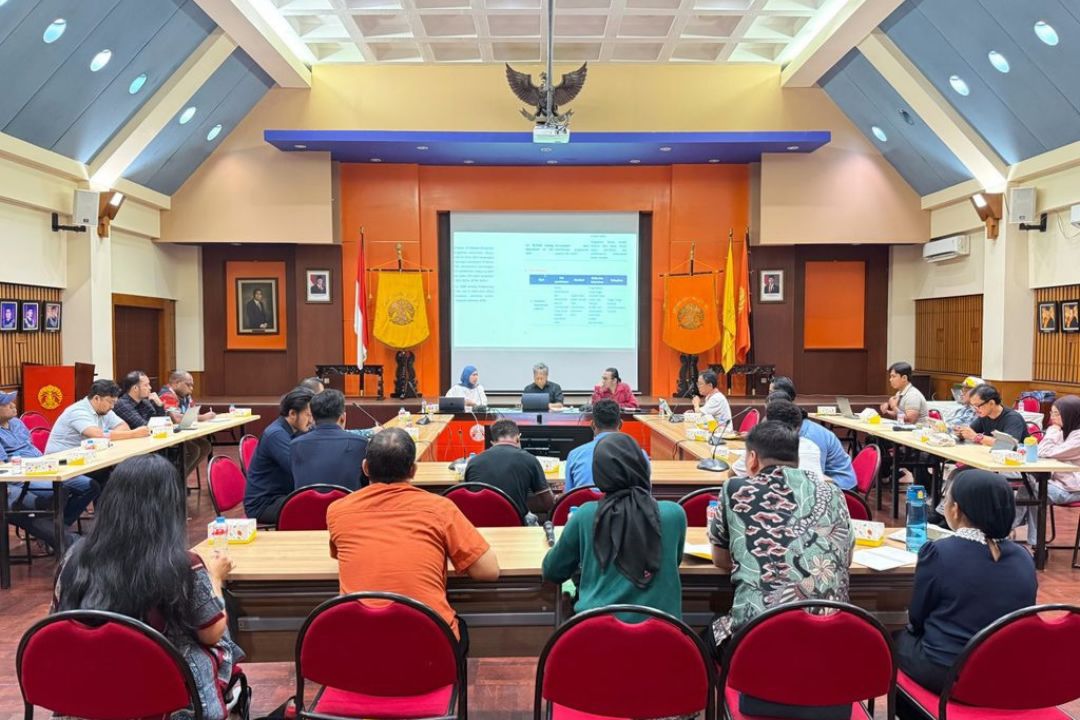
Understanding Papua’s future requires more than infrastructure plans, economic targets, or government policy documents. It also requires listening to the people who live there, examining the region’s social and cultural realities, and understanding how communities themselves define progress. That was the central message of a seminar organized by Papua Center (PACE) at the Faculty of Social and Political Sciences of the University of Indonesia (FISIP UI), which brought together academics, a national legislator, a researcher, and Papuan students to map the region’s strategic issues and anticipate challenges ahead.
Held on November 13, 2026, at the Juwono Sudarsono Auditorium at FISIP UI in Depok, the seminar and Focus Group Discussion (FGD) carried the title Reading Papua Today: Identifying Strategic Issues and Potential Future Challenges. The event was organized in cooperation with the university’s Centre for Ethnicity and Social Identity Studies (Puska EtnIS).
The discussions addressed several interconnected questions: how development should respond to local needs, how relations between government and communities can be strengthened, how natural resources should be managed, how Indigenous Papuans can sustain their cultural and social identities, and how political representation influences the region’s future.
The initiative comes at an important time for Papua. Indonesia’s regional administrative structure has changed following the establishment of new autonomous provinces, creating new responsibilities for local governments and increasing the need for coordination with national institutions. At the same time, development programs must respond to the region’s diverse geography, communities, and economic conditions.
By involving Papuan students alongside established researchers and policymakers, FISIP UI sought to broaden the discussion beyond institutional perspectives and bring lived experience into academic analysis.
Papua Center Brings Different Perspectives Together
The seminar was organized by the Papua Center, known as PACE, under FISIP UI, together with Puska EtnIS. Its purpose was to identify strategic issues affecting Papua and examine problems that could influence the region in the years ahead.
Three speakers represented different areas of expertise and public responsibility.
They were Dr. Yan Permenas Mandenas, a member of Indonesia’s House of Representatives for the 2024-2029 parliamentary period; Professor Bambang S. Laksmono, a professor of Social Welfare at FISIP UI; and Dr. Aisah Putri Budiatri, a researcher at Indonesia’s National Research and Innovation Agency (BRIN).
Their participation allowed the discussion to approach Papua from three complementary perspectives: public policy and political decision-making, social welfare and community development, and political and institutional research.
The topics were not treated as isolated problems. Development policy, relations between the government and communities, natural resource management, cultural continuity, and political representation are closely connected. Decisions in one area can influence outcomes in another.
For example, infrastructure projects can improve access to markets and public services, but their benefits depend on whether local communities are involved in planning and whether environmental consequences are properly considered. Similarly, economic growth may create new opportunities, but the distribution of those opportunities matters for the long-term welfare of Indigenous Papuans.
This broader approach was central to the seminar’s objective: producing a more comprehensive understanding of Papua rather than relying on a single indicator of development.
Understanding Papua Beyond Infrastructure
One of the most significant contributions came from Professor Bambang S. Laksmono, who argued that Papua should not be understood exclusively through the perspective of national development planning.
He emphasized the importance of history, culture, and the way Papuan communities understand welfare and quality of life.
“Papua cannot continue to be viewed only through the lens of Jakarta. We need to learn to understand Papua from the perspective of Papuan communities themselves, including how they interpret life and well-being,” Bambang said.
His remarks highlighted an important distinction in development policy. National infrastructure targets and economic indicators provide useful measures of progress, but they do not necessarily capture every dimension of community welfare.
For people living in different parts of Papua, development may be understood through access to education, healthcare, transportation, employment, and economic opportunities. It may also involve the preservation of customary land, cultural practices, social relationships, and the ability to participate in decisions affecting their communities.
This does not mean that infrastructure development should be set aside. Roads, bridges, schools, health facilities, and telecommunications networks remain important for improving connectivity and expanding access to public services.
Rather, the discussion suggested that physical investment should be accompanied by policies that strengthen human capacity, respect local circumstances, and ensure that communities can participate in shaping development priorities.
For policymakers, the situation presents a practical challenge: how to translate national development objectives into programs that reflect the different needs and aspirations of people across Papua.
Infrastructure Must Deliver More Than Physical Connectivity
Dr. Aisah Putri Budiatri of BRIN raised a related concern about development approaches that place too much emphasis on physical projects.
She used the Trans Papua Road as an example of infrastructure that can improve regional connectivity while also creating consequences for the environment and local communities if construction is not accompanied by sufficient participation and support.
The road network has the potential to improve connections between settlements, facilitate the movement of goods, and make access to public services easier. However, infrastructure projects in areas with distinctive ecological and customary characteristics require careful planning.
Aisah argued that development should extend beyond the construction of roads and buildings.
“Development should not stop at building roads, buildings, or physical infrastructure. Development must also build people, strengthen community capacity, and protect the environment in which they live,” she said.
Her remarks place human development and environmental sustainability alongside physical investment as important considerations in Papua’s future.
This is particularly relevant in areas where communities depend directly on forests, rivers, coastal resources, and customary territories for their livelihoods. Changes in land use and access to natural resources can affect economic activities, cultural practices, and community relationships.
A development strategy that takes these factors into account requires effective consultation, environmental assessment, and support for local communities. It also requires coordination between government agencies responsible for infrastructure, environmental protection, customary affairs, and economic development.
The discussion did not reject infrastructure development. Instead, it emphasized the need to ensure that physical projects produce benefits that extend to people and the environments in which they live.
Policy Implementation and Government Coordination
From the perspective of public policy, Dr. Yan Permenas Mandenas focused on the consistency of government implementation.
He argued that Papua’s development challenges are not necessarily caused by a lack of regulations or formal authority. Indonesia already has a range of legal frameworks and institutional responsibilities concerning development and governance in Papua.
The difficulty, he said, lies in ensuring that these policies are implemented consistently across government institutions, from the central administration to regional authorities.
“The problem in Papua is not primarily a lack of authority or regulations. The issue is the government’s consistency in implementing those rules, from the central level down to the regions,” Yan said.
His assessment drew attention to coordination and sectoral fragmentation, commonly described in Indonesia as ego sektoral. This occurs when government agencies pursue their institutional priorities without sufficient alignment with other departments.
Such fragmentation can affect the implementation of development programs. A project may have funding and formal approval but still encounter difficulties when agencies have different priorities, incomplete coordination, or overlapping responsibilities.
The issue is particularly important following the establishment of new autonomous provinces. New regional administrations need to develop their institutional capacity, coordinate with national ministries, and ensure that development programs are aligned with local needs.
Yan’s comments therefore highlighted the importance of accountability and consistency in public administration. Policy commitments must be followed by implementation, monitoring, and coordination if they are to produce measurable results.
For Papua, stronger coordination between national and regional institutions can help ensure that programs in education, healthcare, infrastructure, and economic development work toward connected objectives.
Indigenous Papuans, Natural Resources and Political Representation
Beyond infrastructure and government administration, the seminar examined issues concerning Indigenous Papuans, natural resource management, and political representation.
These topics are central to discussions about the region’s long-term development because Papua’s economic and social conditions are closely connected to its natural environment and customary structures.
Natural resources provide opportunities for economic development, investment, and employment. However, the way these resources are managed can influence local livelihoods, environmental sustainability, and the distribution of economic benefits.
The seminar’s discussion recognized the need to consider how development and resource management affect Indigenous communities and their ability to sustain their social and cultural life.
Political representation was another important theme. The ability of communities to express their interests through formal institutions and participate in decision-making can influence whether policies respond effectively to local circumstances.
In this context, the relationship between government institutions and communities is not simply a matter of administrative communication. It also concerns public trust, participation, and the extent to which residents can contribute to decisions affecting their future.
The discussion did not present a single solution to these issues. Instead, it sought to identify the connections between them and determine which areas require more detailed research.
That approach is valuable because Papua’s development challenges are complex and differ across provinces, districts, and communities. Policy responses therefore need to be informed by reliable evidence and an understanding of local conditions.
Papuan Students Bring Community Experience into the Discussion
One of the distinguishing features of the program was the involvement of students from Papua in the subsequent focus group discussion.
After the main seminar, PACE FISIP UI and Puska EtnIS continued the activity through an FGD involving several Papuan students.
The purpose was to gather their experiences, views, and interpretations of the issues raised during the seminar.
Their participation broadened the discussion beyond academic and institutional analysis. It introduced perspectives from younger Papuans who have their experiences of education, social change, and life in the region.
This was important because young people will be among those most directly affected by the long-term consequences of development decisions made today.
Their views can help researchers better understand how national policies are experienced at the community level, including questions of access to education, employment opportunities, cultural continuity, and political participation.
The involvement of students also reflects the potential role of universities as spaces for constructive dialogue. Academic institutions can bring together different perspectives, examine policy challenges, and provide opportunities for younger generations to contribute to public discussions.
Rather than treating students simply as participants in an academic event, the FGD sought to include their experiences as part of the process of identifying strategic issues.
Academic Research as an Input for Government Policy
At the conclusion of the activity, PACE FISIP UI and Puska EtnIS expressed the expectation that the seminar and FGD would produce a synthesis of strategic issues, identify relationships between different problems, and establish areas requiring further study.
The results are expected to provide input for government institutions, stakeholders, and other parties involved in understanding Papua and formulating policies that are more responsive to community needs.
This is an important function of academic research in public policy.
Government agencies have responsibility for developing and implementing programs, but effective policymaking also requires research, evaluation, and independent analysis. Universities can contribute by examining the effects of existing policies, identifying gaps in implementation, and presenting evidence that supports future planning.
For Papua, this role is particularly relevant given the number of interconnected development priorities facing the region.
The establishment of new autonomous provinces, for example, has increased the importance of institutional capacity and coordination. Economic development requires attention to investment, local participation, and natural resource management. Social development requires improvements in education, healthcare, and opportunities for Indigenous communities.
Academic research can help examine how these priorities interact and identify practical approaches that are suitable for different local conditions.
The FISIP UI initiative therefore provides an opportunity to connect academic discussion with the broader process of national and regional development planning.
Government Commitment and the Need for Evidence-Based Development
The issues raised during the seminar also have implications for the Indonesian government’s wider development agenda in Papua.
The government has continued to place regional development, public services, and the welfare of Indigenous Papuans among its policy priorities. These objectives require coordination between national ministries, provincial administrations, district governments, and community institutions.
However, the seminar highlighted that policy commitments alone are not sufficient. Their effectiveness depends on consistent implementation, local participation, and the ability to respond to the specific circumstances of each community.
The comments made by the three speakers offer complementary considerations for policymakers.
Bambang’s emphasis on understanding Papua through the perspectives of its people points to the importance of social and cultural context. Aisah’s analysis emphasizes the need to balance infrastructure development with human capacity and environmental protection. Yan’s remarks underline the importance of institutional coordination and consistent implementation.
Taken together, these perspectives suggest that improving welfare in Papua requires more than increasing public expenditure or completing physical projects. It also requires strong institutions, accountable governance, and a development process that recognizes the role of local communities.
For the government, the seminar’s findings could provide useful material for evaluating existing programs and identifying areas where policy implementation needs greater attention.
Papuan students’ participation also provides a chance to make the link between academic research and the lives of the next generation stronger.
Conclusion
The FISIP UI Papua Center seminar demonstrated the importance of bringing academics, policymakers, and Papuan students into the same discussion about the region’s future. Its central message was that Papua’s development cannot be understood through infrastructure and economic indicators alone. History, culture, community welfare, environmental sustainability, political representation, and government coordination must also be considered.
The perspectives presented by Bambang S. Laksmono, Aisah Putri Budiatri, and Yan Permenas Mandenas highlighted different but interconnected challenges. Their analysis pointed to the need for development that strengthens people as well as infrastructure, protects the environment while managing natural resources, and translates government policies into consistent results. The participation of Papuan students added an important community perspective to the academic process.
For Indonesia, the challenge ahead is to connect these insights with practical action. National and regional governments will need to maintain coordination, strengthen local institutional capacity, and ensure that development programs respond to the circumstances of Indigenous Papuans and other communities across the region.
The seminar itself does not constitute a government policy decision or guarantee that all recommendations will be adopted. Its value lies in providing a structured space for analysis and identifying issues that deserve further attention.
Ultimately, a more sustainable future for Papua will depend on the ability of government institutions, universities, and communities to work together. By combining evidence-based policymaking with meaningful participation and respect for local realities, Indonesia can continue working towards development that delivers not only physical progress but also broader opportunities, stronger public services, and improved welfare for the people of Papua.
Read Also
Papua Pegunungan Inaugurates 11 Special Autonomy MPs
Papua Special Autonomy in a Global Perspective

