
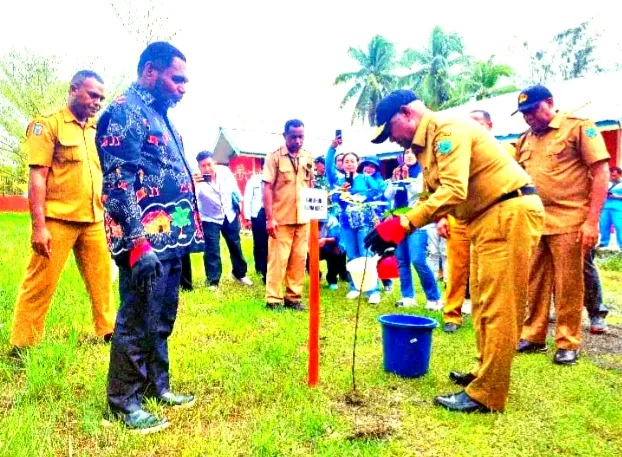
The planting of 600 matoa trees in Manokwari has brought government forestry officials and women’s organisations together in an environmental initiative that connects forest conservation with the preservation of Papua’s cultural heritage. The activity, reported by local media on November 15, 2026, reflects a broader effort by the Papua Barat (West Papua) Provincial Government to encourage the planting of matoa, a tree widely recognised for its fruit and its role in local life.
The initiative comes as the provincial government advances an ambitious target of planting one million matoa trees across Papua Barat. Led by Governor Dominggus Mandacan, the wider programme seeks to increase the availability of a native Papuan tree, encourage community participation in environmental protection and help ensure that future generations remain connected to an important part of the region’s natural heritage.
The involvement of the Forestry Department and women’s organisations adds a community dimension to the campaign. It demonstrates how environmental action can extend beyond government institutions, bringing together different groups to support greener neighbourhoods and a stronger conservation culture.
The local planting initiative serves a broader purpose.
The reported planting of 600 matoa trees in Manokwari represents a practical contribution to the province’s wider environmental agenda. By involving women’s organisations alongside the Forestry Department, the initiative also recognises the role community groups can play in encouraging environmental awareness and participation.
Tree planting is often presented as a straightforward activity: prepare the land, place seedlings in the soil and allow them to grow. In practice, however, the long-term value of such programmes depends on what happens after the planting event. Suitable locations, healthy seedlings, maintenance and community involvement are all necessary if young trees are to survive and mature.
Matoa is particularly relevant to this approach because it is not simply an ornamental plant. Its fruit has economic and cultural value, while the tree forms part of Papua’s natural landscape. Encouraging its cultivation can therefore connect environmental care with the preservation of local identity.
The 600 tree activity should also be understood within the broader provincial campaign rather than as an isolated event. Papua Barat has been encouraging government agencies, communities, religious figures and civil society organisations to take part in the restoration and planting of matoa across the province.
The governor launches a one-million-tree ambition.
The wider programme gained momentum on 14 August 2026, when Governor Dominggus Mandacan launched the movement to plant one million matoa trees across Papua Barat.
The launch took place at the arboretum in the grounds of the Papua Barat Governor’s Office in Arfai, Manokwari. It was marked by the governor’s planting of matoa seedlings alongside representatives of different faith communities.
Mandacan said the programme would be coordinated with the governments of the province’s seven regencies. Each regency would receive a planting target based on its potential and capacity, with the combined contribution expected to reach one million trees.
The governor also said the provincial government would prepare seedlings and seek support from development partners to ensure sufficient planting material was available.
He called on religious leaders, Indigenous communities, community organisations and other groups concerned about environmental protection to take part in distributing and planting the seedlings.
The approach is intended to make the programme a shared responsibility rather than an activity carried out solely by government agencies.
Mandacan also encouraged regency administrations to identify suitable land and provide supporting budgets. Local government involvement is important because the success of a province-wide planting campaign depends on conditions at individual planting sites.
Why Matoa matters to Papua
Matoa, scientifically known as Pometia pinnata, is a tree native to Papua and is widely associated with the region’s natural and cultural identity. Its fruit is valued for its distinctive taste and is commonly associated with local traditions and seasonal harvests.
For many Papuans, matoa is more than a fruit sold in markets. It is part of the natural environment familiar to generations of families and communities. Its presence in gardens and landscapes can also serve as a reminder of the relationship between local culture and the surrounding forest.
The tree has ecological significance as well. As part of tropical forest ecosystems, matoa can contribute to vegetation cover and provide resources for wildlife. Its fruit is consumed by various animals, while trees form part of the wider ecological structure of forested landscapes.
Prof. Charlie Danny Heatubun, Head of the Papua Barat Regional Research and Innovation Agency (BRIDA), highlighted these environmental and cultural dimensions in comments reported by RRI on 14 August 2026.
He described matoa as a native species of Papua, although not exclusive to the island. He also emphasised its contribution to tropical forest ecosystems, its value as a food source for wildlife and its economic and cultural importance for Indigenous communities.
His explanation provides a scientific perspective on why planting matoa can contribute to more than urban greening. It can also help maintain a connection between communities and the natural resources that form part of their regional identity.
Restoring a fruit that is becoming harder to find locally
One concern raised by Governor Mandacan during the launch of the one-million-tree programme was the apparent difficulty of finding matoa in Manokwari, particularly during the fruit season.
He observed that matoa products could be found in shopping centres in cities outside Papua, while supplies in the province itself were becoming less visible.
The contrast prompted his call for a coordinated planting campaign to restore the tree’s presence in its place of origin.
Mandacan said the government wanted matoa to grow more widely across Papua Barat so that future generations could continue to enjoy the fruit and benefit from its potential.
He also highlighted the fruit’s commercial reach. Matoa is already known beyond Papua, with products appearing in markets in Jakarta, Sulawesi, Java and Sumatra.
This creates an opportunity to connect conservation with local economic activity. If supported by appropriate cultivation, harvesting and market development, matoa could provide additional opportunities for farmers and households.
However, expanding the number of trees does not automatically create a commercial supply chain. Production depends on the time required for trees to mature, the quality of seedlings, growing conditions, harvesting practices and access to markets.
For that reason, the planting campaign’s environmental and cultural objectives remain important even before any measurable economic return is achieved.
Women’s organisations bring community participation into conservation
The involvement of women’s organisations in the 600 tree planting activity is an important aspect of the Manokwari initiative.
Environmental programmes often depend on participation at the household and community levels. Women’s organisations can help extend awareness beyond formal government activities by encouraging families and neighbourhood groups to take an interest in planting, maintaining and protecting trees.
Their participation also reflects the wider role of women in community development. Across many communities, women contribute to household food security, local economic activities, education and the transmission of cultural knowledge between generations.
In this context, environmental action can become another area in which organised women’s groups contribute to public life.
The planting of matoa offers an opportunity to connect these roles. Community members can help promote the value of native trees, encourage younger generations to recognise local plant species and support the maintenance of seedlings after planting.
The available report on the 600 tree activity does not provide the names of the participating women’s organisations or detailed individual statements from their representatives. It is therefore important not to attribute specific quotations or responsibilities to particular groups without further confirmation.
Nevertheless, their participation alongside the Forestry Department reflects the collaborative approach encouraged by the provincial government’s broader planting programme.
From planting ceremonies to long-term forest care
The long-term success of the 600 tree activity, as well as the wider one-million-tree target, will depend on sustained care.
Seedlings need suitable locations, sufficient water, protection from damage and regular monitoring. Without follow-up maintenance, even a well-attended planting event may produce limited results.
The provincial government has recognised the importance of local coordination by asking regency administrations to identify planting areas and support the programme through appropriate planning and budgeting.
The Forestry Department also has an important role in ensuring that planting activities are suited to local environmental conditions. Technical guidance on seedling quality, site selection and maintenance can help improve survival rates.
Community participation will remain equally important. Residents who are involved in planting and caring for trees may develop a stronger sense of responsibility for the areas around them.
A transparent monitoring system could further strengthen the programme. Recording the number of seedlings planted, their locations and their survival rates would provide a clearer picture of progress than counting planting events alone.
Such information could help authorities identify which areas require additional maintenance and where future planting should be prioritised.
Connecting conservation with local economic opportunities
Matoa also offers potential economic benefits that could complement its environmental and cultural value.
The fruit is already known in markets outside Papua. Greater availability could create opportunities for local growers, traders and small businesses involved in harvesting, processing and selling agricultural products.
In the longer term, matoa-based products may also contribute to local branding and the promotion of Papua’s natural resources.
Yet commercial development should be approached carefully. The expansion of production needs to respect local land conditions and avoid replacing diverse natural ecosystems with poorly planned monoculture planting.
A balanced approach would encourage matoa cultivation in appropriate areas, including community gardens and suitable agroforestry settings, while maintaining the ecological value of existing forests.
This would help connect environmental protection with household livelihoods without treating tree planting simply as a commercial exercise.
For Papua Barat, the wider one-million-tree initiative could therefore become a platform for cooperation between forestry officials, local governments, Indigenous communities, women’s organisations and development partners.
A shared responsibility for future generations
The Manokwari planting activity reflects a broader understanding that environmental protection requires participation across society.
Government agencies can provide seedlings, technical support and policy direction. Community organisations can help mobilise residents, while families and local groups can contribute to the long-term care of the trees that are planted.
The involvement of women’s organisations in the 600 tree initiative is one example of how environmental programmes can create opportunities for wider public participation.
Governor Mandacan has expressed the principle behind the provincial campaign through a message encouraging people to protect nature and forests so that they can continue to protect human life.
His appeal, reported by SinaPagiNews was, “Let us protect nature and forests, and the forests will protect us. Let us make the skies blue and the earth green.”
The statement reflects the idea that conservation is not only an environmental responsibility but also an investment in the welfare of future generations.
Conclusion
The planting of 600 matoa trees in Manokwari by the Papua Barat Forestry Department and women’s organisations provides a practical example of cooperation in environmental conservation. It also contributes to the wider provincial ambition to plant one million matoa trees, an initiative led by Governor Domingus Mandacan to restore the presence of a valued Papuan tree.
Matoa connects several important priorities: the protection of natural ecosystems, the preservation of cultural heritage and the potential development of local economic opportunities. Its significance extends beyond the fruit itself, reflecting the relationship between Papua’s communities and their natural surroundings.
The next challenge is to ensure that the seedlings survive and grow. Consistent maintenance, community participation, technical support and transparent monitoring will be essential if planting activities are to produce lasting results.
If these efforts are sustained, the 600 trees planted in Manokwari can become part of a much larger contribution to Papua Barat’s environmental future. More importantly, they can help ensure that matoa remains a living part of the region’s landscape and cultural identity for generations to come.
Read Also
Papua Barat Plants 1 Million Matoa Trees
Discovering the Sweet Treasure of Papua: The Story and Benefits of the Matoa Fruit

