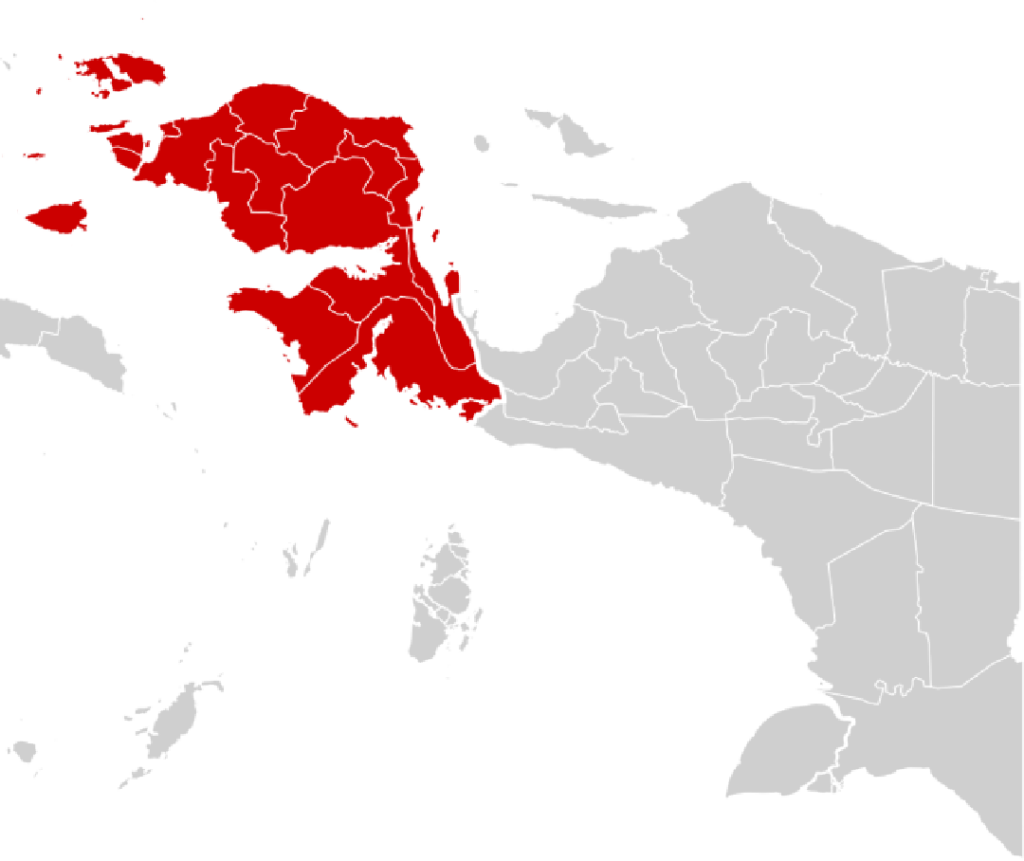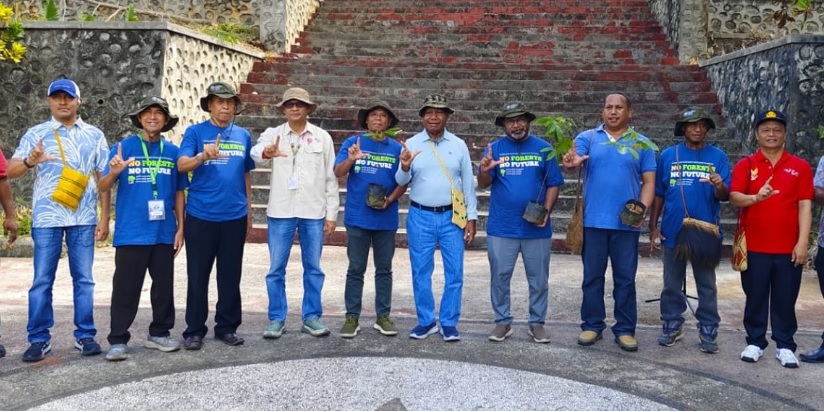
On a Friday morning in Manokwari, the planting of a single matoa tree carried a much larger message. The Government of Papua Barat (West Papua) has launched a campaign to plant one million matoa trees across the province, turning one of Papua’s best-known native fruit trees into a symbol of forest conservation, local economic opportunity, and cultural continuity.
The movement was formally launched by Papua Barat Governor Dominggus Mandacan on 14 August 2026, with the first planting held at the Arboretum within the Papua Barat Governor’s Office in Arfai, Manokwari. The provincial government plans to coordinate the initiative with regency governments, community organizations, religious leaders, customary communities, and development partners.
But the ambition is bigger than the number itself.
The provincial government says it does not want to count only the seedlings put into the ground. The more meaningful target is one million trees that survive, grow, and eventually become part of the landscape. The Regional Research and Innovation Agency (BRIDA) Papua Barat head, Prof. Charlie Danny Heatubun, told the Radio of the Republic of Indonesia (RRI) that the target is for one million matoa trees to have successfully grown by around 2029 or 2030.
That distinction matters in a region where forest conservation is closely connected with livelihoods, biodiversity, and the cultural identity of local communities.
A Native Tree at the Center of a Conservation Strategy
Matoa, scientifically known as Pometia pinnata, is not simply another fruit tree in Papua.
According to BRIDA Papua Barat, matoa is native to Papua and forms an important part of the tropical forest ecosystem in Papua and New Guinea. Heatubun described it as a “keystone species,” noting that many animals depend on its fruit, tree structure, and presence within the forest.
That ecological role gives the planting campaign significance beyond agriculture.
A mature matoa tree can become part of a wider forest environment that supports wildlife and contributes to maintaining the ecological character of tropical landscapes. For policymakers, planting a species that already belongs to the local ecosystem can therefore connect environmental restoration with the productive use of indigenous biodiversity.
The approach also fits Papua’s longstanding relationship with the forest.
BRIDA says local communities have recognized different varieties of matoa and have traditionally used both its fruit and timber. The tree consequently occupies a space where environmental, economic, and cultural interests overlap.
For the provincial government, strengthening that relationship could help turn conservation into something that communities can see and benefit from in everyday life.
From Ceremonial Planting to Long-Term Maintenance
There is, however, a practical challenge behind the one million tree target.
Planting a seedling is relatively easy. Keeping it alive for years is much harder.
BRIDA has stressed that the success of the campaign should be measured by trees that actually survive and grow, rather than simply by the number of seedlings distributed or planted during official ceremonies. Continuous maintenance and monitoring will therefore be crucial.
The provincial government has also asked regency administrations to provide land and supporting budgets. Governor Mandacan said the province would prepare seedlings while seeking assistance from development partners and involving religious figures, customary communities, and civil society organizations.
This creates an opportunity to build a more decentralized conservation model. Rather than concentrating the program in one location, each regency can receive a planting target based on its capacity and potential.
The province’s plan is to aggregate those local efforts until they reach the overall target of one million trees.
Why Matoa Matters to Papua’s Economy
The environmental argument is only one side of the campaign.
Matoa also has commercial potential.
Governor Mandacan has pointed to an unusual situation: although matoa is a fruit associated strongly with Papua, it can be easier to find commercially in other parts of Indonesia than in its place of origin. He noted that matoa is already available in markets and shopping centers outside Papua, including Java, Sulawesi, and Sumatra.
That market demand creates an opportunity for local producers.
If properly managed, a larger and more sustainable supply of matoa could support farmers, small businesses, traders, processors, and other parts of the local food economy. The economic value does not necessarily stop with the sale of fresh fruit.
Matoa can also be processed into products with longer shelf lives and higher added value. Local small and medium enterprises in Manokwari, for example, have explored products such as matoa-based sweets and ice cream.
Such processing can create a link between environmental conservation and entrepreneurship. A tree planted today can potentially become a source of fruit for households, raw material for local businesses, and an additional product for Papua’s tourism economy in the future.
That prospect is particularly relevant as Papua seeks to broaden economic activity beyond extractive industries and strengthen community-based enterprises.
A successful matoa industry would require more than planting trees. Farmers would need quality seedlings, technical knowledge, access to markets, post-harvest facilities, and reliable transportation. Processing businesses would also need packaging, branding, and distribution networks.
The one million tree campaign could therefore become a starting point for a much larger value chain if it is followed by appropriate agricultural and business support.
The Health Appeal of a Distinctly Papuan Fruit
Matoa’s economic potential is helped by another characteristic: the fruit itself has an increasingly interesting nutritional profile.
Matoa is closely related to rambutan and longan and is known for its sweet flavor and distinctive aroma. Health references describe the fruit as containing vitamin C, vitamin E, and various plant compounds, including flavonoids and other polyphenols.
These nutrients are associated with antioxidant activity. Antioxidants help protect cells from oxidative stress, while vitamin C plays an established role in normal immune function.
Matoa has also attracted interest because of the potential health properties of compounds found in its fruit and other parts of the plant. Some studies and health publications have discussed possible links with cardiovascular health, blood sugar regulation, and other conditions. However, many of these claims still require stronger human clinical evidence before they can be treated as established medical benefits.
That distinction is important.
Matoa should not be presented as a miracle food or substitute for medical treatment. Its strongest immediate value is as a nutritious local fruit that can contribute to a balanced diet while opening possibilities for further research and product development.
For Papua, that combination is attractive. A fruit that already has cultural recognition can potentially be promoted simultaneously as a local food, a commercial product, and an emblem of biodiversity.
Forest Conservation With an Economic Incentive
The most interesting feature of the program is perhaps the way it connects conservation with economic value.
Forest protection is often discussed in terms of carbon, biodiversity, and climate resilience. Those arguments are important, but conservation becomes more durable when local communities can also see tangible benefits from maintaining the landscape.
Matoa provides one possible bridge.
A living tree can support an ecosystem while eventually producing a marketable fruit. A community that plants and maintains matoa trees may therefore have an incentive to protect them over the long term.
This is particularly relevant in Papua, where customary communities have deep connections with forest resources. Involving customary leaders in the program could help ensure that planting strategies reflect local knowledge and land use patterns rather than relying solely on administrative planning.
The provincial government’s decision to involve customary communities, religious leaders, and civil society organizations is therefore significant. The campaign is designed not simply as a government forestry project but as a broader community movement.
A Potential Model for Sustainable Development
For international observers, Papua Barat’s matoa campaign offers an example of how conservation policy can be connected with local economic development.
The model is straightforward in principle. Protect a species that belongs to the local ecosystem, encourage communities to cultivate it, create demand for its products, and reinvest part of the resulting economic value into maintaining the trees.
In practice, the results will depend on implementation.
The province will need to track survival rates, maintain seedlings, protect planting areas, and ensure that distribution is geographically appropriate. It will also need to prevent the campaign from becoming dependent on short-term planting events.
The emphasis from BRIDA on counting surviving trees rather than seedlings is therefore a useful indicator of the program’s intended direction.
If the initiative reaches its target by 2029 or 2030, the result could be more than a large number of trees. It could produce a stronger local supply of matoa fruit, new opportunities for small businesses, additional income for farmers, and a more visible conservation culture.
Papua’s Biodiversity as Part of Its Development Story
International discussions often focus on Papua’s forests, biodiversity, and environmental challenges. The matoa campaign offers another way to understand the region’s natural wealth.
Rather than viewing biodiversity only as something to be protected from economic activity, the program seeks to demonstrate that native biological resources can form part of a sustainable local economy when managed carefully.
That approach is consistent with a broader development objective: ensuring that environmental protection and economic opportunity do not have to be treated as competing goals.
For Papua Barat, the matoa tree provides a particularly powerful symbol because it connects all three elements: nature, culture, and livelihoods.
The challenge now is to make the symbolism tangible.
If seedlings survive, farmers gain income, communities participate, and forest ecosystems benefit, the campaign could become a practical example of how local biodiversity can support sustainable development.
Looking Ahead
The one million matoa target is ambitious, but its significance will ultimately be judged by what happens after the planting ceremonies.
The provincial government has already identified the basic ingredients: seedlings, land, regency participation, development partners, and community involvement. The next stage will require consistent funding, technical assistance, monitoring, and market development.
The health and commercial appeal of matoa could provide additional momentum. Its vitamin content and antioxidant compounds make it an interesting local fruit, while its distinctive taste offers opportunities for food processing and tourism branding. Existing research also suggests that matoa deserves further scientific attention, particularly regarding its nutritional and bioactive properties.
For Papua Barat, the larger goal is not simply to plant one million trees.
It is to make those trees part of a living landscape that can support wildlife, strengthen local food systems, create economic opportunities, and preserve a piece of Papua’s natural and cultural heritage for the next generation.
In that sense, the most important number may not be one million.
It may be the number of trees that are still standing, producing fruit and supporting communities years after the first seedlings were placed in the soil.
Conclusion
The one million matoa tree movement provides Papua Barat an opportunity to turn its natural heritage into a long-term asset for both conservation and community prosperity. By promoting a native species with ecological, cultural, and economic value, the provincial government is seeking to protect tropical forests while creating new opportunities for farmers, local businesses, and future generations.
But the real measure of success will not be the number of seedlings planted during ceremonies. It will be the number of trees that survive, produce fruit, support local livelihoods, and remain part of Papua’s forest landscape years from now.
If sustained through community participation, careful monitoring, and continued government support, the matoa campaign could become more than an environmental initiative. It could demonstrate how Papua’s biodiversity can support a development model that protects nature while creating tangible economic value for local communities.