
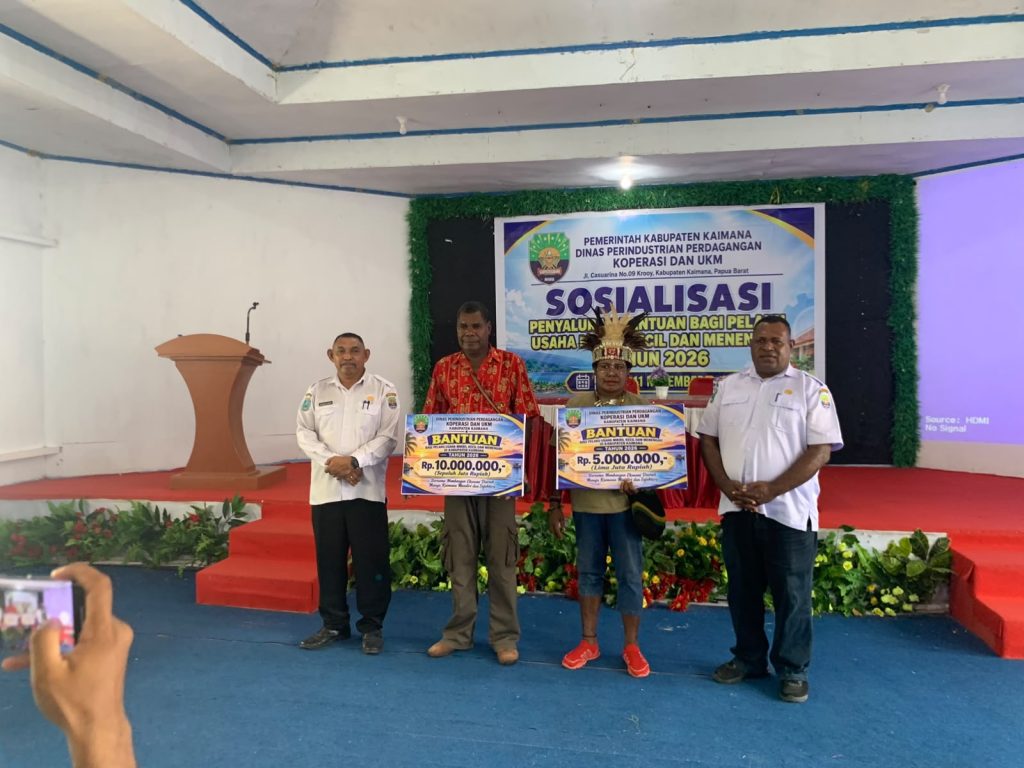
A total of 169 Indigenous Papuan entrepreneurs in Kaimana Regency have been included in the local government’s 2026 business capital assistance programme, which uses Indonesia’s Special Autonomy funds to support micro, small and medium sized enterprises (MSMEs).
The assistance is intended to give local business owners additional capital to strengthen their operations, improve financial management and expand their economic activities. Under the programme, 18 recipients are receiving Rp10 million each, while another 151 entrepreneurs are allocated Rp5 million each. The amounts are determined according to business turnover, individual circumstances and assessments conducted by the local administration.
The programme entered a new phase on November 11, 2026, when the Kaimana Regency Industry, Trade, Cooperatives and MSMEs Office held a socialisation session for selected beneficiaries. The event, which included a symbolic handover of business assistance, was opened by Blasius Kilmas, the Kaimana Regent’s Expert Staff for Government, Legal and Political Affairs.
Beyond the immediate financial support, the local government has also outlined a one-year mentoring programme to help recipients manage their businesses and prepare financial accountability reports. The approach reflects an effort to connect public funding with practical business development rather than treating assistance as a one-off cash transfer.
From Application to Selection: How the Programme Developed
The 2026 assistance programme followed an application and verification process that began before the current distribution period.
According to Hanny Hasna Ombaier, Head of the Cooperatives and MSMEs Division at the Kaimana Industry, Trade, Cooperatives and MSMEs Office, the beneficiaries receiving assistance in 2026 were Indigenous Papuan entrepreneurs whose proposals had been submitted in 2025.
The proposals were assessed by the relevant government office, including through field surveys intended to establish the actual condition and scale of each business. The assessment helped determine the amount of assistance considered appropriate for individual applicants.
The process is designed to ensure that the allocation reflects the needs of the businesses concerned. Rather than providing every recipient with an identical amount, the administration considers turnover, business circumstances and information contained in the proposals.
Hanny explained that 18 entrepreneurs had been selected to receive Rp10 million, while 151 others would receive Rp5 million.
The total number of beneficiaries was reported as 169 in the detailed announcement published by Kaimana News on November 12. An earlier report by Kabar Triton, published around the socialisation event on November 11, described approximately 160 selected recipients. The later report provided the more precise figure and breakdown.
This sequence is important because the programme’s initial public announcement referred to an approximate number, while the subsequent report supplied the final beneficiary total.
The 2026 recipients came from seven districts in Kaimana Regency: Buruway, Kambrauw, Arguni Atas, Arguni Bawah, Kaimana, Etna and Yamor.
Hanny clarified that the distribution was based on submitted proposals and the results of verification, rather than an equal allocation of recipients among all districts. In other words, geographical representation was not the sole basis for selection. The number of proposals received and the assessed condition of the businesses were also taken into account.
Why the Assistance Amounts Differ
One notable feature of the programme is the decision to provide two different levels of financial assistance.
The 18 businesses receiving Rp10 million were assessed as requiring a different level of capital support from the 151 businesses allocated Rp5 million. According to Hanny, the decision was based on business turnover, the condition of each enterprise, the proposals submitted and the results of field surveys.
The local government has also decided not to continue the previous Rp2.5 million assistance category in the 2026 programme. Hanny said the amount was considered less relevant to current business conditions.
The administration plans to revise the Regent’s Regulation, or Peraturan Bupati (Perbup), in 2027 to address the value of future business assistance.
Such a revision could provide an opportunity to review the programme’s financial structure in line with changing business requirements. However, the planned revision should be distinguished from an approved policy change. The available report describes it as a government plan for the following year.
The different assistance levels also underline the importance of assessing businesses individually. A small food enterprise, a retail shop and a service-based business may have different operating expenses, stock requirements and opportunities for expansion.
By considering the circumstances of each applicant, the government aims to direct the available funds towards business needs identified through the application and verification process.
Socialisation Prepares Recipients for Responsible Use of Funds
Before the distribution process, the Kaimana Industry, Trade, Cooperatives and MSMEs Office organised a socialisation session to explain the rules governing the assistance.
The event took place at Rumah Makan Belia on November 11, 2026. It was attended by selected MSMEs beneficiaries and opened by Blasius Kilmas, who represented the Kaimana Regent.
In his remarks, Blasius reminded recipients that receiving government assistance also involved administrative responsibilities. Beneficiaries were required to complete the relevant documentation, including signing a handover record and an integrity pact.
He explained that these documents were important forms of accountability. Proper administration would help ensure that the programme could be examined transparently and would reduce the risk of problems emerging during financial audits.
Blasius also emphasised that the assistance should be used to develop businesses, particularly those owned by Indigenous Papuans, rather than being spent on unrelated personal consumption.
He encouraged entrepreneurs to adopt disciplined financial management practices, including separating business money from household expenses. He also highlighted the value of saving a portion of profits, even when the amount was small, so that the money could be reinvested in business development.
His message reflected a central challenge for small enterprises: access to capital is important, but financial discipline and sound management are equally necessary if businesses are to remain sustainable.
For many small business owners, the ability to distinguish between household income and business capital can influence whether an enterprise grows or struggles to maintain its operations.
Baren Tumanat Stresses Financial Accountability
Kaimana Industry, Trade, Cooperatives and MSMEs Office Head Baren Tumanat, S.E., M.M., said the socialisation session was intended to give beneficiaries a clear understanding of the distribution mechanism, the rules governing the use of funds and their responsibilities after receiving assistance.
He reminded recipients that the money must be used entirely for business development and should not be diverted to personal consumption or other purposes outside the programme.
Baren also stressed the importance of keeping receipts and other transaction records for purchases made using the assistance.
According to the Kabar Triton report, beneficiaries must retain invoices and proof of transactions as supporting documents for their financial accountability reports, known as Surat Pertanggungjawaban (SPJ). These documents will be submitted to the Industry, Trade, Cooperatives and MSMEs Office as evidence that the funds were used in accordance with programme requirements.
The requirement is particularly relevant for public programmes financed through Special Autonomy funds. Clear records allow the government to monitor how assistance is spent and provide a basis for evaluating whether the intended objectives have been achieved.
The socialisation therefore serves two purposes. It informs recipients about the practical steps involved in using the funds while also establishing expectations concerning transparency and accountability.
Special Autonomy Funds Support Indigenous Papuan Entrepreneurs
The 2026 business assistance is financed through Indonesia’s Special Autonomy funds, commonly referred to as Dana Otsus.
The funding is specifically prioritised for MSMEs owners classified as Orang Asli Papua (OAP), or Indigenous Papuans, in accordance with the applicable programme provisions.
Special Autonomy funding forms part of the broader development framework for Papua, including support for economic and social development. In Kaimana, the local government is directing part of the available resources towards small businesses that can contribute to household incomes and local economic activity.
MSMEs play an important role in local economies because they provide goods and services, create livelihood opportunities and support everyday commercial activity. In a regency such as Kaimana, strengthening small enterprises can also help broaden the participation of local residents in economic activities.
The assistance programme is therefore intended to support more than the immediate financial needs of individual entrepreneurs. The local government hopes that recipients will be able to improve their business operations, increase income and gradually move from micro-enterprises towards MSMEs.
However, the long-term economic impact will depend on how effectively recipients use the funds and whether their businesses can maintain or expand their activities after the initial assistance has been spent.
The programme’s one-year mentoring component is intended to help address this challenge.
One Year of Mentoring to Support Business Growth
Hanny Hasna Ombaier said the assistance would be accompanied by mentoring over the following year.
The support is expected to include guidance on business management and the preparation of financial accountability reports. This is intended to help recipients understand both the commercial and administrative responsibilities associated with receiving public funds.
The mentoring element is important because access to capital alone does not necessarily resolve the challenges faced by small entrepreneurs. Business owners may also need support in managing cash flow, recording transactions, calculating operating costs and deciding how much profit should be reinvested.
For a small enterprise, relatively simple improvements in record-keeping and financial planning can make it easier to understand whether the business is profitable and which products or services generate the most income.
The government has not yet published detailed performance targets for the mentoring programme in the cited reports. Nevertheless, the one-year commitment creates an opportunity for the local administration to monitor how the businesses develop after receiving assistance.
A useful evaluation would examine whether recipients have maintained their businesses, improved their financial records, increased sales or expanded their operations. Such information could help the government assess the programme’s effectiveness and improve future assistance schemes.
The Next Application Cycle Is Scheduled for 2027
The 2026 distribution also provides a picture of how the programme is being managed across different application periods.
Hanny explained that proposals submitted during 2026 would not be included in the current distribution. Instead, they are scheduled to be processed for assistance in 2027, following field surveys and verification.
This arrangement means that the 169 recipients in the current programme are drawn from applications submitted in the previous year, while newer applicants will be assessed through a separate process.
The separation between application and distribution periods allows the local administration time to examine proposals and verify business conditions before deciding on allocations.
It also means that entrepreneurs who submitted applications in 2026 should understand that their proposals are part of the next assessment cycle, rather than the 2026 beneficiary list.
For the government, maintaining a clear application schedule and communicating selection results will be important in ensuring that applicants understand the process.
The requirement for each beneficiary to hold a Business Identification Number, or Nomor Induk Berusaha (NIB), is another part of the programme’s administrative framework. Hanny said the document serves as legal recognition of a business and helps the government conduct supervision, provide guidance and offer assistance.
Business formalisation can also help entrepreneurs establish a clearer administrative identity when dealing with government programmes and other business-related services.
Turning Public Assistance into Sustainable Local Enterprises
The Kaimana programme illustrates how local government support can combine financial assistance, business formalisation and mentoring within a single MSMEs development initiative.
For the 169 selected Indigenous Papuan entrepreneurs, the immediate priority is to use the funds according to the approved purpose. The next challenge is to turn that initial capital into stronger business operations and more stable income.
The programme also places responsibilities on local administrations. Beyond transferring funds, the government will need to ensure that mentoring is delivered, accountability documents are reviewed and the condition of supported businesses is evaluated over time.
The different assistance amounts, the use of field surveys and the requirement for NIB registration provide elements of a structured selection and monitoring process. The planned revision of the Regent’s Regulation in 2027 may also provide an opportunity to review the programme’s future funding levels.
Ultimately, the value of the initiative will be determined by what happens after the assistance reaches its recipients. If entrepreneurs can manage their capital carefully, strengthen their business practices and reinvest part of their profits, the programme may help create enterprises capable of sustaining themselves beyond the initial government support.
For Kaimana, supporting 169 Indigenous Papuan MSMEs is an investment in local economic participation. Its longer-term contribution will depend on consistent mentoring, transparent oversight and the ability of small businesses to translate public assistance into lasting commercial activity.
Conclusion
The distribution of business capital assistance to 169 Indigenous Papuan entrepreneurs marks an important step in Kaimana Regency’s efforts to strengthen local economic participation. Through Special Autonomy funding, the programme provides financial support while encouraging beneficiaries to improve business management, maintain proper financial records and develop more sustainable enterprises.
The next challenge is to ensure that the assistance delivers lasting results. Consistent mentoring, transparent monitoring and responsible use of funds will be essential in helping recipients expand their businesses and build greater financial independence. The planned assessment of new applications for 2027 also offers an opportunity to improve the programme and reach more eligible entrepreneurs.
Ultimately, the success of this initiative should be measured not only by the amount of funding distributed but also by the businesses that continue to grow, the livelihoods they support and the economic opportunities they create. By combining public investment with entrepreneurship and accountability, Kaimana can strengthen the role of Indigenous Papuans in its local economy and support more inclusive development across the regency.
Read Also
Nabire Backs Papuan MSMEs Through Skills and Innovation
Indonesia Expands MSMEs Credit in Papua Barat and Papua Barat Daya Province

