
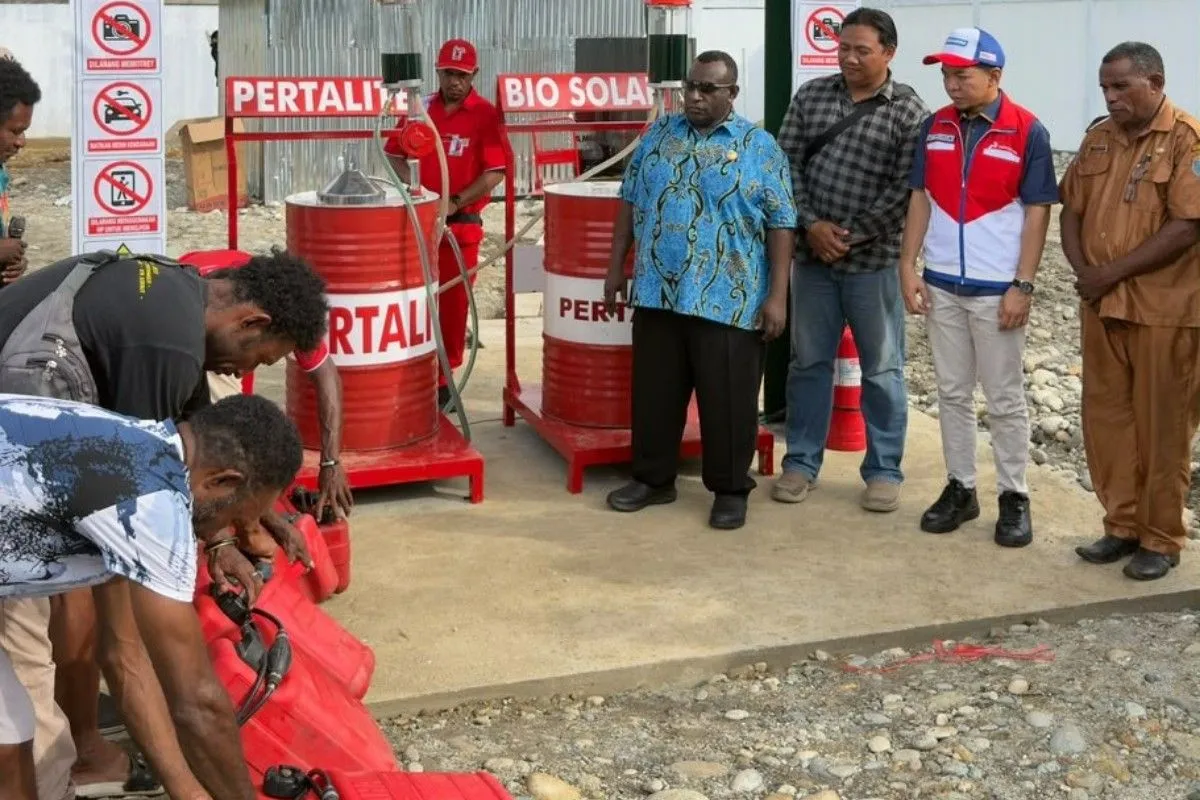
For fishermen in Papua, access to affordable fuel can determine how far they can travel to fishing grounds, how often they can put to sea and how much of their earnings remain after operating expenses. A new facility in Nabire is intended to address that practical challenge. Under a wider initiative, Pertamina is targeting the operation of 19 dedicated fishermen’s fuel stations across Papua by November 30, 2026, while the first outlet has already begun serving coastal communities in Central Papua.
The development is part of the government’s wider effort to strengthen the coastal economy through the Kampung Nelayan Merah Putih (the Red and White Fishermen Villages, or KNMP) programme. In Kampung Sima, Yaur District, Nabire Regency, the newly opened facility provides Pertalite at Rp10,000 per litre and Biosolar at Rp6,800 per litre, prices reported as equivalent to those applied in other parts of Indonesia.
The initiative addresses two issues that directly affect small-scale fishing: the distance fishermen may need to travel to obtain fuel and the importance of access to fuel at prices set under national policy. It also places fuel distribution within a broader programme intended to improve the facilities and economic prospects of fishing communities.
From the KNMP programme to fuel access
The development of dedicated fuel stations is closely linked to the government’s plans for the KNMP. The programme is intended to create stronger economic centres in coastal areas by bringing together production facilities, community services and supporting infrastructure.
President Prabowo Subianto outlined the government’s ambitions for the programme during a plenary session of the House of Representatives (DPR) and the People’s Consultative Assembly (MPR) in Jakarta on May 20, 2026. He said the government planned to develop 5,000 KNMP over the following three years, with 1,386 targeted for completion in 2026.
In explaining the programme, Prabowo stressed the importance of practical facilities that support fishermen’s daily work. These included ice-making installations, cold-storage rooms and fuel stations specifically serving fishing communities.
The emphasis is significant because fishing infrastructure involves more than boats and access to the sea. Fresh ice and cold storage can help preserve catches after landing, while reliable fuel access is essential for vessels operating at sea. Together, these facilities can support the handling, storage and distribution of fish, although their actual economic impact will depend on how effectively they are operated and maintained.
For Papua, where many coastal communities are spread across a large geographical area, the availability of fuel closer to fishing settlements is particularly relevant. A dedicated outlet can reduce the need for fishermen to travel to a town or another fuel station simply to obtain supplies before going to sea.
Pertamina sets a November 30 operational target
The plan for 19 fishermen’s fuel stations in Papua was publicly outlined by Pertamina President Director Simon Aloysius Mantiri during a working meeting with Commission VI of the Indonesian House of Representatives on November 12, 2026.
Simon said Pertamina was targeting the operation of approximately 19 SPBUN facilities in Papua by November 30. The development is being carried out in cooperation with the Jala Samudera Task Force, as part of efforts to support the implementation of the KNMP programme.
He also explained that Pertamina was working with the Ministry of Marine Affairs and Fisheries (KKP) to identify priority areas for fishermen’s fuel facilities. The approach is intended to match infrastructure development with the needs and locations of fishing communities.
Where an existing fuel station is sufficiently close to a KNMP area, Pertamina may use that facility rather than construct a new one. In locations without suitable fuel infrastructure, the company plans to develop a dedicated fishermen’s station.
Simon said Pertamina, through its subsidiary Pertamina Patra Niaga, had identified potential partners and was seeking to accelerate the process.
The distinction matters. The date mentioned is a target set by Pertamina, and it does not confirm that all 19 facilities were already operational at the time of the announcement. The company’s statement also referred to additional facilities being developed through the Ministry of Marine Affairs and Fisheries. The reports did not detail the precise locations and operational status of every planned outlet.
Nabire opens the first fishermen’s fuel station
While the wider Papua rollout is still being prepared, a first concrete step has taken place in Nabire.
On November 12, 2026, Pertamina Patra Niaga Regional Papua Maluku began operating a fishermen’s fuel station through the local fishermen’s cooperative in Kampung Sima, Yaur District, Nabire Regency, Central Papua. The facility was reported as the first fishermen’s fuel station of its kind to operate in Nabire.
Sigit Wicaksono, Sales Area Manager for Retail in Central Papua at Pertamina Patra Niaga Regional Papua Maluku, said the facility was established to make fuel more accessible and affordable for fishermen and coastal residents.
The station sells Pertalite for Rp10,000 per litre and Biosolar for Rp6,800 per litre. According to Sigit, these prices are in line with those applied in other parts of Indonesia.
The pricing arrangement is an important part of the initiative. For fishermen, fuel is a regular operating expense. A reliable supply point with prices aligned with national rates can help reduce uncertainty when preparing for fishing trips and planning household or business expenditure.
Sigit said the company hoped easier access to fuel would encourage coastal economic activity and help fishermen go to sea more readily, with the prospect of improving their catches.
The facility is also expected to serve as a practical link between the national programme and the needs of local fishing communities. Rather than treating fuel distribution as a separate commercial service, the arrangement places it within a cooperative-based initiative intended to strengthen the local fishing economy.
How fishermen can access the fuel
The availability of fuel at the Nabire station is subject to distribution rules and eligibility requirements. Pertamina said the distribution of Pertalite and Biosolar would follow the applicable quotas and be managed transparently to ensure that supplies reach their intended users.
Fishermen are required to present a recommendation letter that has been verified and issued by the Nabire Regency Marine and Fisheries Office. Those who do not yet have the document can apply through the relevant local agency.
This mechanism is intended to support targeted distribution and prevent fuel allocations from being diverted away from eligible users. It also places an administrative responsibility on local authorities to verify applicants and issue recommendations in accordance with the applicable rules.
Yohanis Pigome, Head of the Nabire Regency Fisheries Office, welcomed the opening of the facility. He said fuel was a basic requirement for fishing activities and that the new station would make it easier for coastal residents, particularly fishermen in Kampung Sima, to obtain supplies at affordable prices.
Yohanis also urged Pertamina Patra Niaga and the cooperative managing the facility to ensure that services were delivered properly, transparently and responsibly, with the interests of fishing communities as the priority.
His remarks underline an important point: the success of a fuel station is not measured only by its opening ceremony. Consistent service, fair access, sufficient stocks and accountable management will determine whether the facility provides lasting benefits.
A change in the daily journey to obtain fuel
The practical value of the Nabire facility is reflected in the experience of local fishermen.
Nikolas, a fisherman from Kampung Sima, expressed his appreciation for the new station, saying residents no longer needed to travel all the way to the city to obtain fuel. He described the availability of fuel closer to the village, at a standard price, as a welcome change.
His account illustrates the everyday difficulties that infrastructure programmes seek to address. For a small-scale fisherman, travelling farther to purchase fuel can consume time and add costs before a fishing trip even begins. A nearby supply point can make preparation more straightforward and reduce the burden of obtaining an essential operating input.
However, easier access to fuel should not be interpreted as an automatic guarantee of higher incomes. Fishing results remain influenced by weather, sea conditions, equipment, market prices, storage capacity and the availability of buyers. The new station addresses one important part of that chain, while other supporting services remain necessary for broader improvements in livelihoods.
Why fuel infrastructure matters to Papua’s coastal economy
Papua’s coastal communities depend on access to the sea for livelihoods, food supplies and local economic activity. In this context, fuel distribution is not merely a matter of retail convenience. It is part of the infrastructure that allows fishing operations to function.
When fishermen can obtain fuel closer to their communities, they may spend less time travelling to purchase supplies and have more predictable access to an essential resource. More reliable fuel access can also support the movement of fish from fishing grounds to landing points and markets.
The benefits could extend beyond individual fishermen. Cooperatives, fish traders, transport operators and small businesses may gain from more regular fishing activity and improved access to coastal production areas. Such outcomes, however, will depend on whether the facilities are supplied consistently and connected to adequate transport, ice-making, cold-storage and market infrastructure.
The KNMP approach offers a framework for bringing some of these services together. Its broader purpose is to strengthen fishing settlements as economic centres, rather than focusing on a single facility in isolation.
For Papua, the geographical distribution of coastal settlements makes careful planning essential. The location of each SPBUN should reflect actual demand, the number of eligible fishermen, transport conditions and the capacity to maintain fuel supplies. The cooperation between Pertamina, Pertamina Patra Niaga, the Jala Samudera Task Force and the Ministry of Marine Affairs and Fisheries will therefore be important beyond the initial construction or opening phase.
Maintaining transparency and reliable distribution
As the programme expands, effective oversight will be central to its credibility. The use of verified recommendation letters and established fuel quotas at the Nabire station provides a framework for ensuring that supplies are distributed to eligible fishermen.
Pertamina has also said it will monitor stock availability and distribution at the Kampung Sima facility. That commitment will need to be matched by regular coordination with the local fisheries authorities and the cooperative responsible for day-to-day management.
For fishing communities, the most meaningful measure of success will be whether fuel remains available when needed, whether prices are applied consistently and whether the service can be accessed without unnecessary administrative obstacles.
The planned expansion also creates an opportunity to establish clear operating standards across the 19 targeted facilities. Consistent procedures for eligibility, stock monitoring, public information and complaint handling could help build confidence among fishermen and local communities.
A step towards stronger coastal livelihoods
Pertamina’s fishermen’s fuel station initiative marks a practical step in the government’s effort to strengthen Papua’s coastal economy. The opening of the Kampung Sima facility in Nabire on November 12 demonstrates that the programme has moved beyond planning in at least one location. The target of approximately 19 operational facilities by November 30 signals an ambition to extend that access across Papua.
The sale of Pertalite at Rp10,000 per litre in Nabire, at the same price reported for other parts of Indonesia, is an important element of the initiative. Equally important is the closer location of the fuel supply point and the introduction of a distribution mechanism intended to keep supplies focused on eligible fishermen.
The next test will be implementation. Meeting the November 30 target, maintaining reliable stocks and ensuring transparent cooperative management will determine whether the programme delivers the benefits anticipated by Pertamina and local authorities.
If these elements are sustained, dedicated fishermen’s fuel stations could become a useful part of a wider coastal development strategy in Papua. Combined with ice-making facilities, cold storage, better transport links and stronger local cooperatives, improved fuel access has the potential to support fishing activity and strengthen the economic role of coastal communities.
For fishermen in Kampung Sima, the immediate change is straightforward: fuel is now available closer to home. For Papua’s wider fishing sector, the planned expansion offers an opportunity to turn that local improvement into a more extensive network of support for coastal livelihoods.
Conclusion
Pertamina’s plan to expand fishermen’s fuel stations across Papua represents a practical effort to strengthen the region’s coastal economy and improve access to essential resources. The opening of the first facility in Kampung Sima, Nabire, provides an early example of how the initiative can make fuel more accessible to fishing communities, with Pertalite sold at Rp10,000 per litre, in line with the reported national price. The target of bringing 19 SPBUN facilities into operation by November 30, 2026 reflects the government’s broader commitment to improving infrastructure and supporting the KNMP programme. However, the initiative’s long-term success will depend on reliable fuel supplies, transparent distribution, effective cooperative management and close coordination with local authorities. If these commitments are maintained, the programme could help reduce operational barriers for small-scale fishermen, support local economic activity and create stronger foundations for sustainable development in Papua’s coastal communities.
Read Also
Papua Accelerates 88 Red and White Fishermen Villages
Papua Fish Exports Target the US Market

