
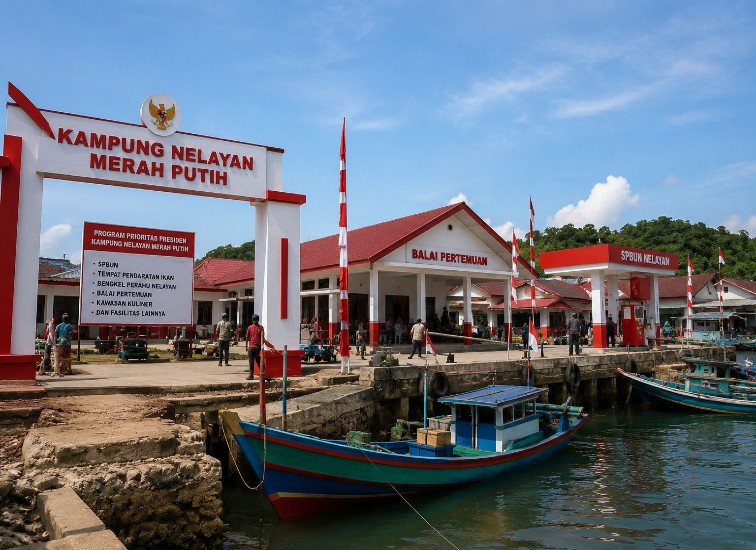
Papua’s coastal development programme is approaching a significant milestone, with construction of 88 Red and White Fishermen Villages (Kampung Nelayan Merah Putih) reaching approximately 87 percent completion as of November 6, 2026. The provincial government is stepping up supervision and coordination, aiming to complete the projects by the end of November or, at the latest, the middle of December.
Led by the Papua Provincial Government through its Marine Affairs and Fisheries Agency (DKP), the initiative is intended to strengthen fishing infrastructure, improve the handling of catches and make it easier for coastal communities to bring their products to market. Beyond physical construction, officials say the programme is designed to support a more integrated fisheries economy, connecting production, post-harvest management and distribution.
The progress figure, reported by Indonesia’s national news agency ANTARA on November 6, marks an important update in a programme that began with a wider process of proposals, verification and site planning. Its next challenge will be to ensure that the completed facilities can operate effectively and deliver practical benefits to fishermen communities across Papua.
From 111 Proposed Locations to 88 Selected Villages
The development programme emerged from a broader allocation of Red and White Fishermen Villages for the Tanah Papua region, which encompasses several provinces in Indonesia’s easternmost territory.
According to the Papua Provincial Government, the initial proposals from across Tanah Papua totalled 208 locations, while the regional allocation stood at 200 fishermen villages. Within that process, Papua Province submitted 111 proposed locations for consideration.
The proposals did not automatically qualify for construction. Authorities first carried out verification and prepared designs for the proposed sites. This process was intended to assess which locations could proceed, taking into account their suitability and development priorities.
Following those stages, 88 locations in Papua Province were selected for construction. The difference between the 111 proposals and the 88 approved sites reflects the screening process described by the provincial government, rather than a reduction made without assessment.
Papua’s Marine Affairs and Fisheries Agency Head, Iman Djuniawal, explained that the selected locations were determined after verification and design preparation.
“From the 111 proposals, after verification and the preparation of designs, they became 88 fishermen villages that are now being built,” Iman said, as quoted by the provincial government on November 4.
He added that the provincial administration hoped implementation would proceed according to the established priorities.
The selection stage is significant because the programme is intended to serve different coastal settings across the province. Papua has communities in coastal and island areas where access to infrastructure and transportation can vary considerably. A development model that takes local conditions into account is therefore important to the usefulness of the facilities being built.
Construction Moves into an Advanced Stage
After the 88 locations were established, the provincial government continued to monitor construction through the DKP. The agency has been carrying out periodic supervision and providing assistance to ensure that work progresses according to plan.
In its November 4 report, the provincial government said that almost all construction locations had recorded progress above 25 per cent, with several sites already approaching completion. At that point, the administration was targeting the end of November or the middle of December for the completion of the projects.
Iman said the agency was continuing to visit and assess the development sites.
“We continue to provide assistance and check the progress. We hope construction can be completed by the end of November or in mid-December, so that the benefits can begin to be seen,” he said on November 2, according to the provincial government’s report.
Two days later, the provincial government published that update, describing the construction programme as progressing across the selected locations.
The more detailed progress figure followed on November 6, when ANTARA reported that construction had reached approximately 87 per cent. The figure was provided by Iman in Jayapura on Thursday, November 5, and published the following morning.
The latest report also confirmed that the DKP would continue regular supervision and assistance to ensure that construction remained on schedule and that the facilities could soon be used by fishermen communities.
The 87 per cent figure indicates that the programme has entered an advanced stage. However, construction progress and operational readiness are not necessarily the same. The remaining work, the preparation of facilities for use and the availability of supporting transport will all influence when communities can fully benefit from the projects.
Building More Than Physical Infrastructure
The provincial government has stressed that the Red and White Fishermen Villages programme is not limited to constructing facilities on land. Its wider objective is to support an integrated fisheries management system, from the moment fish are caught to the point at which products reach buyers.
This approach matters because fishermen communities need more than places to land their catches. The quality and value of seafood can also depend on how quickly it is handled, how it is stored and processed, and whether it can be transported efficiently to distribution centres and markets.
Iman said the facilities were expected to support fishing activities, increase production capacity and improve the handling and distribution of fisheries products.
“The existence of these facilities is expected to support fishing activities, increase production capacity, and facilitate the handling and distribution of fisheries products,” he said, according to ANTARA on November 6.
The emphasis on the entire supply chain reflects an economic challenge faced by many coastal communities. Greater production does not automatically translate into higher income if fishermen encounter difficulties preserving their catches or accessing buyers. Improvements in post-harvest handling and distribution can therefore be as important as the construction of production facilities themselves.
For Papua, the issue is particularly relevant in areas where settlements are separated by stretches of sea, islands or difficult inland routes. In such locations, the ability to move fish from landing points to larger markets can determine whether additional production creates meaningful economic opportunities.
Sea Transport Identified as a Key Priority
One of the main issues identified by the DKP is transportation between fishermen communities and distribution centres.
Some of the selected villages are located in island areas or places where road access is limited. In these circumstances, relying solely on land-based transportation could restrict the movement of fish and other marine products.
To address this challenge, the agency has begun mapping the need for a supporting fleet of vessels. The proposed boats are expected to help transport catches from fishermen villages to distribution centres and markets.
Iman described maritime transport as an important requirement, particularly for communities in island regions and areas with limited road infrastructure.
“Sea transportation support is very necessary to help transport production from fishermen villages to distribution centres and markets, so that the marketing of the community’s catches can run more smoothly,” he said, as quoted by ANTARA.
The provincial government has also said that it is continuing coordination and assistance to ensure the facilities can support both production and distribution activities.
The vessel plan remains at the mapping and preparation stage in the reports published by the provincial government and ANTARA. The sources do not provide details about the number of boats required, their specifications, procurement schedule or the routes they will serve. Those details will be important in assessing how the proposed transport support will be implemented.
Nevertheless, identifying maritime connectivity as part of the programme’s development priorities highlights the practical relationship between infrastructure and market access. A fishermen village may have improved facilities, but its economic potential will remain constrained if catches cannot reach buyers in a timely and reliable manner.
Strengthening the Coastal Economy
The programme is expected to contribute to the development of Papua’s fisheries sector by improving the conditions under which coastal communities produce, manage and distribute their catches.
For fishermen, better facilities could support more organised daily operations and improve the handling of seafood after landing. For businesses involved in processing, transportation and trading, more reliable production and distribution arrangements could create opportunities to strengthen local supply chains.
The broader economic effect will depend on how effectively these elements work together. Infrastructure must be maintained, facilities need to be accessible to their intended users, and transport arrangements must connect fishermen communities with realistic market opportunities.
The provincial government’s approach places the DKP in a continuing supervisory and coordination role. This is important not only during construction but also as the facilities move towards operation. Regular monitoring can help identify problems that might otherwise reduce the usefulness of the investment.
At the same time, the 88 selected locations represent a considerable geographical undertaking. Different coastal conditions and transport requirements mean that implementation cannot be measured solely by the number of buildings or facilities completed. Their suitability for local fishing activities and their ability to connect with distribution networks will also matter.
The programme’s longer-term value will therefore depend on the transition from construction to effective use. That includes ensuring that fishermen communities understand how the facilities are intended to operate and that the supporting logistics are available when construction is completed.
The Next Milestone: Completion and Operational Readiness
With construction progress reported at approximately 87 per cent, attention is now turning towards the final stage of implementation. The DKP has maintained its target of completing the work by the end of November or, at the latest, in mid-December 2026.
The agency has said that regular supervision and assistance will continue to ensure that development remains consistent with the plan. The next phase will also require coordination around maritime transport, particularly for villages where road access is limited.
The reports available as of November 6 do not yet specify an inauguration date, the exact operational schedule for each location or a detailed breakdown of the facilities provided at individual sites. Nor do they include projected increases in fishermen’s incomes or production volumes. These outcomes will need to be assessed once the facilities are in use and reliable data become available.
Even so, the programme establishes a framework for addressing several connected needs in Papua’s coastal economy: production infrastructure, fisheries management, post-harvest handling and access to markets. Its emphasis on maritime connectivity also recognises the realities of a province where sea routes are essential to the movement of people and goods in many communities.
Conclusion
The construction of 88 Red and White Fishermen Villages marks an important phase in Papua’s efforts to strengthen its coastal economy. From 111 proposed locations, the provincial government selected 88 after verification and design preparation. By November 6, construction had reached approximately 87 per cent, with completion targeted for the end of November or mid-December.
The next measure of success will be how effectively the facilities serve fishermen after construction ends. Better production infrastructure must be accompanied by reliable post-harvest handling, accessible distribution channels and practical sea transport support.
If these elements are developed in coordination, the programme could help fishermen communities improve the value of their catches and establish stronger links with regional markets. For Papua, the challenge now is to turn construction progress into functioning economic infrastructure that can support coastal livelihoods over the long term.
Read Also
Papua Tengah Seeks Major Boost for Fisheries Sector
Papua Fish Exports Target the US Market

